Does alpha-lipoic acid come in powder form?
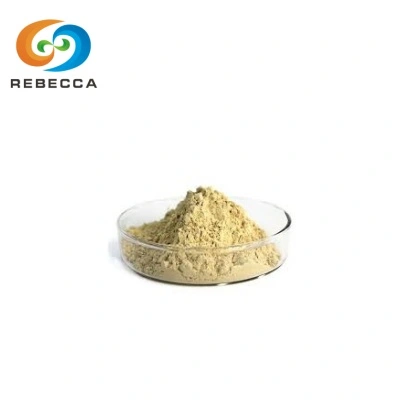
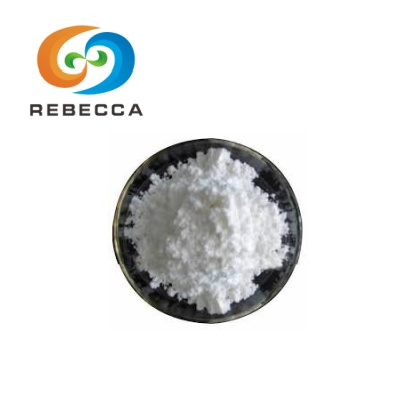
Alpha-lipoic acid is easily accessible in powdered form and has been a popular choice in B2B procurement in the pharmaceutical, nutraceutical, cosmetic, and functional beverage sectors. alpha-lipoic acid powder is very versatile in the formulation creation providing accurate dose control and easy incorporation into tablets, capsules, topical creams and beverage systems. It is a light yellow to yellow powder. Its requirements are 99% purity (confirmed by HPLC). CAS No. is 1077-28-7. It has the property of both water-soluble and fat-soluble antioxidation. It is an excellent component for product innovation and scalable production processes.
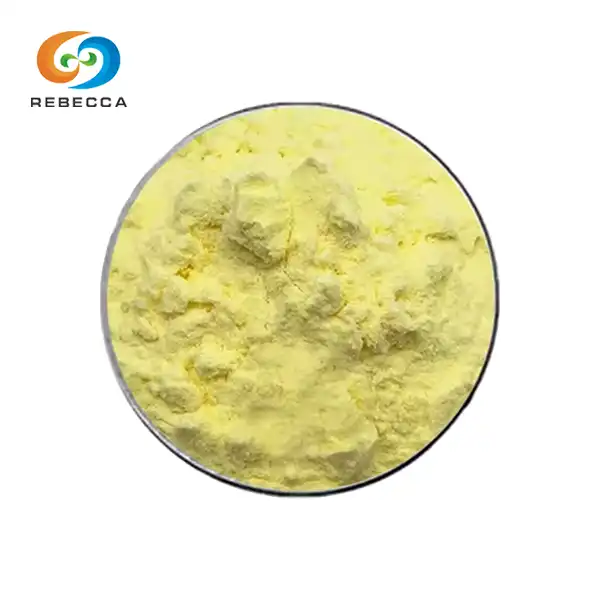
Product Name:alpha lipoic acid
CAS No.:1077-28-7
Specification:99%
Test Method:HPLC
Appearance:Light yellow to yellow powder
Shelf Life: 2 years
Minimum Order Quantity: 1 kg
Samples: Free samples available
Certifications: GMP, ISO, HACCP, KOSHER, and HALAL.
Payment: Various payment methods accepted.
Advantages: Manufactured in a 100,000-grade cleanroom, our products are additive-free, non-GMO
Inner Package: Double PE Bags; Net 5kg/Bag
Outside Package: Paper Drums, Net 25kg/Drum
Storage:Store in a cool, dry place away from Light and Heat.
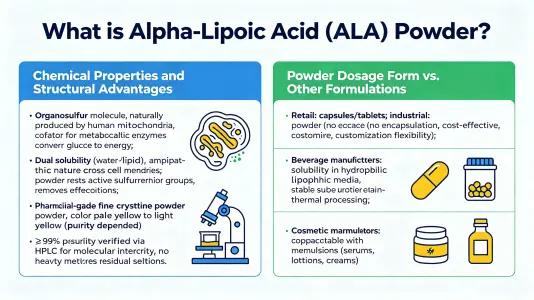
What is Alpha-Lipoic Acid Powder?
Chemical Nature and Structural Advantages
Alpha-lipoic acid (ALA) is an organosulfur molecule produced spontaneously in human mitochondria that works as a cofactor for vital metabolic enzymes involved in converting glucose into cellular energy. Many antioxidants are confined to either aqueous or lipid environments, however ALA has a dual solubility. Its unusual amphipathic nature allows it to cross cellular membranes and function efficiently across all tissue types from brain circuits to dermal layers.
The powder formulation maintains bioactive sulphur groups of ALA but removes excipients seen in final consumer goods. Pharmaceutical-grade powder is usually a thin crystalline powder which may be light yellow to yellowish in colour depending on purity standards and storage circumstances. The highest purity grades (≥ 99%) are rigorously analysed by HPLC to verify the integrity of the molecule and the absence of possible impurities like heavy metals or residual solvents.
Powder Form VS Other Delivery Formats
Capsules and pills are the most common form at retail outlets, whereas powder is the preferred shape for the industrial customer. Encapsulated forms need more processing processes (encapsulation equipment, binding agents, and quality assurance standards) which raise manufacturing costs and reduce the flexibility of customisation. Manufacturers may precisely regulate the quantity of active ingredient in the dose, combine the active ingredient with other complimentary elements and customise the composition to the unique product matrix without the need to reformulate and start the process again.
The beverage makers especially like the solubility profile of powder. Alpha-lipoic acid powder, adequately micronised, disperses well in hydrophilic and lipophilic media and is stable during thermal processing. For cosmetic formulators, it is compatible with emulsion systems and may be integrated into serums, lotions and creams without sacrificing texture or effectiveness.
Key Benefits and Applications of Alpha-Lipoic Acid Powder
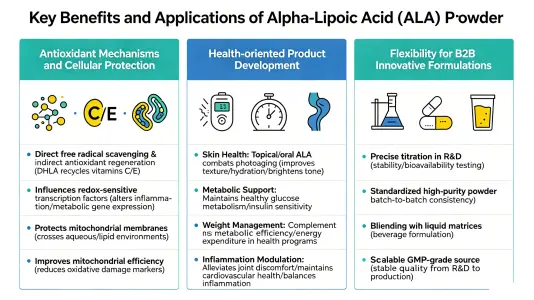
Antioxidant Mechanisms and Cellular Protection
Alpha-lipoic acid powder is a direct scavenger of free radicals and an indirect regenerator of antioxidants. In its reduced form, dihydrolipoic acid (DHLA) scavenges reactive oxygen species (ROS) and concurrently regenerates the active forms of oxidised vitamins C and E. This capacity to “recycle antioxidants” increases cellular defence mechanisms beyond the capacity of single-function antioxidants.
Studies have shown that ALA may affect redox-sensitive transcription factors, hence changing gene expression profiles associated with inflammation and metabolic control. Mitochondrial membranes, a site where lipid peroxidation occurs, are especially sensitive, and ALA can travel across both water and lipid environments, which is a plus. Cellular studies demonstrate that supplementation with physiologically appropriate amounts of ALA improves mitochondrial efficiency and decreases indicators of oxidative damage.
Health-Focused Product Development
Wellness industry product manufacturers are looking to ALA powder for a variety of health-oriented applications:
Skin Health Formulations: ALA-based medicines, including topical and oral, are used to combat photoaging by reducing oxidative damage caused by UV radiation. Dermatological research has shown that supplementation with ALA is associated with positive changes in skin texture metrics, including a reduction in fine wrinkles and an increase in moisture retention. Cosmetic chemists create brightening serums with ALA due to its ability to assist with an even skin tone via antioxidant pathways.
Metabolic assist Products: Nutraceutical manufacturers formulate ALA-based supplements intended to assist healthy glucose metabolism and insulin sensitivity. As the chemical is involved in glucose metabolism it is a useful element for products targeted at those who are controlling blood sugar levels in the normal range.
Weight Management Formulations combining ALA with additional bioactives focus on metabolic efficiency and energy expenditure. Although ALA itself does not stimulate weight loss, its metabolic actions are ideally suited to complement complete wellness regimens that include food modification and physical exercise.
Modulation of Inflammation: Chronic low-grade inflammation is the root cause of many health issues. ALA's effect on inflammatory signalling pathways is pertinent to formulations that aim to help with joint comfort, cardiovascular health and general inflammatory balance.
Formulation Flexibility for B2B Innovation
Powder form allows precision titration throughout product development stages. R&D teams can test numerous levels of concentration and change formulations easily using stability studies and bioavailability evaluations. Standardised testing processes confirm compositional homogeneity, thus batch-to-batch consistency is controllable when dealing with certified high-purity powder.
It's far more accurate than dealing with pre-encapsulated forms. Tablet manufacturers are able to mix ALA powder with excipients, flow agents and coating ingredients to unique specifications. Beverage formulators dissolve known amounts of powders into liquid matrices to acquire the desired concentrations, and then validate retention using accelerated shelf life testing.
Another important benefit is scalability. Scaling up from pilot batches to commercial production means ingredient sources that hold up in quality with increased volumes. Reliable sources of GMP grade alpha lipoic acid powder guarantee that the formulation parameters defined in the R&D space transition well into the production space.
Conclusion
In conclusion, alpha-lipoic acid powder is a key ingredient option for sectors from medicines to cosmetics, providing unrivalled formulation flexibility and scientifically verified functioning. Successful procurement requires working with vendors who possess technical competence, rigorous quality systems and reliable supply chains. A thorough review of purity requirements, regulatory compliance documents and logistical capabilities ensures that sourcing choices meet both urgent production demands and longer-term product development objectives. Powder format is the favoured option of B2B purchasers that value innovation and operational efficiency, due to its benefits in dose accuracy, formulation flexibility and scalability.
Rebecca Alpha-Lipoic Acid Powder Factory
Rebecca is prepared to serve you for your alpha-lipoic acid powder needs, offering pharmaceutical grade supplies that satisfy even the most exacting quality demands. We can deliver projects of any size with a production capacity of more than 500 metric tonnes per year and GMP-certified manufacturing infrastructure and quality standards. Whether you require 99% purity material for nutraceutical applications, customised particle size for beverage formulations, or full regulatory paperwork to support global market submissions, our technical team delivers customisable solutions that fit your development deadlines.
We know that effective B2B partnerships are more than a transactional delivery of ingredients. Rebecca’s vertical integration from raw material certification through to final product delivery provides the transparency and traceability that procurement experts seek. We’ve served pharmaceutical R&D firms, health supplement brands, functional beverage makers and cosmetic developers in North America, Europe and Asia-Pacific markets, and have the practical knowledge to help you with your formulation difficulties and regulatory navigation.
Connect with our team today at information@sxrebecca.com to discuss your alpha-lipoic acid powder specifications, volume requirements, and delivery timelines. Discover why leading manufacturers trust Rebecca as their preferred alpha-lipoic acid powder supplier for quality, consistency, and responsive partnership.
FAQ
Can I substitute alpha-lipoic acid powder for capsules in formulations?
Absolutely. Powder provides greater formulation control compared to pre-encapsulated forms. Manufacturers can blend precise quantities with other active ingredients, adjust dosing for specific product positioning, and select encapsulation or delivery systems matching their production capabilities. Converting from capsule to powder format simply requires calculating active ingredient content and adjusting for any excipients present in the original capsule formulation.
What is the typical shelf life of alpha-lipoic acid powder?
Properly stored pharmaceutical-grade ALA powder maintains specification compliance for 24-36 months from manufacturing date. Optimal conditions include storage between 15-25°C in sealed containers protected from light and moisture. Retest dating protocols involve periodic reanalysis to confirm ongoing purity and potency, with many suppliers offering extended dating supported by real-time stability data.
Are there contraindications when using alpha-lipoic acid in formulations?
While ALA demonstrates excellent safety profiles, formulation scientists should note potential interactions with glucose-modulating compounds and thyroid-supporting ingredients. Product labeling should include appropriate precautionary statements advising consultation with healthcare providers for individuals managing specific health conditions. Cosmetic applications rarely present contraindications, though patch testing protocols verify compatibility with sensitive skin types.
References
1. Packer L, Witt EH, Tritschler HJ. Alpha-lipoic acid as a biological antioxidant. Free Radical Biology and Medicine. 1995;19(2):227-250.
2. Shay KP, Moreau RF, Smith EJ, Smith AR, Hagen TM. Alpha-lipoic acid as a dietary supplement: molecular mechanisms and therapeutic potential. Biochimica et Biophysica Acta. 2009;1790(10):1149-1160.
3. Rochette L, Ghibu S, Muresan A, Vergely C. Alpha-lipoic acid: molecular mechanisms and therapeutic potential in diabetes. Canadian Journal of Physiology and Pharmacology. 2015;93(12):1021-1027.
4. Gorąca A, Huk-Kolega H, Piechota A, Kleniewska P, Ciejka E, Skibska B. Lipoic acid - biological activity and therapeutic potential. Pharmacological Reports. 2011;63(4):849-858.
5. Biewenga GP, Haenen GR, Bast A. The pharmacology of the antioxidant lipoic acid. General Pharmacology. 1997;29(3):315-331.
6. Smith AR, Shenvi SV, Widlansky M, Suh JH, Hagen TM. Lipoic acid as a potential therapy for chronic diseases associated with oxidative stress. Current Medicinal Chemistry. 2004;11(9):1135-1146.