
How Alpha-Ketoglutarate Affects Protein Synthesis?
All your muscle fibers need a continual supply of amino acids. These building blocks originate from the food you consume. But amino acids alone do not cause protein synthesis. Your cells require metabolic signals and nitrogen transporters to get those amino acids to operate. alpha-ketoglutarate powder (AKG) is the key ingredient in this procedure.
AKG is a five carbon molecule that resides in every cell. Then it is used in the Krebs cycle to make energy. It also takes in excess nitrogen and directs it to new amino acids. Without enough AKG your body has a hard time building or repairing protein structures. That’s why it’s a focus for athletes, researchers and formulators.
Let’s go through the actual mechanics. We will discuss how AKG shuttles nitrogen, feeds the creation of glutamine, stimulates anabolic pathways and how it compares to other supplements.
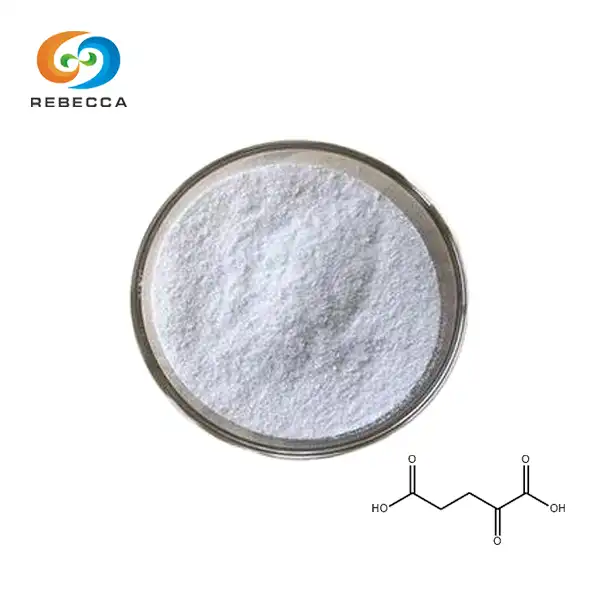
Alpha-Ketoglutarate Powder
【English name】: Alpha-Ketoglutarate
【CAS No.】: 328-50-7
【Molecular Formula】: C5H6O5
【Active ingredients】: Alpha-Ketoglutarate
【Specification】: Alpha-Ketoglutarate 98%
【Appearance】: White powder
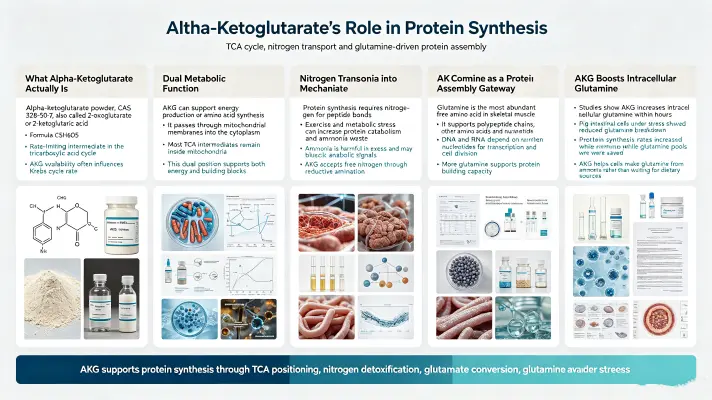
Alpha-Ketoglutarate's Role in Protein Synthesis
What Alpha-Ketoglutarate Actually Is
Alpha-ketoglutarate powder (CAS 328-50-7) is called by the following names. Chemists know it as 2-oxoglutarate or 2-ketoglutaric acid. Its formula is C5H6O5. In the body, it serves as a rate-limiting intermediate in the tricarboxylic acid (TCA) cycle. That implies the rate of the whole Krebs cycle frequently relies on how much AKG is available.
Picture the Krebs cycle as a manufacturing floor. Incoming glucose and lipids. ATP energy goes away. AKG is at a crucial point on this floor. It can go forward and create energy. Or it may stand aside and aid to make amino acids. This dual function is unusual among metabolic intermediates.
Most TCA intermediates remain within mitochondria. AKG is another story. It passes through mitochondrial membranes and enters the cytoplasm. From there it participates in transamination reactions. These processes transfer amino groups from one molecule to another. This provides a steady supply of new glutamate and glutamine ready to assemble proteins.
The Nitrogen Transport Mechanism
Proteins are synthesized from nitrogen . A lot of it. Each peptide bond between two amino acids includes nitrogen. When you exercise, or put your body under metabolic stress, your body will catabolize certain proteins. This results in the production of ammonia as a waste product. Ammonia is harmful in excessive amounts. It also blocks anabolic signals in the muscle.
AKG addresses this issue immediately. It serves as a nitrogen acceptor. AKG takes free ammonia and turns it into glutamate via a pathway termed reductive amination. The reaction is as follows . AKG + NH3 -> Glutamate . Simple, quick and important.
This is when protein synthesis truly comes into play. What occurs next? Glutamate is not resting. This goes into glutamine synthetase, an enzyme that adds another nitrogen atom. The product is glutamine. Free glutamine is the most abundant amino acid in skeletal muscle. In muscle tissue it makes up around 50 to 60 percent of the free amino acid pool.
Glutamine as the Gateway to Protein Assembly
Glutamine is more than simply a storage form of nitrogen. It is reactive nitrogen. Cells employ glutamine for at least three protein-related functions. Firstly, it is a direct constituent of polypeptide chains. Secondly, it provides nitrogen for the production of other amino acids, such as alanine and aspartate. Third, it drives the creation of nucleotides. DNA and RNA are made of nucleotides. Without them, cells can’t transcribe new proteins or divide.
Studies have shown that treatment with AKG boosts intracellular quantities of glutamine within hours. This increase is important during recovery windows. Heavy workout requires glutamine for the muscle cells, and the diet just cannot provide it quickly enough. AKG short-circuits the cells. Rather of waiting for dietary glutamine to be digested, cells create their own glutamine from AKG and ammonia.
Another research looked at pig intestinal cells under metabolic stress. The breakdown of glutamine was inhibited by over 30 percent when AKG was added to the culture medium. Meanwhile, protein synthesis rates increased. The cells saved their glutamine pools, rather than burning them for fuel. More glutamine was left over for building protein.
Now we’ve seen how alpha-ketoglutarate powder grabs nitrogen and feeds glutamine into the protein assembly process, let’s go deeper. Next question: What exact signaling pathways does AKG activate in muscle cells to stimulate protein synthesis?
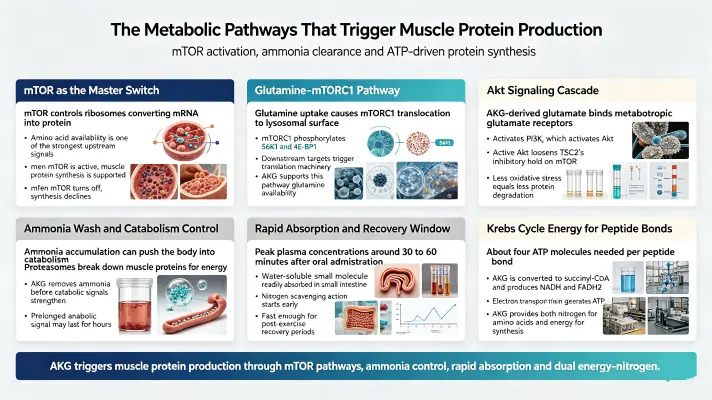
The Metabolic Pathways That Trigger Muscle Protein Production
mTOR Activation and Anabolic Signaling
The master switch for muscle development is the mechanistic target of rapamycin (mTOR) . When mTOR is active, ribosomes begin converting mRNA into protein. When mTOR turns off, muscle protein synthesis is turned off. mTOR is regulated by many upstream signals. One of the strongest is the availability of amino acids.
AKG regulates mTOR in at least two ways. The first pathway is via glutamine. Uptake of glutamine into the cell causes translocation of mTORC1 to the lysosomal surface. There, mTORC1 phosphorylates S6K1 and 4E-BP1. These downstream targets subsequently trigger the translation mechanism.
The second pathway is the Akt signaling cascade. The AKG-derived glutamate binds to metabotropic glutamate receptors on the cell surface. This binding event then activates PI3K, which activates Akt. Active Akt then loosens TSC2’s inhibitory hold on mTOR. This creates a prolonged anabolic signal lasting for hours following delivery of AKG.
Ammonia Wash Maintains Protein Conformation
Protein breakdown and protein synthesis are not independent processes. They fight for resources. When ammonia accumulates your body goes into catabolism. Proteasomes break down muscle proteins to provide amino acids for energy. This is what survival mode is. It’s the last thing an athlete or convalescing patient needs.
Alpha-ketoglutarate powder removes the trigger and restores the synthesis equilibrium. It removes ammonia before catabolic signals may be triggered. This impact is seen in studies on older mice. Mice using calcium AKG exhibited better blood total antioxidant status and reduced oxidative damage indicators. Less oxidative stress equals less protein degradation.
What matters here is the time. AKG is ready in minutes, not hours. It is a tiny molecule, water soluble, therefore it is readily absorbed throughout the small intestine. Peak plasma concentrations are reached approximately 30 to 60 minutes following oral administration. AKG is fast enough to be effective during post-exercise recovery periods. The nitrogen scavenging action starts while other nutrients are still being absorbed.
The Energy-Protein Link Through the Krebs Cycle
Protein synthesis is costly. You need around four ATP molecules to make one peptide bond. There are millions of peptide connections in one muscle fiber . The math is ugly. No matter how many amino acids there are, ribosomes cannot work without sufficient ATP.
From inside the Krebs cycle itself, alpha-ketoglutarate powder supplies this energy need. It produces NADH and FADH2 while being converted to succinyl-CoA. Electron carriers are used in the electron transport chain. The chain makes ATP. This indicates that AKG simultaneously offers the energy for the protein synthesis and the nitrogen for the amino acid creation.
This dual function explains why AKG works better than basic amino acid supplementation in various metabolic stress conditions. Amino acids provide nitrogen. They don't necessarily provide energy. Both are made by one molecule from AKG .
The biochemical processes are clear: AKG grabs nitrogen, makes glutamine, activates mTOR, drives ATP generation. But what does this mean in actual terms? Let’s see how formulators and nutrition companies exploit these techniques.
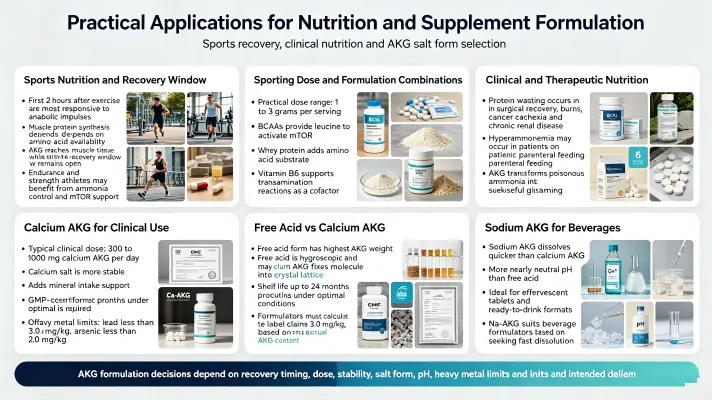
Practical Applications for Nutrition and Supplement Formulation
Sports Nutrition and Post-Exercise Recovery
Heavy exercise generates a reduction in muscle protein synthesis. It doesn’t stay down forever. A recovery window opens during the first 2 hours. That is when the muscle cells are most responsive to anabolic impulses. The amount of protein that is made depends on the availability of amino acids during this window.
Alpha-ketoglutarate powder is the ideal match for this timeframe. It is rapidly absorbed and hence reaches muscle tissue while the recovery window is still open. This is good news for endurance athletes who experience larger ammonia spikes after extended exertion. This is good for strength athletes, since their mTOR pathways have already been primed by mechanical loads. AKG adds another, chemical signal to the mechanical one.
For sporting applications, practical dose is in the range of 1 to 3 grams per serving. Most of the formulators add BCAAs or whey protein to AKG. The BCAAs give leucine to activate mTOR. Alpha-ketoglutarate powder feeds the nitrogen management system to keep the signal up. Formulators incorporate vitamin B6, as well. Pyridoxal phosphate (active form of B6) is a cofactor for transamination reactions with AKG.
Clinical and Therapeutic Uses
Protein wasting is a problem for millions of sufferers. Protein breakdown is increased in surgical recovery, burns, cancer cachexia and chronic renal disease. Nutritional supplementation as usual helps. But clinical evidence reveals AKG has a distinct effect beyond just delivering calories.
Hyperammonemia may occur in patients on complete parenteral feeding. Their livers can't handle the nitrogen quickly enough. In these circumstances, alpha-ketoglutarate powder serves as an ammonia sponge. It transforms poisonous ammonia to useful glutamine without contributing to the urea cycle. Nutritional therapies seldom provide the combined advantages of detoxification and protein supplementation.
In sports doses are higher than in clinics. In typical procedures, 300 to 1000 mg of calcium AKG is used each day. In the clinic, the calcium salt is the recommended type. It is more stable and also adds to the mineral intake. GMP-certified production is a must here. Clinical goods must pass batch level heavy metal testing (lead < 3.0 mg/kg, arsenic < 2.0 mg/kg) to comply with pharmacopeia guidelines.
Choosing Between AKG Salt Forms
Not every AKG is created equal. The free acid form (2-ketoglutaric acid) has the highest AKG weight. But it’s hygroscopic. It draws moisture out of the air and it clumps up when stored. This poses complications with automatic capsule filling and powder mixing.
The solution to the stability issue is calcium alpha-ketoglutarate (Ca-AKG). The calcium ion fixes the molecule into a crystal lattice. Shelf life up to 24 months, under optimal circumstances. The calcium level further supports mineral fortification claims in some markets. The trade-off is reduced AKG per gram. Formulators must consider this while computing label claims.
Sodium alpha-ketoglutarate (Na-AKG) is a compromise. It dissolves quicker than the Ca-AKG. This makes it perfect for effervescent tablets and ready-to-drink formats.” It is more nearly neutral in pH than the free acid. For this reason, beverage formulators frequently favor Na-AKG.
Protein synthesis is supported by several ingredients than alpha-ketoglutarate powder. Most customers know a lot more about glutamine and creatine. Understanding the differences between AKG, and when one is preferable to the other, allows formulators to make evidence-based judgments.
How AKG Compares with Glutamine and Creatine
AKG vs. Glutamine: Different Entry Points
Both glutamine and AKG support protein synthesis. They accomplish this via distinct metabolic entry sites. Pre-formed glutamine is taken up into the cell. It provides its amino group straight to transaminations. The cell may then immediately employ it to make proteins or to make nucleotides.
AKG goes upstream. It does not release nitrogen. It takes nitrogen from ammonia and other sources and transforms itself to glutamate and glutamine. This makes AKG more flexible when many amino acids are being degraded at the same time. Branched-chain amino acids, alanine and aspartate release nitrogen during vigorous exercise. Glutamine can only deal with one of these streams. All of these may be done using AKG.
Cost’s another matter. Wholesale pricing for pharmaceutical grade glutamine vary from 15 to 25 USD per kilogram. AKG costs 45 to 80 USD per kilogram depending on purity and salt form. The increased cost is due to the more complicated synthesis of AKG and its role as a rate-limiting metabolic intermediary rather than a simple building block.
AKG vs. Creatine: Complementary Mechanisms
Creatine and AKG do not compete. They function in distinct systems that converge to the same objective. Creatine boosts muscular phosphocreatine reserves. More phosphocreatine = quicker ATP regeneration while working at high intensity for brief bursts. This means athletes may workout harder. More mTOR activation from harder training mechanical loads.
AKG works the chemical side of the same equation. It supplies nitrogen for repair and gets rid of ammonia that otherwise limits performance. Creatine allows you to destroy muscle during workout. AKG provides you the tools to rebuild throughout recovery.
Combined formulations often have a 2:1 ratio of glutamine to AKG with creatine added at 3 to 5 grams per serving. This three-part combination includes nitrogen supply (glutamine), nitrogen management (AKG), and energy output (creatine). Now all three are present in certain commercial post-workout products. Consumer feedback has consistently shown better next-day recovery indicators vs. creatine-only formulations.
When AKG Makes More Sense
Alpha-ketoglutarate powder is great in three particular cases. First, for those athletes training more than 90 minutes each session. At this length of time, ammonia buildup is a major performance restriction. The scavenging action of AKG is more important than the direct provision of glutamine. Second, for the elderly. mTOR sensitivity to leucine alone decreases with aging. The multi-pathway stimulation of mTOR by AKG could surmount this age-related resistance. Thirdly, in clinical groups with reduced liver function. Their urea cycles are already overtaxed. Increased nitrogen from glutamine may aggravate hyperammonemia. AKG does the opposite. It takes ammonia out of circulation.
The main distinctions are summarized at a glance in the table below:
|
Feature |
AKG |
Glutamine |
Creatine |
|
Primary Mechanism |
Nitrogen acceptor |
Nitrogen donor |
Phosphate donor |
|
Absorption Speed |
30–60 min |
30–45 min |
60–90 min |
|
Best For |
Endurance, aging, clinical recovery |
Gut health, immune support |
Strength, power output |
|
Wholesale Cost (USD/kg) |
45–80 |
15–25 |
8–15 |
|
Typical Serving |
1–3 g |
5–10 g |
3–5 g |
FAQ
1. Does AKG by itself boost muscle protein synthesis without exercise?
AKG supplies the metabolic conditions for protein synthesis. It gives nitrogen, helps make glutamine and turns on mTOR. But mechanical loading is the most potent anabolic stimulation. Exercise prepares muscle cells to react to nutrition. AKG promotes baseline protein turnover without exercise — it’s not generating net muscle growth.” AKG is the fuel, think of AKG as the fuel. Movement is the spark.
2. In terms of absorption, is calcium AKG superior than free form AKG?
Both versions are efficiently absorbed in the small intestine. The storage stability of the calcium salt is superior. It is less hygroscopic implies less clumping difficulties in production. The free acid version has higher AKG per gram but needs moisture-controlled packaging. Ca-AKG is the practical option for most applications. The sodium salt or the free acid may be more appropriate for the effervescent or liquid forms.
3. What is a safe daily dose for AKG?
Most human studies utilize 1 to 3 grams a day for sports usage. Clinical nutrition regimes often employ 300 to 1,000 mg/day. Animal studies have utilized far larger dosages with no deleterious effects. AKG is a metabolite that naturally exists in every cell. It is considered to have a good safety profile at common supplemental doses. As with any supplement ingredient, formulators should check supplier paperwork for purity and contaminant screening.
Partner with Rebecca for Premium Alpha-Ketoglutarate Powder Supply
Rebecca supplies pharmaceutical-grade alpha-ketoglutarate powder to firms who need uncompromising quality and regulatory assistance. Our Shaanxi manufacturing facility is GMP and ISO22000-certified, which means every batch of our products adheres to international standards for purity and uniformity. As a professional alpha-ketoglutarate powder supplier, we know the technical needs of R&D managers and buyers in pharmaceutical, nutraceutical and functional food industries.
Our quality assurance exceeds baseline specs: we conduct rigorous testing for heavy metal screening, microbiological analysis and residual solvent verification. Documentation packages like as certificates of analysis, allergy declarations, and stability data are included to enhance formulation development schedules. Our yearly production capacity is above 500 metric tons in different extract categories, giving the supply chain stability to scale commercial goods.
Rebecca’s technical team works with customers to optimize formulations, advising on ingredient compatibility and stability issues. Our flexible MOQ rules support projects at every step, from first samples for feasibility testing to metric ton volumes for full-scale manufacturing. For a discussion of your unique needs and to acquire full product specifications adapted to your application demands, please contact our ingredients experts at information@sxrebecca.com.
References
1. Wu N, Yang M, Gaur U et al.Alpha-Ketoglutarate: Physiological Functions and Applications. Biomolecules and Therapeutics. 2016;24(1):1-8.
2. Xiao D, Zeng L, Yao K, et al. Glutamine-alpha-ketoglutarate (AKG) metabolism and nutritional consequences.Amino Acids . 2016;48(9):2067-2080.
3. Harrison AP, Pierzynowski SG. Biological effects of 2-oxoglutarate with specific attention on the control of protein, mineral and lipid absorption/metabolism, muscle performance, renal function, bone formation and cancerogenesis, all seen from a healthy ageing viewpoint.Physiol. Pharmacol. J. 2008;59 Suppl 1:91-106.
4. Niemiec T, Sikorska J, Harrison A, et al. Alpha-ketoglutarate re-establishes redox equilibrium and increases vascular elasticity in old mice.Journal of Physiology & Pharmacology. 2011;62(1):37-43.
5. Yao K, Yin Y, Li X, et al. Alpha-ketoglutarate inhibits glutamine catabolism and stimulates protein synthesis in intestinal porcine epithelial cells.Amino Acids. 2012;42(6):2491-2500.
6. Wu G, Bazer FW, Davis TA, et alArginine in growth, health and illness. Metabolism and nutrition.Amino Acids. 2009;37(1):15