How long does creatine monohydrate take to work?
creatine monohydrate is one of the most researched sports supplements on the market. This popular product is sometimes misinterpreted with regards to the timeframe of visual and performance related effects. In this essay, I explain down what you may realistically anticipate based on physiology, dosage tactics and individual variability.
What Happens After You Start Taking Creatine Monohydrate?
Early biological response (Day 1 to Week 1)
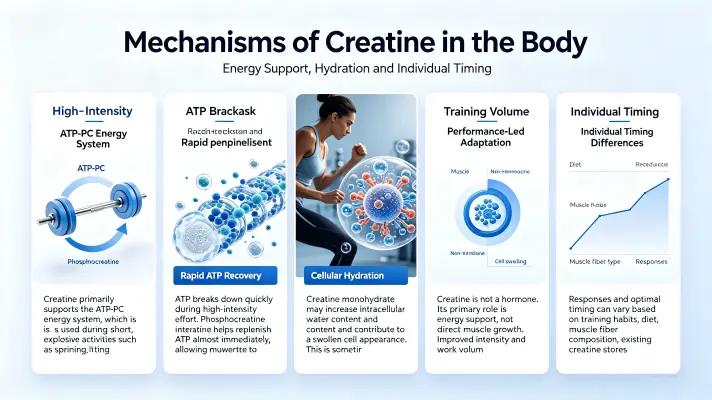
The first change when you begin supplementing with creatine is energy at the cellular level. Creatine increases the amount of phosphocreatine retained in muscular tissue. This helps to restore ATP which is the main energy molecule needed in high intensity activities.
Most individuals will not see obvious muscle gain in the first few days. Training performance, for example, is subtly affected. Some users report a better ability to repeat an effort, or lower weariness on brief bursts of activity.
If a loading phase is employed (usually approximately 20g per day, divided into doses), muscle creatine reserves may be saturated within 5-7 days. This normally takes more like 2-4 weeks without loading.
Water retention and weight change
One of the first things you will notice is that you are gaining weight. This is not a fat increase. It's mostly water retention in the cells of the muscles.
The rise is generally moderate, often 1 to 3 pounds the first week. This alteration suggests water shifts, not muscle development from structural changes. Don’t confuse it with hypertrophy right away however.
This first stage is commonly misinterpreted, particularly by those new to the practice who expect to see speedy change. What is happening is that creatine is preparing the muscular environment so that exercise capacity may be increased, not actively growing muscle tissue at this time.
How Creatine Works in the Body (And Why Timing Varies)?
Energy system support during high-intensity activity
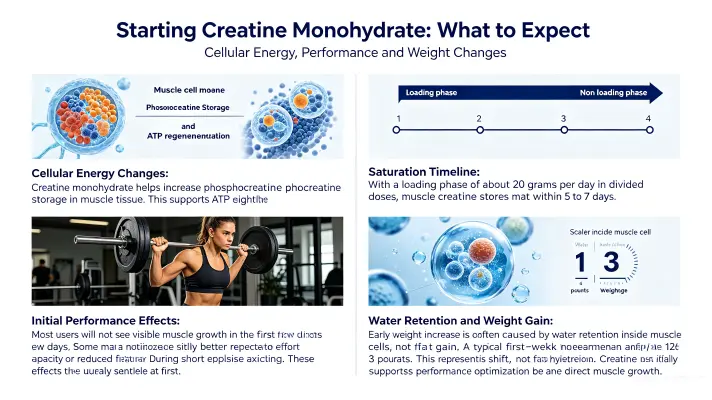
Creatine mostly helps the ATP-PC energy system. It is the system that is used for brief bursts of powerful activity such as running, leaping and lifting large weights.
When we break down ATP during activity, energy is generated, but it is used up within seconds. The phosphocreatine is used to refill the ATP practically instantly, enabling muscles to hold a high level of power for a somewhat longer period of time.
That’s why gains in performance are typically recognised before any evident physical changes. The body may do greater overall work in training sessions.
Muscle cell hydration and signaling effects
Creatine monohydrate also pulls water into the muscle cells. This makes the intracellular environment more hydrated.
This hydration might cause cell swelling, which occasionally is related with anabolic signalling. However, the specific processes are currently under study, and benefits likely occur indirectly via enhanced training performance, rather than direct muscle growth stimulation alone.
This procedure should not be simplified too much. Creatine is not a hormone. It is used mostly for energy support, not for really growing muscle.
When Visible Results Actually Appear?
First week: performance changes, not muscle growth
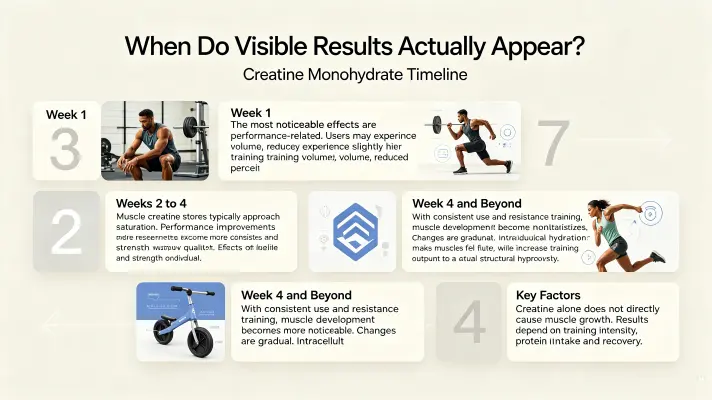
In the first 3–7 days, most noticeable effects are performance-related. Users may observe:
• Slight increase in training volume capacity
• Reduced perceived exertion during sets
• Mild body weight increase due to water retention
These changes are often subtle and vary significantly between individuals. People with lower baseline creatine levels, such as those consuming little meat or fish, may notice faster effects.
Weeks 2–4: strength and endurance improvements
Between two and four weeks, muscle creatine stores are typically fully saturated (if no loading phase was used). At this point, performance improvements become more consistent.
Users may experience increased strength output during resistance training. This is not due to immediate muscle fiber growth but due to improved training quality.
Over time, this allows for greater training volume, which indirectly contributes to muscle growth. In controlled studies, creatine monohydrate users often gain more lean mass compared to placebo groups when training conditions are identical.
Weeks 4 and beyond: visible physical changes
When consistent use and resistance training are combined for three to four weeks, noticeable gains in muscle development often take place. These alterations are not sudden but rather progressive.
An increase in the duration of intracellular hydration may cause the muscle to feel fuller. Over the course of time, increased training output leads to the development of true structural hypertrophy.
However, creatine by itself will not result in muscular growth. A great deal is dependent on the intensity of your workouts, the amount of protein you consume, and how well you recover in general.
Why Results Differ Between Individuals?
Loading vs non-loading protocols
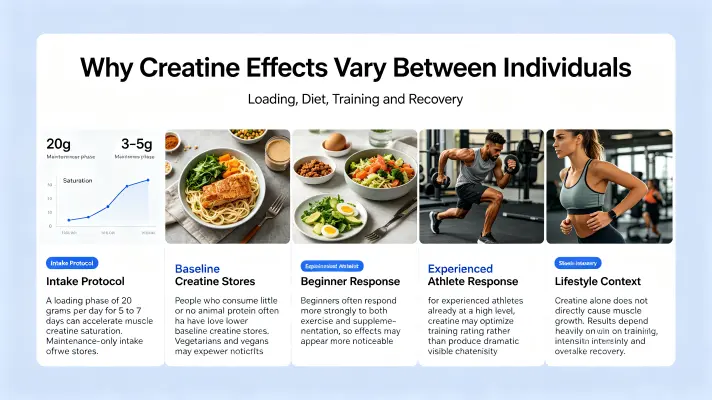
The rate of saturation of creatine relies largely on the dosage approach. A loading phase (20g per day for 5-7 days) increases the saturation of the muscle. This means earlier weight decreases and performance improvements are seen quicker. Maintenance merely ( 3-5g per day ) is slower but gets you to the same place. The variation is mostly in timing, not in long-term efficacy.
Diet and baseline creatine levels
It is possible that the pace at which you consume food has an effect on how fast you react. People who consume fewer or no animal protein supplements often have lower baseline creatine stores than those who consume more animal protein. In light of this, it is possible that vegetarians and vegans would see more dramatic initial advantages than those who already consume diets that are high in creatine.
Training intensity and experience level
Moreover, training status is a significant factor. Because their bodies respond more strongly to both exercise and supplementation, beginners will experience more dramatic impacts than more experienced individuals. Because of the fact that their baseline performance is already excellent, the adjustments may be less significant for athletes who are farther along in their careers. Taking creatine in these conditions will mostly assist you in optimising your workouts, rather than bringing about noticeable and significant enhancements.
Conclusion
Creatine monohydrate will not make you visibly gain muscle immediately. It starts working on energy levels within days and you should expect notable increase in performance within 1-2 weeks.
Visible physical improvements normally occur after 2-4 weeks of constant nutrition together with resistance exercise. The timing will depend on the dosage approach, food, workout intensity and individual physiology.
Knowing these timescales helps to manage expectations. Creatine is a long term performance support tool rather than a short time transformation supplement.
FAQ
How long before end-users see visible muscle gains from supplementation?
Visible muscle volume increases typically emerge after 14 to 21 days when combined with structured resistance training. Initial weight gain (1-3 pounds) within the first week primarily reflects intracellular water retention rather than lean tissue growth. Actual muscle fiber hypertrophy develops progressively as enhanced training capacity and protein synthesis effects accumulate over subsequent weeks.
What certifications should B2B buyers verify when sourcing this ingredient?
Procurement teams should confirm GMP certification for manufacturing standards, ISO22000 for food safety management, and HACCP compliance for hazard control protocols. Additionally, request batch-specific Certificates of Analysis confirming purity via HPLC, heavy metal screening results (ICP-MS), and microbiological testing reports. These documents ensure regulatory compliance across pharmaceutical, nutraceutical, and functional food applications.
Does micronized creatine monohydrate offer advantages over standard grades?
Micronized variants (200 mesh particle size) provide improved solubility and suspension stability in liquid formulations without altering bioavailability or efficacy. This processing refinement benefits manufacturers producing ready-to-drink beverages or powder blends requiring uniform mixing characteristics. While slightly more expensive, the enhanced handling properties justify the cost for premium product lines targeting convenience-oriented consumers.
Partner With Rebecca for Premium Creatine Monohydrate Supply Solutions
Rebecca (Shaanxi Rebeccia) stands ready to support your product development and supply chain needs with pharmaceutical-grade creatine monohydrate powder (CAS: 6020-87-7) verified at 99.5%-102.0% purity via HPLC. Our GMP-certified production facilities in Shaanxi operate three specialized lines capable of delivering 500+ metric tons annually, ensuring scalable supply for growing brands and established distributors. We offer flexible MOQs, customizable packaging options, and comprehensive documentation including free samples and MSDS for initial evaluation. Contact our team at information@sxrebecca.com to discuss your specific formulation requirements and receive a detailed quotation from a trusted creatine monohydrate manufacturer committed to quality, compliance, and reliable delivery.
References
1. Kreider, R.B., et al. (2017). International Society of Sports Nutrition position stand: safety and efficacy of creatine supplementation in exercise, sport, and medicine. Journal of the International Society of Sports Nutrition, 14(1), 18.
2. Buford, T.W., et al. (2007). International Society of Sports Nutrition position stand: creatine supplementation and exercise. Journal of the International Society of Sports Nutrition, 4(1), 6.
3. Hultman, E., et al. (1996). Muscle creatine loading in men. Journal of Applied Physiology, 81(1), 232-237.
4. Harris, R.C., Söderlund, K., & Hultman, E. (1992). Elevation of creatine in resting and exercised muscle of normal subjects by creatine supplementation. Clinical Science, 83(3), 367-374.
5. Jäger, R., et al. (2011). Analysis of the efficacy, safety, and regulatory status of novel forms of creatine. Amino Acids, 40(5), 1369-1383.
6. Antonio, J., & Ciccone, V. (2013). The effects of pre versus post workout supplementation of creatine monohydrate on body composition and strength. Journal of the International Society of Sports Nutrition, 10(1), 36.