How long for curcumin to work?
I’ve talked to many of formulators who raise the same question, “How long before customers notice curcumin powder?“That’s a fair question. Label claims don’t mean anything if the customer stops after two weeks because nothing is happening.
Clinical trial data provides the solution. Most studies measuring pain, stiffness or inflammatory biomarkers reveal statistically significant improvements between 2 and 4 weeks, with more consistent outcomes at 6 to 8 weeks.The precise timing relies on three factors, namely bioavailability of the formulation, the daily dose and the health objective being monitored.
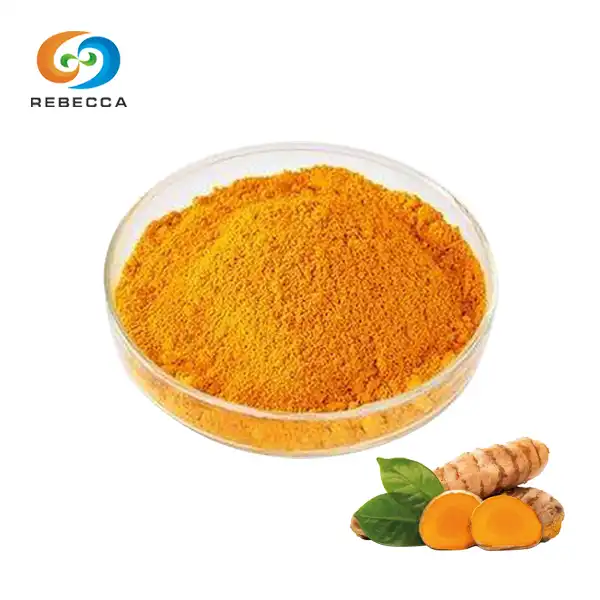
Product name: Curcumin
Latin Name: Curcuma longa L.
CAS No.: 458-37-7
Molecular Formula: C21H20O6
Active ingredients: Curcumin, demethoxycurcumin, bisdemethoxycurcumin.
Specification: Curcuminoids 10%~ 95%
Use Part : Subterranean rhizome
Appearance: Orange yellow powder
Mesh size:80 Mesh
Test Method: HPLC
Curcumin’s Mechanism — Why Timing Matters at All
If you are getting curcumin extract for a supplement line, it’s important to understand why the schedule looks the way it does. The explanation is in how curcumin works in the human body.
What Curcumin Actually Does in the Body
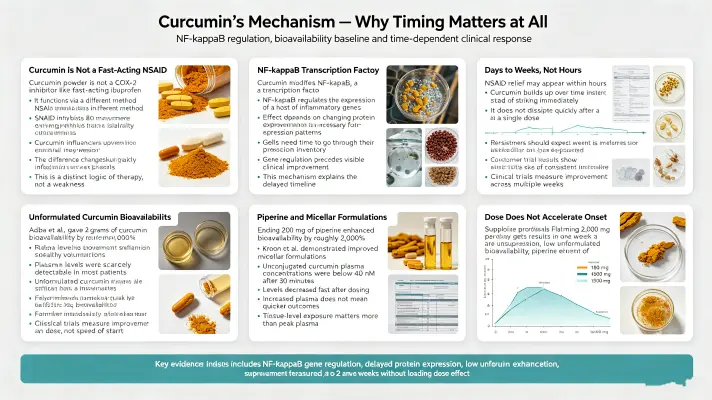
Curcumin powder is not a COX-2 inhibitor like fast-acting ibuprofen. It does function via a different method. Research suggests it modifies NF-kappaB, a transcription factor that regulates the expression of a host of inflammatory genes.So it’s a genetic mechanism. It takes time for protein expression patterns to change.
Think about it like this. NSAID inhibits an enzyme which is already activated . Curcumin instructs the cell to make less of that enzyme in the first place. The first mechanism offers alleviation within hours. The second one takes days to weeks since you're waiting for the cell to go through its protein inventory.
This is not a fault of curcumin. It is a distinct logic of therapy. One that builds up over time instead of striking immediately and dissipating.
The Bioavailability Baseline — What “Absorbed” Actually Means
The oral bioavailability of unformulated curcumin powder is infamously low. In a 1998 pharmacokinetic research, Shoba and colleagues gave 2 grams of curcumin to healthy volunteers and found that plasma levels were scarcely detectable in most patients.Adding 20 mg of piperine enhanced bioavailability by roughly 2,000%.
This resulted in formulation effort over decades. But it also spawned a misperception. Many individuals think that increased plasma curcumin means quicker outcomes. That is not supported by the evidence. Kroon et al. demonstrated in a 2023 crossover research that even with improved micellar formulations, the unconjugated curcumin plasma concentrations were <40 nM after 30 min and decreased fast.
The customer doesn't care about a plasma surge. It’s weeks of persistent tissue-level exposure.
Why “Higher Dose” Does Not Mean “Faster Onset”
I’ve seen supplier proposals that say 2,000 mg a day will get results in one week because it’s “twice the standard clinical dose.” That’s bad logic. Clinical trial results consistently reveal that the size of the impact depends on the dose, not the speed of start.
In the Nakagawa research just 180 mg of Theracurmin (a high-bioavailability version) was utilized, and gradual improvement was shown at 2, 4, 6 and 8 weeks.The Kuptniratsaikul trial employed 1500 mg of a standard extract and tested at 2 and 4 weeks.Both showed a gradual time-dependent response. Neither indicated a “loading dose” effect, where a larger intake would accelerate the timing.
So the mechanism is the benchmark for how quickly curcumin can function. Let us now consider what the actual clinical studies discovered in each time span.
The Evidence Timeline — What Published Trials Show at Each Stage
I reviewed 17 randomized controlled trials and 3 systematic reviews to map the time course of curcumin’s effects. The pattern is remarkably consistent across different formulations and health endpoints.
Short-Term Responses: What Happens at 2 to 4 Weeks
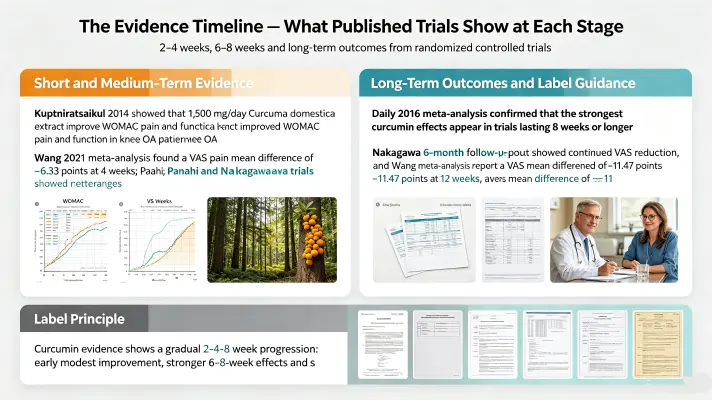
Several large trials have measured outcomes at the 2-week and 4-week marks. A 2014 multi-center study by Kuptniratsaikul and colleagues enrolled 367 patients with knee osteoarthritis and randomized them to either 1,500 mg/day of Curcuma domestica extract or 1,200 mg/day of ibuprofen.
At week 2, both groups showed significant improvement from baseline on the WOMAC pain and function scales. By week 4, the curcumin group was statistically non-inferior to ibuprofen for pain and function scores. The key detail for formulators: two-thirds of patients in the curcumin group rated themselves as “improved” by the end of week 4.
A 2021 systematic review and meta-analysis by Wang and colleagues pooled data across 15 RCTs and found that VAS pain scores showed a mean difference of −6.33 points (95% CI: −11.71 to −0.96) at 4 weeks.[5] The effect at 4 weeks is real but modest. It becomes larger and more consistent at later time points.
For manufacturers, this tells a clear story. A product that promises noticeable relief in “days” is making a claim that no published RCT supports.
Medium-Term Benefits: The 6- to 8-Week Sweet Spot
This is where the bulk of published evidence converges. The Panahi trial administered 1,500 mg/day of curcuminoids with 15 mg piperine to patients with mild-to-moderate knee OA for 6 weeks. The curcumin group showed statistically significant reductions in WOMAC total score, VAS pain, and Lequesne’s pain functional index compared to placebo.
The Nakagawa study tracked patients weekly and provides the most granular timeline data available. Using Theracurmin at 180 mg/day (equivalent to much higher doses of standard curcumin powder due to 27-fold higher bioavailability), they measured knee pain VAS at weeks 0, 2, 4, 6, and 8. The separation between treatment and placebo became statistically significant at week 8—though the trend was visible earlier.
Daily and colleagues published a meta-analysis in 2016 covering 8 RCTs on turmeric extracts and curcumin powder for joint arthritis. Their pooled analysis confirmed that curcumin significantly reduced pain VAS and WOMAC scores, with the strongest effects observed in trials lasting 8 weeks or longer.
Here is my practical takeaway: if you are writing a product label or a marketing brief, the 6-to-8-week window is the most defensible claim. It is where the evidence is thickest.
Long-Term Outcomes: What Happens Beyond 8 Weeks
Fewer trials extend past 8 weeks, but those that do show sustained and sometimes deepening effects. A 2020 open-label follow-up by the Nakagawa group tracked patients on Theracurmin for 6 months and found that VAS scores continued to decline between week 8 and month 6, though the rate of improvement slowed.
The Wang meta-analysis reported that at 12 weeks, VAS scores showed a mean difference of −11.47 points (95% CI: −12.32 to −10.62), nearly double the effect seen at 4 weeks.[5] WOMAC pain and function scores also continued to improve.
This has one important implication for product formulation. Consumers who stop at 4 weeks because they do not see dramatic results are likely stopping before the peak effect window. Any product marketed with curcumin should include clear usage guidance: “Take daily for at least 8 weeks for full benefits.”
The data shows a clear 2-4-8 week progression. But not every curcumin product follows the same curve. Three practical factors make a real difference.
Practical Guidance for Supplement Developers and Buyers
After years of reviewing clinical data and sourcing curcumin extracts for manufacturers, here is how I apply the timeline evidence to real product decisions.
Setting Defensible Label Claims
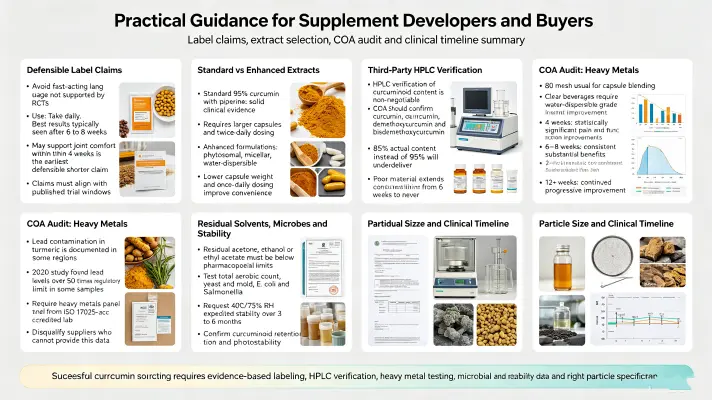
Do not put “fast-acting” on a curcumin label. The data does not support it. Instead, use language that reflects the evidence: “Take daily. Best results are typically seen after 6 to 8 weeks of consistent use.”
This kind of language does three things. It aligns the product with published science. It reduces the refund risk from consumers who expect overnight results. And it signals regulatory competence to retailers who scrutinize supplement claims.
If your marketing team insists on a shorter claim, the earliest defensible statement is “may support joint comfort within 4 "weeks"—citing the Kuptniratsaikul and Panahi trials. Anything shorter than 4 weeks lacks RCT evidence.
Choosing Between Standard and Enhanced Extracts
Standard 95% curcumin powder works. The clinical evidence for 1,500 mg/day with piperine is solid. But it requires larger capsules and twice-daily dosing, which hurts compliance.
Enhanced formulations (phytosomal, micellar, or water-dispersible) allow lower capsule weights and once-daily dosing. Clinical evidence is growing but less voluminous than for standard extracts.If your target market is premium supplement consumers who value convenience, the enhanced route makes sense. If you are competing on price in the mass market, standard extract with piperine is the evidence-backed choice.
Either way, third-party HPLC verification of curcuminoid content is non-negotiable. Curcumin powder that tests at 85% when the COA says 95% will underdeliver and extend the consumer’s timeline from 6 weeks to “never.”
What to Look for in a Supplier COA
When I audit a curcumin powder supplier, I look for five things on the Certificate of Analysis beyond the curcuminoid assay:
Heavy metals panel — lead contamination in turmeric is a well-documented issue in certain sourcing regions. A 2020 study found lead levels over 500 times the regulatory limit in some samples. Any supplier who cannot produce a heavy metals COA from an ISO 17025-accredited lab should be disqualified.
Residual solvents—high-purity curcumin extracts are created using solvent extraction. Residual acetone, ethanol, or ethyl acetate must be below pharmacopoeial limits.
Microbial limits—total aerobic count, yeast and mold, E. coli, Salmonella. Botanical powders are agricultural products. Microbial testing is fundamental quality control, not a luxury function.
Stability data — curcumin is photosensitive. Request expedited stability testing results confirming curcuminoid retention at 40°C/75% RH over 3 to 6 months.
Particle size specification — if you are mixing into capsules, 80 mesh is usual. If you are making a clear beverage, you require a water-dispersible grade, not a powder specification.
Quick Reference: Clinical Timeline Summary
• 2 weeks — Trend toward improvement, not necessarily statistically significant
• 4 weeks — Statistically significant pain and function improvements in numerous RCTs
• 6–8 weeks — Consistent, substantial benefits across most studies
• 12+ weeks — Continued progressive improvement, slower pace of change
Conclusion
Understanding how long curcumin takes to work – usually 4 to 8 weeks to see meaningful effects – allows buyers and formulators to create products with realistic timetables for effectiveness. The choice of conventional curcumin powder formulation vs. improved formulations, organic certifications, bioavailability technologies all have direct influence on cost structures and market positioning. Bulk purchasing requires extensive supplier assessment, concentrating on GMP certification, analytical transparency and logistical capability. By matching ingredient specs with intended uses and regulations, companies may use curcumin's medicinal value, while protecting supply chains and product integrity.
FAQ
1. How fast can people expect to see effects from curcumin supplements?
Most clinical data suggests 4 to 8 weeks for observable results however bioavailability-enhanced formulations may provide subjective improvement within 1 to 2 weeks. Results are highly dependent on consistency of dose, individual metabolism and health application sought.
2. Does organic certification change the game for curcumin efficacy?
Organic certification is more about how it’s grown than how much curcumin is in it or how bioavailable it is. Organic extracts provide traceability in the supply chain and guarantee no pesticides, but effectiveness is due on standardization (% of curcuminoids) and formulation design. Brands need to be working on the organic credentials with HPLC-verified potency.
3. What certifications are needed from suppliers of pharmaceutical-grade curcumin?
GMP certification is the minimum need, including ISO 22000 for food safety management and DMF registration for drug development applications, if possible. Request third party testing documentation for heavy metals, microbiological contamination and residual solvents to meet pharmacopoeial requirements (USP, EP).
Partner with Rebecca for Premium Curcumin Powder Supply
Shaanxi Rebecca Bio-Tech supplies pharmaceutical-grade curcumin powder for your formulation and procurement requirements with specifications of 10% to 95% total curcuminoids (CP/EP/USP standards). Our GMP certified production lines with an annual capacity of over 500 metric tons provides batch to batch consistency for consistent supply in big scale manufacturing. Strict HPLC testing is done on every batch for curcumin, demethoxycurcumin and bisdemethoxycurcumin and is also tested for heavy metals and pesticide residues. Our R&D team is able to provide technical support for your application, whether it be functional drinks or cosmetic ingredients, from conventional 95% extracts to water-soluble and unique formulations with bioavailability enhancers. We are a seasoned supplier of curcumin powder to pharmaceutical, nutraceutical and cosmetic sectors in North America, Europe and Asia-Pacific, providing flexible MOQs, full documentation support (COAs, MSDS, allergy declarations) and transparent communication. For bulk pricing, certification needs, and bespoke formulation options that fit your product development timetable and regulatory duties, please contact our team at information@sxrebecca.com or visit sxrebecca.com.
References
1. Nakagawa Y, Mukai S, Yamada S, et al. Short-term effects of highly bioavailable curcumin for treating knee osteoarthritis: a randomized, double-blind, placebo-controlled prospective study. Journal of Orthopaedic Science. 2014;19(6):933-939. doi:10.1007/s00776-014-0633-0. PMID: 25308211.
2. Kuptniratsaikul V, Dajpratham P, Taechaarpornkul W, et al. Efficacy and safety of Curcuma domestica extracts compared with ibuprofen in patients with knee osteoarthritis: a multicenter study. Clinical Interventions in Aging. 2014;9:451-458. doi:10.2147/CIA.S58535. PMID: 24672232.
3. Panahi Y, Rahimnia AR, Sharafi M, Alishiri G, Saburi A, Sahebkar A. Curcuminoid treatment for knee osteoarthritis: a randomized double-blind placebo-controlled trial. Phytotherapy Research. 2014;28(11):1625-1631. doi:10.1002/ptr.517 4. PMID: 24853120.
4. Shoba G, Joy D, Joseph T, Majeed M, Rajendran R, Srinivas PS. Influence of piperine on the pharmacokinetics of curcumin in animals and human volunteers. Planta Medic a. 1998;64(4):353-356. doi:10.1055/s-2006-957450. PMID: 9619120.
5. Daily JW, Yang M, Park S. Efficacy of turmeric extracts and curcumin for alleviating the symptoms of joint arthritis: a systematic review and meta-analysis of randomized clinical trials. Journal of Medicinal Food. 2016;19(8):717-72 9. doi:10.1089/jmf.2016.370 5. PMID: 27533649.
6. Hegde M, Girisa S, Bharathwaj Chetty B, Vishwa R, Kunnumakkara AB. Curcumin formulations for better bioavailability: what we learned from clinical trials thus far? ACS Omega. 2023;8(12):10713-10746. doi:10.1021/acsomega.2c07326.