How to use shilajit extract?
Shilajit extract, is a natural material that is high in fulvic acid and trace minerals. It is frequently utilised in nutritional supplements, functional foods and cosmetic formulations. Its usefulness relies on good standardisation, safe sources and techniques of use. This article discusses the practical use of shilajit extract in formulations, typical dose structure and safety issues during product development.
To comprehend the uses of shilajit extract properly, we need to look at what makes it functionally helpful in formulation science.
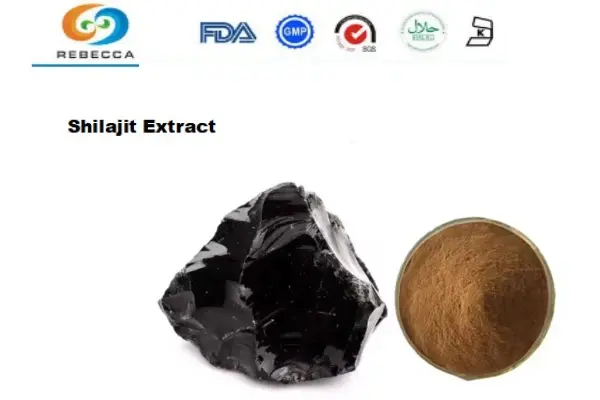
【English name】: Shilajit Extract
【Latin Name】: SHILAJIT Asphaltum (Shilajit)
【CAS No.】: 479-66-3
【Active ingredients】: fulvic acid
【Specification】: fulvic acid 50%
【Appearance】: Yellow brown Fine Powder
【Mesh size】:80 Mesh
【Test Method】: HPLC
Functional Composition and Role in Product Development
Standardized Fulvic Acid Content
Pure shilajit extract is often standardised for fulvic acid concentration. The common commercial grades are 20% to 60%. Fulvic acid is a combination of chemical molecules with low molecular weight. It is soluble in water and readily reacts with minerals. This feature makes shilajit perfect for capsules, powders and liquid mixtures.
Standardisation is a key part of formulation development. Enables batch to batch uniformity. It also allows for more certainty in dosage and labelling.
Trace Minerals and Organic Matrix
Contains trace minerals such as magnesium, zinc, iron, and potassium. These minerals are not in the form of isolated salts but are of complexed organic types. This is part of why it’s commonly included in nutritious mixes.
But mineral content varies by source. Hence the need for purification and testing in commercial manufacturing. With composition determined, next step is to see how shilajit extract is really employed in various product forms.
Application Methods in Modern Formulations
Capsule and Tablet Formulations
Capsules are the most typical type of delivery. They provide accurate dosage and consistent shelf life. Standardised extracts are often used in doses of 200 mg to 500 mg.
To allow tableting, the powder flow and moisture content must be carefully controlled. Shilajit extract must be well-dried and granulated to provide even compression.
Capsules are superior in flavour masking during supplement manufacture. The raw version of shilajit is quite difficult to consume since it has an earthy and unpleasant natural taste.
Functional Beverages and Powder Blends
Pure shilajit extract may be added to powdered drink mixes. When treated properly, it’s water soluble. This makes it perfect for energy drinks, electrolyte mixes and health drinks.
But you need to test for stability. Solubility is affected by temperature, pH and interactions with minerals. Taste masking is also significant in beverage systems. They're often flavoured with natural flavours like citrus or berry.
Cosmetic and Topical Applications
In cosmetics, shilajit extract is used to make creams, masks and serums. Mineral and organic composition is typically subject for skin conditioning treatments. Formulators need to consider colour stability and odour control. Shilajit is darkly pigmented which is a frequent feature and has to be dealt with during formulation.
Once the ways of applying are identified, the structure of the dose and the safety controls are essential for the responsible creation of the product.
Dosage Guidance and Safety Considerations
Typical Dosage Ranges in Supplements
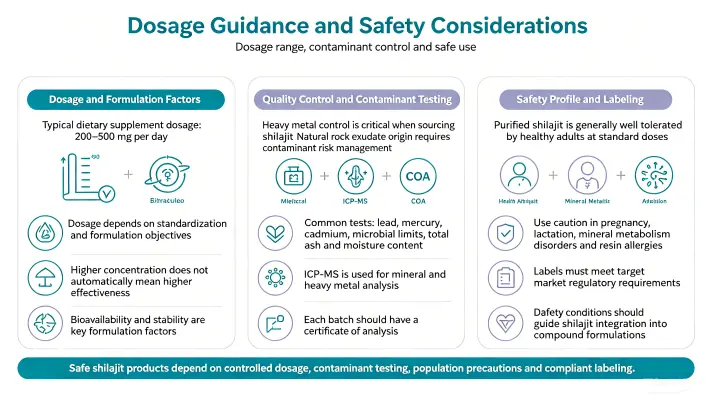
In dietary supplement products, shilajit extract is commonly used in the range of 200–500 mg per day. This depends on standardization level and formulation goals.
Higher concentrations are not necessarily more effective. Bioavailability and product consistency are more important factors.
Quality Control and Contaminant Testing
One of the most important aspects of shilajit sourcing is heavy metal control. Because it is naturally derived from rock exudates, contamination risk must be managed.
Common testing includes:
· Lead, mercury, cadmium screening
· Microbial limits (E. coli, Salmonella, yeast, mold)
· Total ash and moisture content
Analytical methods such as ICP-MS are often used for mineral and heavy metal detection. Each batch should be accompanied by a certificate of analysis (COA).
Safety Profile and Usage Limitations
Current research suggests that purified shilajit is generally well tolerated in healthy adults when used at standard doses.
However, caution is recommended in certain populations:
· Pregnant or breastfeeding individuals
· People with known mineral metabolism disorders
· Individuals with sensitivities to resin-like natural compounds
Labeling should always reflect regulatory requirements in the target market. After establishing safe use conditions, it is important to understand how shilajit integrates into combination formulations and product strategy.
Formulation Strategy and Combination Use
Blending with Botanical Ingredients
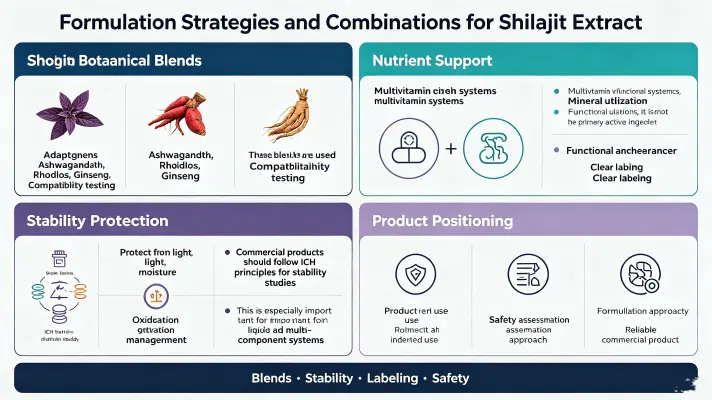
Pure shilajit extract is often used in combination with adaptogenic herbs. Common pairings include ashwagandha, rhodiola, and ginseng. These combinations are used in energy and stress-support formulations. However, compatibility testing is required to ensure stability and uniform distribution.
Nutrient Absorption Support in Formulas
Shilajit is sometimes included in multivitamin systems. It is positioned as a supporting ingredient for mineral utilization. In formulation terms, this means it is not the primary active ingredient but a functional enhancer. This role must be clearly defined in product labeling to avoid overclaiming.
Stability and Shelf-Life Considerations
Formulations containing shilajit should be protected from moisture and light. Oxidation may gradually damage the smell and colour. Stability studies in accordance with ICH principles are suggested for commercial goods. In liquid and multi-ingredient systems this is particularly significant.
With the uses, safety and formulation approach set, we can now summarise the positioning of shilajit extract in current product development.
Conclusion
Pure shilajit extract is a useful natural ingredient in supplements, drinks and cosmetics. The value of the product is its standardised fulvic acid concentration, mineral composition and formulation flexibility.
Success, however, relies on regulated sourcing and scientific formulation procedures. Heavy metals testing, microbiological safety testing and adequate standardisation are all critical needs.
Hence, shilajit should be considered as a functional support element and not a medicinal ingredient in product development. This assures conformity with regulatory frameworks and enhances long-term product reputation.
When properly standardised and tested, shilajit extract may be made into a broad variety of contemporary wellness products. Its adaptability allows it to be used in capsules, powders, drinks and cosmetic systems, as long as formulation limits are correctly handled.
FAQ
What potential side effects should formulators consider when incorporating shilajit extract?
Shilajit extract indicates great tolerability when it is obtained from recognised producers that satisfy the rules for the safety of heavy metals and microorganisms. The gastrointestinal system may become sensitive to large doses, and persons who are sensitive to plant resins may have allergic responses. These are uncommon issues. As a result of the lack of available safety evidence, women who are pregnant or breastfeeding should avoid using supplements. In order to comply with the laws set out by the FDA regarding labelling, formulators are required to include relevant label warnings and contraindication disclosures.
How does standardized powder extract differ from traditional resin forms for manufacturing purposes?
When it comes to industrial-scale manufacturing, standardised powder extracts provide a number of major benefits, including better mix homogeneity, easier handling logistics, accurate dosage accuracy, and compatibility with automated encapsulation equipment. Traditional resins need the use of dissolving procedures and provide difficulties associated with batch variance. Our standard for 50% fulvic acid powder guarantees that the product's potency remains constant throughout all production runs, therefore lowering the overhead costs associated with quality control and accompanying regulatory compliance documents.
Can shilajit be incorporated into custom OEM formulations with other botanicals?
Absolutely. The neutral pH profile and broad compatibility make shilajit suitable for combination products. Synergistic pairings include adaptogenic herbs (ashwagandha, rhodiola), antioxidant compounds (resveratrol, curcumin), and amino acids supporting energy metabolism. Our R&D team collaborates with formulators to optimize ratios, address potential interactions, and conduct stability testing for shelf-life validation. Customized blending services accommodate specific concentration requirements and delivery format preferences.
Partner with Rebecca for Premium Shilajit Extract Supply
Rebecca specializes in producing pharmaceutical-grade pure shilajit extract powder backed by comprehensive quality documentation and flexible customization capabilities. Our Shaanxi facility operates three GMP-certified production lines with 500+ metric ton annual capacity, ensuring stable supply for bulk orders and private label programs. Every batch undergoes rigorous heavy metal screening, microbiological testing, and HPLC verification confirming 50% fulvic acid potency. Whether you require kosher certification, organic compliance, or customized purity grades ranging from standardized extracts to high-concentration isolates, our technical team provides formulation support and regulatory guidance. Contact our procurement specialists at information@sxrebecca.com to request COA documentation, product samples, and tailored quotations. As a trusted shilajit extract supplier serving North American and European markets, we deliver the quality assurance, technical expertise, and logistics reliability your business demands for successful product launches.
References
1. Carrasco-Gallardo C, Guzmán L, Maccioni RB. Shilajit: A Natural Phytocomplex with Potential Procognitive Activity. International Journal of Alzheimer's Disease. 2012;2012:674142.
2. Stohs SJ. Safety and Efficacy of Shilajit (Mumie, Moomiyo). Phytotherapy Research. 2014;28(4):475-479.
3. Meena H, Pandey HK, Arya MC, Ahmed Z. Shilajit: A Panacea for High-Altitude Problems. International Journal of Ayurveda Research. 2010;1(1):37-40.
4. Goel RK, Banerjee RS, Acharya SB. Antiulcerogenic and Antiinflammatory Studies with Shilajit. Journal of Ethnopharmacology. 1990;29(1):95-103.
5. Pandit S, Biswas S, Jana U, De RK, Mukhopadhyay SC, Biswas TK. Clinical Evaluation of Purified Shilajit on Testosterone Levels in Healthy Volunteers. Andrologia. 2016;48(5):570-575.
6. Wilson E, Rajamanickam GV, Dubey GP, Klose P, Musial F, Saha FJ, Rampp T, Michalsen A, Dobos GJ. Review on Shilajit Used in Traditional Indian Medicine. Journal of Ethnopharmacology. 2011;136(1):1-9.