Is AKG powder safe?
AKG powder when produced with pharmaceutical-grade purity and administered within the dosage range researched, has a satisfactory safety record in both animal and human studies. Alpha-ketoglutarate is considered safe for most persons when taken appropriately. But not enough is known regarding the use of alpha-ketoglutarate during pregnancy and breast-feeding. That said, “safe” in the B2B world means more than a clean toxicology sheet. This means documented dosage, guaranteed purity, transparent supply chains and formulation compatibility. This article guides procurement managers, R&D executives and brand owners via what current research truly indicates and what to ask your supplier before you make a significant buy.
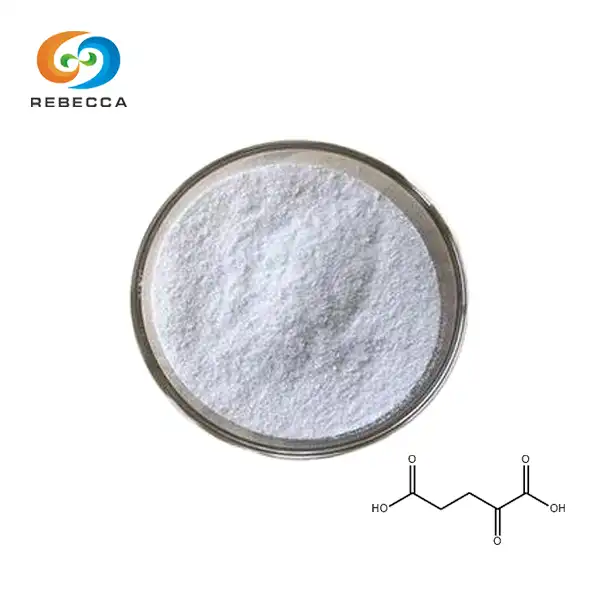
【English name】: Alpha-Ketoglutarate
【CAS No.】: 328-50-7
【Molecular Formula】: C5H6O5
【Active ingredients】: Alpha-Ketoglutarate
【Specification】: Alpha-Ketoglutarate 98%
【Appearance】: White powder
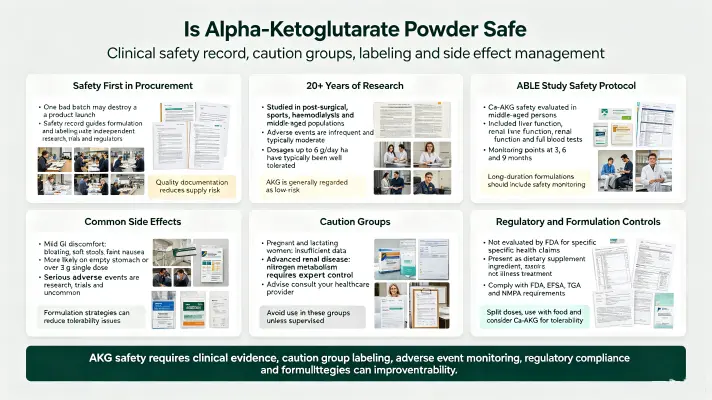
Is Alpha-Ketoglutarate Powder Safe
There’s a reason safety considerations often dominate procurement negotiations. One bad batch may destroy a product launch. Before we discuss advantages or sourcing, let’s first analyse what independent researchers, clinical trials and regulators have said about this chemical.
The Clinical Safety Record at a Glance
For more than 20 years alpha-ketoglutarate powder has been studied in humans, from post-surgical patients to sports, to haemodialysis populations and healthy middle-aged individuals. Adverse events are infrequent and typically moderate throughout these investigations. In a recent study of the field it was found that AKG has a good safety record, and dosages up to 6 g/day have typically been well tolerated. Side effects, if they occur, are usually moderate GI discomfort - bloating, soft stools, faint nausea - particularly if the powder is taken on an empty stomach or over 3 grams in a single dosage.
Additional work continues to support this view. In the ABLE clinical study, the scientists included liver function, renal function, and full blood tests at 3, 6 and 9 months to investigate the safety of Ca-AKG supplementation in middle-aged persons. Alpha-ketoglutarate powder is regarded as low-risk, however competent developers nevertheless include monitoring points into any long-duration formulation, as seen by protocols such as this.
Populations That Require Extra Caution
But no supplement ingredient is right for everyone, and alpha-ketoglutarate powder is no different. There are two categories that deserve a cautious label and a “consult your healthcare provider” comment on every final product. The first is pregnant and lactating ladies. There is not enough information regarding the usage of alpha-ketoglutarate during pregnancy and breast-feeding. To be on the safe side, avoid use. The second group is those with advanced renal disease. Compounds that contribute in nitrogen metabolism should need expert control in the end-use procedure when formulating medicines for renal or metabolic clinical channels.
Also consider a regulatory reality. Alpha-ketoglutarate has not been evaluated by the FDA for safety and efficacy in the light of specific health claims. This is not to say the chemical is banned -- it just means marketers have to present it as a dietary supplement ingredient and stay away from illness claims. Compliance teams should evaluate the requirements for each market (FDA for US, EFSA for EU, TGA for Australia, NMPA for China) before finalising label text.
Common Side Effects and How to Design Around Them
The majority of adverse effect complaints related to alpha-ketoglutarate powder are due to two variables: the magnitude of the dosage and the administration method. Formulation partners have provided field input that GI issues are reduced when a daily dosage is split into two or three portions, capsules are taken with food, and sustained-release or calcium-bound versions (Ca-AKG) are used. Muscle cramping is rarely discussed in the sports-nutrition literature, but causation is unclear since there are several factors of cramping including hydration, electrolyte balance and training load. When advising customers, we suggest starting consumer servings at 1 gram per serving and allowing the stack labelling do the rest.
Once that safety basis is established, the next question B2B customers ask is similarly pragmatic: what does alpha-ketoglutarate powder truly accomplish in a final product, and why should a brand choose it over cheaper options?
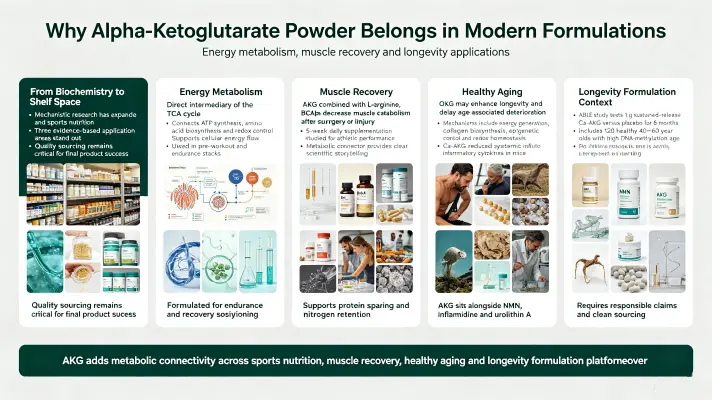
Why Alpha-Ketoglutarate Powder Belongs in Modern Formulations?
Shelf space isn’t just about safety. Mechanistic research has been expanding, and that has pushed AKG from a little player in a biochemistry textbook to a star element in longevity and sports nutrition. These are the three applications with the strongest evidence for the ingredient.
Energy Metabolism and Sports Nutrition
Alpha-ketoglutarate powder, a direct intermediary of the tricarboxylic acid (TCA) cycle, lies at the intersection of ATP synthesis, amino acid biosynthesis, and redox control. Alpha-ketoglutarate is a cell molecule involved in energy metabolism as an intermediary of the TCA cycle, and nitrogen and amino acid metabolism. For this mechanistic clarity sports companies mix AKG with L-arginine, BCAAs or B-complex vitamins in pre-workout and endurance stacks. A tiny research has showed that consuming alpha-ketoglutarate supplements daily for 5 weeks improved athletic performance. The ingredient’s function as a metabolic “connector” provides formulators with a scientific tale to tell customers, even if the impact magnitude is minor.
Muscle Recovery, Nitrogen Balance, and Post-Surgical Nutrition
One of the oldest and best-documented applications of alpha-ketoglutarate powder is to decrease muscle catabolism. Alpha-ketoglutarate appears to help prevent muscle breakdown after surgery or injury. This is the reason why for decades clinical nutrition businesses have been using ornithine alpha-ketoglutarate (OKG) in enteral formulations. The same process also benefits consumer brands in the “recovery” and “healthy aging” categories, where protein-sparing effects and nitrogen retention translate directly into consumer-friendly statements regarding lean mass maintenance.
Longevity and Healthy Aging Applications
Geroscience is the most interesting recent frontier for alpha-ketoglutarate powder. Experimental models of nematodes, fruit flies, yeasts and mice have shown that AKG supplementation may enhance longevity and delay the beginning of age-associated deterioration via pleiotropic mechanisms including energy generation, collagen biosynthesis, epigenetic control and redox homeostasis. In C57BL/6 mice, calcium AKG resulted in a longer and healthier life span with reduced systemic inflammatory cytokines. Investigators proposed that dietary AKG induces IL-10 to control chronic inflammation. Human translation is still early but active – the ABLE study randomises 120 healthy 40-60 year olds with high DNA-methylation age to either 1 g sustained-release Ca-AKG or placebo for 6 months intervention + 3 months follow-up. If you are a brand that wants to be in the longevity area, adding alpha-ketoglutarate powder to your formulation puts you in the same discourse as NMN, spermidine and urolithin A.
But knowing what the chemical does is half the battle. The other half, and possibly the more important part for procurement teams, is understanding how to acquire it without being stuck with a quality issue.
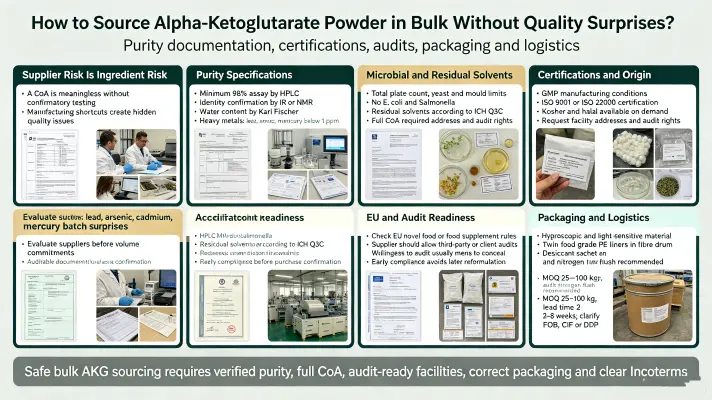
How to Source Alpha-Ketoglutarate Powder in Bulk Without Quality Surprises?
Supplier risk is ingredient risk. A 98% assay recorded on a Certificate of Analysis is meaningless if the CoA can’t be confirmed or if the manufacturing facility cuts corners on residual solvents. Here’s the checklist we suggest procurement teams use to evaluate potential AKG partners.
Purity Specifications and Analytical Documentation
Demand 98% minimum assay by HPLC, with a complete Certificate of Analysis supplied for each batch. A full CoA for alpha-ketoglutarate powder should include identity (IR or NMR), assay purity, water content (Karl Fischer), heavy metals (lead, arsenic, cadmium, mercury—all below 1 ppm), microbial limits (total plate count, yeast and mould, no E. coli and Salmonella), and residual solvents according to ICH Q3C guidelines. If a supplier is reluctant to provide a comprehensive CoA until after the purchase is confirmed, regard it as a red signal rather than a negotiating strategy.
Certifications, Manufacturing Origin, and Audit Rights
Good alpha-ketoglutarate powder manufacturers work under GMP conditions and are certified ISO 9001 or ISO 22000 and may provide kosher and halal certifications on demand for certain market channels. Request facility addresses, not simply corporate names. Check if the site is open to third-party or client audits. Suppliers who are willing to audit usually have less to conceal. For companies selling into the EU, checking compliance with EU innovative food or food supplement rules at the ingredient level avoids unpleasant reformulation later.
Packaging, Storage, and Logistics
The alpha-ketoglutarate powder is hygroscopic and light sensitive, therefore packaging matters for shelf life. Industry standard is twin food grade polyethylene liners within a fibre drum with desiccant sachet and nitrogen flush for quantities held beyond six months. The normal MOQ is 25kg-100kg, lead time is two to four weeks for in-stock material and six to eight weeks for custom particle sizes or private label packaging. Clarifying Incoterms (FOB, CIF or DDP) at the quote stage, avoids conflicts when the container hits customs.
Conclusion
Pharmaceutical-grade purity and adherence to dosing limits provide a solid clinical safety profile for alpha-ketoglutarate (AKG) powder, with minor gastrointestinal disturbances being the most reported adverse effect. But real safety in a B2B setting is more than toxicology, it is strict quality assurance, open supply chains and regulatory compliance. AKG provides brands and formulators attractive science-backed applications in sports nutrition, muscle rehabilitation and the rapidly growing longevity industry. The key to effectively commercialising this chemical is thorough supplier verification – requiring validated Certificates of Analysis, GMP production, and complete openness about sourcing and handling – to assure product purity, regulatory alignment, and consumer confidence.
FAQ
1. What is a safe daily dose of alpha-ketoglutarate powder?
Clinical studies have used doses ranging from about 1 gram to 6 grams per day in healthy adults, with 6 g/day cited as generally well tolerated in published reviews. Sports nutrition products commonly deliver 1–3 g per serving. Clinical or medical-food applications occasionally use higher amounts under professional supervision. Always confirm the final label dose with a qualified regulatory consultant for your target market.
2. Is alpha-ketoglutarate powder FDA approved?
No dietary supplement ingredient is "FDA approved" in the drug sense. The FDA has not evaluated alpha-ketoglutarate for specific disease claims, but it is legally sold as a dietary supplement ingredient in the United States when marketed in compliance with DSHEA. Manufacturers are responsible for the safety and correct labeling of finished products.
3. Who should avoid taking AKG?
Pregnant and nursing women should avoid it due to insufficient safety data. People with kidney disease should consult a physician before use because AKG participates in nitrogen metabolism. Anyone on prescription medications—particularly for diabetes or blood pressure—should also check with a healthcare professional.
4.Does alpha-ketoglutarate powder interact with other supplement ingredients?
Published research has not identified significant negative interactions with common supplement ingredients such as BCAAs, creatine, B-vitamins, or minerals. It is often formulated with L-arginine (as AAKG) or with calcium (as Ca-AKG). If your formula includes prescription-strength actives or unusual botanicals, request a compatibility review from your CDMO.
5. What is the difference between AKG, Ca-AKG, and AAKG powder?
Plain alpha-ketoglutaric acid is the free acid form. Ca-AKG is the calcium salt, which offers better stability and is the form used in most recent longevity trials. AAKG (arginine alpha-ketoglutarate) pairs AKG with L-arginine and is popular in pre-workout formulas. Choose the salt form that matches your target claim and delivery format.
Work with a Verified Alpha-Ketoglutarate Powder Manufacturer
Rebecca Bio-Tech supplies pharmaceutical-grade alpha-ketoglutarate powder (CAS 328-50-7, 98%+ HPLC) to supplement brands, contract manufacturers, and clinical nutrition companies across North America, Europe, and Asia-Pacific. Every batch ships with a full CoA, third-party heavy-metals report, and residual-solvent analysis. We operate three GMP-certified production lines with combined annual capacity above 500 metric tons, and our technical team supports customers on particle-size customization, stability data, and regulatory dossier preparation.
Ready to move forward?
· Request a free 50 g sample with full CoA to run your own incoming QC.
· Get a bulk quotation within 24 business hours—FOB, CIF, or DDP.
· Book a technical call with our formulation specialists to discuss stack compatibility.
Email: information@sxrebecca.com
References
1. Asadi Shahmirzadi, A., Edgar, D., Liao, C.-Y., et al. (2020). Alpha-Ketoglutarate, an Endogenous Metabolite, Extends Lifespan and Compresses Morbidity in Aging Mice. Cell Metabolism, 32(3), 447–456.e6.
2. Chin, R. M., Fu, X., Pai, M. Y., et al. (2014). The metabolite α-ketoglutarate extends lifespan by inhibiting ATP synthase and TOR. Nature, 510, 397–401.
3. Gyanwali, B., Lim, Z. X., Soh, J., et al. (2022). Alpha-Ketoglutarate dietary supplementation to improve health in humans. Trends in Endocrinology & Metabolism, 33(2), 136–146.
4. Bayliak, M. M., & Lushchak, V. I. (2021). Pleiotropic effects of alpha-ketoglutarate as a potential anti-ageing agent. Ageing Research Reviews, 66, 101237.
5. Wu, N., Yang, M., Gaur, U., Xu, H., Yao, Y., & Li, D. (2016). Alpha-Ketoglutarate: Physiological Functions and Applications. Biomolecules & Therapeutics, 24(1), 1–8.
6. Demidenko, O., Barardo, D., Budovskiy, V., et al. (2021). Rejuvenant effects of natural alpha-ketoglutarate (AKG) on biological age and clinical parameters. Aging, 13(22), 24485–24499.