Is fucoxanthin an antioxidant?
fucoxanthin extract is known as a natural antioxidant. It is a marine carotenoid which is predominantly found in brown seaweeds such as Laminaria japonica, Undaria pinnatifida, and various types of microalgae. Fucoxanthin has been demonstrated by research to be able to quench reactive oxygen species (ROS) and contribute to the body’s antioxidant defence mechanism.
However, it is not enough to consider fucoxanthin just as an antioxidant. This unique marine substance is of great interest to scientists because to its unusual chemical structure, possible metabolic advantages, and increasing usage in nutritional supplements, functional meals and cosmetic preparations.
To understand the reasons for the fucoxanthin craze, it would be good to look at the structure of fucoxanthin and how it relates to antioxidant activity.
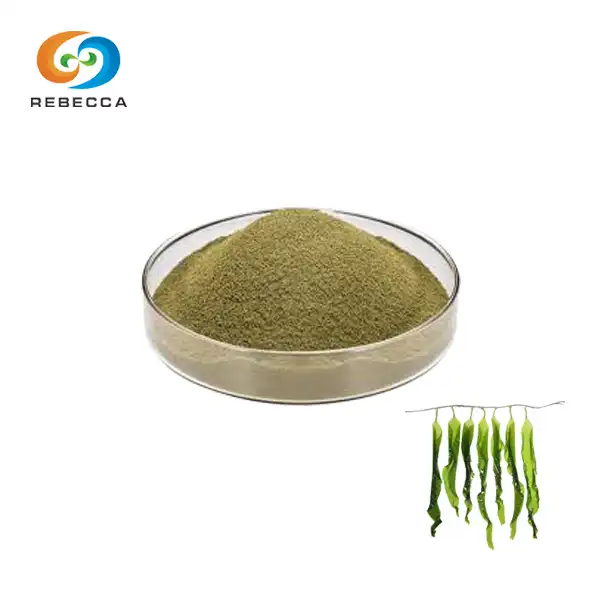
Fucoxanthin Extract
【English name】: Kelp Extract
【Latin Name】: Laminaria japonica.
【CAS No.】: 3351-86-8
【Molecular Formula】: C42H58O6
【Active ingredients】: Fucoxanthin,Fucoidan sulfate, Laminarin /Laminaria japonica polysaccharides /Kelp Polysaccharides.
【Specification】: Fucoxanthin 5%~50% UV; Fucoidan sulfate 10%~95% GC; Kelp Polysaccharides 10%~95% UV.
【Use Part】 : Laminaria japonica thallus.
【Appearance】: Fucoxanthin(Brown green yellow powder);Fucoidan(Off-white to light yellow powder);Kelp Polysaccharides(Brown yellow to white powder)
【Mesh size】:80 Mesh
【Test Method】:UV,GC.
Fucoxanthin Antioxidant Properties
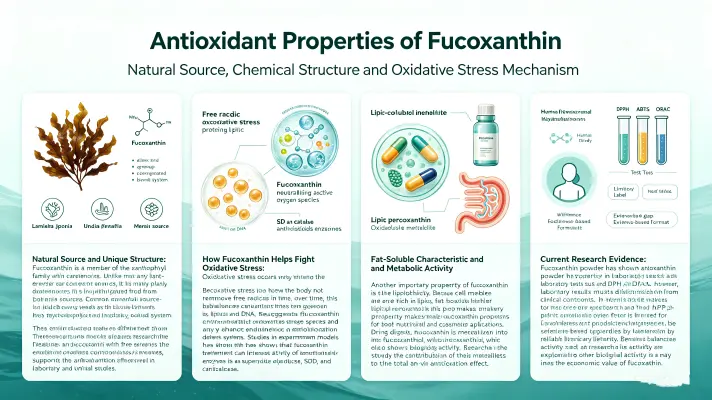
Natural Sources and Distinctive Structure
Fucoxanthin is a member of the xanthophyll family of carotenoids. It is acquired mostly from marine species, unlike many carotenoids from plants. Some of the most commercial sources are brown seaweeds such as Laminaria japonica and Undaria pinnatifida.
One of the reasons fucoxanthin is special is its chemical structure. It has a unique allenic bond, an epoxide group and an extensive system of conjugated double bonds. These structural properties distinguish it from more recognised carotenoids such as beta-carotene and lycopene.
Researchers think these features help the chemical interact with free radicals and oxidative compounds. Thus, fucoxanthin has shown antioxidant efficacy in several laboratory and animal experiments.
How Fucoxanthin Helps Combat Oxidative Stress?
If the body can’t keep up with neutralising free radicals , then oxidative stress arises . Such imbalance damages proteins, lipids and DNA over time.
Research indicates fucoxanthin might aid in fighting oxidative stress in a number of ways. It may directly scavenge reactive oxygen species and may also enhance endogenous antioxidant defences. Studies have indicated that treatment of experimental models with fucoxanthin boosted the activity of antioxidant enzymes such as superoxide dismutase (SOD) and catalase.
Another essential property is its lipid solubility. Lipid peroxidation may be inhibited by antioxidants that are soluble in lipids, as cell membranes are rich in lipids. The property has been of interest for both nutritional and cosmetic uses.
In digestion, fucoxanthin is metabolised to fucoxanthinol, which likewise demonstrates biological action. The contribution of these metabolites to the total antioxidant effects found in vivo is still under investigation by researchers.
What Current Research Indicates?
fucoxanthin powder has showed antioxidant properties in laboratory tests such as DPPH, ABTS and ORAC. It is necessary, however, to differentiate between test findings and clinical results.
In vitro studies have repeatedly shown antioxidant action, however human trials are more restricted. Recent clinical investigations show that fucoxanthin may be effective in reducing indicators of oxidative stress, but more comprehensive clinical research are required to identify the appropriate dose and long-term effects.
This balanced approach is valuable to formulators and product developers seeking evidence-based components with reputable scientific literature backing.
In addition to antioxidant action, researchers have also investigated numerous additional biological activities of fucoxanthin that could contribute to its increasing economic worth.
Potential Health Benefits Beyond Antioxidant Activity
Metabolic Health and Weight Management Research
Metabolic health is among the most debated topics of fucoxanthin study. Several works were studying its impact on energy metabolism and control of fat.
Experimental studies have shown that fucoxanthin may impact the production of uncoupling protein 1 (UCP1), a protein involved in thermogenesis. This mechanism is of interest since it is not like stimulant-based compounds for weight control.
A few human studies have shown decreases in body weight and belly fat when fucoxanthin was included of a larger dietary intervention. However, the data is preliminary, and outcomes may vary according on the dose, research design, and characteristics of the participants.
Therefore, fucoxanthin should not be considered a miracle product for weight-loss. Instead, it might be part of a holistic wellness plan.
Inflammation and Cellular Protection
Oxidative stress and inflammation are closely related biological processes. Thus, the ability of fucoxanthin to modulate inflammatory pathways has been investigated apart from its antioxidant activity.
Preclinical investigations have shown that fucoxanthin can modulate the expression of several inflammatory mediators. There are several possible connections with pathways related to cytokine generation and cell signalling that have been noticed by scientists.
While these discoveries are intriguing, much of the information so far is from laboratory and animal research. More human study is needed before any clear health claims can be made.
Applications in Skin Health
Fucoxanthin has also received a growing attention from the beauty sector. Ultraviolet light, an environmental stressor, may cause oxidative damage in the skin.
Research indicates that the antioxidant action of fucoxanthin may assist to aid skin protection. Some studies have also researched its possible impact on collagen preservation and pigmentation processes.
These results have led to the creation of skin care products from the sea that include standardised fucoxanthin extracts. However, effectiveness might be dependent on quality of formulation, concentration and delivery mechanism.
Manufacturers should take into account practical formulation obstacles and quality control issues while dealing with fucoxanthin, with a growing research interest.

Why Is Fucoxanthin Continually Gaining Market Attention?
Growing Interest in Marine-Derived Ingredients
Consumers are increasingly looking for components that are considered as natural, sustainable and science-backed. Marine-based bioactive chemicals satisfy several of these wishes.
Fucoxanthin powder is in a unique position to profit from this development. It blends a recognisable natural source with a rising scientific literature from antioxidant activity to metabolic health to skin wellbeing.
Versatility Across Product Categories
One of the benefits of fucoxanthin is that it is applicable in several sectors. It is used by dietary supplement producers in capsules, softgels and powdered forms. Functional food producers are investigating its usage in nutritious goods and wellness drinks. Cosmetic companies use fucoxanthin to make anti-aging and protective skin care products.
This flexibility enables organisations to use a single ingredient platform across several product categories while yet keeping a consistent science-based marketing message.
What Buyers Should Consider Before Sourcing?
Not all fucoxanthin constituents are the same. There is a wide variation in source material, extraction processes, standardisation and quality control which might result in quite different products in terms of performance.
Buyers should seek for analytical transparency, regulatory paperwork, production capability and long-term supply stability while selecting providers. Often these characteristics will be more important to commercial success than pricing alone.
Premium health and wellness companies are increasingly seeking suppliers that can ensure consistent quality, provide technical assistance, and give verifiable sourcing information.

Conclusion
Fucoxanthin powder is a well-known natural anti-oxidant obtained mostly from brown seaweed and marine microalgae. Scientific research shows that it may aid to neutralise reactive oxygen species and may help promote antioxidant defence systems. These properties have also been studied for possible benefits to metabolic health, inflammatory control and skin health.
Although several results are encouraging, continuous clinical research is required to better elucidate appropriate uses and long-term advantages in people. The value for manufacturers and formulators is not just in the antioxidant effects of fucoxanthin, but also in its adaptability as a multifunctional marine-derived ingredient backed by a growing body of scientific data.
FAQ
How does fucoxanthin powder compare to synthetic antioxidants in efficacy?
Compared with many synthetic antioxidants, fucoxanthin from marine sources has better free radical scavenging ability, the ORAC value is larger, and it has more functions than simple antioxidants. Consumers like its natural origin because it fits their clean-label tastes, and it has metabolic and anti-inflammatory properties that synthetic substances lack.
Are there potential side effects or interactions buyers should consider?
Clinical data suggest great tolerability at dietary dosages up to 8 mg/day. People who are taking anticoagulants should check with their healthcare providers; there are possible interactions with blood thinning, but no adverse effects have been reported in investigations. Suppliers should offer safety data sheets to help risk assessments for the target population.
How can procurement teams verify product quality and authenticity?
Ask for batch-specific Certificates of Analysis from ISO-accredited labs showing active content using UV or HPLC techniques. Third-party testing for heavy metals, pesticides and microbiological pollutants confirms compliance. Manufacturing controls to avoid adulteration are validated by supplier site audits or reputable third-party certifications (GMP, HACCP, ISO 22000).
Partner with Rebecca for Premium Fucoxanthin Powder Supply
Rebecca has the entire solutions for procurement managers looking for dependable fucoxanthin powder supply with technical superiority and regulatory compliance. Rebecca, a Shaanxi, China-based company with over 500 MTS of annual production capacity, has world-leading extraction facilities for kelp extract standardised to 5-50% fucoxanthin concentration by UV spectrophotometry. Our GMP-compliant, ISO 22000-certified facility guarantees batch uniformity needed for long-term product stability. Customisation in purity grades, comprehensive documentation packages (including CoAs and stability studies), and OEM partnerships with formulation development experience are available. Our procurement teams like the flexibility of MOQs, the price transparency on bulk purchases and the full logistical coordination (FOB/CIF/DDP terms). Rebecca is the preferred provider of fucoxanthin powder to distributors, nutritional supplement makers and cosmetic firms in North America, Europe and Asia-Pacific. To obtain product catalogues, specification sheets and samples for your formulation needs, contact our technical staff at information@sxrebecca.com or visit sxrebecca.com.
References
1. Miyashita K, Hosokawa M. Fucoxanthin in the management of obesity and its related disorders. Journal of Functional Foods. 2017;36:195-202.
2. Peng J, Yuan JP, Wu CF, Wang JH. Fucoxanthin, a marine carotenoid present in brown seaweeds and diatoms: metabolism and bioactivities relevant to human health. Marine Drugs. 2011;9(10):1806-1828.
3. Maeda H, Hosokawa M, Sashima T, Funayama K, Miyashita K. Fucoxanthin from edible seaweed, Undaria pinnatifida, shows antiobesity effect through UCP1 expression in white adipose tissues. Biochemical and Biophysical Research Communications. 2005;332(2):392-397.
4. Heo SJ, Yoon WJ, Kim KN, Ahn GN, Kang SM, Kang DH, et al. Evaluation of anti-inflammatory effect of fucoxanthin isolated from brown algae in lipopolysaccharide-stimulated RAW 264.7 macrophages. Food and Chemical Toxicology. 2010;48(8-9):2045-2051.
5. Shimoda H, Tanaka J, Shan SJ, Maoka T. Anti-pigmentary activity of fucoxanthin and its influence on skin mRNA expression of melanogenic molecules. Journal of Pharmacy and Pharmacology. 2010;62(9):1137-1145.
6. Xia S, Wang K, Wan L, Li A, Hu Q, Zhang C. Production, characterization, and antioxidant activity of fucoxanthin from the marine diatom Odontella aurita. Marine Drugs. 2013;11(7):2667-2681.