Is L carnitine good for your body?
l carnitine powder is one of the most discussed chemicals in the fitness and health world. Brands selling it as a supplement hawk it as a fat burner, energy enhancer, and brain protector. But what does science actually tell us? Here’s how L-carnitine works, the benefits that are actually supported by research, the safety record and some practical recommendations if you are thinking of taking it.
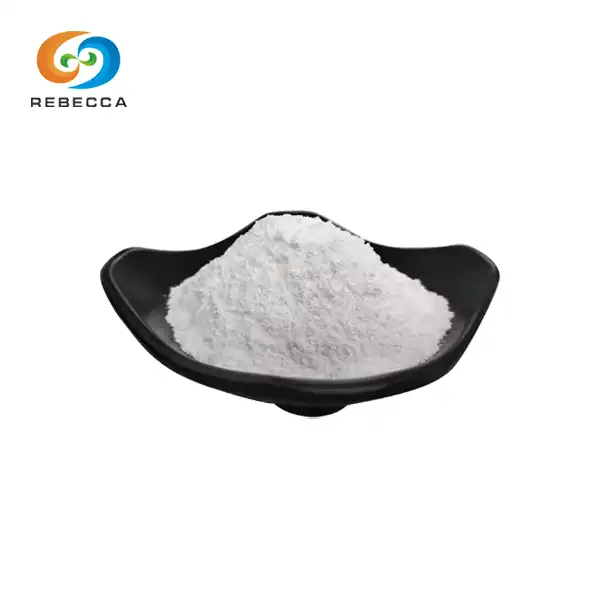
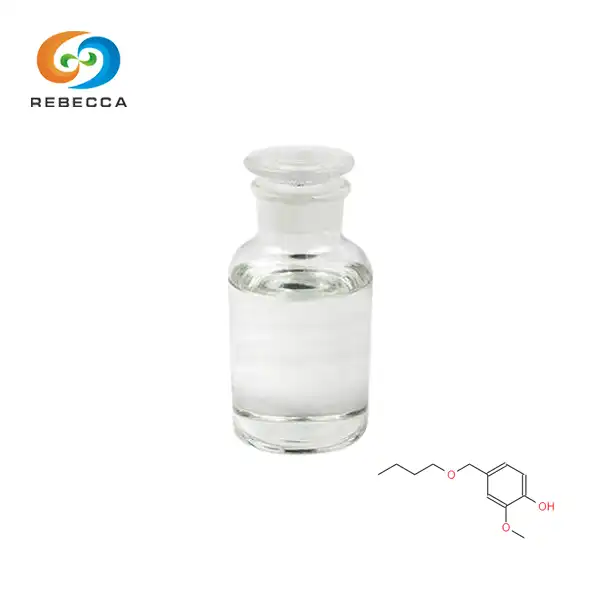
L Carnitine Powder
Product Name:L-carnitine
CAS No.:541-15-1
Specifications :L(-)-Carnitine,Min 99%
Test :HPLC
Appearance :White crystalline Powder
Applying:The safest nutritional supplement for weight loss without side effects.
What L-Carnitine Does Inside Your Body?
Before you decide if L-carnitine is “good” for you, it’s helpful to know what it works at the cellular level. The story starts in your mitochondria, the microscopic powerhouses of every cell that turn fuel into useful energy.
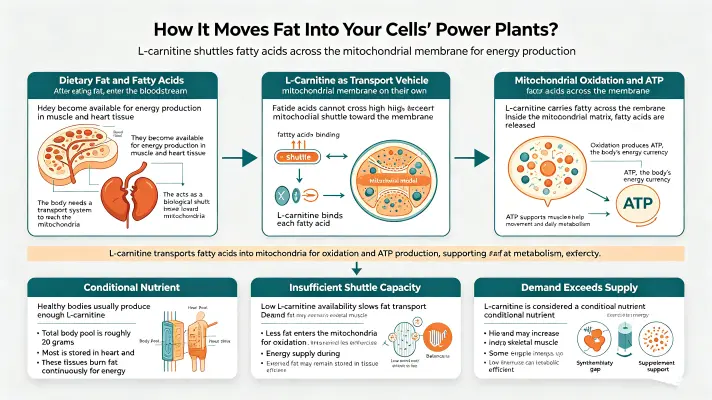
How It Moves Fat Into Your Cells' Power Plants?
Your body holds roughly 20 grams of L-carnitine, predominantly in heart and skeletal muscle (Rebouche & Seim, 1998). Sounds reasonable enough. These tissues burn fat all day long, 24/7, providing sustainable energy.
Here’s the mechanism, in simple terms. When you eat fat, the fatty acids go into your blood. They have to go into the mitochondria and burn them up for energy. But fatty acids can’t cross the mitochondrial membrane on their own. L-carnitine is the transport vehicle. It binds each fatty acid, shuttles it over the membrane and releases it inside where the cell may oxidize it and make ATP – the energy currency of your body.
If you don’t have enough L-carnitine, that shuttle slows down. The fat that should be burnt stays stored. This is why researchers term L-carnitine a “conditional nutrient” – most healthy people produce enough, but when demand exceeds supply, performance and metabolism might be compromised (Pekala et al., 2011).
Three Forms, Three Different Jobs
Not all L-carnitine on the shelf is the same. Three forms dominate the market, and each suits a different purpose.
|
Form |
Key Trait |
Best For |
|
L-Carnitine (base) |
Highly water-soluble |
Liquid supplements, drinks, general metabolic support |
|
Acetyl L-Carnitine |
Crosses blood-brain barrier |
Cognitive health, mental clarity, nootropic blends |
|
L-Carnitine Tartrate |
Stable in powder format |
Sports nutrition, muscle recovery, capsule products |
The acetyl form costs more because that extra acetyl group lets it reach the brain. If your goal is fat metabolism or exercise performance, the base form or tartrate works just fine and saves money. If you are targeting cognitive health, acetyl is the smarter choice.
So L-carnitine powder clearly plays a biological role. But does taking it as a supplement actually deliver measurable benefits? That is where the evidence gets more nuanced.
The Real Benefits (And Where the Evidence Stands)
It is easy to find bold claims about L-carnitine online. Some are backed by solid data. Others are overstated. Here is a benefit-by-benefit breakdown with the research behind each one.
Fat Burning and Weight Management
L-carnitine helps your body burn more fat by letting fatty acids enter mitochondria. That's a real mechanism. But does supplementing actually result in fat loss?
M-Clinical trials demonstrate small impact. L-carnitine administration may shift the body towards utilizing fat for energy instead of stored glucose, particularly during exercise (Karlic and Lohninger, 2004). The catch: the results are all over the place. Those with lower baseline levels of carnitine tend to respond better. The already saturated get not much more advantage.
N-The lesson is honest: L-carnitine is a metabolic aid, not a miraculous medication. It works best along with calorie awareness and regular physical activity. The fat-loss effect alone is tiny – usually a few percent improvement over months, not weeks.
Energy and Exercise Performance
Two reasons why athletes like L-carnitine. First you burn fat during activity and so spare your glycogen stores. So you can keep going longer before you hit "the wall". 2. Better recovery after workout. Studies have shown that supplementation decreases indicators of muscle injury and accelerates lactate clearance (Brass, 2000).
Timing is everything. Taking L-carnitine 30-60 minutes before workout allows the body time to absorb it, and start shuttling fatty acids. Doses post-workout instead promote recuperation. Some athletes mix it with BCAAs or electrolytes for more overall assistance, although L-carnitine alone already handles the fat-to-energy pathway.
Heart Health
Your heart muscle is almost entirely running on fatty acid oxidation. This makes enough L-carnitine levels important for the heart to function properly. Supplementation in patients with heart diseases (e.g. angina and post-heart-attack recovery) has been shown to increase exercise tolerance, and lessen episodes of chest pain (Flanagan et al., 2010).
The cardiovascular advantage is less striking for persons who are otherwise healthy. Your heart needs energy to work and L-carnitine helps provide that energy, but taking more than your body already produces doesn’t seem to offer any further protection. This is an area in which further large-scale, long-term investigations are needed.
Brain Function and Mental Clarity
And this is where the cognitive narrative becomes intriguing. Acetyl L-carnitine. It passes the blood brain barrier and goes straight to neurons. And it has three roles there: it helps make acetylcholine, a vital neurotransmitter; it protects brain cells from oxidative stress; and it keeps mitochondria ticking along inside neurons.
In a significant study by Malaguarnera and coworkers (2007), 104 centenarians were given 2 grams of acetyl L-carnitine daily for 6 months. The result was a significant reduction in mental tiredness levels and an increase in cognitive test scores. It was a double-blind, placebo-controlled trial – the research design gold standard.
The data is very sparse for younger, healthier persons. Some tiny trials show increased focus, lower mental tiredness. However, big confirmatory trials are still missing. It can be used with omega-3s or phosphatidylserine for brain support. Acetyl L-carnitine These target various neural circuits, and may perform better when used jointly.
The picture on benefits is mixed: actual mechanisms, some good clinical data, and plenty of places where the research is still playing catch-up to the marketing. Before you decide whether L-carnitine is good for you, you need the other half of the tale – the safety profile and the hazards most articles ignore.

Safety, Side Effects, and Who Should Think Twice
L-carnitine powder has a strong safety record at standard doses. But no supplement is risk-free. Here is what you should know before reaching for the bottle.
What Happens at Normal and High Doses?
The usual supplement dose is 500–2,000 mg daily. Side effects are rare and moderate in this window. Some persons get mild nausea or stomach upset, particularly with doses higher than 1,500 mg or if taken on an empty stomach. This is frequently adjusted by dividing the dose into two or three servings.
Gastrointestinal discomfort is more likely at very high doses (more than 3,000 mg/day). There are also occasional complaints of a fishy body odor, a result of the way the body metabolizes extra carnitine. It is a harmless but socially awkward smell.
Groups That May Need More (or Less)
Most healthy humans produce sufficient L-carnitine from the amino acids lysine and methionine with the help of iron, vitamin C, vitamin B6 and niacin. But some groups fall short.
Preterm newborns are not able to synthesize yet. Therefore, hospital formulas regularly add L-carnitine. Strict vegetarians and vegans obtain less from diet alone, as the richest food sources are meat and dairy. People on long term renal dialysis lose carnitine during therapy and often need supplements.
On the caution side, those with seizure problems should first consult to a doctor. This group has limited safety data. Pregnant and lactating women should also avoid self-supplementation, as clinical safety studies have not been performed in these populations.
The TMAO Debate — A Risk Worth Knowing
This is what most L-carnitine writings forget. In 2013 Koeth and colleagues published a study in Nature Medicine demonstrating that L-carnitine is metabolized by gut bacteria to produce trimethylamine-N-oxide (TMAO). higher blood levels of TMAO have been associated with higher cardiovascular risk in several population studies.
That nuance is important. This effect is very dependent on your gut microbiota. Vegans and vegetarians produce less TMAO from L-carnitine than omnivores because their gut microbes are used to digesting carnitine-rich meals. An omnivore would make a lot more TMAO than a vegan using L-carnitine.
This doesn’t mean L-carnitine powder is hazardous for everyone. But it does mean that the question “Is L-carnitine good for your body?” cannot be answered simply in the affirmative. It is contingent upon your own microbiome, your dietary pattern and your health history. If you have heart disease, consider this risk with your cardiologist before you start supplementing.

Conclusion
Carnitine is an amino acid that is found in the body and is used to convert fat into energy. It is also used to treat heart disease, muscle disease, and some other conditions. Carnitine is available as a supplement and can be taken by mouth. Carnitine is also found in some foods, such as red meat, dairy products, and some fish. Carnitine is also available in a topical form that is applied to the skin. Carnitine is generally considered safe, although it can cause side effects such as nausea, diarrhea, and vomiting. Carnitine should not be taken by people with certain medical conditions, such as kidney disease or liver disease. The honest answer: it depends. The chemical has a true, well-documented function in fat metabolism and cellular energy. Clearly supplementation helps for those who are lacking - premature infants, dialysis patients, strict vegans. For healthy individuals, the benefits are real, but small. You’re not going to shed 10 lbs in a month. You don’t wake up one morning running a faster marathon. However, when used consistently and with realistic expectations, L-carnitine can be a beneficial addition to a broader health plan.
FAQ
Which form of L-carnitine should I take?
It depends on your goal. For brain health, use Acetyl L-Carnitine — it crosses the blood-brain barrier. For sports or fat metabolism, the base form or tartrate works great and costs less. Don't chase "best absorption." Pick the form that matches what you actually want to achieve.
Are there serious side effects?
At 500–2,000 mg per day, side effects are rare and mild — mostly stomach discomfort at higher doses. Splitting your dose across the day usually solves it. People with seizure disorders should check with a doctor first. Pregnant and nursing women should avoid it unless prescribed.
Can L-carnitine cause heart problems through TMAO?
Some research links L-carnitine metabolism to TMAO, a compound associated with cardiovascular risk. The effect varies by gut microbiome — meat eaters produce more TMAO than vegans do. If you have heart disease, discuss this with your cardiologist before supplementing.
Partner with Rebecca for Premium L-Carnitine Supply
Rebecca provides pharmaceutical grade carnitine tartrate to suit the stringent needs of worldwide supplement makers and functional beverage formulators. The purity of our white crystalline powder is at least 99% (HPLC) and CAS number 541-15-1 for exact matching of specifications. In our Shaanxi production base, we have three dedicated production lines with a yearly capacity of over 500 metric tons to service new companies and established industry leaders who want reliable, scalable supply.
Our technical team offers complete formulation support, stability testing guidance and regulatory documentation to help ensure seamless product registrations in North American, European and Asia-Pacific markets. We are GMP and ISO certified, ensuring batch-to-batch consistency and quality assurance across our production processes. For weight management supplements, sports nutrition items or functional beverages, we can adapt to your specific needs with our flexible MOQ policies and bespoke purity parameters.
To talk about your L-carnitine powder supplier needs, get in touch with our procurement professionals at information@sxrebecca.com. We provide cheap bulk order prices, full documentation packages for international compliance, and logistics solutions for on-time delivery while maintaining product integrity. See our full array of botanical extracts at sxrebecca.com and how our R&D expertise may help shorten your product development timeline while maximizing formulation performance.
References
1. Rebouche, C. J., & Seim, H. (1998). Carnitine metabolism and its regulation in microorganisms and mammals. Annual Review of Nutrition, 18(1), 39–61.
2. Pekala, J., Patkowska-Sokoła, B., Bodkowski, R., et al. (2011). L-carnitine — metabolic functions and meaning in human life. Current Drug Metabolism, 12(7), 667–678.
3. Karlic, H., & Lohninger, A. (2004). Supplementation of L-carnitine in athletes: does it make sense? Nutrition, 20(7–8), 709–715.
4. Brass, E. P. (2000). Supplemental carnitine and exercise. The American Journal of Clinical Nutrition, 72(2), 618S–623S.
5. Malaguarnera, M., Cammalleri, L., Gargante, M. P., et al. (2007). L-Carnitine treatment reduces severity of physical and mental fatigue and increases cognitive functions in centenarians: a randomized, double-blind, placebo-controlled study. The American Journal of Clinical Nutrition, 86(6), 1738–1744.
6. Koeth, R. A., Wang, Z., Levison, B. S., et al. (2013). Intestinal microbiota metabolism of L-carnitine, a nutrient in red meat, promotes atherosclerosis. Nature Medicine, 19(5), 576–585.