Is Vitamin B12 Fat Soluble?
Cobalamin, or vitamin B12 is a water-soluble vitamin. Water-soluble vitamins dissolve easily in water. Fat-soluble vitamins (A, D, E and K) are stored in the human body’s liver and fatty tissues for lengthy periods of time. The body only absorbs what it needs. It then eliminates the surplus by urination. That fundamental biological reality is well known to customers. However, for B2B customers, such as pharmaceutical formulators and nutraceutical procurement teams, this solubility feature may determine everything from formulation stability to production methods.
The first step toward the effective creation of high quality dietary supplements is to convert the biological science of solubility into practical formulation techniques. Next, we will look at the effect of water solubility on product development.
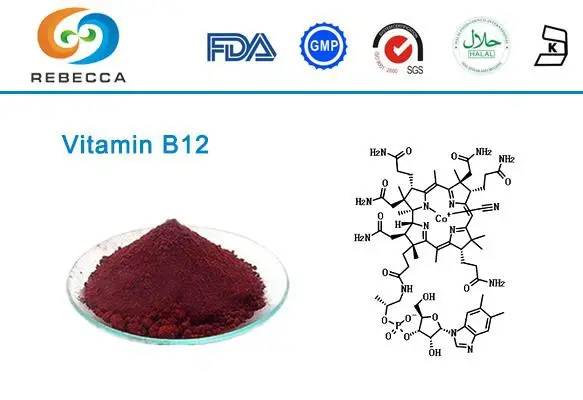
1. Product Name:Vitamin B12 (Cyanocobalamin)
2. CAS No.:68-19-9
3. Specification: 99%
4. Test Method: HPLC
Solubility: What Formulators Need to Know
Water-Soluble vs. Fat-Soluble Characteristics
The water solubility determines how a nutrient acts within the human body and inside a mixing vat. Fat-soluble vitamins also need lipid carriers, such as oils or fats, to be absorbed efficiently in the human digestive system. They also need emulsifiers when included into liquid health products. Vitamin B12 is a whole separate thing. It dissolves directly in watery settings. In the human body this means it may be quickly absorbed in the small intestine after it attaches to a stomach glycoprotein called intrinsic factor. For industrial formulators this means you can forget about the complicated oil-based delivery methods. Manufacturers may use premium vitamin b12 powder to produce clean-label goods. No artificial emulsifiers are required to maintain the active ingredient in suspension inside the mix. This is a very desirable feature for firms making clear protein drinks, hydration multipliers and vegan nutritional shakes. The body metabolises it fast, requiring daily consumption, which fuels ongoing consumer demand for B12 supplements.
How Aqueous Environments Affect Formulation
One key benefit of liquid goods is that they are water soluble, but this also presents some distinct obstacles. Water-soluble substance formulation demands stringent management of the environment. Cyanocobalamin is very stable in the dry, crystalline form. But when it meets a liquid matrix, it is open to attack. The vitamin molecule is rapidly degraded by direct UV radiation, high temperatures and severe pH. This deterioration diminishes the nutritional efficacy of the substance. This decrease in effectiveness should be expected by manufacturers. High quality vitamin b12 powder needs protective procedures in the production process. Many facilities use micro-encapsulation or spray-dried methods. These techniques wrap the sensitive vitamin particles, providing protection from moisture and light throughout the tableting or capsule-filling process. Formulators need opaque packaging for liquid shots and functional drinks. You also require buffers to keep the pH at an optimum. It is usual practice to include a 10% to 15% formulation overage. This overage helps to guarantee the product still satisfies its label promises at the end of its 24 month shelf life.
It’s merely the first step to knowing these water-soluble features. The translation of this chemistry to large-scale manufacturing involves the actual physical handling and processing of the raw material on the factory floor.
Industrial Manufacturing and Handling Applications
Achieving Dosage Precision and Blend Uniformity
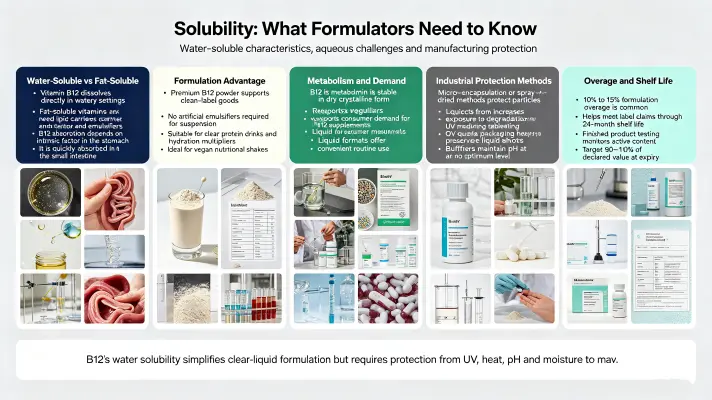
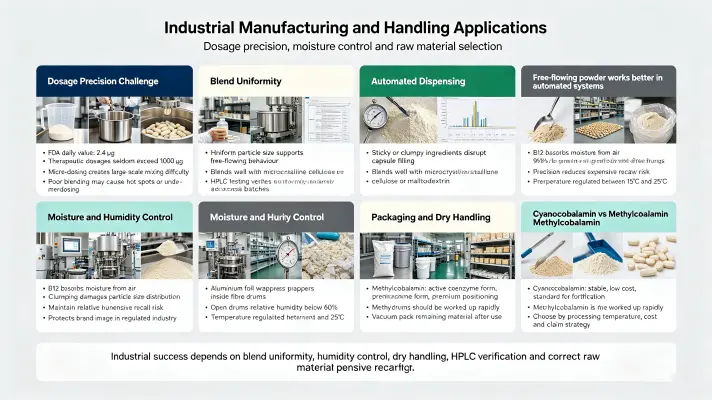
Dietary supplements should be dosed properly. For healthy people, the FDA daily value for Vitamin B12 is just 2.4 micrograms. Therapeutic dosages seldom surpass 1000 micrograms. The micro-dosing poses a massive mixing difficulty at an industrial scale. It is quite difficult to have a uniform dispersion in a 1,000 kilogram batch of multivitamin mix. Poor blending may cause “hot spots” where one capsule has 5,000 micrograms and another has none. Here, it is vital to choose a very refined vitamin b12 powder. The crystalline structure is 99 % pure with a uniform particle size. The homogeneous size of the active ingredient enables it to free flow and blend uniformly with conventional excipients like microcrystalline cellulose or maltodextrin. Automated dispensing systems work significantly better with free-flowing powder than with sticky or clumpy ingredients. HPLC (High Performance Liquid Chromatography) testing verifies proper mixing techniques and uniformity across batches. This accuracy helps avoid expensive recalls and protects your brand’s image in a highly regulated industry.
Overcoming Stability and Moisture Challenges
B12 likes water, therefore it will naturally suck moisture from the air. This makes humidity management in the plant a top concern. Clumping will occur when the raw material absorbs excessive ambient moisture during storage. Clumping damages particle size distribution and throws automated capsule-filling technology out of whack. Plant managers must guarantee that every facility that handles vitamin b12 powder maintains a relative humidity below 60% (relative humidity). The temperature should be regulated between 15 °C and 25 °C. Packaging is just as crucial. Premium vendors distribute bulk powder in double-layered, medical grade, static-free bags. The bags are then wrapped in aluminium foil wrappers and put into strong fibre drums. Once a barrel is opened on the factory floor the material has to be worked up rapidly. Staff have to use certain dry scoops to avoid cross-contamination. Any remaining raw material should be quickly vacuum packed. Strict compliance to these dry-handling guidelines improves the shelf life of the item to 36 months, reducing raw material waste and increasing your bottom line.
Choosing Between Cyanocobalamin and Methylcobalamin
There are generally two main ways in which procurement teams might get this vitamin. Cyanocobalamin is a man-made form. It is very stable, inexpensive and the industry standard for food fortification. The trace cyanide molecule connected to it is physiologically safe and quickly metabolised by the human body. Methylcobalamin is the active, naturally occurring coenzyme form. It needs no biological conversion, which is very enticing to premium supplement manufacturers for customers with certain genetic abnormalities (such the MTHFR mutation). Methylcobalamin is far more susceptible to light and moisture, however. It is also substantially more costly You have to consider these considerations while buying vitamin b12 powder. The workhorse ingredient is cyanocobalamin. It can withstand extreme processing settings such as gummy production and hot-fill beverage lines. Methylcobalamin is better suitable for high-end, two-piece hard capsules or sublingual tablets when processing temperatures are low. What you decide here will directly impact your cost of manufacturing and how you will price your goods for sale.
Once the R&D team has worked out the formulation mechanics and found the proper form, the next obstacle is to provide a dependable, transparent and economically feasible supply chain.
Strategic Sourcing and Quality Assurance for Manufacturers
Evaluating Global Supply Chains and Production Capacities
Synthetic B12 is produced on an international basis using highly specialised microbial fermentation. This is no easy chemical synthesis. That involves growing certain strains of bacteria in enormous bioreactors and then subjecting them to stringent purifying methods. You must evaluate your supplier’s real manufacturing capabilities as a B2B customer. Because the worldwide need for pure B12 is only in tonnes, because of the microgram dose, the plant has to be quite sophisticated to provide pure yields. Rebecca runs a cutting-edge laboratory for precise extraction and purification. We run large amounts of substrate via our fermentation and finishing lines to create highly concentrated APIs at 99% purity. If you’re securing your supply of vitamin b12 powder, you need a partner that can ensure constant allocation. Supply chain interruptions, raw material shortages and shipment delays may grind your whole manufacturing line to a standstill. When you choose an experienced manufacturer with many manufacturing lines, your raw materials will arrive on time, every time. Ask your supplier about lead times, minimum order quantities (MOQs) and whether they can ramp up delivery if your retail sales surge.
Certifications and Analytical Testing Standards
Documentation is just as crucial in the nutraceutical business as the actual ingredient. A cheap price per kilo is meaningless if the raw material does not pass third party laboratory testing. Trustworthy manufacturing partners, not dodgy commodities brokers, are differentiated by quality control. Every batch of vitamin b12 powder you purchase should be accompanied by a full Certificate of Analysis (COA). This COA should confirm HPLC testing for assay purity of 98.0% to 102.0%. It should also include particular threshold findings for heavy metals. Limits for lead, arsenic, cadmium and mercury should meet with rigorous USP or EP pharmacopoeia requirements. Furthermore, microbiological safety standards should be negative for pathogens such as E. coli and Salmonella . Vegan certification is no longer a choice, it is a must, with the increasing popularity of plant-based diets. True synthetic B12 is vegan by nature, but your provider must guarantee that no animal-derived processing aids were utilised during fermentation. If you are a pharmaceutical manufacturer, verify your supplier offers Drug Master File (DMF) assistance to help speed up your regulatory clearance process.
Pricing Dynamics and Purchasing Models
Prices for raw materials may change due to worldwide energy prices, availability of fermentation substrates and shipping constraints. However, cyanocobalamin is still the most cost-effective for large market manufacturing. Methylcobalamin is often 30-50% more expensive. Strategic buying models are used by smart procurement teams to manage expenses. You will pay far less for quality vitamin b12 powder when you purchase it in large amounts (usually 25kg drums) than if you were to buy 1kg or 5kg batches. We strongly encourage concluding long-term supply contracts. Such arrangements provide favourable pricing and inventory allocation in the event of market shortages. You will also want to explicitly specify your shipping conditions. FOB (Free On Board), CIF (Cost, Insurance and Freight) and DDP (Delivered Duty Paid) are terms you need to know. You can compute the real landing cost of your raw materials. Having a manufacturer that can provide flexible MOQs during your initial R&D phase, and significant volume reductions throughout commercial scale-up, gives your organization a unique competitive edge.
Conclusion
In essence, vitamin b12 powder is a water-soluble vitamin. This basic biological fact determines all aspects of industrial handling. For the B2B manufacturer, this knowledge of solubility is the key to developing stable, effective and lucrative health solutions. The ability to deal with high quality raw materials is critical, from preventing moisture concerns on the floor to obtaining accurate microgram mix consistency. Cyanocobalamin is the most stable and cost effective for mass market fortified foods and multivitamin complexes. Methylcobalamin is for the premium, bio-active supplement market. Regardless of the form you pick, diligent quality assurance, thorough COA documentation, and dependable worldwide sourcing are the cornerstones of a successful product launch. Working with a transparent, GMP-certified manufacturer helps you secure your supply chain and ensures that your final goods give the precise nutrition your customers want.
FAQs
1.Why would large-scale supplement manufacturers rather use Vitamin B12 powder than liquid bulk?
Bulk liquid suspensions are less chemically stable and have a much shorter shelf life (up to 36 months) compared to powder forms. Powder removes the substantial water weight that must be sent, thereby cutting freight costs. This enables formulators complete control over the excipients and buffering agents that are included in the final product.
2. Can I add your B12 powder to 100% vegan product lines?
Yes, I am. Our synthetic cyanocobalamin is made by microbial fermentation with no animal-derived substrates or processing aids. It is certified to meet the strictest vegan and vegetarian certification requirements worldwide.
3. What is the minimum order quantity of bulk B12 raw materials?
Due to the high hygroscopic and light-sensitive nature of the powder, bulk orders are normally packed in medical-grade, static-free inner bags, sealed within aluminium foil moisture-barrier pouches, and then secured inside strong 25kg fibre drums.
4. When administering B12 in micrograms, how do I handle mix uniformity?
To make sure it blends evenly, you need standardised, constant particle size of 99% pure crystalline powder. We propose that you use geometric dilution strategies while mixing. You would first combine the B12 with a little quantity of your main excipient ( microcrystalline cellulose , for example ) . Then you slowly add this mixture to the bulk .
Partner with Rebecca for Premium B12 Supply
Rebecca specializes in pharmaceutical-grade API and botanical extract manufacturing. We offer 99% pure cyanocobalamin (CAS No. 68-19-9) verified through strict HPLC methodology. Our GMP-certified production facility provides stable, scalable supply for global B2B clients. We provide comprehensive documentation, including COAs, heavy metal ICP-MS testing, and microbiological screening to ensure full regulatory compliance across North America and Europe. We offer flexible packaging, tailored particle sizes, and expert formulation support.
Ready to upgrade your raw material supply?Email us directly: information@sxrebecca.com
References
1. National Institutes of Health (NIH) Office of Dietary Supplements. "Vitamin B12 - Health Professional Fact Sheet." U.S. Department of Health and Human Services.
2. Watanabe, Fumio. "Vitamin B12 Sources and Bioavailability." Experimental Biology and Medicine, vol. 232, no. 10, 2007, pp. 1266-1274.
3. European Food Safety Authority (EFSA) NDA Panel. "Scientific Opinion on Dietary Reference Values for cobalamin (vitamin B12)." EFSA Journal, vol. 13, no. 7, 2015.
4. Obeid, Rima, et al. "Cobalamin Coenzyme Forms Are Not Likely to Be Superior to Cyano- and Hydroxyl-Cobalamin in Prevention or Treatment of Cobalamin Deficiency." Molecular Nutrition & Food Research, vol. 59, no. 7, 2015, pp. 1364-1372.
5. United States Pharmacopeia (USP). "Cyanocobalamin Official Monograph." USP-NF.
6. Paul, C., and Brady, D. M. "Comparative Bioavailability and Utilization of Particular Forms of B12 Supplements With Potential to Mitigate B12-related Genetic Polymorphisms." Integrative Medicine: A Clinician's Journal, vol. 16, no. 1, 2017, pp. 42-49.