
L-ergothioneine For Skin Care
This guidance is provided by Rebecca Biotech, a GMP-certified producer of cosmetic grade actives located in Shaanxi, China. It is meant for R&D managers, chiefs of procurement and cosmetic chemists considering L-ergothioneine for use in skincare compositions.
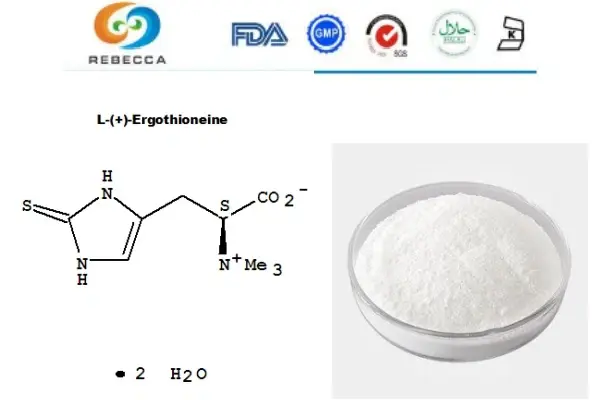
【English name】:L-Ergothioneine
【Chemical Name】:2-mercaptohistidine trimethylbetaine, EGT
【CAS No.】:497-30-3
【Molecular Formula】: C9H15N3O2S
【Specification】: 99%
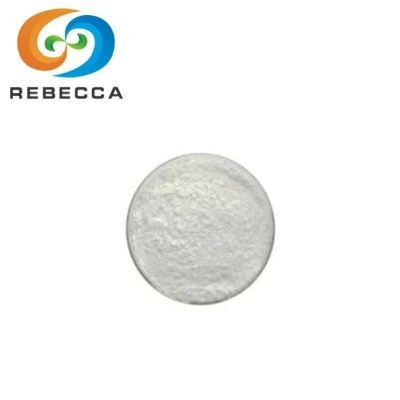
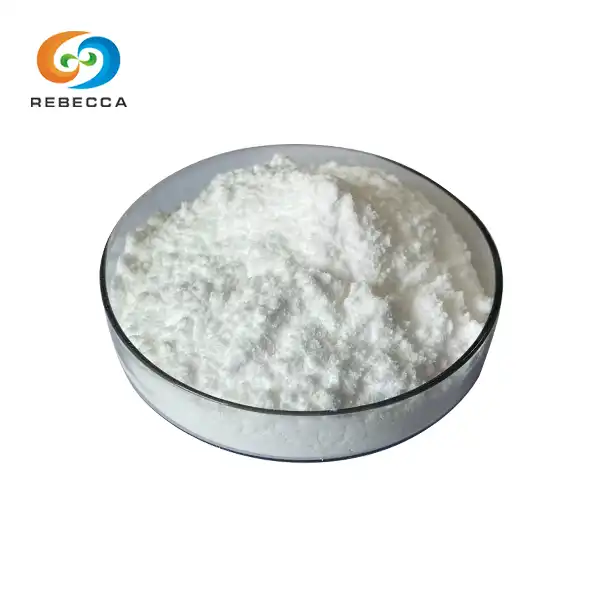
【Appearance】: White Crystalline Powder
【Test Method】: HPLC
【Solubility】:Soluble in Water (up to 10 mg/ml)
【Function】Remove stains, whiten skin, delay aging and prevent various diseases etc.
【Application】Food and health care,Cosmetic,Medicine etc.
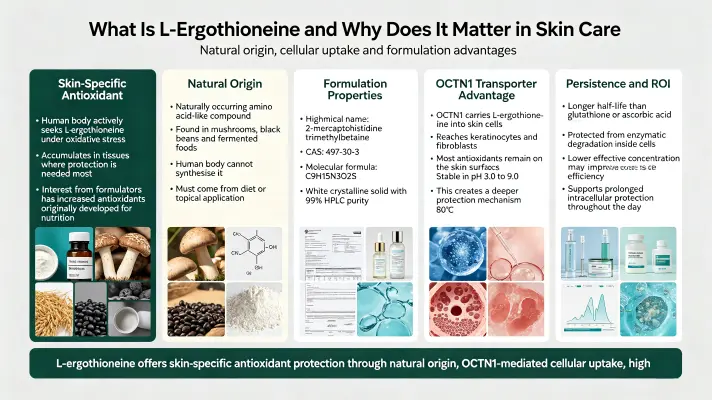
What Is L-Ergothioneine and Why Does It Matter in Skin Care
Most of the antioxidants in today’s skincare products were not created for the skin. They are derived from the study of nutrition or industrial chemistry and then reformulated for use on the skin. L-ergothioneine is not. It’s a chemical that the human body actively seeks for and accumulates in tissues when under oxidative stress. That biological inclination makes it particularly suited to protecting skin, which is why interest from formulators has increased dramatically over the last decade.
The Natural Origin and Chemical Profile
L-ergothioneine is a naturally occurring amino acid-like compound. It’s largely present in mushrooms, black beans and certain fermented foods. Cannot be synthesized by the human body. It must, instead, be derived from diet or used topically. In the skin it accumulates primarily in the places of maximal oxidative burden, such as the epidermis following UV exposure.
It is chemically 2-mercaptohistidine trimethylbetaine, CAS number 497-30-3, molecular formula C₉H₁₅N₃O₂S. L-ergothioneine powder, as a raw material, appears as a white crystalline solid. Under the regulated fermentation environment, it achieves 99% purity as confirmed by HPLC tests. It is highly soluble in water (up to 10 mg/ml) making it easy to formulate in aqueous based formulations such as serums, toners and emulsions.
The only structural difference is the thione-thiol equilibrium. This structure inhibits auto-oxidation of the molecule under normal circumstances. It is stable in a pH range of 3.0 to 9.0 and is intact at processing temperatures up to 80°C. This implies less stability difficulties to formulators with hot-process manufacture.
The Cellular Uptake Advantage
Most antioxidants applied to the skin remain on the surface. They generate a thin protective coating, but do not reach live cells. L-ergothioneine does things another way. In human skin cells, there is a transporter protein named OCTN1 (Organic Cation Transporter Novel 1). This transporter actively drags ergothioneine into keratinocytes and fibroblasts, the cells that make up the living layers of skin.< /p>
Research in Free Radical Biology and Medicine (Markova et al., 2009) demonstrated that l ergothioneine powder is used by skin cells as a key component of their antioxidant protective mechanism. Inside the cell it is protected from enzymatic degradation. Its half-life in skin tissue is much longer than that of glutathione or ascorbic acid. This persistence allows for prolonged intracellular protection throughout the day at a lower administered dosage.
This bioavailability profile is economically essential for procurement managers who are analyzing ingredient ROI. That is, a lower effective concentration means a cheaper cost per unit of formulation and also supports greater effectiveness claims on the label. The basis is to understand what ergothioneine is and how it gets to the active skin cells. The next phase is precisely what it does once it gets there.
Key Benefits of L-Ergothioneine in Skin Care Products
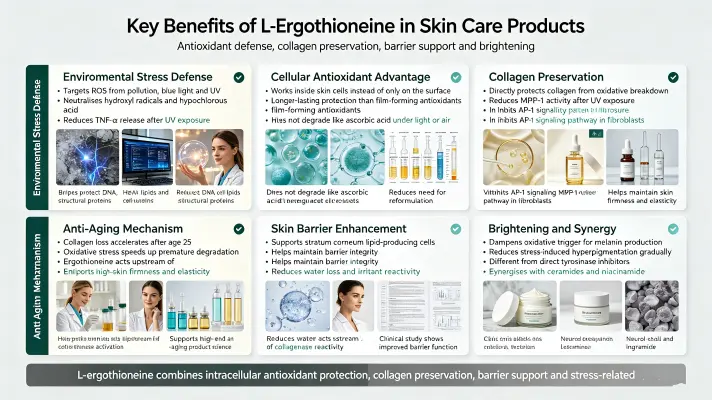
There is no shortage of antioxidant alternatives for formulators. It’s a simple purchase choice when one ingredient addresses many formulation difficulties at the same time. L-ergothioneine has unique but complimentary ways to combat oxidative damage, collagen loss, barrier disruption and uneven tone. Published research supports each of the benefits mentioned.
Advanced Antioxidant Defense Against Environmental Stressors
Air pollutants, blue light from computers, and ultraviolet light are some of the things that make ROS. These unstable chemicals hurt the DNA, cell lipids, and structure proteins. It caused lines, stiffness, and loss of elasticity before it was time.
Two of the worst ROS are hydroxyl radicals and hypochlorous acid. L-ergothioneine might be able to get rid of them. In human skin cells that had been subjected to UV light, ergothioneine reduced the release of TNF-α and the activity of MMP-1 (Obayashi et al., 2005). After UV light, MMP-1 is the main enzyme that breaks down collagen. If antioxidants work inside cells instead of just on the outside, they protect longer than antioxidants that form a film.
With ergothioneine powder, you can make the best SPF products for city dwellers, pollution defense serums, and daily creams. It doesn't turn into ascorbic acid when exposed to light or air. Because of this, the product doesn't need to be reformulated as often, and it can last longer without the need for extra chelating agents.
Anti-Aging and Collagen Preservation
Loss of collagen is the main cause of skin that looks old. After age 25, the skin makes about 1% less collagen every year. Oxidative stress in the environment speeds up that loss even more.
There are two ways that ergothioneine protects collagen. To begin, it directly stops the ROS that turn on collagenase enzymes (MMPs). Second, Hseu et al. (2020) showed that ergothioneine stops the AP-1 signaling pathway in fibroblasts that have been exposed to UVA. AP-1 is a transcription factor that makes more MMP genes work. The element stops collagen breakdown at the gene expression level by stopping this upstream signal. This is different from just cleaning up free radicals at the end.
When it comes to preparation, l-ergothioneine powder improves the science case for high-end anti-aging products. The mechanism is clear, can be measured, and is based on data that has been reviewed by experts. That's important for brands in controlled markets like the EU and the US that make claims on their labels that can be backed up.
Skin Barrier Enhancement and Brightening
If the barrier of the skin is broken, it rapidly loses water and becomes reactive to external irritants. Ergothioneine helps to maintain barrier integrity by protecting the lipid-producing cells of the stratum corneum from oxidative damage. Benson et al. (2020) reported in a clinical trial that subjects using high-ergothioneine formulations showed a substantial increase in skin barrier function.
On the positive side, however, oxidative stress is known to stimulate melanin production. Stress induced by ROS in keratinocytes leads to the activation of inflammatory mediators, which in turn stimulate the melanocytes to overproduce pigment. L-ergothioneine dampens this upstream oxidative trigger. This leads to a gradual reduction in stress-induced hyperpigmentation, not by direct inhibition of tyrosinase, but by removal of the oxidative signal that kicks off the cascade. This procedure makes it different from conventional whitening chemicals and is in line with clean-beauty regulatory standards.
Ceramides and niacinamide l-ergothioneine powder added for an amplified effect on barrier function and even tone. This synergistic impact may be used by formulators when making multipurpose serums, or brightening moisturizers, to lower total ingredient count yet still satisfy larger promises.These benefits can only be achieved if the raw material you get is pure, consistent and adequately documented. What to look for while evaluating suppliers.
How to Source High-Quality L-Ergothioneine Powder for B2B Procurement
The ergothioneine raw material market has developed, however quality differs widely across vendors. lesser price point may be indicative of lesser stereochemical purity, residual fermentation by-products or batch specification variations. Any of such difficulties may jeopardize a product launch for regulated cosmetic items.
Purity Standards and Quality Certifications
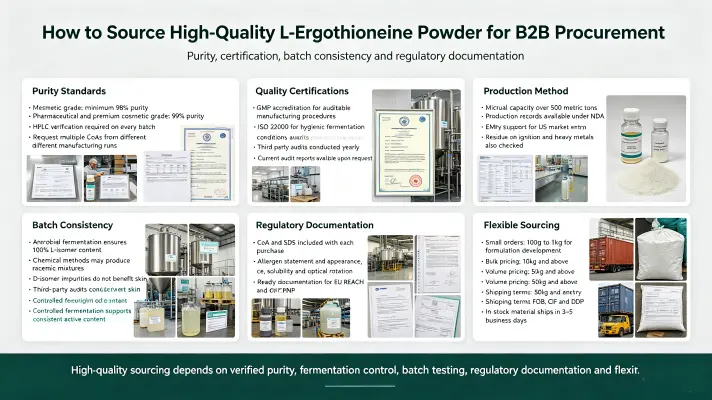
The purity should be at least 98% for ergothioneine powder for cosmetics, and 99% for pharmaceuticals and premium cosmetics. HPLC analysis must verify purity on each batch – not as a one-time qualifying test. Request representative CoA’s from many manufacturing runs from suppliers, not just one reference batch.
Manufacturing plant certifications are important too. GMP accreditation means that manufacturing procedures are recorded, regulated and auditable. ISO 22000 accreditation refers to hygienic requirements at the food-safety level in fermentation conditions, which is directly reflected on the lack of microbial contamination in the finished powder. Rebecca’s facility in Shaanxi is also certified and conducts third party audits on a yearly basis. Current audit reports are available upon request.
Production Methods and Batch Consistency
Microbial Fermentation Precision for L-ergothioneine Production This biosynthetic pathway ensures 100% L-isomer content of the physiologically active stereoisomer. Chemical production methods may lead to racemic mixtures that dilute the active substance and add D-isomer impurities that provide no benefit to the skin.< /p>
When growing a product from pilot to commercial production, batch-to-batch consistency is non-negotiable. We possess an annual capacity of over 500 metric tons, validated by production records accessible to eligible purchasers under NDA. Before releasing l-ergothioneine powder, every batch is examined for appearance, solubility, optical rotation, residue on ignition and heavy metals. The same spec document accompanies every lot, whether the buyer is moving from 1 kg sample amounts to multi-ton commercial purchases.
Regulatory Documentation and Flexible Sourcing
A technically better substance is of no commercial use without the right paperwork. Rebecca ships a comprehensive compliance package with each purchase including a Certificate of Analysis (CoA), Safety Data Sheet (SDS), allergy statement and country-of-origin declaration. We help brands entering the US market using Drug Master File (DMF). We have ready paperwork packages for EU registrations REACH and CPNP.
Emerging brands may start with minimal orders of 100g to 1 kilogram for formulation development. For established producers, pricing is available in bulk price levels beginning at 10 kg. Volume pricing starts at 50 kg. International shipping offered FOB, CIF and DDP rates. In-stock material typically ships within 3-5 business days following order confirmation.
Once you have a qualified source, the next important step is getting the formulation correct. The next part deals with concentration, compatibility and safety—the three areas that formulators most typically have concerns about.
How to Incorporate L-Ergothioneine Powder into Skin Care Formulations
Optimal Concentration and Formulation Tips
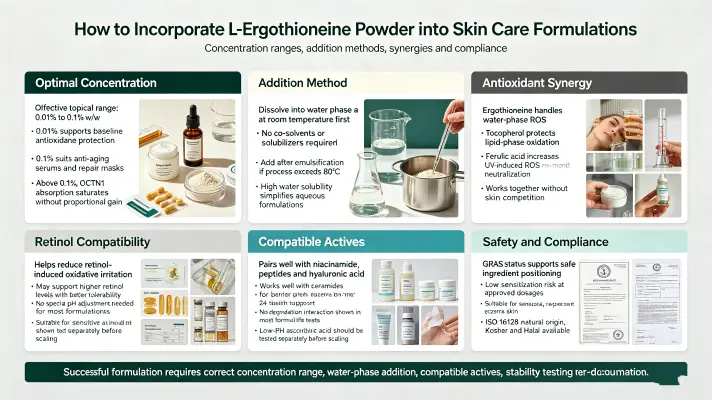
The effective usage of l-ergothioneine powder in topical applications is between 0.01% and 0.1% (w/w). It offers reliable baseline antioxidant protection at 0.01%. It is a level for daily moisturizers, sunscreen and light fluid formulas. For targeted treatments such as anti-aging serums or repair masks, the substance offers more extensive action at concentrations nearing 0.1%.
If it is above 0.1%, effectiveness is not increased proportionately. At this concentrations cellular absorption via OCTN1 becomes saturated. Economically speaking, it is economically reasonable to maintain the concentration within the clinically relevant range. 1. Dissolve 1 ergothioneine powder into water phase at room temperature before mixing with emulsifier systems. It is very water soluble and hence does not need co-solvents or solubilizers. If the process temperature is over 80 °C it may also be added after emulsification.
Synergistic Combinations with Other Actives
L-ergothioneine does not compete with other antioxidants, it enhances them. Tocopherol. This vitamin E + ergothioneine combination provides double protection . Ergothioneine takes care of water-phase ROS, tocopherol handles lipid-phase oxidation. Adding ferulic acid to this combination greatly increases UV-induced ROS neutralization.
The other function ergothioneine plays is with retinol. Retinoids are powerful anti-agers but notorious irritants. They might break the barrier and provoke reactions on sensitive skin. L ergothioneine powder helps to counter this retinol-induced oxidative irritation, so companies may formulate with higher retinol levels without compromising tolerability. Stability tests indicated no degrading interaction between the two actives throughout normal 24-month shelf-life durations.
Works well with niacinamide, peptides, hyaluronic acid and ceramides. No particular pH adjustment is needed for most combinations. If your recipe is using ascorbic acid at low pH (less than 3.5) add ergothioneine as a separate step or test for possible interaction at your unique circumstances before scaling.
Safety Profile and Regulatory Compliance
L-ergothioneine is known to be safe. It has been assessed under GRAS (Generally Recognized as Safe) concerns in food applications and has no known sensitization risk in topical usage at approved dosages. Suitable for sensitive, rosacea prone and eczema afflicted skin types.
l ergothioneine powder from microbial fermentation, a natural-origin substance in accordance with ISO 16128. This backs up the statements on packaging for the natural content %. We can provide kosher and halal certifications upon request to meet the needs of brands in the Middle Eastern, Southeast Asian and specialized retail sectors. Our fermentation technique for clean-beauty items does not include synthetic chemical alteration, which enables us to provide clear source stories in consumer-facing messaging.
Conclusion
L-ergothioneine isn’t a trendy ingredient. It is a physiologically active chemical with a defined mechanism of cellular absorption, a well-documented safety profile and a growing amount of peer-reviewed clinical data. It provides formulation stability benefits that lower manufacturing risk for procurement managers. L-ergothioneine powder offers claims around antioxidant defense, collagen preservation, barrier support and brightness that are now proven and available to R&D teams. It offers product producers a scientifically sound story that can withstand regulatory examination in the US, EU and elsewhere.Ingredient selection is no more important than sourcing considerations. Purity, batch consistency, quality of documentation and supplier technical skill all factor into whether an item works on the market as it does in the lab. Start with a sample. Conduct your own stability testing. Reach out to our formulation team. That’s the quickest route to a product that does what it says it will.
FAQ
Q1: What is the difference between 98% and 99% purity l ergothioneine powder?
A: The 1% difference is more significant than it sounds in regulated applications. At 98%, residual impurities may include trace fermentation metabolites that can cause faint off-odors or affect long-term shelf stability in emulsions. At 99% purity, these risks are substantially reduced. For clinical-grade serums or products making specific efficacy claims, 99% is the standard we recommend. For cost-sensitive mass-market moisturizers, 98% may be adequate depending on the formulation matrix.
Q2: How soon can consumers expect to see results?
A: Antioxidant protection begins immediately upon application—free radical scavenging is not a cumulative process. For visible improvements such as increased brightness and smoothness, consumer perception studies suggest most users notice change within 4 to 6 weeks of consistent daily use at 0.05–0.1%. Structural changes related to collagen preservation—such as reduced fine line depth—become measurable in controlled studies at 8 to 12 weeks. These timelines assume the product is used at recommended concentrations and paired with SPF during the day.
Q3: Can l ergothioneine powder be used in rinse-off products?
A: Yes, but the benefit profile changes. In rinse-off formats such as cleansers or shampoos, contact time with the skin is short. Cellular uptake via OCTN1 requires sustained skin contact for meaningful internalization. Rinse-off applications provide surface-level antioxidant benefit during the wash phase but will not deliver the intracellular protection that leave-on formats achieve. For brands wanting to include ergothioneine across an entire product range, rinse-off inclusion is defensible from a consumer communication perspective, but leave-on formats should carry the primary efficacy claim.
Q4: Is a minimum order quantity required to get samples?
A: No. Rebecca provides 5g to 50g evaluation samples free of charge for qualified cosmetic manufacturers and R&D laboratories. Sample requests are processed within 2 business days. We include a full CoA, SDS, and basic formulation guidance note with every sample shipment. Larger trial quantities (100g–1kg) are available at standard pricing with no volume commitment.
Q5: Does this ingredient comply with EU Cosmetics Regulation (EC) No 1223/2009?
A: L-ergothioneine is not listed as a restricted or prohibited substance under Annex II, III, IV, V, or VI of the EU Cosmetics Regulation. It can be used freely as a cosmetic ingredient within its established safety profile. Rebecca provides a full EU compliance documentation package, including a Safety Data Sheet prepared according to REACH Regulation (EC) No 1907/2006 and supporting data for Cosmetic Product Safety Reports (CPSR). Our technical team can assist with CPNP notification preparation on request.
Request a Sample or Get a Custom Quote
Rebecca supplies 99% purity l ergothioneine powder to cosmetic manufacturers in over 30 countries. We work with emerging indie brands and established multinational formulators alike. Our Shaanxi facility is GMP and ISO 22000 certified, with third-party audit reports available under NDA.
Here is what happens when you contact us:
· Sample request: Processed within 2 business days. Free for qualified manufacturers (5g–50g).
· Bulk quote: Pricing provided within 24 hours based on volume, destination, and Incoterms preference.
· Technical support: Our formulation chemists can advise on concentration, compatibility, and stability testing protocols specific to your product type.
Email: information@sxrebecca.com
We respond to all qualified inquiries within one business day.
References
1. Cheah, I.K. and Halliwell, B. (2021). Ergothioneine, recent developments. Redox Biology, 42, 101868.
2. Obayashi, K., Kurihara, K., Okano, Y., Masaki, H. and Yarosh, D.B. (2005). L-Ergothioneine scavenges superoxide and singlet oxygen and suppresses TNF-α and MMP-1 expression in UV-irradiated human dermal fibroblasts. Journal of Cosmetic Science.
3. Hseu, Y.C., Gowrisankar, Y.V., Chen, X.Z., Yang, Y.C. and Yang, H.L. (2020). The antiaging activity of ergothioneine in UVA-irradiated human dermal fibroblasts via the inhibition of the AP-1 pathway and the activation of Nrf2-mediated antioxidant genes. Oxidative Medicine and Cellular Longevity, 2020, Article ID 2576823.
4. Markova, N.G., Karaman-Jurukovska, N., Dong, K.K., Damaghi, N., Smiles, K.A. and Yarosh, D.B. (2009). Skin cells and tissue are capable of using L-ergothioneine as an integral component of their antioxidant defense system. Free Radical Biology and Medicine, 46(8), pp.1168–1176.
5. Benson, K.F., Rana, R.L. and Jensen, G.S. (2020). Improvements in skin barrier function and anti-inflammatory properties of supplements containing high levels of ergothioneine. Journal of Medicinal Food, 23(8), pp.874–881.
6. Cumming, B.M., Chinta, K.C., Reddy, V.P. and Steyn, A.J.C. (2018). Role of ergothioneine in microbial physiology and pathogenesis. Antioxidants & Redox Signaling, 28(6), pp.431–444.

 EXTRACT_1756803389333.jpg)