Lingonberry Extract For Skin Whitening
The use of lingonberry extract (Vaccinium vitis-idaea L.) is receiving attention in cosmetic research given its potential to help achieve a more uniform skin tone. It’s not relevant as a straight “whitening agent” but rather as a mix of antioxidant protection, modest tyrosinase regulation and anti-inflammatory action. These processes combined may offset the development of dullness and uneven pigmentation associated with oxidative damage and environmental exposure.
To determine its real-world relevance to skincare formulations, it is crucial to assess its botanical origin, main bioactive component and the biological routes via which it may impact skin appearance, followed by examination of practical formulation factors.
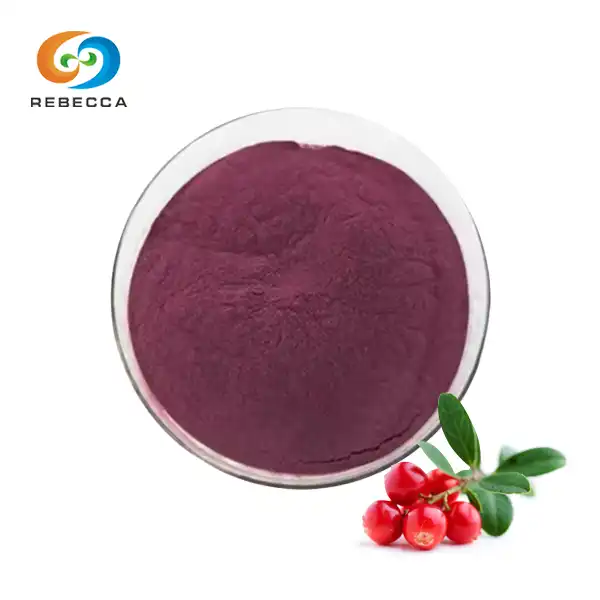
Product name: Lingonberry fruit extract anthocyanidins
Plant source: Vaccinium vitis-idaea L.
Product specification: 5-25% anthocyanins,fruit powder,juice powder
Detection method: UV
Product properties: purple powder
Use part: Fruit
Shelf life: 24 months
Certifications: GMP, ISO, HACCP, KOSHER, and HALAL.
Payment: Various payment methods accepted.
Advantages: Manufactured in a 100,000-grade cleanroom, our products are additive-free, non-GMO
Inner Package: Double PE Bags; Net 5kg/Bag
Outside Package: Paper Drums, Net 25kg/Drum
Storage:Store in a cool, dry place away from Light and Heat.
Botanical Origin and Bioactive Composition
Plant source and extraction overview
Lingonberry is a resilient arctic berry that develops in low nutrition, cold settings. These circumstances induce the plant to develop secondary metabolites of protection, also of cosmetic significance. Ethanol-water extraction is widely employed in the manufacturing of ingredient, with the aim to get a polyphenol-rich fraction but at the same time to eliminate the sugars and non-active components that may influence the stability.
Standardisation is an essential point to consider in the evaluation of botanical extracts. The lingonberry extract is characterised by polyphenol or proanthocyanidin concentration, depending on the provider. However, it is vital to notice that the particular marker chemicals may vary greatly depending on the place of harvest, the extraction procedure, and the quality of the raw material.
Key bioactive compound groups
Lingonberry extract has a primarily cosmetic relevance because of its polyphenolic profile. Rather than a single active molecule, its possible effects are the outcome of a collection of chemicals acting via complimentary routes.
· Proanthocyanidins (PACs): Contribute to antioxidant activity and help neutralize free radicals that can accelerate skin aging and uneven tone.
· Anthocyanins: Pigments that support protection against oxidative stress and may help reduce visible redness associated with environmental stress.
· Minor phenolic compounds: Including flavonols and related structures that contribute to overall antioxidant capacity.
Arbutin is occasionally discussed when talking about substances that come from berries but it is not normally a significant or consistently measured aspect of all lingonberry extract raw materials. Therefore, its contribution should be seen as subordinate and conditional on certain extract criteria rather than as a key active driver.
The profile of many components accounts for the reason why lingonberry extract is often a supporting cosmetic ingredient rather than a single-mechanism skin lightening agent.

Biological Pathways Related to Skin Tone Appearance
Oxidative stress and skin dullness
Oxidative stress is one of the most significant mechanisms in skin appearance and is induced by UV exposure, pollution and intrinsic metabolic activities. Oxidative stress and free radicals may speed up the process of lipid peroxidation and protein damage in the skin, leading to a dull or uneven appearance of the skin with age.
Polyphenol-rich extracts such as lingonberry may help enhance the skin’s antioxidant defence system. This does not directly “bleach” pigment, but it may help relieve upstream stress factors impacting pigmentation abnormalities and uneven tone creation.
Tyrosinase modulation and pigmentation balance
Tyrosinase is an important enzyme in melanin production. Some plant chemicals have been investigated for their potential to modify its action. In general, the potential for interaction with tyrosinase of lingonberry extract is believed to be weak and indirect, and is dependent on its polyphenolic content.
It is important to emphasize that:
· Evidence for direct, strong depigmenting activity in humans is limited.
· Effects, if present, are typically gradual and supportive rather than corrective.
· Results depend heavily on formulation design and concentration.
Inflammation and post-inflammatory pigmentation
The discrepancy in skin tone is commonly connected to melanin synthesis but also to inflammation. Environmental irritation and stress may activate inflammatory pathways that indirectly induce melanogenesis, causing to post-inflammatory hyperpigmentation.
Antioxidant and anti-inflammatory properties of lingonberry polyphenols may help diminish this upstream trigger. This makes the component “more flexible in formulation situations for ‘tone maintenance’ and ‘skin clarity’ positioning as opposed to aggressive brightening claims,”

Formulation Considerations and Application
Extract standardization and quality variability
One of the most crucial things from a formulation point of view when dealing with botanical extracts is the consistency. The content of lingonberry extract depends on the origin of the raw material, seasonal fluctuation and the extraction process.
To ensure predictable performance, formulators typically evaluate:
· Total polyphenol content or PAC levels as quality indicators
· Residual solvent profiles and microbial limits
· Batch-to-batch consistency supported by analytical documentation
These parameters are often more important for product performance than focusing on any single “active molecule” claim.
Compatibility in cosmetic and nutraceutical systems
Lingonberry extract is usually utilised in topical and oral preparations. In topical systems, it is found in products such as emulsions, serums and essence-type products. It is coupled with other antioxidants or skin-supporting elements in oral supplements.
The polyphenolic composition of the compound may interact with certain oxidising agents and impact its compatibility profile. So formulation testing is needed when combining with substances like vitamin C derivatives or niacinamide to assure stability.
Positioning in finished products
In commercial product development, lingonberry extract is most appropriately positioned as a supporting multifunctional botanical rather than a primary depigmenting agent. Typical positioning includes:
· Support for skin radiance and clarity
· Antioxidant protection against environmental stress
· Complementary ingredient in anti-aging or tone-evening systems
This positioning aligns more closely with available scientific evidence.

Conclusion
Lingonberry extract is a polyphenol-driven multifunctional profile that may support the improvement of skin appearance via antioxidant, anti-inflammatory and moderate pigmentation regulating mechanisms. However, the function should be seen as a supporting impact rather than a direct effect on skin whitening.
For formulators, its usefulness is in improving the overall quality of skin tone when used into carefully designed cosmetic systems rather than as a stand alone depigmenting agent. Proper standardisation, stability assessment and realistic placement are the essential to assuring the product performance as well as the regulatory compliance.
FAQ
Is lingonberry extract suitable for all skin types?
The extract exhibits a gentle profile appropriate for most skin types, including sensitive complexions. The naturally occurring compounds provide brightening benefits without the harshness associated with some synthetic alternatives. Product developers should conduct standard compatibility testing when combining with other active ingredients, particularly acids or retinoids, to ensure formulation stability and skin tolerance.
How long does it typically take to observe brightening effects?
Visible improvements in skin tone evenness generally emerge after consistent use over 6-12 weeks, reflecting the biological timeline of epidermal cell turnover. Topical applications typically show gradual, cumulative benefits rather than immediate transformation. This timeline aligns with realistic consumer expectations for natural ingredient formulations and supports sustainable improvements rather than temporary cosmetic effects.
What specifications should cosmetic formulators prioritize?
Product developers should request detailed analytical data including OPC content, arbutin levels, particle size distribution, and solubility characteristics. Batch-to-batch consistency metrics demonstrate manufacturing control essential for commercial-scale production. Safety documentation covering microbial limits, heavy metals, and allergen status satisfies regulatory requirements across major markets, streamlining approval processes.
Partner with Rebecca for Premium Lingonberry Extract Supply
Rebecca specialises in providing pharmaceutical quality plant extracts to fulfil the strict requirements of international R&D and purchasing teams. Our lingonberry fruit extract is standardised to 25% oligomeric proanthocyanidins using approved UV detection techniques, to provide the uniformity and documentation necessary for competitive cosmetic and nutritional products.
Our manufacturing plant in Shaanxi is GMP and ISO22000 certified and we guarantee that each batch complies with strict quality requirements from raw material verification to final packing. We are capable of pilot scale research and commercial manufacturing quantities with more than 500 metric tonnes of yearly production capability in a variety of extract categories. Ingredient supply is only the start. Our applications team offers formulation help, stability data and regulatory documents based on your target markets.
To discuss your unique needs, please feel free to contact our customer service professionals directly at information@sxrebecca.com. Enquiries for special specs, sample requests and technical consultations are welcome. Discover why prominent businesses trust Rebecca with their lingonberry extract supply for quality and responsiveness.
References
1. Kylli, P., Nohynek, L., Puupponen-Pimiä, R., Westerlund-Wikström, B., Leppänen, T., Welling, J., Moilanen, E., & Heinonen, M. (2011). Lingonberry (Vaccinium vitis-idaea) and European cranberry (Vaccinium microcarpon) proanthocyanidins: isolation, identification, and bioactivities. Journal of Agricultural and Food Chemistry, 59(7), 3373-3384.
2. Vostalova, J., Vidlar, A., Simanek, V., Galandakova, A., Kosina, P., Vacek, J., Vrbkova, J., Zimmermann, B. F., Ulrichova, J., & Student, V. (2015). Are high proanthocyanidins key to cranberry efficacy in the prevention of recurrent urinary tract infection? Phytotherapy Research, 29(10), 1559-1567.
3. Migas, P., & Krauze-Baranowska, M. (2015). The significance of arbutin and its derivatives in therapy and cosmetics. Phytochemistry Letters, 13, 35-40.
4. Teleszko, M., Nowicka, P., Wojdyło, A., Cebulak, T., & Oszmiański, J. (2016). How do health-promoting compounds in fruits change after freezing and thawing: comparison of six cultivars of red and black raspberries (Rubus idaeus and Rubus occidentalis). Food Chemistry, 190, 742-750.
5. Isaacs, C. E., Xu, W., & Pullarkat, R. K. (2013). Inactivation of enveloped viruses in human bodily fluids by medium-chain fatty acids and monoglycerides. Antimicrobial Agents and Chemotherapy, 57(8), 3507-3510.
6. Lätti, A. K., Riihinen, K. R., & Kainulainen, P. S. (2008). Analysis of anthocyanin variation in wild populations of bilberry (Vaccinium myrtillus L.) in Finland. Journal of Agricultural and Food Chemistry, 56(1), 190-196.
 EXTRACT_1756803389333.jpg)