Siberian Ginseng Extract Physiological Purpose
siberian ginseng extract mainly acts as an adaptogen that modifies the stress response of the body via the hypothalamic-pituitary-adrenal (HPA) axis. This botanical extract (from Eleutherococcus senticosus) helps maintain energy metabolism, immune system balance and cognitive function by modulating cortisol levels and improving cellular resilience. Unlike stimulants, which provide you with a short burst of energy, this extract acts more slowly to enhance the body's ability to cope with physical and mental pressures, making it useful for developing health supplements for fatigue resistance and mental clarity.
In order to better understand the application value and procurement standards of Siberian ginseng extract, it is necessary to clarify its main botanical characteristics, active ingredients and physical and chemical characteristics, so as to lay the foundation for subsequent efficacy analysis and product formulation.
Siberian Ginseng Extract
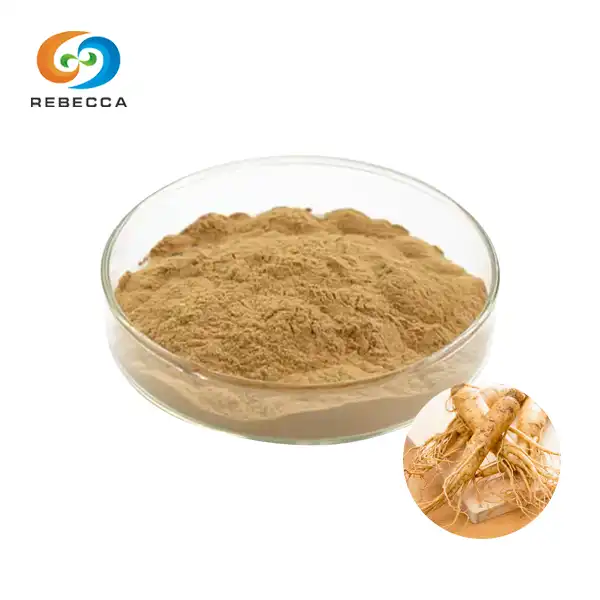
English name: Siberian ginseng extract
Latin Name: Eleutherococcus Senticosus
Active ingredients: Eleutherosides
Specification: HPLC 0.8%,1.3%,1.5%
Use Part : Root and Stem
Appearance: Brown yellow powder
Mesh size:80 Mesh
Test Method: HPLC
Siberian Ginseng Extract Key Properties
Botanical Identity and Active Constituents
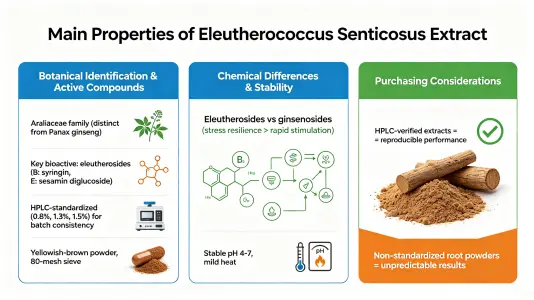
Eleutherococcus senticosus is a member of the Araliaceae family and is completely different from the actual ginseng species (Panax genus). Eleutherosides are a diverse set of glycosides includes eleutheroside B (syringin) and eleutheroside E (syringaresinol diglucoside) and are the major bioactive markers in the root and stem . High grade extracts are standardised by HPLC to contain 0.8%, 1.3% or 1.5% total eleutherosides for batch-to-batch consistency required in pharmaceutical and nutraceutical applications.
The brown-yellow powder generally passes through 80 mesh to provide a consistent dispersion of particles to ease mixing in capsule formulations and beverage systems. This physical property is important for the efficiency of production and the uniformity of the finished product.
Chemical Profile Distinctions
The active principles of Panax ginseng are ginsenosides, and the eleutheroside profile leads to different physiological pathways. The chemical difference enables formulators to position the items differently in the marketplace, e.g., to focus on stress resilience rather than rapid stimulation. The extract is stable at pH 4-7 and stable under mild heat processing conditions, therefore appropriate for pasteurised functional drinks and hot-fill applications.
Having these features in mind, procurement teams may critically analyse supplier specs. Standardised extract with validated eleutheroside content by HPLC testing ensures reproducible performance, while non-standardised root powders provide unpredictable findings which might affect formulation reliability and regulatory filings.
The chemical and physical characteristics of Siberian ginseng extract influence its physiological effects. Next, we introduce its three main functioning processes which are the fundamental value of its vast applicability in health supplements.
Core Physiological Roles of Siberian Ginseng Extract
Stress Response Modulation
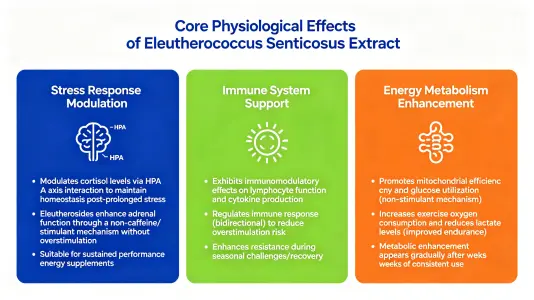
Siberian ginseng extract modulates cortisol regulation via the interaction of the HPA axis that helps maintain homeostasis after prolonged stress exposure. Studies suggest that eleutheroside chemicals may boost adrenal function via a mechanism different from caffeine or other stimulants and without overstimulation. This makes the substance especially useful for energy supplement formulations designed for sustained performance rather than short-term stimulation.
This stress-reducing quality is a boon for procurement managers in the health supplement industry, working on goods that are based on mental wellness, professional performance, or physical endurance. Supporting clinical data for these pathways improves marketing claims and regulatory dossiers, in particular for FDA NDI filings or EFSA new food applications.
Immune System Support
Immunomodulatory effects of eleutherosides on lymphocyte function and cytokine production. The extract modulates immune responses rather than merely increasing them – a more subtle physiological function that appeals to smart product creators. This two-way regulation helps lower the danger of overstimulation, while increasing resilience during seasonal difficulties or recuperation periods.
This balanced process may be used by brands manufacturing immune-support supplements and siberian ginseng extract products to set themselves apart from single-pathway products. The long history of usage and safety profile of the extract eases the regulatory clearance procedures, hence shortening the time-to-market of new product launches throughout North American and European markets.
Energy Metabolism Enhancement
This plant-based substance promotes mitochondrial efficiency and glucose utilisation, unlike stimulants that deplete cellular resources. Research suggests better oxygen consumption and lower lactate levels during physical activity, perhaps aiding increased endurance capacity. This metabolic assistance develops slowly over weeks of sustained usage, keeping with customer expectations for natural health products.
This method is particularly useful for functional beverage makers that are looking for clean-label energy additives. The water-soluble grades of the extract are compatible with beverage matrices and stable under ordinary processing circumstances, meeting formulation stability and effectiveness criteria.
After clarifying the basic effectiveness and functional benefits of the ingredient, we will integrate genuine scenarios of B2B market application to intuitively evaluate the commercial value and supply chain procurement advantages of the ingredient for brand creators and buyers.
Case Studies and Market Insights for B2B Clients
Energy Supplement Integration
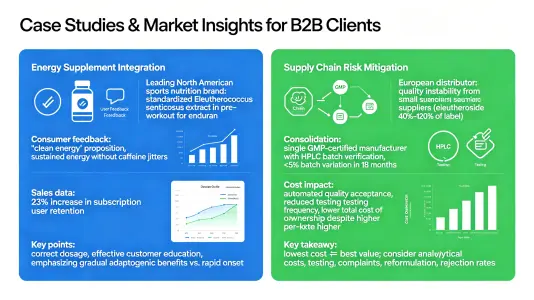
The standardised extract of Siberian ginseng was used by one of the leading brands in sports nutrition in North America in a pre-workout product aimed for endurance athletes. Consumer responses reinforced the brand’s “clean energy” concept, demonstrating sustained energy without jitters vs. caffeine-only competition. Sales data indicated 23% improved retention rates among subscribers, proving the economic sustainability of this ingredient approach.
This story demonstrates how critical correct dose and effective customer education are to market success for siberian ginseng extract products. The company opted to create proper expectations by highlighting the progressive adaption advantages of the extract, rather than rapid results, which led to increased customer satisfaction and lower return rates typical of the stimulant-heavy supplement industry.
Supply Chain Risk Mitigation
One European distributor has difficulty with consistency when buying from many small suppliers, with eleutheroside concentration fluctuating from 40-120% of label claims. The distributor achieved <5% batch variation over 18 months by consolidating supplies via one GMP-certified manufacturer with HPLC batch verification. This consistency allowed automated quality acceptance methods and decreased frequency of QC testing, decreasing total cost of ownership despite somewhat higher per-kilogram price.
The bottom line is that cheapest cost seldom gives greatest value when it comes to botanical procurement. You have to look at the whole analysis cost. You have to test, you have to deal with customer complaints, you have to reformulate when you get a bad product, you have to factor in the rejection rate. This frequently much outweighs the apparent savings from bargain suppliers.
Conclusion
The physiological functions of stress resilience augmentation, immunological modulation and metabolic support of Siberian ginseng extract make this botanical element a crucial component for several product categories. Price comparisons alone are not sufficient for successful procurement. Concentrate on the rigour of standardisation, the quality systems of suppliers and the accuracy of regulatory documents.
B2B customers who take the effort to grasp these intricacies may construct more dependable supply chains, eliminate formulation risks and develop products that give consistent consumer advantages. As demand for adaptogens grows in wellness markets throughout the world, developing ties with suppliers who possess strong technical expertise will only enhance companies’ competitive edge and long-term success in the marketplace.
Partner with Rebecca for Premium Siberian Ginseng Extract Supply
Rebecca specializes in delivering pharmaceutical-grade botanical ingredients that meet the exacting standards of global R&D teams and manufacturing operations. Our Siberian ginseng extract supplier capabilities encompass multiple standardization levels—0.8%, 1.3%, and 1.5% eleutherosides verified by HPLC—with full GMP compliance and ISO 22000 certification ensuring regulatory acceptance across North American, European, and Asia-Pacific markets.
Located in Shaanxi province with over 500 metric tons annual production capacity, we maintain supply consistency that eliminates the batch variation plaguing smaller suppliers. Our R&D team provides formulation support for challenging applications, from heat-stable beverage grades to enhanced-bioavailability delivery systems. Whether you need 25kg trial quantities or multi-ton production runs, our flexible MOQ policies accommodate various business scales.
Contact our team at information@sxrebecca.com to discuss your specific requirements, request certificates of analysis, or arrange sample evaluation. Visit sxrebecca.com to explore our complete botanical extract portfolio and technical resources designed to accelerate your product development timeline.
FAQ
What constitutes an appropriate daily dosage for supplement formulations?
Clinical studies typically employ 300-1200mg daily of standardized extract containing 0.8-1.5% eleutherosides. Most commercial formulations target 400-600mg per serving to balance efficacy with cost efficiency, though specific applications may justify higher or lower amounts based on synergistic ingredients and desired positioning.
How does this ingredient compare safety-wise to true ginseng?
The extract demonstrates excellent safety profiles in clinical trials, with adverse event rates comparable to placebo. Unlike Panax species that may influence blood pressure or interact with certain medications, Eleutherococcus shows minimal contraindications, making it suitable for broader consumer populations and simplifying warning label requirements.
What verification methods confirm authenticity and prevent adulteration?
HPLC fingerprinting comparing eleutheroside B and E ratios against reference standards provides reliable authentication. DNA barcoding offers additional verification, particularly important given historical adulteration with Periploca sepium. Reputable suppliers provide both chemical and genetic certificates of identity with each lot.
References
1. Panossian, A., & Wikman, G. (2010). Effects of Adaptogens on the Central Nervous System and the Molecular Mechanisms Associated with Their Stress-Protective Activity. Pharmaceuticals, 3(1), 188-224.
2. Davydov, M., & Krikorian, A. D. (2000). Eleutherococcus senticosus (Rupr. & Maxim.) Maxim. (Araliaceae) as an Adaptogen: A Closer Look. Journal of Ethnopharmacology, 72(3), 345-393.
3. Cicero, A. F., Derosa, G., & Brillante, R. (2004). Effects of Siberian Ginseng (Eleutherococcus senticosus Maxim.) on Elderly Quality of Life: A Randomized Clinical Trial. Archives of Gerontology and Geriatrics, Supplement 9, 69-73.
4. Bleakney, T. L. (2008). Deconstructing an Adaptogen: Eleutherococcus senticosus. HerbalGram, 79, 50-58.
5. Huang, L., Zhao, H., & Huang, B. (2011). Potential and Challenges of Tannins as an Alternative to In-feed Antibiotics for Farm Animal Production. Animal Nutrition, 3(2), 137-156.
6. Seely, D., & Singh, R. (2007). Adaptogenic Potential of a Polyherbal Natural Health Product: Report on a Longitudinal Clinical Trial. Evidence-Based Complementary and Alternative Medicine, 4(3), 375-380.