
Tomato Extract Lycopene Benefits
Lycopene is extracted from physiologically matured fruits of Lycopersicon esculentum . It is one of the most potent antioxidant chemicals found in nature. This dark red powder is standardised to contain between 5% to 98% pure lycopene verified using HPLC, a high-purity functional ingredient for nutraceutical, cosmetic and functional food applications for B2B procurement experts. Unlike standard tomato powder, Lycopene extract powder, delivers concentrated bioactive components with better stability, batch-to-batch consistency and formulation flexibility – critical attributes for pharmaceutical R&D managers, supplement brand developers and ingredient distributors seeking clinical-grade raw materials to support cardiovascular health, skin protection and cellular defence mechanisms.
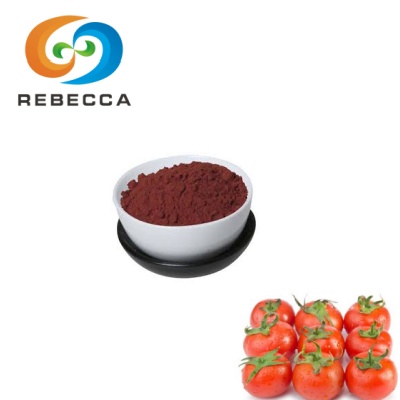
English name: tomato extract
Latin Name: Lycopersicon esculentum
CAS No.: 502-65-8
Molecular formula:C40H56
Molecular Weight: 536.88
Active ingredients: lycopene
Specification: 5%~98%
Use Part : fruit
Appearance: Dark red powder
Mesh size:80 Mesh
Test Method: HPLC
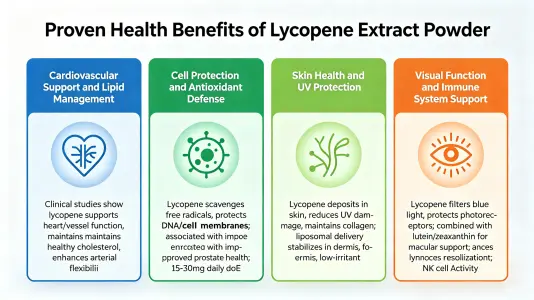
Proven Health Benefits of Lycopene Extract Powder
Scientific study has shown the many health-promoting characteristics of lycopene, making this carotenoid an ideal element for health-oriented market sectors. Knowledge of these evidence-based advantages may help product managers and formulators build focused solutions to address consumer wellness needs.
Cardiovascular Support and Lipid Management
Clinical studies show that lycopene extract powder supports the normal function of the heart and blood vessels in many ways. This chemical promotes a healthy cholesterol ratio by helping to reduce lipid peroxidation and promoting flexibility in arteries. Study participants who consumed standardised amounts of lycopene demonstrated increases in vascular endothelial function and reductions in oxidative stress markers. Functional beverage producers creating heart-healthy functional beverages are helped by the use of water-soluble lycopene variants which remain stable after pasteurisation and are capable of providing constant levels of bioactivity.
Cellular Protection and Antioxidant Defense
The enhanced free radical scavenging activity of lycopene offers cellular protection against oxidative injury. It may neutralise reactive oxygen species before they damage cellular membranes and DNA structures. Research shows that those who eat lycopene regularly had lower levels of indicators of oxidative stress in their blood samples. The importance of this protective mechanism is particularly highlighted in the context of prostate tissue, where observational studies have linked increased lycopene intake with improved prostate health indices. Men's health product developers in R&D commonly mix lycopene with saw palmetto or vitamin E to produce synergistic prostate support solutions that need 15-30mg daily dose procedures.
Skin Health and UV Protection
Cosmetic chemists are adding lycopene extract powder to their skincare formulas for its photoprotective and anti-aging benefits. The carotenoid deposits into the skin tissue where it diminishes UV damage and maintains collagen integrity. Clinical experiments have shown that systemic lycopene supplementation lowers UV-induced skin erythema, and that the benefits of improved skin texture are maintained. Product makers looking for ISO 16128 natural ingredient compliance use liposomal delivery technologies to stabilise lycopene in dermal layers without surface colour transfer. Safety test data reveals low-irritation profiles suited for sensitive skin applications, enhancing market prospects in nutricosmetics and topical skincare ranges.
Visual Function and Immune System Support
Lycopene is an antioxidant that accumulates in eye tissues to filter blue light and protect photoreceptor cells from oxidative damage. Innovation managers develop vision support supplements combining lycopene with lutein and zeaxanthin for full macular support. Besides eye advantages, lycopene boosts immune system function by increasing lymphocyte proliferation and natural killer cell activity. Such expanded health uses allow ingredient distributors to market lycopene as a component of numerous product categories, from immune-boosting supplements to age management formulas that help maintain bone density.
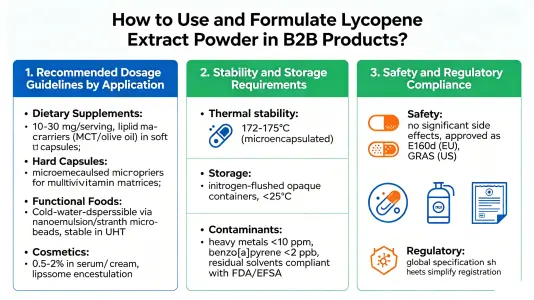
How to Use and Dose Lycopene Extract Powder in B2B Products?
Successful utilisation of lycopene extract powder involves knowledge of the dose parameters, formulation techniques and stability aspects in many product matrices. Procurement specialists must match technical parameters to planned applications in order to obtain best performance in bioavailability and shelf life.
Recommended Dosing Guidelines by Application
Dietary supplement formulations generally include 10-30mg lycopene per serving, aligning with clinical research methods that have shown health benefits. To enhance absorption, because lycopene powder needs fat to get into the intestines, a good way to suspend it in lipid carriers such as MCT oil or olive oil is via softgel capsules. Hard capsule forms use microencapsulated beadlets to avoid oxidative deterioration in the presence of minerals such as iron or copper in multivitamin matrix.
For functional food applications, lower levels of concentration are employed for natural colouring and antioxidant fortification. Cold water dispersible versions are needed that are made using nano-emulsion or starch-based beadlet technology, that maintain stable turbidity and do not separate oil during distribution. These unique forms keep their colour intensity even throughout UHT processing and solve sedimentation problems in clear drink formats.
Lycopene concentrations in serum and cream bases for cosmetic applications are 0.5-2%. The trick is to find a compromise between effectiveness and colour stability, and this is accomplished by encapsulating the chemical into liposomes which will transport it to the targeted layers of the skin and reduce its deposition on the skin surface.
Stability and Storage Requirements
Lycopene has 11 conjugated double bonds, which are susceptible to oxidation and isomerisation from the advantageous all-trans form to less active cis isomers by light and heat. Good quality vendors will deliver microencapsulated forms with thermal stability up to melting temperatures of 172-175°C. Storage guidelines require nitrogen-flushed, opaque container stored at less than 25° C to ensure potency across stated shelf life durations.
Heavy metal limits < 10ppm, benzo(a)pyrene < 2ppb and residual solvent controls are in line with FDA and EFSA regulations. Bulk purchasers should require confirmation of pesticide screening and lack of mycotoxins in the Certificate of Analysis, especially if pursuing organic certification paths.
Safety Profile and Regulatory Compliance
Lycopene has shown very good safety tolerance, no notable side effects have been found with normal dosage amounts. The chemical is approved as the natural colour E160d in Europe and is GRAS in the United States. This regulatory clearance opens up market access into pharmaceutical, nutraceutical and food sectors. Sourcing agents benefit from suppliers’ single specification sheets that consider worldwide regulatory frameworks and make product registration easier across many jurisdictions.
Conclusion
Lycopene extract powder is a science-based, commercially flexible substance that fits a number of health and wellness categories. Its cardiovascular advantages, cellular protective qualities and skin health applications provide up prospects across nutraceutical, functional food and cosmetic industries. To successfully buy the required products, it is necessary to assess the quality of each supplier’s certifications, manufacturing capabilities, and technical support services that ensure the quality of the products and compliance with regulatory requirements. Standardised extracts with HPLC-verified purity of 5%-98% provide B2B professionals with the consistency, bioavailability and formulation flexibility they need to build competitive health solutions for the worldwide market.
FAQ
What purity level of lycopene extract powder should I specify?
Purity selection depends on your application requirements. Supplement formulations targeting clinical health claims typically specify 10%-20% lycopene concentrations, balancing efficacy with cost efficiency. Pharmaceutical applications requiring precise API measurements often demand 95%-98% purity grades. Functional food colorants utilize 5%-10% concentrations sufficient for natural pigmentation without excessive costs. Cosmetic formulations typically incorporate 10%-20% purity variants providing antioxidant benefits while minimizing color transfer concerns.
How does lycopene bioavailability differ between powder and oil formulations?
Lycopene's lipophilic nature necessitates fat presence for intestinal absorption. Powder forms suspended in oil carriers demonstrate superior bioavailability compared to dry powder alone. Studies indicate oil-based formulations achieve 2-3 times greater plasma lycopene concentrations versus aqueous systems. Microencapsulated beadlets using lipid matrices enhance stability while maintaining bioavailability advantages.
What certifications should I require from lycopene suppliers?
Essential certifications include GMP facility compliance, ISO22000 food safety management, and HACCP protocols. Organic certification suits natural product positioning, while halal and kosher certifications expand market access. Request third-party testing documentation confirming heavy metal limits, pesticide screening, and microbiological purity meeting international standards.
Rebecca Lycopene Extract Powder Supplier
Our Shaanxi manufacturing plant has three specialised extraction lines and produces over 500 metric tonnes of standardised botanical extracts annually.Rebecca provides pharmaceutical-grade lycopene extract powder prepared from our Shaanxi production facility. We provide tomato lycopene at the highest quality standards, with 5%-98% lycopene guaranteed by HPLC, 80-mesh dark red powder, and full compliance certificates such as GMP, ISO22000, and HACCP for worldwide registration.
What Makes Rebecca Your Go-To Supplier for Lycopene Extract Powder? We have comprehensive supply chain transparency from procurement of certified organic tomatoes to supercritical CO2 extraction to ensure batch to batch uniformity which is vital for pharmaceutical registration assistance. Whether you need oil-soluble concentrates for softgel applications, cold water dispersible variants for beverage fortification or microencapsulated beadlets that prevent oxidation in multivitamin matrices, we can provide technical consultation for formulation optimisation. Our R&D team is composed of chemistry, biology and pharmacology specialists.
Procurement managers like our customisation flexibility: customisable purity criteria, private labelling and variable MOQ to support development-stage samples as well as commercial-scale purchases. We have common specification sheets for FDA, EFSA and ICH regulatory frameworks and a full safety testing data with heavy metal screening below 10ppm and verification of pesticide residues. Our experience in exports to the North America, Europe and Asia Pacific regions, together with FOB, CIF and DDP shipping options, provide international customers with the supply chain stability they want.
Contact our technical team at information@sxrebecca.com to discuss your lycopene extract powder requirements. We provide detailed product specifications, application guidance, and competitive bulk pricing supporting your formulation success.
References
1. Clinton, S. K., Emenhiser, C., Schwartz, S. J., Bostwick, D. G., Williams, A. W., Moore, B. J., & Erdman, J. W. (1996). Cis-trans lycopene isomers, carotenoids, and retinol in the human prostate. Cancer Epidemiology, Biomarkers & Prevention, 5(10), 823-833.
2. Giovannucci, E., Ascherio, A., Rimm, E. B., Stampfer, M. J., Colditz, G. A., & Willett, W. C. (2002). Intake of carotenoids and retinol in relation to risk of prostate cancer. Journal of the National Cancer Institute, 87(23), 1767-1776.
3. Rao, A. V., & Agarwal, S. (2000). Role of antioxidant lycopene in cancer and heart disease. Journal of the American College of Nutrition, 19(5), 563-569.
4. Stahl, W., & Sies, H. (2003). Antioxidant activity of carotenoids. Molecular Aspects of Medicine, 24(6), 345-351.
5. Erdman, J. W., Ford, N. A., & Lindshield, B. L. (2009). Are the health attributes of lycopene related to its antioxidant function? Archives of Biochemistry and Biophysics, 483(2), 229-235.
6. Agarwal, S., & Rao, A. V. (1998). Tomato lycopene and low density lipoprotein oxidation: a human dietary intervention study. Lipids, 33(10), 981-984.
_1747205699273.webp)
 EXTRACT_1756803389333.jpg)