What does yeast beta-glucan do for your skin?
Beta-glucan from yeast spent decades in study labs before it was used by formulators, and more and more proof keeps coming in. The polysaccharide ingredient comes from the cell walls of Saccharomyces cerevisiae, which is also known as baker's yeast. It does a lot more than just add moisture. With its ability to boost collagen production, calm inflammation, and protect against UV-induced stress, it helps the skin's own defence systems. For companies that make cosmetics and supplements, Yeast beta-glucan powder is a rare combination of effectiveness, safety, and adaptability.
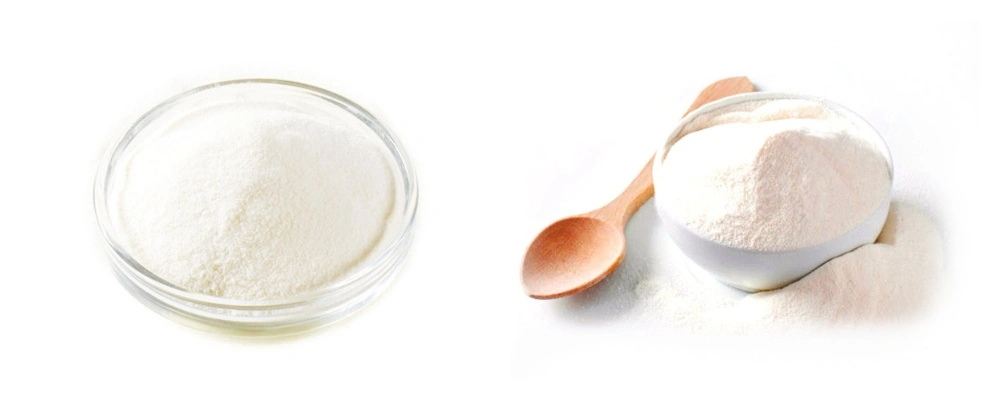
【English name】: yeast beta glucan powder
【Other name】: Beta-(1,3)-D-Glucan ; yeast dextran
【CAS No.】: 9012-72-0
【Molecular Formula】: (C 6 H 10 O 5 ) N
【Active ingredients】: Beta-1,3-1,6 Glucan
【Specification】: ≥70%
【Grade】 :Food Grade / Cosmetic Grade
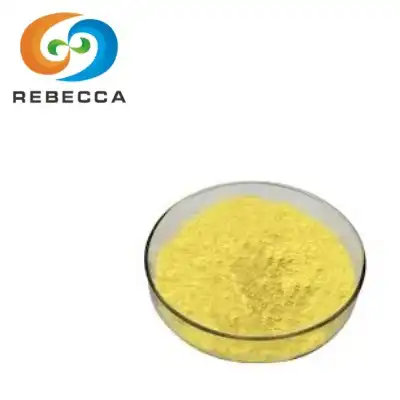
【Appearance】: Off-white or yellowish powder
【Mesh size】:80 Mesh
【Test Method】: HPLC
What Exactly Is Yeast Beta-Glucan
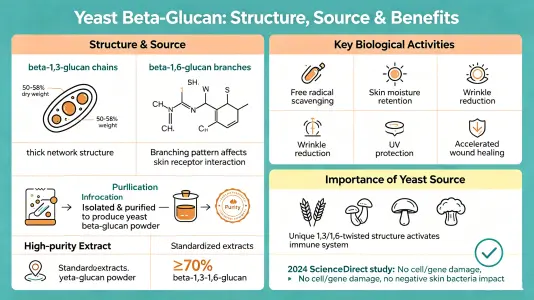
Structure and Source
Beta-glucan is a naturally occurring polysaccharide, which means it is made up of many glucose units joined together. In yeast, it makes up 50–58% of the dry mass of the cell wall and forms a thick meshwork inside it. The specific chemical structure of Saccharomyces cerevisiae is mostly made up of Beta-1,3-glucan links and Beta-1,6-glucan branches. This branching pattern is a big deal in the world of chemistry. In turn, this affects how strongly the chemical reacts with skin receptors and, as a result, how well it triggers the skin's defence and repair systems. 、
These cell wall parts are separated and cleaned to make yeast beta glucan powder. The most stable and repeatable results can be found in formulas that use high-purity extracts, like those that are standardised at ≥70% active Beta-1,3-1,6 glucan. Research on PubMed shows that beta-glucan's bioactivities include protecting against free radicals, keeping wetness in the skin, fighting wrinkles, protecting against UV light, and speeding up the healing of wounds.
Why the Yeast Source Matters
Beta-glucan can also be found in wheat, oats, and mushrooms. But the form made from yeast has a special twisted 1,3/1,6-glucan structure that makes it very good at activating the immune system. A safety review released in ScienceDirect in 2024 proved that glucans from Saccharomyces cerevisiae do not harm cells or genes and do not affect the skin bacteria negatively. This makes them a good choice for use in both beauty and food-grade products.
How Does Yeast Beta-Glucan Improve Skin Hydration and Barrier Function
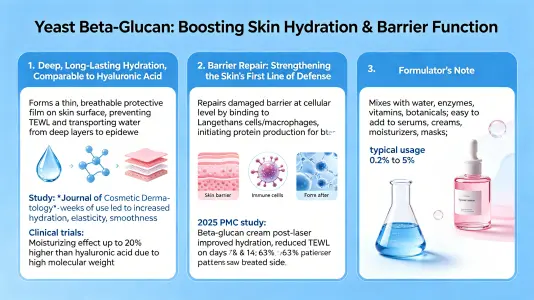
Deep, Lasting Moisture That Rivals Hyaluronic Acid
Getting enough water is important, but it's not the end of the story. When yeast beta glucan powder is put on the skin, it makes a thin, airy film on top of it. Trans-epidermal water loss (TEWL) is stopped by this film, which also pulls water from lower layers of skin to the epidermis. The result is long-term hydration instead of a short-term increase in surface volume.
A study in the Journal of Cosmetic Dermatology discovered that using products with beta-glucan made skin much more hydrated, elastic, and smooth after just a few weeks. Based on some clinical tests, the molecule may be up to 20% more moisturising than hyaluronic acid. This is mostly because beta-glucan has a high molecular weight, which means it not only holds water but also links to receptors that set off the skin's own moisture-retention pathways.
Barrier Repair: Supporting the Skin's First Line of Defense
Many common skin problems are caused by a damaged skin barrier, such as dryness and sensitivity that won't go away and redness after rough weather or too much scrubbing.This is taken care of at the cellular level by yeast beta glucan powder. It engages with certain receptors on Langerhans cells and macrophages, which are immune cells that patrol the skin. This starts an organised repair reaction. Proteins that act as barriers are made. Short-term discomfort goes away. Over time, this makes the face look calmer and stronger.
A study from PMC in 2025 talks about a clinical trial where using a beta-glucan cream after laser treatment made the skin much more hydrated and lowered TEWL at both Days 7 and 14, compared to a vehicle control. Over 63% of patients said that the beta-glucan side of their face had better results. These are not claims made about makeup; they are measured, peer-reviewed results.
Formulators should keep this in mind: It is possible for yeast beta glucan powder to mix with water and enzymes, vitamins, and plant products. This makes it easy to add to serums, essences, moisturisers, and sheet masks, where amounts of 0.2 to 5 percent are common.
Can Yeast Beta-Glucan Help With Anti-Aging and Skin Renewal
Stimulating Collagen and Restoring Firmness
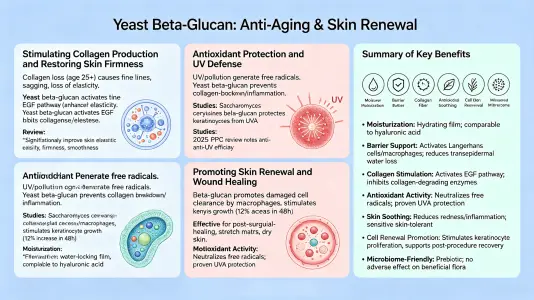
Loss of collagen is the main cause of noticeable ageing. When you hit your mid-20s, your body starts making less collagen every year. This makes your face get fine lines, sag, and lose its bounce. There are two different ways that yeast beta glucan powder stops this process.
First, it turns on Epidermal Growth Factor (EGF) pathways in the skin. This then increases the activity of fibroblasts, which are cells that make collagen and elastin. Second, it stops the enzymes (collagenase and elastase) that break down collagen that is already there. All of these things work together to protect and repair the skin's basic proteins. It was written in a review that using yeast-derived beta-glucan regularly leads to a "pronounced improvement in the skin's elasticity, firmness, and smoothness."
Antioxidant Protection and UV Defense
UV rays and pollution in the surroundings damage free radicals, which speed up skin ageing much more than age alone would. In response, yeast beta glucan powder works as an antioxidant to stop reactive oxygen species from breaking down collagen or starting a chain of inflammation.
A study from more than 20 years ago in the International Journal of Cosmetic Science showed that carboxymethylated beta-glucan from Saccharomyces cerevisiae protects keratinocytes, which are the main type of cell in the top layer of skin, from UV-A rays. Recently, a review in PMC (2025) showed that beta-glucans from yeast and fungi can protect against UV light both in vitro and in vivo. This makes the ingredient a useful addition to photoprotection plans.
Supporting Skin Renewal and Wound Recovery
Yeast beta-glucan does more than just protect against damage; it also helps the skin restore itself. It makes macrophages work to get rid of damaged cells and encourages the growth of keratinocytes, which are the cells that repair the skin's surface. In one study, keratinocyte growth went up by 12% after just 48 hours of beta-glucan treatment. This effect on cell turnover is what makes the ingredient good for improving healing after surgery, lowering the look of stretch lines, and helping dry, damaged skin heal. When it comes to water, it forms a film that keeps wetness in and is as good as or better than hyaluronic acid in clinical settings.
· Hydration: Forms a moisture-retaining film; comparable to or exceeding hyaluronic acid in clinical settings.
· Barrier support: Activates Langerhans cells and macrophages; reduces trans-epidermal water loss.
· Collagen stimulation: Activates EGF pathways; inhibits collagen-degrading enzymes.
· Antioxidant activity: Neutralizes free radicals; provides documented UV-A protective capacity.
· Skin soothing: Reduces redness and inflammatory signals; well-tolerated by sensitive skin.
· Cellular renewal: Promotes keratinocyte proliferation; supports post-procedure recovery.
· Microbiome-friendly: Acts as a prebiotic; no adverse impact on beneficial skin bacteria.
Yeast Beta Glucan Powder Supplier: Rebecca Bio-Tech
Picking the right production partner is the first step in getting a reliable, high-purity yeast beta glucan powder. Rebecca Bio-Tech is a high-tech company based in Shaanxi, China, that focuses on exports. They do study on plant extracts, herbal active ingredient separation, and functional compounds used in traditional Chinese herbal medicine. Rebecca Bio-Tech has more than 100 types of plant extract products and can make more than 500 metric tonnes of them every year. They sell these ingredients to companies all over the world that make medicines, health products, drinks, and cosmetics.
Rebecca Bio-Tech can help you with a stable supply, uniform batch quality, and full technical support whether you are making a barrier-repair makeup line, a useful health supplement ingredient, or a high-end skin care product. With a team focused on R&D and export compliance, our production sites run on three separate lines.
Ready to request a sample or discuss your formulation requirements? Contact our team directly:information@sxrebecca.com
FAQs
1. What is the difference between yeast beta-glucan and oat beta-glucan for skin?
They are both glucan polysaccharides, but their structures are different. Yeast beta-glucan, which comes from Saccharomyces cerevisiae, has a twisted Beta-1,3/1,6-glucan structure that works very well to boost the immune system and bind to skin receptors. oat beta-glucan is mostly Beta-1,3/1,4-linked and is valued for its ability to soothe and moisturise. Beta glucan powder made from yeast usually has a wider range of uses when it comes to barrier repair and collagen stimulation.
2. Is yeast beta-glucan powder safe for sensitive skin formulations?
Yes. A broad safety review released in ScienceDirect in 2024 found that glucans from Saccharomyces cerevisiae did not harm cells or genes, make skin more sensitive, or have a bad effect on the microbiome. A lot of people think it is one of the safest bioactive polysaccharides to use in beauty products. But people who are known to be allergic to grains or yeast should do a patch test before using.
3. At what concentration should yeast beta-glucan powder be used in cosmetic formulations?
Rates of use in finished mixtures usually run from 0.2% to 5%, based on the type of product and the result that is wanted. Most of the time, serums and essences use higher ratios than moisturisers and cleaners. The element can be mixed with water and added to the water phase of most formulas.
4. How long does it take to see results from yeast beta-glucan in skincare?
After 30 days of regular use, clinical data shows that skin's hydration, clarity, suppleness, and antioxidant ability all get better. Within the first one to two weeks, you may notice some changes, especially effects that soothe and strengthen the barrier.
5. Is yeast beta-glucan powder available in both food grade and cosmetic grade?
Yes. There are good sources that sell both food-grade and cosmetic-grade yeast beta glucan powder to companies that make ingredients for health supplements, useful foods, and skin care products. Before you buy, you should always check the standard (pure 70%), mesh size, and test method documents.
References
1. Schiano et al. (2021). Skin hydration, brightness, elasticity, and antioxidant capacity after β-glucan use.
2. Sousa et al. (2023). β-Glucan extracts as high-value multifunctional ingredients for skin health: A review.
3. Zulli et al. (1998). Carboxymethylated β-glucan from Saccharomyces cerevisiae and UV-A protection.
4. Cao et al. (2021). β-Glucan skincare regimen after CO2 fractional laser: hydration and TEWL outcomes.
5. Vibrant Skin Bar (2025). Beta-Glucan for the Skin.
6. Tessin Biotechnology (2025). Can Yeast Beta Glucan be used in cosmetics?