What is the difference between creatine monohydrate and creatine hcl?
The main difference between creatine monohydrate and creatine HCL is the molecular structure and solubility. Creatine monohydrate is only a creatine molecule coupled to a molecule of water . This is the type that has been studied the most, and has decades of clinical validity. Creatine HCL is bound to hydrochloric acid and has a much higher water solubility and needs fewer serving quantities. Both are used in the sports nutrition and supplement industry but the difference in production cost, dose efficiency and formulation flexibility means that B2B buyers looking at ingredient sourcing methods will have different procurement paths.
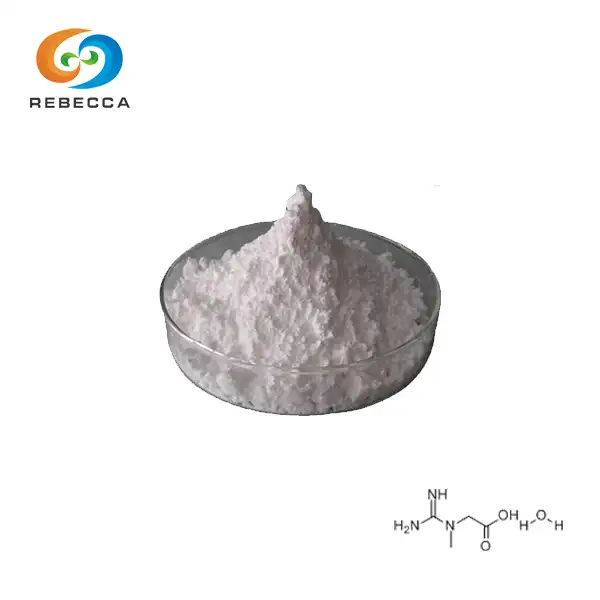
Micronized Creatine Monohydrate
【Product name】: Creatine Monohydrate
【Specification】 99.5%-102.0% 【CAS No.】: 6020-87-7
【Molecular Formula】: C4H11N3O3
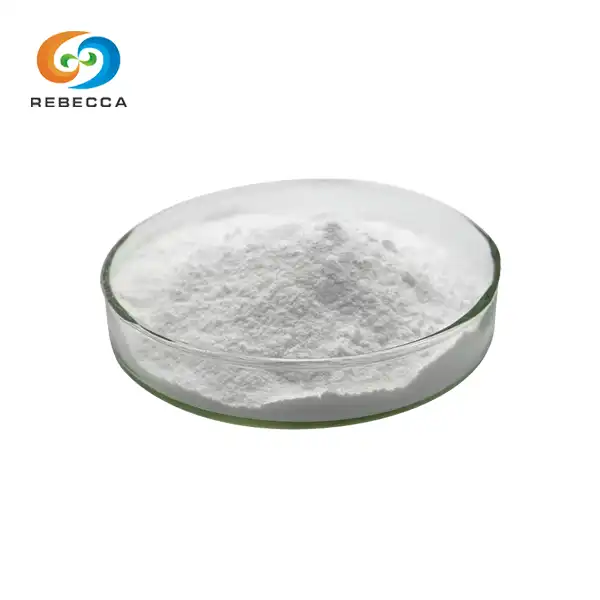
【Appearance】:White crystal or white powder
【Test Method】: HPLC
Shelf Life: 2 years
Minimum Order Quantity: 1 kg
Samples: Free samples available
Certifications: GMP, ISO, HACCP, KOSHER, and HALAL.
Payment: Various payment methods accepted.
Advantages: Manufactured in a 100,000-grade cleanroom, our products are additive-free, non-GMO
Inner Package: Double PE Bags; Net 5kg/Bag
Outside Package: Paper Drums, Net 25kg/Drum
Storage:Store in a cool, dry place away from Light and Heat.
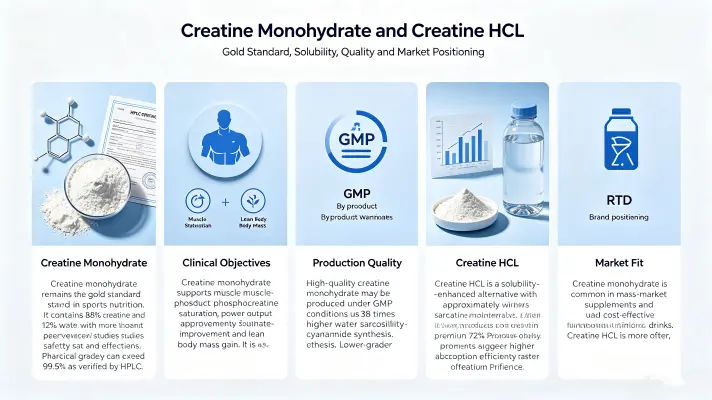
Understanding Creatine Monohydrate and Creatine HCL
The Gold Standard: Creatine Monohydrate
Creatine monohydrate is still the gold standard in sports nutrition compounds. This form has an estimated molecular makeup of 88% creatine and 12% water by weight, with over 1,000 peer-reviewed studies supporting its safety and effectiveness profile. The manufacturing techniques are far more sophisticated with pharmaceutical grade purity levels of more than 99.5% as validated by HPLC testing methods.
The substance has been widely used because it consistently delivers on clinical goals such muscle phosphocreatine saturation, increases in power output and lean mass development. The Sarcosinate-Cyanamide synthesis method under GMP conditions is used by manufacturing plants to produce the highest quality creatine monohydrate. The lower grade creatine monohydrate products include certain byproducts such as dicyandiamide and dihydrotriazine that are of concern.
The Emerging Alternative: Creatine HCL
Creatine hydrochloride was brought into the supplement industry as a solubility-enhanced option to help solve some of the formulation problems. By attaching creatine to hydrochloric acid molecules, producers got around 38 times better water solubility than the monohydrate version. This property may be useful in potential ready-to-drink beverage applications in which settling of ingredients and textural problems have historically limited formulation alternatives.
Creatine HCL provides around 72% creatine by weight compared to 88% in monohydrate due to the molecular weight difference. Proponents, however, claim that this disadvantage is outweighed by the increased efficiency of absorption . The ingredient is especially interesting for innovation managers designing premium product lines where tiny serving sizes and no loading stages are commercial differentiators.
Market Positioning and Customer Segments
Each type appeals to different consumer profiles depending on their procurement goals. Pharmaceutical R&D businesses often choose to use creatine monohydrate for active pharmaceutical ingredient applications, since it has significant documentation for regulatory filings and decades of safety data. Brands in the health supplement industry are carefully tapping into both – using monohydrate for popular, value-driven goods and HCL for premium lines geared toward convenience-minded shoppers.
Functional beverage makers have unique formulation limits. Often the selection of ingredients is determined by heat stability in processing, flavour masking, and suspension stability in liquid matrices. The most common type of creatine is creatine monohydrate because of cost benefits. Creatine HCL is used in more complex ready-to-drink formulations where its solubility features may support premium price structures.
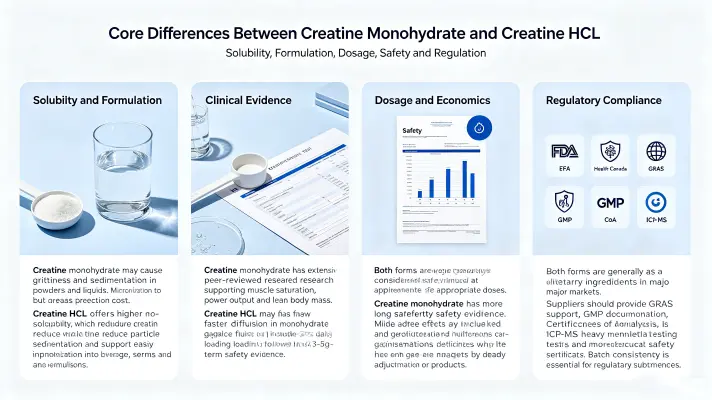
Core Differences Between Creatine Monohydrate and Creatine HCL
Solubility and Formulation Impact
The difference in solubility has ripple implications across product development and manufacture. Creatine monohydrate has to be formulated carefully in order to minimise grittiness in powdered supplements and settling in liquid applications. Micronization technologies, which reduce particle size to 200 mesh or below, partly overcome these limits but add to processing costs.
The increased solubility of Creatine HCL makes it easier to formulate in a variety of delivery systems. Beverage makers seek less particle formation and better stability throughout shelf life. For cosmetic chemists studying the use of creatine in skin care, they say, HCL is simpler to include into aqueous serums and lotions without creating textural problems.
These practical differences are confirmed by testing techniques. Dissolution tests showing the release profile in simulated stomach fluid, show the more rapid dispersion rates of Creatine HCL . Theoretically this feature promotes bioavailability although there is little clinical data to suggest absorption efficiency between the forms vs the substantial monohydrate research foundation.
Dosage Requirements and Cost Per Serving
Standard creatine monohydrate regimens are the ones to start with, ie, 3-5 grams daily following a loading period of 20 grams split over 4 daily doses (ie, 4 doses of 5 grams each). Creatine HCL producers recommend 1-2 grams per day, playing on the increased solubility to indicate you need less to get the same results.
From a procurement standpoint, these dose discrepancies need to be looked at carefully in terms of cost. Generally speaking, bulk creatine monohydrate is more cheaper per kilogram than creatine HCL. However, the actual cost per serving will vary depending on the suggested dose, the complexity of the formulation, and where the product is positioned in the target market. Higher ingredient costs may be absorbed by premium brands, which may also distinguish themselves with lower serving sizes and marketing promises around better absorption.
Packaging format also impacts cost structures. Monohydrate is economical for powdered supplements, but for single-serve packets and ready-to-drink liquids, HCL’s higher cost might be justified by its solubility, which makes production easier or permits new product categories.
Safety Profiles and Regulatory Compliance
Both types of creatine have been shown safe when taken at acceptable dosages. Creatine monohydrate is backed by significant long-term safety evidence including many studies that have examined indicators of kidney and liver function across a broad spectrum of individuals. Common adverse effects include water retention and minor gastrointestinal upset, although they are uncommon and often disappear with dose modification or better hydration habits.
Creatine HCL makers say smaller dosages are necessary, leading to less bloating and intestinal upset. Anecdotal evidence exists to support these claims, but well-controlled clinical investigations comparing the prevalence of adverse effects are limited. In reviewing safety data, procurement teams should be attentive to ingredient suppliers who provide detailed testing paperwork such as heavy metals testing by ICP-MS and microbiological testing panels that show the absence of dangerous contaminants.
In the main markets, legislation such as those of the FDA in the US, EFSA in Europe and Health Canada, define both forms of creatine as dietary constituents rather than as medications. Suppliers must provide paperwork that supports Generally Recognised as Safe (GRAS) certification and adhere to Good Manufacturing Practices. Batch consistency, as shown by Certificates of Analysis, is critical for companies submitting to regulators and for ensuring product quality from one manufacturing run to the next.
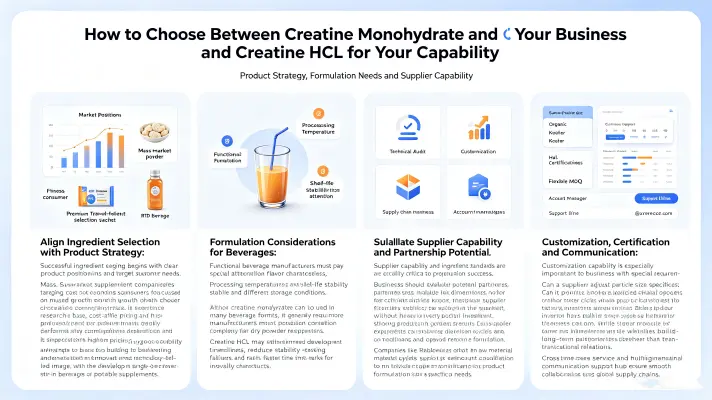
How to Choose Between Creatine Monohydrate and Creatine HCL for Your Business?
Aligning Ingredient Selection with Product Strategy
You have to be clear about your product positioning and the demands of your target customers to successfully pick ingredients. The mainstream supplement firms that cater to the budget-conscious client trying to gain muscle bulk choose creatine monohydrate. “Unmatched research base, budget-friendly pricing and proven efficacy make compelling value propositions that resonate with discerning fitness buffs.
extra product lines of Creatine HCL may be marketed as being more convenient, travel-friendly, or have purported absorption benefits, which might explain the extra price. The solubility features of HCL may be a competitive advantage for brands seeking to position themselves as innovative and scientifically advanced, especially for the development of single-serve packets, ready-to-mix drinks, or travel-friendly supplement systems.
Special concerns for functional beverage makers. The selection of ingredients is dictated by flavour profiles, processing temperatures, and shelf-life stability under different storage circumstances. Creatine monohydrate has been introduced effectively into several beverage forms; nevertheless, the formulation complexity rises relative to dry powder supplements. Creatine HCL may help meet development schedules and eliminate stability testing failures, therefore improving time-to-market for breakthrough product ideas.
Evaluating Supplier Capabilities and Partnership Potential
Supplier competencies are as much a determinant of procurement success as are ingredient standards. Assess prospective partners on many fronts: calibre of technical assistance, adaptability in customisation, robustness of supply chain, promptness in communication.
The best ingredient suppliers do more than just supply commodity items, they also give formulation help, stability testing support and regulatory paperwork aid. Supplier knowledge may cut development times and save expensive reformulation cycles in the creation of new product lines. Companies like as Rebecca provide ingredient supply and technical consulting, assisting product producers to optimise their formulations for their unique purposes.
The ability to customise is especially important for companies that have unique needs. Can particle size standards be modified by suppliers? Do they provide organic, kosher or halal certified options to cater to different market needs? Minimum order amounts may be flexible so developing businesses can explore markets without over-investing in inventory, and scalability allows existing brands to secure supplies during periods of growth.
The communication infrastructure should not be disregarded. Suppliers that provide several contact methods, such as specialised account managers, technical hotlines, and email addresses like information@sxrebecca.com, show that they are looking for a partnership rather than just a transactional connection. Seamless communication across multinational supply chains is made possible by time zone coverage and linguistic skills.‘’
Conclusion
Chemical differences alone are not enough to tell creatine monohydrate and creatine HCL apart and must be considered across numerous dimensions. Creatine monohydrate has the most research behind it, is the most cost effective and has well documented production techniques. It is the industry standard for mainstream uses. Creatine HCL has solubility benefits and dose ease that may warrant premium placement in some product categories.
Good procurement strategies match the selection of ingredients with the product positioning, the target consumer demands and the commercial reality. Work with proven quality consistency, regulatory and technical support skills of suppliers to build competitive advantages that last through your product lifetime. Whether you are acquiring creatine for pharmaceutical applications, health supplements, functional drinks or developing cosmetic formulations, intelligent decision making based on scientific knowledge and commercial pragmatism is the key to best results.
FAQ
Is creatine monohydrate safe for long-term bulk ingredient procurement?
Creatine monohydrate demonstrates excellent stability profiles supporting extended storage under proper conditions. Ingredient suppliers should provide stability data confirming minimal degradation over 24-36 months when stored in sealed containers at controlled temperatures below 25°C with relative humidity under 60%. Bulk purchasing strategies benefit from this stability, enabling economical inventory management without quality deterioration concerns that affect more sensitive ingredients.
How does creatine HCL's solubility advantage translate to formulation benefits?
Enhanced water solubility simplifies beverage applications and reduces formulation complexity across multiple delivery formats. Products experiencing reduced consumer complaints about grittiness or settling benefit measurably. However, procurement teams should conduct application-specific testing rather than assuming solubility automatically translates to superior finished products across all categories, as other formulation variables significantly influence user experience.
What quality certifications should buyers prioritize when sourcing creatine ingredients?
GMP certification demonstrates systematic quality management essential for pharmaceutical and supplement applications. ISO 22000 and HACCP certifications signal food safety commitment relevant across health supplement and functional food categories. For athletic populations, suppliers supporting third-party testing programs like Informed-Choice or NSF Certified for Sport provide added value through independent verification of label accuracy and absence of prohibited substances.
Partner with Rebecca for Premium Creatine Monohydrate Supply
Rebecca is standing by to help you with your creatine monohydrate sourcing needs with pharmaceutical grade products made under rigorous quality norms. Shaanxi manufacturing facilities provide 99.5%-102.0% purity criteria, confirmed by HPLC testing, and are supported by complete quality documentation including batch-specific Certificates of Analysis and MSDS safety data.
We know procurement professionals need more than just basic materials. You need trusted alliances that support your product success. Our technical staff supports you in efficiently developing your product with formulation consultancy, assistance on stability testing, and regulatory support documents. Our yearly manufacturing capacity exceeds 500 metric tonnes, and we can adapt minimum order quantities to fit organisations at any level of development.
Experience our quality commitment through complimentary samples enabling independent verification before bulk orders. Contact our team at information@sxrebecca.com to discuss your specific requirements, request technical specifications, or explore how partnering with an experienced creatine monohydrate manufacturer enhances your supply chain reliability and product quality outcomes.
References
1. Kreider, R.B., et al. "International Society of Sports Nutrition Position Stand: Safety and Efficacy of Creatine Supplementation in Exercise, Sport, and Medicine." Journal of the International Society of Sports Nutrition, 2017.
2. Buford, T.W., et al. "International Society of Sports Nutrition Position Stand: Creatine Supplementation and Exercise." Journal of the International Society of Sports Nutrition, 2007.
3. Jäger, R., et al. "Analysis of the Efficacy, Safety, and Regulatory Status of Novel Forms of Creatine." Amino Acids, 2011.
4. Antonio, J., et al. "Common Questions and Misconceptions about Creatine Supplementation: What Does the Scientific Evidence Really Show?" Journal of the International Society of Sports Nutrition, 2021.
5. Miller, D.W., et al. "Oral Bioavailability of Creatine Supplements: Is There Room for Improvement?" Annual Review of Food Science and Technology, 2020.
6. Harris, R.C., et al. "The Absorption of Orally Supplied β-alanine and Its Effect on Muscle Carnosine Synthesis in Human Vastus Lateralis." Amino Acids, 2006.