What is the difference between pure creatine and creatine monohydrate?
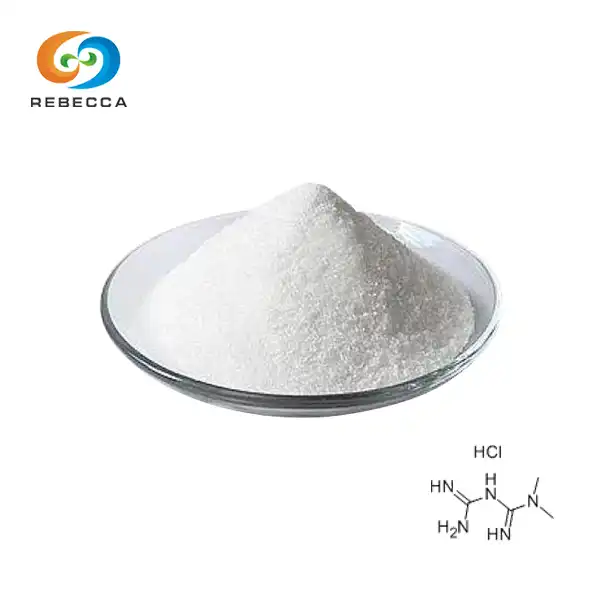
creatine monohydrate
Creatine is one of the most often utilised substances in sports nutrition & performance supplements. However, many customers, formulators and brand owners become confused when comparing “pure creatine” with “creatine monohydrate”. The names are commonly used interchangeably in marketing brochures, however they do not necessarily relate to the same thing.
Understanding the difference is critical when analysing raw material specifications, product claims, production needs and sourcing prices. Both types eventually get creatine to the body , but their chemical structure , handling properties and commercial uses may not.
Before we compare technical specs it is useful to establish what these phrases represent and how they are used in the supplement business.
Creatine: Pure Creatine vs. Creatine Monohydrate
What Does “Pure Creatine” Actually Mean?
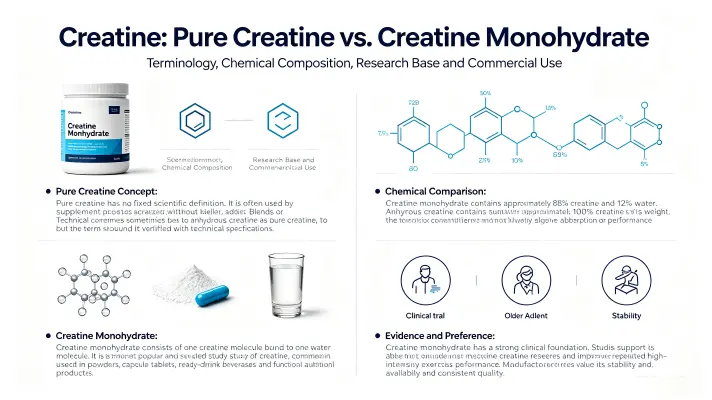
In scientific circles, the phrase "pure creatine" does not have a fixed meaning. Supplement companies often use the term to highlight the fact that their product is free of fillers, additives, and blending agents.
Therefore, the meaning might differ from one manufacturer to another.
It is common practice to refer to creatine anhydrous as "pure creatine" while having a technical conversation. This version has creatine but does not have any water molecules connected to it. The concentration of creatine per gram is somewhat greater than that of creatine due to the removal of water.
Creatine monohydrate has about 88% creatine and 12% water, but creatine anhydrous has roughly 100% creatine by weight, according to chemical analysis. Although this discrepancy seems substantial on paper, it is not always indicative of improved absorption or performance.
"Pure creatine" is more of a marketing word than a specific kind of substance; this is the most crucial thing for procurement teams to remember. Never trust a product description alone; instead, ask for comprehensive technical specs.
What Is Creatine Monohydrate?
Creatine monohydrate is the most popular type of creatine in the world today. It is one molecule of creatine combined with one molecule of water to form a solid crystalline structure that has been researched intensively for decades.
Creatine has been the standard of the sports nutrition industry since its inception, and all other forms of creatine have been measured against it. It’s quite common in powders, capsules, tablets, ready to mix drinks and functional nutrition products.
One reason for its appeal is the solid scientific base. A number of clinical trials have evaluated creatine monohydrate in a variety of demographics, including athletes, the elderly, leisure exercisers and military people. These studies are consistent in their support for its usefulness in raising muscle creatine reserves and boosting performance in repeated high-intensity exercise.
Manufacturers also like the consistency, availability and consistent quality properties of creatine monohydrate, in addition to its performance advantages. These benefits have helped it become the leading option for most commercial supplement formulations.
Having cleared up the terms, the next step is to consider the practical distinctions that matter when developing a product and acquiring ingredients.
Key Differences Between Pure Creatine and Creatine Monohydrate
Creatine Content Per Gram
The main chemical difference between the two types is the amount of creatine.
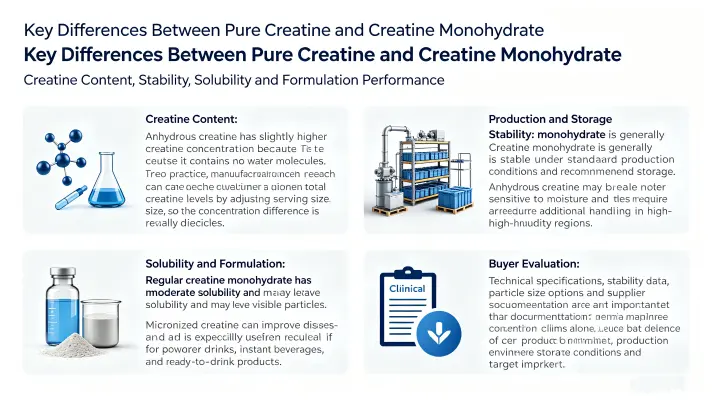
Creatine anhydrous has no water molecule, hence it contains a little more creatine by weight. In principle, one gram of creatine anhydrous contains more creatine than one gram of creatine monohydrate.
But in real-world supplements, this difference is quite minor. Manufacturers may simply alter serving sizes to deliver equal levels of creatine. Therefore, the concentration advantage seldom plays a decisive role in commercial formulations.
So a formulation that has to offer 5 grams of creatine may do so with either form by just altering the amount of the ingredient. Therefore the practical importance is usually little.
Stability During Manufacturing and Storage
Stability is one of the most essential concerns for purchasers of ingredients and producers of products. Creatine monohydrate has been shown to be quite stable under standard circumstances of manufacture. Properly managed, it retains its quality through all blending, encapsulating, tableting and packing operations. The crystalline structure also influences the predictablility of shelf life performance. Creatine is stable for lengthy periods of time under approved storage settings without appreciable deterioration.
Creatine anhydrous could suggest a greater concentration of active creatine, but it can also be more susceptible to exposure to moisture. This feature might need extra handling procedures in shipping and storage, particularly in high humidity areas. In big scale manufacturing, the stability of ingredients is typically more important than slight changes in concentration.
Solubility and Formulation Performance
Another element that is often considered is solubility. Regular creatine monohydrate is somewhat soluble in water and may leave some visible particles when put with drinks. This is typical behaviour and does not suggest a quality problem. Many firms employ micronised creatine to solve formulation problems. Micronization is the reduction of particle size and the improvement of dispersion properties without affecting the chemistry of the material.
Micronised grades are especially beneficial in powdered drinks, quick drink mixes, and ready-to-drink applications where texture and appearance are critical. Particle size selection may impact flowability and production efficiency for capsule and tablet products. Hence, mesh size requirements should be included in procurement specifications whenever practical.There are technical distinctions but many purchasers want to know whether one type is better than the other in terms of outcomes. Clinical evidence is important for understanding.
Comparing Bioavailability and Performance Benefits
Does Pure Creatine Absorb Better?
One of the most prominent marketing promises for different creatine formulations is better absorption. However, at this point in time, there is no data to suggest any large absorption benefits of creatine anhydrous over creatine monohydrate when the latter is dosed correctly.
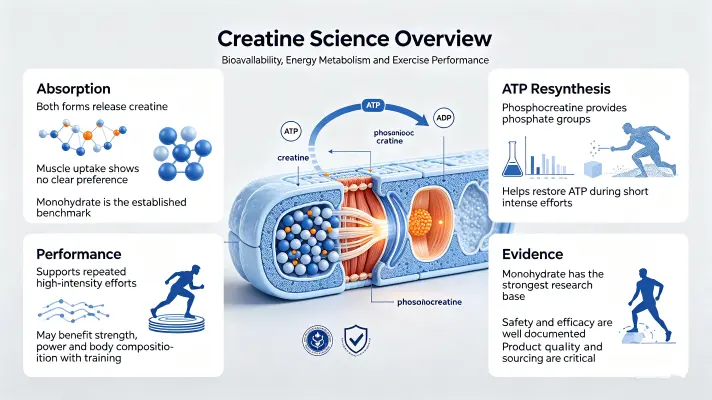
Both forms dissociate after ingestion and provide creatine that may be carried into muscle tissue. The body doesn't seem to have a clear physiological preference for either source. However, actual variations in absorption are often negligible when similar doses of creatine are provided. Hence why creatine monohydrate is still the benchmark against which many sports nutrition specialists compare alternative creatine supplements.
Effects on ATP Production and Exercise Performance
Both types have the same biological role in the body. Creatine helps to replenish adenosine triphosphate (ATP), which is the main energy source for muscular contractions. ATP reserves are quickly depleted during brief, strong exercise. Creatine phosphate provides phosphate groups for the regeneration of ATP. This technique allows for repeated high-intensity activities such as running, weight lifting, leaping and explosive sports motions.
Research has shown that elevating creatine reserves within the muscles may enhance the quality of training and aid in the development of strength and increased lean mass increases when paired with resistance training. Of significance, the present data do not support the idea that creatine anhydrous is more effective in promoting performance benefits compared to an equal dose of creatine base.
What Does the Research Say?
However, creatine monohydrate remains the most scientifically supported. It is still the most thoroughly-researched version accessible today. Sports nutrition organisations have issued many evaluations and policy statements concluding that creatine is useful and safe when taken correctly.
For companies that emphasise evidence-based formulas, this long research background is a big benefit. Scientific credibility may support product positioning and build customer trust. Performance advantages are simply one aspect of the purchase decision. The quality of ingredients and dependability of suppliers are as vital for long term success in company.
How to Choose the Right Creatine for Your Product?
Evaluate Purity and Quality Specifications
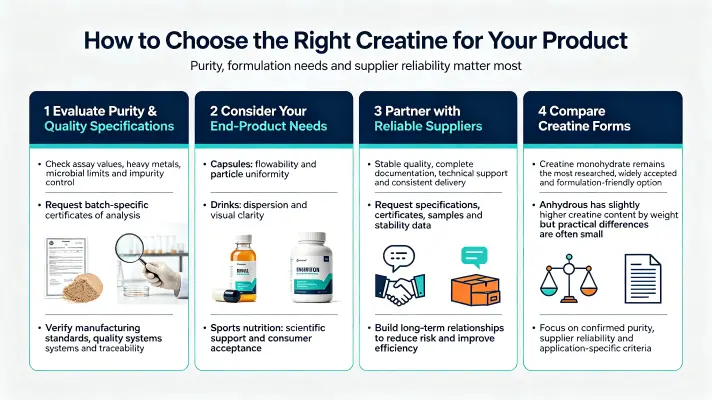
One of the first variables to look at when you’re buying creatine ingredients is purity. Good providers will give Certificates of Analysis verifying assay, heavy metal compliance, microbiological testing and impurity control. Documentation should be supplied for each manufacturing batch.
Procurement teams should also look at production standards, quality management systems, and traceability processes before accepting vendors. A quality ingredient is not only about assay value but also about uniformity of manufacturing and documentation.
Consider the Needs of Your Final Product
The optimal creatine grade varies based on the application. Capsule producers may choose flowability and particle size uniformity. Beverage formulators tend to concentrate on dispersion performance and visual appeal. Sports nutrition businesses may argue scientific support and consumer recognition.
Knowing the technical requirements of the final product will assist to avoid needless expenses and formulation issues. Creatine monohydrate often represents the best blend of performance, stability, research, and commercial viability in many circumstances.
Partner With a Reliable Supplier
Successful sourcing is about more than the ingredient alone. Reliable vendors offer consistent quality, comprehensive documentation, prompt technical assistance and predictable delivery dates.
When considering suppliers, customers should obtain product specifications, quality certificates, sample materials and stability data relevant to their planned use. Having a good connection with the supplier reduces risk and improves efficiency of production and supports the long term growth of the product.
The difference between pure creatine and creatine monohydrate is usually less than what marketing materials would have you believe. Creatine anhydrous has a slightly greater amount of creatine by weight, however creatine monohydrate is still the most studied, commercially acceptable and formulation friendly type.
For most supplement companies, contract manufacturers and ingredient purchasers, creatine remains the finest mix of scientific backing, production stability, quality consistency and cost-effectiveness. Buyers should concentrate on confirmed purity, supplier dependability and application-specific criteria to make educated sourcing selections that contribute to product performance and brand trust.
FAQ
What purity level should I specify when purchasing creatine monohydrate in bulk?
Pharmaceutical-grade applications require minimum 99.5% purity verified through HPLC analysis, with particular attention to Dicyandiamide (DCD) levels below 50 ppm. Health supplement brands typically accept 99%-99.5% ranges, though premium positioning may justify higher specifications. Request Certificate of Analysis documentation confirming assay results, heavy metal content, and microbial testing for every production lot.
How does particle size affect creatine monohydrate functionality?
Standard 80-mesh grades provide adequate dissolution for capsule and tablet manufacturing with superior flowability during automated processing. Micronized 200-mesh variants dissolve faster in aqueous solutions, preventing grittiness in ready-to-drink beverages and protein shakes. Specify mesh size based on end-application technical requirements rather than assuming finer particles inherently indicate superior quality.
Can creatine monohydrate remain stable during beverage pasteurization?
Properly manufactured creatine monohydrate withstands typical pasteurization temperatures (72-85°C for 15-30 seconds) without significant degradation to creatinine. Extended exposure above 90°C may accelerate conversion rates. Request stability testing data under your specific processing conditions, including pH ranges and thermal profiles, before finalizing formulation parameters.
Partner with Rebecca for Premium Creatine Monohydrate Supply
Rebecca is a reputable producer of creatine monohydrate, using modern extraction techniques and strict quality control procedures. We have a manufacturing facility in Shaanxi, China with 3 GMP certified production lines with an output of more than 500 metric tonnes per year. Specifications are confirmed as 99.5%-102.0% purity by HPLC examination. We provide full regulatory assistance with COA paperwork, MSDS papers and free samples for formulation testing prior to bulk commitments. Our R&D team works with customers to provide bespoke specifications to meet special application needs such as micronised grades for beverage systems or specified mesh sizes for encapsulation efficiency. Reach out to info@sxrebecca.com to discuss your creatine monohydrate sourcing requirements and find how our technical experience may assist you in meeting your product development goals.
References
1. Kreider, R.B., Kalman, D.S., Antonio, J., et al. "International Society of Sports Nutrition Position Stand: Safety and Efficacy of Creatine Supplementation in Exercise, Sport, and Medicine." Journal of the International Society of Sports Nutrition, 2017.
2. Cooper, R., Naclerio, F., Allgrove, J., Jimenez, A. "Creatine Supplementation with Specific View to Exercise/Sports Performance: An Update." Journal of the International Society of Sports Nutrition, 2012.
3. Buford, T.W., Kreider, R.B., Stout, J.R., et al. "International Society of Sports Nutrition Position Stand: Creatine Supplementation and Exercise." Journal of the International Society of Sports Nutrition, 2007.
4. Jäger, R., Purpura, M., Shao, A., Inoue, T., Kreider, R.B. "Analysis of the Efficacy, Safety, and Regulatory Status of Novel Forms of Creatine." Amino Acids, 2011.
5. Persky, A.M., Brazeau, G.A. "Clinical Pharmacology of the Dietary Supplement Creatine Monohydrate." Pharmacological Reviews, 2001.
6. Harris, R.C., Söderlund, K., Hultman, E. "Elevation of Creatine in Resting and Exercised Muscle of Normal Subjects by Creatine Supplementation." Clinical Science, 1992.