Blueberry Extract VS Pterostilbene
Chemically, bioavailability-wise, and functionally, pterostilbene and blueberry extract couldn't be more different. pterostilbene extract is a refined stilbene molecule with better lipophilicity, longer half-life, and higher cellular absorption, in contrast to blueberry extract, which provides a wide range of anthocyanins and polyphenols with known antioxidant effects. Pterostilbene, chemically known as CAS No. 537-42-8, is a blueberry and Vaccinium uliginosum L. plant-based dimethylated analogue of resveratrol. Due to its superior metabolic stability compared to traditional blueberry polyphenols and a molecular modification that makes it four times more bioavailable than resveratrol, pterostilbene is a sought-after component in cutting-edge pharmaceutical, nutraceutical, and cosmetic products.
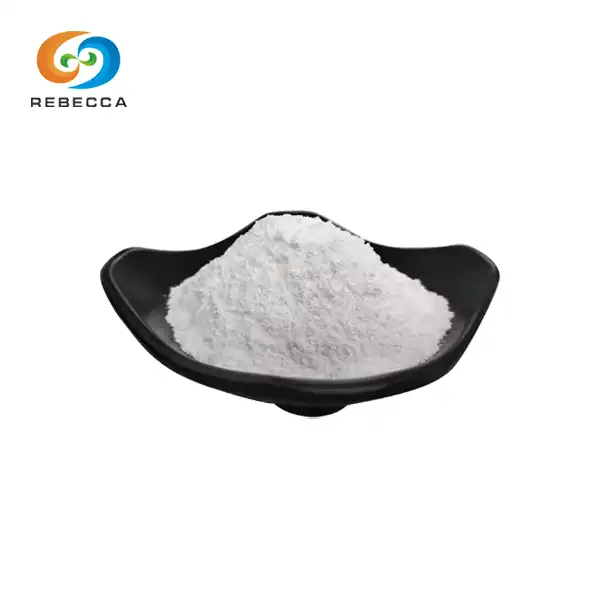
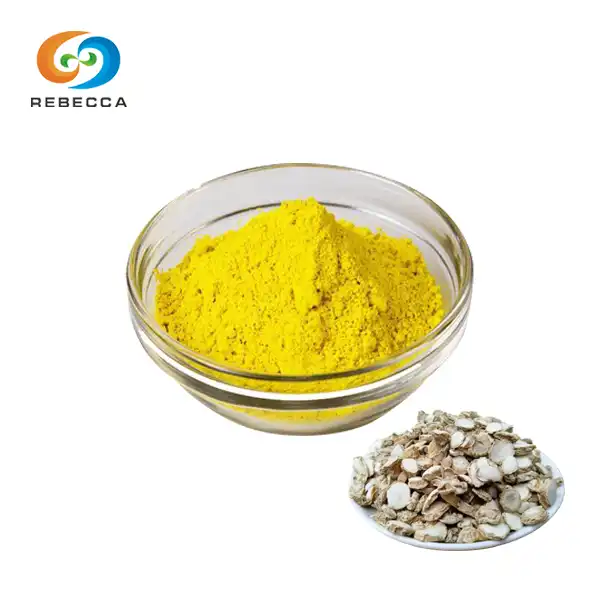
Product Name: Pterostilbene extract, Pterostilbene Powder
CAS No.: 537-42-8
Specification: Pterostilbene , Min 99%, HPLC.
Test Method: HPLC
Latin Name:Vaccinium uliginosum L.
Shelf Life: 2 years
Minimum Order Quantity: 1 kg
Samples: Free samples available
Certifications: GMP, ISO, HACCP, KOSHER, and HALAL.
Payment: Various payment methods accepted.
Advantages: Manufactured in a 100,000-grade cleanroom, our products are additive-free, non-GMO
Inner Package: Double PE Bags; Net 5kg/Bag
Outside Package: Paper Drums, Net 25kg/Drum
Storage:Store in a cool, dry place away from Light and Heat.
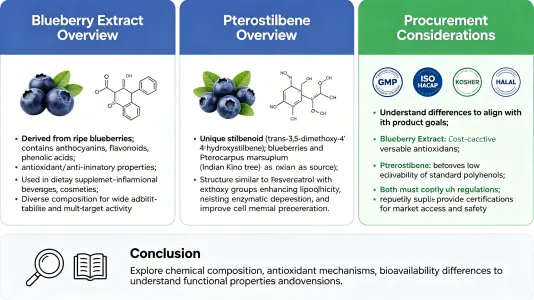
Overview of Blueberry Extract and Pterostilbene
Blueberry extract is obtained from ripe blueberries and contains phytochemicals such anthocyanins, flavonoids and phenolic acids . Their antioxidant and anti-inflammatory properties have made these compounds popular ingredients of health supplements, functional beverages and cosmetic products. The diverse composition of the extract makes it adaptable and capable of multi-targeted biological actions suitable for general wellness applications.
Pterostilbene, also known as trans-3,5-dimethoxy-4'-hydroxystilbene, is a unique stilbene compound. Blueberries are one of the good sources of pterostilbene extract. There are plant sources such as Pterocarpus marsupium widely known as the Indian Kino Tree. The structure of this compound is similar to that of resveratrol, but the presence of two methoxy groups in place of hydroxyls radically modifies its pharmacological profile. This structural advantage of pterostilbene boosts its lipid solubility, enabling it to endure quick enzymatic degradation and penetrate cell membranes more efficiently.
Having a good understanding of these variations helps procurement professionals to determine whether component fits with certain product development aims. The blueberry extract is an affordable and general antioxidant. The pterostilbene extract overcomes the main issue of the bioavailability failure of standard polyphenols. Both of them have to comply with rules. Reputable suppliers may prove this by providing certifications from organisations such as GMP, ISO, HACCP, KOSHER and HALAL which allow entry into foreign markets and ensure consumer safety.
Armed with the understanding of the fundamental properties and market positioning of blueberry extract and pterostilbene, let us go further into their chemical makeup, antioxidant mechanisms, and variances in bioavailability. Only then can we begin to comprehend why these two chemicals have differing functional performances and application benefits.
Chemical Composition and Antioxidant Properties
Phytochemical Profiles
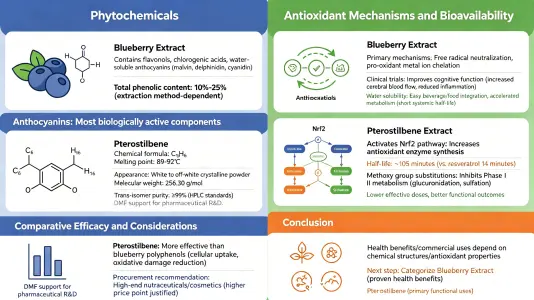
Blueberry extract also contains flavonols and chlorogenic acids, as well as water-soluble anthocyanins such as malvidin, delphinidin and cyanidin glycosides . They are antioxidants because they regulate oxidative processes and scavenge free radicals. The overall phenolic content may range between 10% and 25% depending on the extraction procedure and anthocyanins are the most bioactive component.
Pterostilbene has the chemical formula of C₁₆H₁₆ - this helps paint a better image of the molecule.O has a melting point of 89-92 degrees Celsius. It is a crystalline powder with a white to off-white appearance and a molecular weight of 256.30 g/mol. High purity pterostilbene minimises the generation of inactive cis-isomers while achieving a trans-isomer purity of ≥99% and meeting HPLC purity specifications. Such a high purity level is vital for pharmaceutical R&D companies that need stable active pharmaceutical ingredients with DMF support to ensure a consistent performance from batch to batch.
Antioxidant Mechanisms and Bioavailability
Direct neutralisation of free radicals and chelation of pro-oxidant metal ions are the main mechanisms by which blueberry extract exerts its antioxidant properties. Clinical trials have shown that it may improve cognitive performance by increasing blood flow to the brain and decreasing inflammatory markers. While anthocyanins' water solubility makes them easy to include into drinks and functional meals, it also speeds up metabolism and reduces their systemic half-lives.
The Nrf2 pathway, which is responsible for regulating the cellular antioxidant response, is activated by pterostilbene extract. This process increases the synthesis of antioxidant enzymes in the body, which provides long-term protection against oxidative stress. The methoxy-substitution that drives pterostilbene's longer half-life—approximately 105 minutes compared to resveratrol's 14 minutes—drives the inhibition of fast Phase II metabolism, which includes glucuronidation and sulfation. Lower effective doses and improved functional outcomes in final goods are the results of this prolonged bioavailability.
The cellular absorption and efficacy in lowering oxidative damage indicators are consistently better in pterostilbene compared to blueberry polyphenols, according to research. Pterostilbene is a better choice than traditional blueberry extracts for procurement teams aiming for high-end supplement lines or cosmetic formulations with proven effectiveness, even if it is more expensive.
Their distinct health benefits and potential commercial uses are dictated by the chemical structures and antioxidant properties of the two substances. To help with product formulation innovation, we will next categorise blueberry extract according to its confirmed health advantages and pterostilbene according to its major functional use domains.
Health Benefits and Functional Applications
Established Benefits of Blueberry Extract
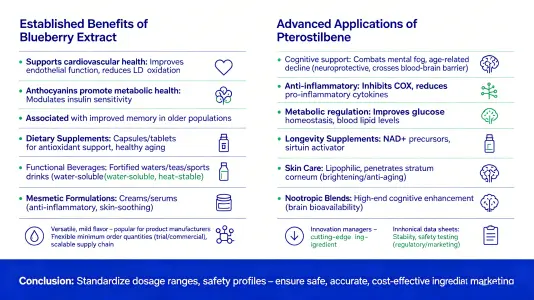
Blueberry extract supports cardiovascular health by improving endothelial function and reducing LDL oxidation. Its anthocyanins contribute to metabolic wellness through insulin sensitivity modulation and have been linked to improved memory performance in aging populations. Common applications include:
· Dietary supplements: Capsules and tablets targeting general antioxidant support and healthy aging
· Functional beverages: Fortified waters, teas, and sports drinks requiring water-soluble, heat-stable ingredients
· Cosmetic formulations: Creams and serums leveraging anti-inflammatory and skin-soothing properties
The versatility of blueberry extract and its moderate flavour profile make it a popular choice among product producers. Flexible minimum order numbers allow for both trial runs and commercial production, while scalable supply chains guarantee dependable availability for high-volume manufacture.
Advanced Applications of Pterostilbene
To combat mental fogginess and age-related cognitive loss, cognitive support formulations may benefit from pterostilbene extract, which has potent neuroprotective properties and effectively crosses the blood-brain barrier. It inhibits cyclooxygenase (COX) and reduces pro-inflammatory cytokines, two of the several mechanisms by which it exerts its anti-inflammatory effects. Studies have shown better glucose homeostasis and lipid profiles, lending credence to its function in metabolic control.
Industry applications leverage pterostilbene's unique physical properties:
· Longevity supplements: Combined with NAD+ precursors in advanced biohacking formulations as a potent sirtuin activator
· Dermocosmetic products: Lipophilic nature enables effective penetration through the stratum corneum for brightening and anti-aging serums
· Nootropic blends: Premium cognitive enhancement products requiring ingredients with documented brain bioavailability
Managers of innovation who are working on functional product formulations might use pterostilbene to their advantage by marketing it as a cutting-edge ingredient. Regulatory filings and marketing claims substantiation are made easier with technical data sheets that prove stability in processing conditions and safety test findings.
It is critical to further standardise the appropriate dose ranges and safety profiles of blueberry extract and pterostilbene after elucidating their respective efficacies and application variances. This allows the procurement teams and formulators to ensure safe, accurate, and economical ingredient matching throughout manufacturing.
Dosage, Safety, and Side Effects
Recommended Dosage Parameters
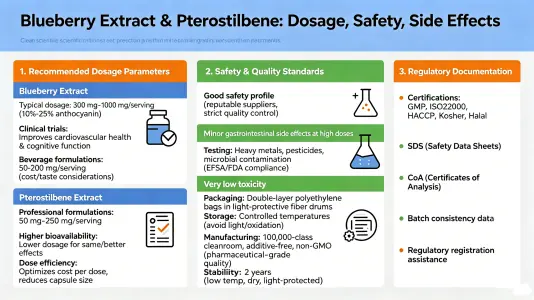
Standardised to a certain anthocyanin concentration (often 10%-25%), the dose of blueberry extract in dietary supplements normally ranges from 300 mg to 1,000 mg per serving. The results of clinical trials showing improvements to cardiovascular health and cognitive function are consistent with these levels. Lower concentrations (50-200 mg per serving) may be used in beverage formulations, taking into account cost and taste concerns.
Pterostilbene extract is used in professional formulations with doses ranging from 50 mg to 250 mg per serving, according to research published on its effectiveness. Because it is more bioavailable, less of it is needed to provide the same or better functional effects than blueberry extract, even at lower absolute doses. Because of this dosage efficiency, manufacturers may optimise their cost-per-dose and reduce the size of their capsules.
Safety Profiles and Quality Standards
When purchased from trustworthy vendors who strictly enforce quality control requirements, both substances have favourable safety profiles. Although some people may have modest gastrointestinal side effects at very high dosages, blueberry extract generally has few negative effects across various demographics. Heavy metal, pesticide residue, and microbiological contamination testing is standardised to guarantee consumer safety and regulatory compliance according to EFSA and FDA regulations.
Clinical and experimental trials on pterostilbene extract have shown little toxicity. When sourcing, be sure to use protective packaging (such as double PE bags in light-proof fibre drums) and store them at a regulated temperature to avoid light and oxidation sensitivity. The products that are made in additive-free, non-GMO procedures in 100,000-grade cleanrooms exceed the standards for delicate applications that are required by the pharmaceutical industry. The stability and efficacy of the ingredients are preserved for up to two years when stored in the correct circumstances (cold, dry, and shielded from light).
Certifications (GMP, ISO22000, HACCP, KOSHER, HALAL), safety data sheets, and certificates (CoA) are all pieces of regulatory documents that help with product registration in global marketplaces and with procurement choices. Suppliers who provide batch consistency data and assistance with registration in difficult regulatory settings are a boon to R&D managers.
Conclusion
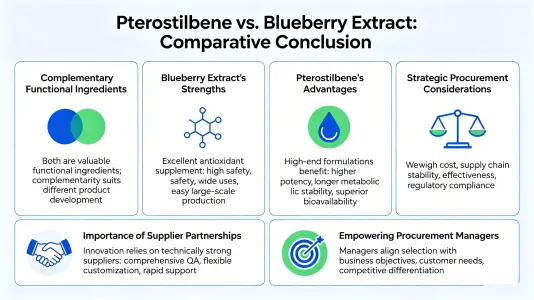
Both pterostilbene and blueberry extract are useful functional ingredients, but they complement one another in different ways and are best used for different types of product development. With its well-documented safety profile, wide range of potential uses, and affordable scalability, blueberry extract is an excellent antioxidant supplement. Premium formulations aiming for improved health results may benefit from pterostilbene extract's increased potency, prolonged metabolic stability, and higher bioavailability.
When making strategic purchasing selections, it is important to weigh the following factors: overall cost, supply chain stability, ingredient effectiveness, and regulatory compliance. Product innovation in the pharmaceutical, nutraceutical, functional food, and cosmetic industries is made possible via partnerships with technically competent suppliers that provide thorough quality assurance, adaptable customisation, and rapid support. When purchasing managers are aware of these distinctions, they are better able to match ingredient choices with business goals, customer needs, and competitive differentiation strategies.
Source Premium Pterostilbene Extract from Rebecca
Research and development managers, product developers, and procurement experts all across the globe rely on Rebecca to meet their stringent demands for pharmaceutical-grade pterostilbene extract. Three specialised production lines run in 100,000-grade cleanrooms as part of our sophisticated manufacturing infrastructure, guaranteeing additive-free, non-GMO ingredients that are up to par with global standards. From pilot-phase testing to commercial manufacture, Rebecca offers scalable supply solutions with a production capacity surpassing 500 metric tonnes per year and thorough certifications (GMP, ISO, HACCP, KOSHER, HALAL).
Vaccinium uliginosum L. is the source of our pterostilbene extract, which has a minimum purity level of 99% as confirmed by HPLC technology and, when stored correctly, may be kept for up to two years. We provide free samples to help you test applications and optimise formulations, and our minimum purchase quantities start at 1 kilogram, so we can handle a wide range of project sizes. The ingredient integrity is preserved throughout international transportation with double PE bag packing inside protective fibre drums. Procurement processes are made easier with multiple payment terms and delivery choices (FOB, CIF, DDP).
Help with regulatory paperwork, stability testing recommendations, and bespoke formulation creation are all part of the extensive support offered by Rebecca's technical team. We provide uniform specification sheets, safety test data, and batch consistency reports that accelerate regulatory clearances as an experienced pterostilbene extract supplier. We understand the intricacies of worldwide compliance. Discuss your project needs, get complete technical details, and get competitive quotes by contacting information@sxrebecca.com or visiting sxrebecca.com. Rely on Rebecca's premium botanical extracts, supported by her dependable service and established quality guarantee, to revolutionise your product creativity.
FAQ
What are the primary natural sources of pterostilbene beyond blueberries?
Among the many natural plant sources of pterostilbene, one of the most well-known is the heartwood of the Indian Kino Tree, or Pterocarpus marsupium. There are trace levels in grapes, particularly in certain Vitis species, although commercial extraction is focused on sources with a larger yield. Although nature-identical synthesis is being used more and more in industrial production for its efficiency and purity benefits, blueberries (Vaccinium species) still serve as a well-known and consumer-friendly source. If you need to verify the source for marketing claims or regulatory filings, carbon-14 dating tests can tell you if something is natural or manufactured.
How does bioavailability impact functional effectiveness in finished products?
The amount of a consumed substance that enters the bloodstream in an active state is directly correlated to its bioavailability. The methoxy groups on pterostilbene make it more lipophilic, which lowers first-pass metabolism and makes it easier to absorb across intestinal membranes. Because of its unique structural property, it outperforms water-soluble blueberry anthocyanins and has a bioavailability that is almost four times greater than resveratrol. Reduced raw material costs per serving without sacrificing efficacy are possible because to increased bioavailability, which allows for lower effective doses. Development teams working on products with targeted health outcomes may include compounds with proven bioavailability profiles backed by pharmacokinetic research.
What criteria should procurement teams use to evaluate supplier reliability?
There are technical, quality, and business aspects to consider while evaluating suppliers. The technical capabilities include research and development assistance, process technologies (such as supercritical extraction and cleanrooms), analytical equipment (such as HPLC purity verification), and analytical equipment. Comprehensive certifications (GMP, ISO22000, HACCP), third-party testing processes, and batch consistency documentation are necessary components of quality systems. Production capacity (the ability to scale), transparency in the supply chain (the ability to track raw materials), adjustable minimum order quantities (MOQs), and helpful customer service are all commercial considerations. Reducing procurement risk is an important aspect of international experience, which includes being acquainted with the legislation of the target market and having effective logistical coordination. The supplier's dedication to the success of the collaboration is shown by their readiness to offer extensive technical documentation and the availability of free samples.
References
1. Chang, J., Rimando, A., Pallas, M., et al. (2012). "Low-dose pterostilbene, but not resveratrol, is a potent neuromodulator in aging and Alzheimer's disease." Journal of Cellular and Molecular Medicine, 16(9), 2087-2095.
2. Kapadia, G.J., Azuine, M.A., Sridhar, R., et al. (2010). "Chemoprevention of DMBA-induced UV-B promoted, NOR-1-induced TPA promoted skin carcinogenesis, and DEN-induced phenobarbital promoted liver tumors in mice by extract of beetroot." Pharmacological Research, 62(6), 463-472.
3. Rimando, A.M., Kalt, W., Magee, J.B., et al. (2004). "Resveratrol, pterostilbene, and piceatannol in Vaccinium berries." Journal of Agricultural and Food Chemistry, 52(15), 4713-4719.
4. McCormack, D., McFadden, D. (2013). "A review of pterostilbene antioxidant activity and disease modification." Oxidative Medicine and Cellular Longevity, Article ID 575482.
5. Kosuru, R., Rai, U., Prakash, S., et al. (2016). "Pterostilbene decreases cardiac oxidative stress and inflammation via activation of AMPK/Nrf2/HO-1 pathway in fructose-fed diabetic rats." Cardiovascular Drugs and Therapy, 30(1), 47-60.
6. Riche, D.M., McEwen, C.L., Riche, K.D., et al. (2013). "Analysis of safety from a human clinical trial with pterostilbene." Journal of Toxicology, Article ID 463595.
_1730079799361.webp)