Can garlic oil be absorbed through the skin?
For thousands of years, garlic has been valued in both traditional medicine and cuisine. However, formulators, researchers, and purchasers of ingredients often ask the same question: Is it possible for the skin to absorb natural garlic oil ? In a nutshell, the answer is yes, at least somewhat. There is some very intriguing biology in the extended response.
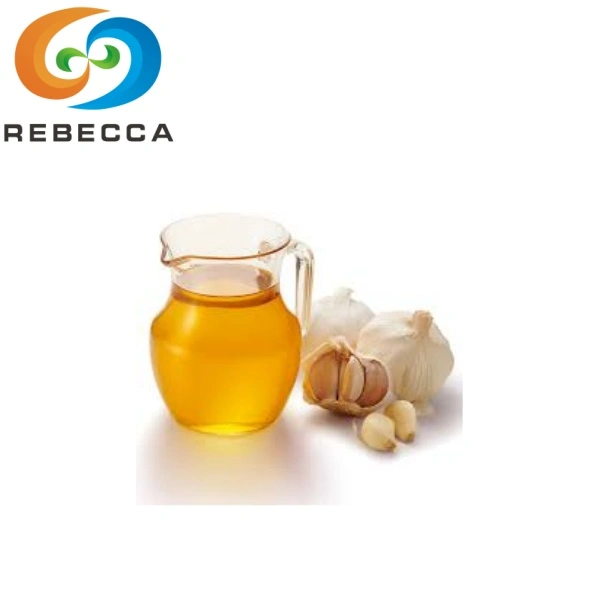
Natural Garlic Oil
Natural Garlic Oil
1.Natural Garlic Oil manufacturer and supplier
2.USA FCC Standards
3.CAS 8000-78-0
4.Years of Production and Export
5.Free Sample Avaialble
Transdermal Absorption of Natural Garlic Oil
What the "500 Dalton Rule" Tells Us
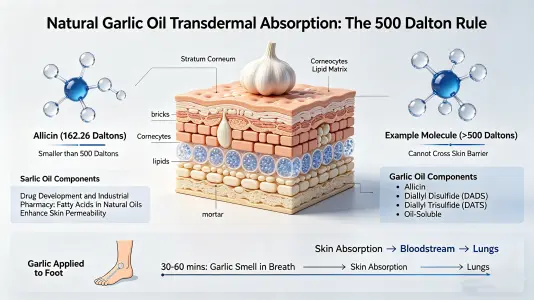
The 500 Dalton Rule is often mentioned by dermatologists and pharmacologists as the first skin penetration criterion. According to the rule, any molecule may pass through the skin barrier and enter the systemic circulation if its molecular weight is less than 500 Daltons. Generally speaking, molecules larger than that threshold cannot pass through the stratum corneum, the skin's outermost layer.
This is the intriguing part about using natural garlic oil. Allicin, an organosulfur thiosulfinate, is the main bioactive component of fresh garlic. With a molecular weight of just 162.26 Daltons, it is significantly below the 500 Dalton barrier. Garlic oil is a good option for transdermal permeation because of its molecular size and lipophilic nature.
Naturally, absorption is not guaranteed by molecular weight alone. The skin is an organ with layers. Its outer layer of corneocytes serves as a membrane for selection. However, lipophilic compounds have a clear advantage: they can permeate and dissolve in the stratum corneum's lipid-rich intercellular matrix. Compared to water-soluble chemicals, the organosulfur compounds in garlic oil, such as diallyl disulfide (DADS), diallyl trisulfide (DATS), and ajoene, are more suited for this lipid-mediated route since they are mostly oil-soluble.
162 Natural garlic oil and allicin both have molecular weights that are much lower than the 500 Da skin-penetration threshold.
Garlic is one of the 500+ plant extract species that have been examined the most, containing 70–80% natural garlic oil. Allicin and its derivatives, which are also found in natural garlic oil, are responsible for a part of the beneficial substances found in garlic.
How Natural Garlic Oil Interacts With the Skin Barrier
The stratum corneum is not only a wall. Imagine it as a building made of brick and mortar, with layers of lipids (the "mortar") encasing corneocyte cells (the "bricks"). In order to temporarily enlarge the spaces between cells, penetration enhancers primarily break or fluidize this lipid mortar.
Fatty acids in natural oils increase skin permeability by fluidizing lipids in the stratum corneum, according to research published in Drug Development and Industrial Pharmacy that looked at these oils as penetration enhancers. This method is advantageous for oil infused with garlic. Lipid fluidization is provided by the carrier oil, and the garlic compounds pass via the open channels. In this way, the oil matrix actively promotes delivery rather than just acting as a solvent.
A well-known illustration of transdermal garlic absorption comes from a simple experiment: after rubbing garlic on the soles of the feet, individuals can detect a garlic-like odor on their breath within 30–60 minutes. Even though the feet have a thick outer layer, absorption still happens there, although more slowly than in places with thinner skin, such the wrist or belly. Garlic chemicals clearly pass biological membranes since volatile sulfur metabolites leave the skin, enter the circulation, and are subsequently expelled via the lungs.
Key Active Compounds in Natural Garlic Oil and Their Skin Relevance
From Alliin to Allicin: A Chain Reaction
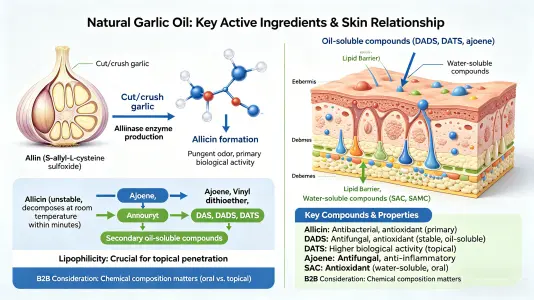
Comprehending the potential of garlic oil begins at the molecular level. Alliin (S-allyl-L-cysteine sulfoxide) is stored in the cells of intact garlic cloves. An enzyme known as alliinase is produced as soon as garlic is cut or crushed. Almost instantaneously, it comes into contact with alliin, which catalyzes the creation of allicin, the chemical that gives fresh garlic its strong scent and the majority of its instantly apparent biological qualities.
Allicin is unstable. At room temperature, it breaks down in a matter of minutes into a series of oil-soluble chemicals, including ajoene, vinyldithiins, diallyl sulfide (DAS), diallyl disulfide (DADS), and diallyl trisulfide (DATS). The majority of commercial natural garlic oil utilized in ingredient formulations is composed of these secondary chemicals. Their oil-soluble characteristic is especially important for topical and transdermal treatments, and they are more stable than allicin itself.
Important organosulfur compounds found in natural garlic oil include:
Allicin is a primary thiosulfinate that quickly transforms into secondary chemicals and has antibacterial and antioxidant properties.
Diallyl Disulfide (DADS) is a stable, oil-soluble compound that has been researched for its antifungal and antioxidant qualities.
Diallyl trisulfide, or DATS, has a higher sulfur chain, more bioactivity, and is useful for topical study.The breakdown of allicin produces ajoene, which has been investigated for its antifungal and anti-inflammatory properties.
Water-soluble and stable, S-allylcysteine (SAC) has a significant antioxidant profile and is present in old garlic extracts.
Why Lipophilicity Matters for Topical Ingredient Sourcing
When acquiring garlic oil for use as a supplement or ingredient in cosmetics, B2B buyers should consider the chemical profile rather than simply the amount of garlic. The components most likely to show significant skin penetration in topical preparations include oil-soluble organosulfur compounds (DADS, DATS, and ajoene). Instead of resting on top of the skin's natural lipid barrier, they work effectively with it because of their affinity for lipid environments.
Water-soluble substances, such as SAC and SAMC, exhibit distinct pharmacokinetic characteristics. Following oral consumption, they are more bioavailable; in animal experiments, they were found in kidney tissue and plasma. A water-soluble fraction could be better for formulations of oral supplements. The oil-soluble portion of steam-distilled natural garlic oil is often the important component for topical applications.
Operationally, this divergence is important. A formulator creating an oral softgel requires different specifications than one creating a topical wellness product. It is crucial to collaborate with a provider that is knowledgeable about both the anticipated delivery route and the chemistry.
Topical Applications of Natural Garlic Oil: Research Overview and Industry Use
What Peer-Reviewed Research Has Found
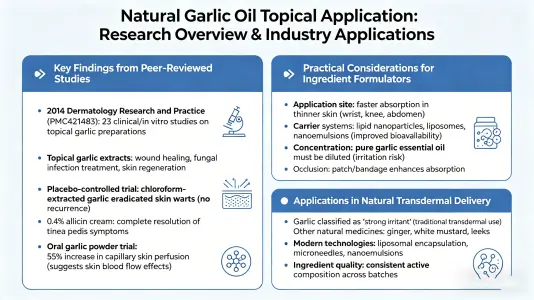
Contrary to popular belief, there is a substantial body of research on topical garlic formulations. A 2014 evaluation of 23 clinical and in vitro research on garlic formulations administered topically was published in Dermatology Research and Practice (PMC4211483). Topical garlic extract has shown promise in a number of dermatological settings, including wound healing, fungal infection treatment, and skin renewal.
The use of a garlic product extracted with chloroform resulted in the eradication of cutaneous warts, and no recurrence was seen during a follow-up period, according to one placebo-controlled trial included in that evaluation. Athlete's foot, or tinea pedis, completely resolved clinically in the treated group of another trial that used ajoene cream at a 0.4% concentration. These results suggest that topical formulations may be used as functional ingredient inputs for the creation of health supplements and cosmetic products, rather than as medications.
Five hours after oral garlic powder administration, capillary skin perfusion rose by around 55% in healthy individuals, according to a research on cutaneous microcirculation. The erythrocyte column's diameter grew by an average of 8.6% when precapillary arterioles dilated. Even though this was an oral trial, it shows how garlic has been shown to affect cutaneous blood flow, which has drawn the attention of cosmetic formulators who want to promote healthy skin tone and brightness.
Practical Considerations for Ingredient Formulators
Transdermal administration is never a straightforward pass-through. In a formulation setting, a number of factors influence how well natural garlic oil molecules penetrate the skin barrier:
Application site: Compared to thick-skinned places like the soles of the feet, thin-skinned locations like the inner wrist, behind the knee, and belly allow for speedier absorption.
Carrier system: Lipid nanoparticles, liposomes, and nanoemulsions greatly increase the bioavailability of oil-soluble substances. When compared to traditional topical formulations, research in PMC7662758 shows that nanosized drug delivery methods enhance transdermal penetration.
Concentration and dilution: Because strong allicin and volatile sulfur compounds may irritate and burn skin, pure garlic essential oil should never be used undiluted. Diluting in a carrier oil or formulation base is standard procedure.Occlusion: Applying a patch or bandage over a garlic oil application improves skin moisture and permeability, increasing the pace and duration of absorption.
These elements immediately translate into specification criteria for purchasers of ingredients. The foundation of successful topical product development is the proper garlic oil extract, which has a well-documented organosulfur profile, a suitable dilution, and a compatible carrier.
Garlic Oil in the Context of Natural Transdermal Delivery
In this area, garlic is not by itself. Garlic is classified as "strong irritants" with a long history of transdermal administration in traditional medicine, along with other natural agents (ginger, white mustard, and leek), according to a study published in PMC7662758. The same paper details how contemporary drug delivery technologies, such as liposomal encapsulation, microneedles, and nanoemulsions, are now being used to maximize the transdermal distribution of these chemicals produced from plants.
Ingredient quality becomes crucial at this nexus of current delivery science and traditional botanical understanding. The functional basis of any meaningful topical formulation is the uniformity of active ingredient profiles across manufacturing batches, which is not a cosmetic concern.
Natural Garlic Oil Supplier: Rebecca Bio-Tech
Quality and consistency are crucial when selecting premium natural garlic oil components for supplement, cosmetic, or functional food formulations. Rebecca Bio-Tech is aware of this to be it is the foundation of our whole business.
Shaanxi Rebecca Bio-Tech Co., Ltd. is a high-tech, export-focused business that specializes in the manufacturing, development, and marketing of plant extracts, the separation of herbal active ingredients, and the study of functional compounds used in traditional Chinese herbal medicine. We serve clients in the pharmaceutical, health product, beverage, and cosmetic sectors worldwide with three manufacturing lines, more than 100 plant extract variations, and an annual production capacity surpassing 500 metric tons.
Are you prepared to talk about price, samples, or specifications? From the first inquiry to the full-scale purchase, our staff is here to assist ingredient buyers at every step.
Please email us at information@sxrebecca.com.
Manufacturers, formulators, and procurement teams worldwide in the pharmaceutical, nutraceutical, beverage, and cosmetic industries are invited to contact us. Give us your goal specs, and we'll get back to you with technical documentation right away.
FAQ
1.How quickly can natural garlic oil compounds penetrate the skin?
Absorption speed depends on several factors, including application site, carrier system, and compound type. In the well-known foot-rub experiment, garlic odor compounds have been detected on the breath within approximately 30–60 minutes. In thin-skinned areas, permeation is faster. Nanosized delivery systems can accelerate transdermal delivery considerably compared to conventional topical formulations.
2.Is natural garlic oil safe for topical use in supplement ingredient formulations?
When properly diluted in a carrier and formulated within safe concentration limits, garlic oil is widely used as a topical ingredient. Undiluted or highly concentrated garlic essential oil can cause skin irritation or burns. Always follow Good Manufacturing Practice (GMP) guidelines and work with a supplier who provides documented safety data and batch-specific analytical testing. Natural garlic oil ingredients for the supplement and cosmetic industry should meet appropriate purity and specification standards.
3.What is the difference between garlic essential oil and natural garlic oil for B2B formulation use?
Garlic essential oil is produced by steam distillation and contains primarily volatile organosulfur compounds like DADS and DATS. It does not typically contain allicin, which degrades during processing. Natural garlic oil (garlic-infused oil) is made by macerating or infusing garlic in a carrier oil, yielding a different compound profile. For topical formulations, the choice depends on the target active compounds, desired stability, and intended skin benefit claims. Always request a Certificate of Analysis (CoA) from your supplier.
4.Can garlic oil ingredients be used in cosmetic as well as supplement formulations?
Yes. Depending on the formulation approach and regional regulatory frameworks, garlic oil ingredients appear in both health supplement ingredients and cosmetic product bases. Formulators must align their claims with applicable regulations in their target markets. As a raw ingredient supplier, Rebecca Bio-Tech provides garlic-derived botanical extracts as functional components — not as finished products or finished medicines.
5.What should I look for when evaluating a natural garlic oil supplier?
Key criteria include: consistent organosulfur compound profiles verified by HPLC or UV analysis; batch-specific Certificates of Analysis; GMP-certified production; transparent sourcing documentation; and the technical capacity to support formulation inquiries. A reliable supplier offers both the ingredient data and the technical knowledge to help you use it effectively.
References
1.Pazyar N, Yaghoobi R. Garlic in Dermatology. Dermatology Reports. 2011;3(1):e4. PMC4211483.
2. Tisserand Institute. "Tasting" Garlic Through Your Feet and Aromatherapy. April 2021.
3. Linus Pauling Institute, Oregon State University. Garlic. Updated January 2026.
4. Djordjevic S, et al. Penetration Enhancing Effects of Selected Natural Oils Utilized in Topical Dosage Forms. Drug Development and Industrial Pharmacy. 2015;41(12). PubMed: 26161938.
5. Gao CM, et al. Transdermal Delivery Systems of Natural Products Applied to Skin Therapy and Care. Molecules. 2020;25(21):5051. PMC7662758.
6. Bayan L, Koulivand PH, Gorji A. Garlic: A Review of Potential Therapeutic Effects. Avicenna Journal of Phytomedicine. 2014. PMC4103721.