What is purple sweet potato extract?
purple sweet potato extract is a term that keeps coming up at trade shows for food and supplement ingredients today. It can be found on labels for drinks, in nutritional supplements, and in makeup colour decks. Even so, a lot of B2B buyers still ask the same first question: what is it?
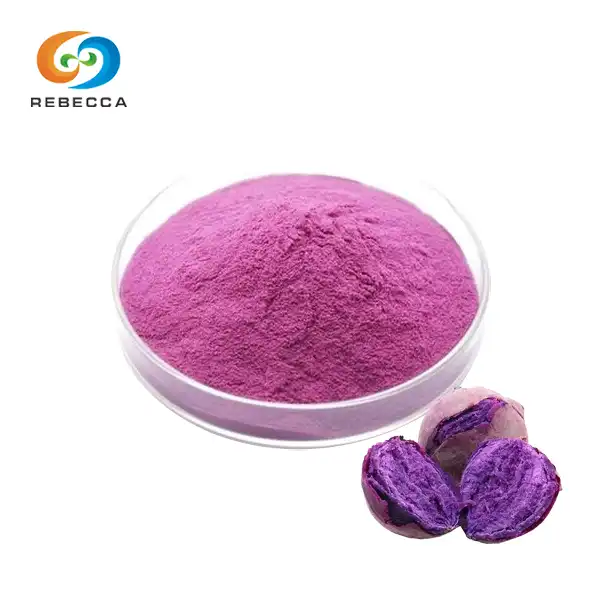
Purple Sweet Potato Extract
Product Name: Natural Purple Sweet Potato Extract
Latin Name: Ipomoea batatas L.
Appearance: Purple Powder
Grade: Food Grade
Specification: Straight Powder
Active Ingredient: Anthocyanidins
What Is Purple Sweet Potato Extract? — Definition & Origin
Botanical Identity and Plant Source
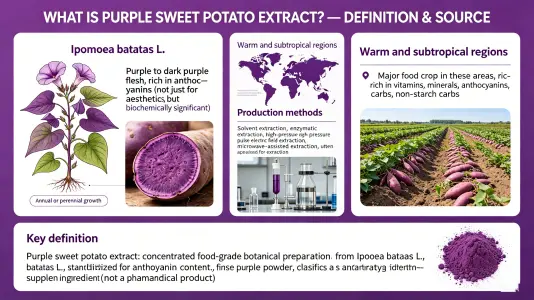
Ipomoea batatas L., or purple sweet potato, is a plant that grows back every year or more than once in the family Convolvulaceae. Its meat is purple to dark purple, and it has all the nutrients that regular sweet potatoes do, plus a lot of anthocyanins. That bright colour is not pretty. It has to do with biochemistry, which is what makes this plant a useful raw material for supplement makers.
In warm and subtropical places, purple sweet potato is one of the main crops grown for food. It is full of nutrients like vitamins, minerals, anthocyanins, carbs, and non-starch carbohydrates. Its root or stem is used to make an extract that combines these beneficial chemicals into a standard, shelf-stable form that buyers of ingredients can add straight to formulations.
Purple sweet potato, also called Okinawan potato, is a type that is low in carbs and fats and high in fibre and vitamins. It is grown in many places in South America and Asia, especially China, Korea, and Japan. This global growing base makes sure that there is a steady, scalable supply for business needs.
How Is the Extract Produced?
Purple sweet potato extract is obtained by isolating the bioactive fraction — primarily anthocyanins — from the dried root or its by-products. In recent years, anthocyanins have been extracted from purple sweet potato by different methods, such as solvent extraction, enzymatic extraction, high-voltage pulse electric field, microwave-assisted extraction, and ultrasound-assisted extraction.
As a natural edible pigment, it is safe, non-toxic, odorless, and bright in color, with advantages of high yield, low cost, rich nutrition, better light and heat stability, and certain pharmacological effects. These production characteristics give it a competitive edge over many other botanical pigment sources.
Key definition: Purple sweet potato extract is a concentrated, food-grade botanical preparation derived from Ipomoea batatas L., standardized for its anthocyanidin content. It is available as a fine purple powder and is classified as a health supplement ingredient — not a pharmaceutical finished product.
Chemical Composition: Anthocyanidins and Beyond
The Core Active: Anthocyanidins
Colours in plants called anthocyanins give fruits, veggies, and flowers their bright red, blue, or purple colours. In that group, anthocyanidins are the sugar-free (aglycone) types. They are the most dense form of the colour compound that can be used by living things.
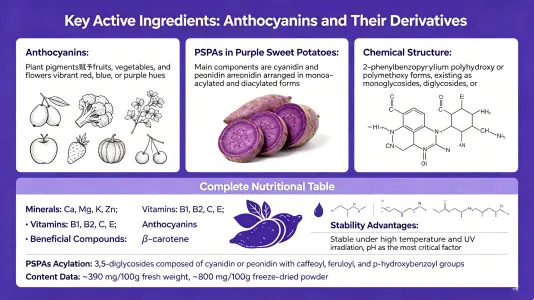
It has been thought that anthocyanins are the main biological molecules that give purple sweet potatoes their deep purple colour. A major part of purple sweet potato anthocyanins (PSPAs) is made up of cyanidins and peonidins, which are arranged in monoacylation and diacylation, respectively.
Anthocyanins are natural colours found in fruits, veggies, and flowers. They are in the flavonoid family and give them a wide range of colours. These chemicals are polyhydroxy or polymethoxy forms of 2-phenyl-benzopyrylium. They are mostly found in plants linked to sugars as mono, di, or triglycosides. In nature, there are more than 500 different kinds of anthocyanins. The most common ones are cyanidin, pelargonidin, peonidin, delphinidin, petunidin, and malvidin, all of which have a 3-glycoside structure.
Full Nutritional Profile
The UN's Food and Agriculture Organization says that sweet potatoes are a healthy food because they contain minerals (Ca, Mg, K, and Zn), vitamins (B1, B2, C, and E), and good chemicals like anthocyanins and β-carotene. The extract focuses the anthocyanidin part while keeping the polyphenols that are linked to it.
The anthocyanins in purple sweet potato are mostly 3,5-diglucosides that are made up of cyanidin or peonidin and groups of caffeoyl, feruloyl, and p-hydroxybenzoyl. This acylated structure makes it different from anthocyanins found in berries and directly adds to its higher stability.
Nature has more than 500 types of anthocyanins.It is said to have 800 mg of anthocyanins per 100 g of dry powder.
12 kinds of anthocyanins were found in a Chinese PSP variety.
According to research, purple sweet potato has a yield of about 390 mg anthocyanins per 100 g of fresh weight and about 800 mg anthocyanins per 100 g of lyophilised powder. This makes it one of the best natural sources of anthocyanins for commercial buyers.
Stability Advantages
Formulation scientists care a lot about how stable the ingredients are. Anthocyanins in purple sweet potatoes are stable in heat and UV light and have many health-promoting properties. Because they are stable at both high temperatures and high temperatures of light, they are better for use in real-world industrial settings than other natural colours.
The pH value, not the temperature, was found to be the most important factor in how stable the purple sweet potato extract was. The pigment keeps its colour and strength in acidic mixtures, which is a feature that beverage and functional food makers really value.
Key Properties and Health-Promoting Benefits
Antioxidant Activity: The Most Documented Property
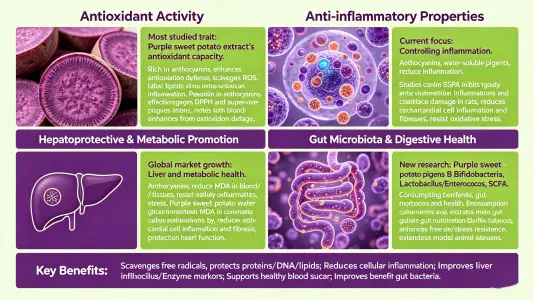
The most well-studied property of purple sweet potato extract is its ability to act as an antioxidant. Anthocyanins found in purple sweet potatoes (Ipomoea batatas) help the body's antioxidant defence system work better and get rid of reactive oxygen species (ROS), which is good for health.
Studies done in a lab dish show that anthocyanins protect proteins, DNA, and lipid layers from oxidative harm. This defence at the cellular level is what makes people want anti-aging vitamins and useful foods.
The peonidin-based parts of purple sweet potato anthocyanins were good at getting rid of DPPH radicals and superoxide anions. They also had a lot of potential for lowering the total antioxidant power activity and Fe› chelating ability.
Anti-Inflammatory Properties
Managing inflammation is a big part of the drug business right now. Anthocyanins are water-soluble pigments that are good for you and have health benefits, such as reducing inflammation. Several studies using experimental models back up this possibility.
Anthocyanins from purple sweet potatoes (PSPA) have been shown to stop rats with gout arthritis from inflaming and breaking down cartilage. Anthocyanin extracts also decreased cardiac cell inflammation and swelling and slowed down cardiac fibrosis to protect heart function. These findings show that PSPA is useful as a functional ingredient for products that focus on health.
Liver-Protective and Metabolic Support Properties
In the global supplement business, liver health and metabolic wellness are two of the benefit groups that are growing the fastest. Anthocyanin, which is found in purple sweet potato roots, lowers the amount of malondialdehyde (MDA) in the blood and tissues and protects against oxidative stress. Because of this, giving purple sweet potato water extracts can lower MDA levels.
Anthocyanins are beneficial chemicals that have been shown to be very useful. They are the pigments that give some types of sweet potatoes their purple colour. They change how glucose is used by controlling enzymes that break down and absorb carbohydrates. This process is useful for people who are making nutrients to help with blood sugar.
Gut Microbiota and Digestive Wellness
New study shows that there is another level of value. Studies show that PSPAs, along with their associated monomers, can clearly boost the number of Bifidobacterium and Lactobacillus/Enterococcus species as well as the amount of short-chain fatty acids (SCFA). So, eating purple sweet potatoes, which are high in cyanidins, may be good for the health of both the microbes in the gut and the human.
According to research, purple sweet potato extract may help keep the balance of nutrients in the gut and boost the body's ability to fight free radicals and stress, which can lead to longer lifespans in model animals. Longevity-focused composition teams should find this data point very interesting.
Support for antioxidants: gets rid of free radicals and keeps proteins, DNA, and lipid membranes safe from oxidative stress
“Anti-inflammatory activity” means that it might help lower inflammation signs in cells.
Potential to protect the liver: in preliminary tests, it helped improve liver enzyme markers.
Support for metabolism: Changing enzymes may help keep blood sugar levels healthy.
Support for the gut microbiome: encourages good bacteria like Bifidobacterium and Lactobacillus
Purple Sweet Potato Extract Supplier: Rebecca Bio-Tech
It takes more than a catalogue entry to find a trusted, food-grade purple sweet potato extract on a large scale. It needs a partner with a proven industrial system, strict quality control, and a lot of experience in the science of plant extracts.
Rebecca Bio-Tech (Shaanxi Rebecca Bio-Tech Co., Ltd.) is a high-tech business that focuses on exports. They make, study, and sell plant extracts, separate herbs active ingredients, and do research on functional compounds used in traditional Chinese herbal medicine. Rebecca Bio-Tech has more than 100 plant extracts and three specialised production lines that can make more than 500 metric tonnes of products every year. They sell their products to companies around the world that work in the medicine, health supplement, beverage, and cosmetics industries.
Our Natural Purple Sweet Potato Extract is made to strict food-grade standards and can be bought by businesses as a raw material:
Our team is ready to offer samples, scientific information, and cheap bulk prices whether you are making a new line of nutraceuticals, creating a clean-label beverage, or looking for a plant colour for cosmetic use.
Send your inquiry today:
information@sxrebecca.com Frequently Asked Questions Q1: What is the difference between purple sweet potato extract and regular sweet potato extract?
FAQ
1. What is the active ingredient in purple sweet potato extract?
Anthocyanidins, especially cyanidin and peonidin derivatives, are the main active agent. Anthocyanins are thought to be the main biological molecules that give purple sweet potatoes their deep purple colour. The main chemical structure includes cyanidins and peonidins in the form of monoacylation and diacylation.
2. Is purple sweet potato extract stable in food and beverage manufacturing?
Yes, when compared to a lot of other natural colours. Anthocyanins in purple sweet potatoes are stable in heat and UV light and have many health-promoting properties. Instead of temperature, pH value is the most important factor for stability. This means that making in an acidic pH environment keeps both colour strength and biological effectiveness.
3. In which product categories is purple sweet potato extract commonly used?
PSPAs are used in a lot of different food and beauty products, like rouge and makeup, because they are safe, come in bright colours, and have bodily functions. They are also used in ice cream, plant drinks, candy, dairy drinks, water products, cereals, and other food products. As a rich form of anthocyanidin, it is also being used more and more in functional food powders and dietary supplement pills.
4. What is the standard specification for food-grade purple sweet potato extract?
Purple sweet potato extract that is safe for food is usually sold as a fine purple powder that is standardised by the amount of anthocyanidin it contains. Ipomoea batatas L. is the Latin name for the purple powder that Rebecca Bio-Tech sells. It is food grade and comes in a straight powder standard. The active ingredient is anthocyanidins, and it is ready to be added directly to the process of making supplements or foods.
References
1. He, Y., et al. (2019). "Research Advances of Purple Sweet Potato Anthocyanins: Extraction, Identification, Stability, Bioactivity, Application, and Biotransformation." Molecules, PMC6864833.
2. Chen, C.-Y., et al. (2019). "Stability and Quality of Anthocyanin in Purple Sweet Potato Extracts." Foods, 8(9), 393.
3. Oktay Yıldız, A., et al. (2023). "Recent advances on the biological activities of purple sweet potato anthocyanins." Industrial Crops and Products.
4. Lu, J., et al. (2013). "In vivo antioxidant, hypoglycemic, and anti-tumor activities of anthocyanin extracts from purple sweet potato." Nutrition Research and Practice, PMC3796660.
5. Mi, Y., et al. (2025). "Anthocyanins From Sweet Potatoes (Ipomoea batatas): Bioavailability, Mechanisms of Action, and Therapeutic Potential." Food Science & Nutrition, PMC12409302.
6. Mustapha, U. F., et al. (2021). "Protective Effects of Anthocyanin Extract from Purple Sweet Potato on Blood MDA, Liver and Renal Activity, and Blood Pressure of Hyperglycemic Rats." BMC Complementary Medicine, PMC7813593.