Water Soluble Ginger Extract Uses
For more than 2,000 years, ginger has been used to stock homes and drug stores. Ginger is a flowering herbaceous plant that is known for its root, which is used as both a spice and a herb. It has been used in traditional medicine and cooking for its health benefits since ancient times. But the raw root alone gives formulators a constant problem because it is oily, has uneven strength, and is hard to mix evenly into modern product forms. water soluble ginger extract that dissolves in water takes care of that issue.
Manufacturers get a standard, shelf-stable raw material by separating the bioactive part (mostly gingerols) and making it fully dispersible in water-based systems. It works well in pills, drinks, emulsions for skin care, and functional food bases. It's no longer a question of whether this ingredient is useful. The real question is which tool will help you reach your design goals?
This guide breaks down the main use categories—supplements, food and drinks, and cosmetics—with evidence to back them up, so B2B buyers of ingredients can make an informed choice about where to get them.
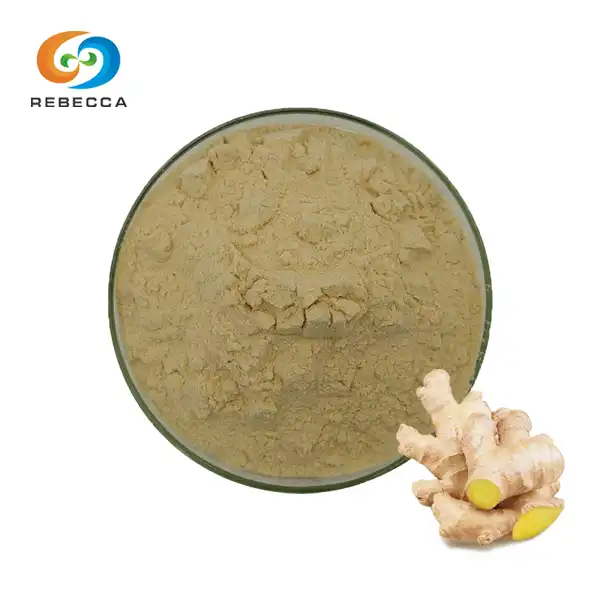
Water Soluble Ginger Extract
Product Name:Ginger Extract,Ginger Powder,Ginger Dry Extract Gingerol 1%.
Solubility: Water Soluble
Specification: Gingerol 1%
Test Method: HPLC
Latin Name: Zingiber officinale
Packaging: Roller, Aluminum Foil Bag
Specification: 100% Pure
Appearance: Light Yellow Powder
Storage: Cool and Dry Place
What Is Water Soluble Ginger Extract?
Botanical Source and Active Chemistry
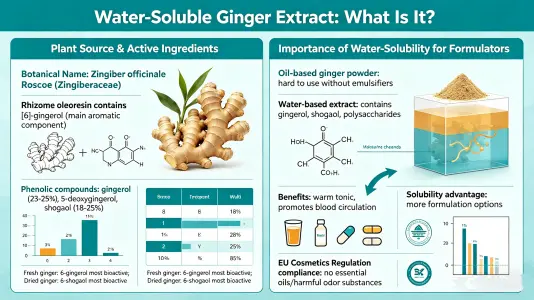
For plants, ginger is called Zingiber officinale Roscoe. It is in the Zingiberaceae family. The oleoresin that comes from ginger's rhizomes has many beneficial ingredients, including [6]-gingerol, which is the main fragrant ingredient and is thought to have many amazing physiological and pharmaceutical effects.
Ginger's smelly parts are made up of phenolic compounds, which also make up a lot of its active chemicals. These include gingerols (23–25%), paradols (5-deoxygingerols), and shogaols (18–25%). Most of the health benefits linked to ginger-based ingredients are thought to come from these substances.
When ginger is fresh, 6-gingerol is the most bioactive substance. When ginger is dried, 6-shogaol is the most bioactive principle. Setting a standard for gingerol content, like a Gingerol 1% guideline that has been checked by HPLC, gives buyers of ingredients faith that the strength will be the same from batch to batch.
Why Water Solubility Matters to Formulators
Ginger powder that are based in oil make it hard to use in a lot of different ways. Without emulsifiers, they can't be mixed well into water-based drinks, makeup emulsions, or capsule-fill solutions. Ginger extract made from water includes gingerols, shogaols, and polysaccharides. These smelly, water-soluble substances make up ginger's warming and blood flow-boosting properties. Being able to dissolve in water opens up a lot more preparation options.
The water-based extract doesn't contain any essential oils, which means it doesn't contain any smell toxins that have been declared. For personal care brands that have to follow EU makeup rules, this one feature makes compliance a lot easier.
Uses in Dietary Supplements and Nutraceuticals
Digestive Wellness and Nausea Relief
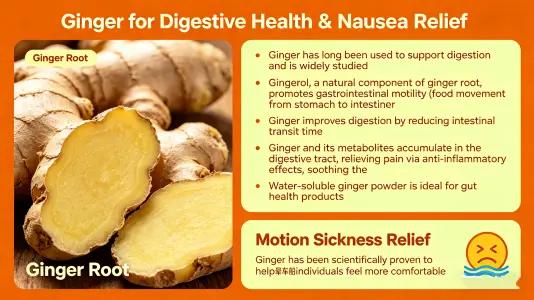
Ginger has been used for digestive support for a very long time and has been studied a lot. Gingerol, a natural part of ginger root, helps gastrointestinal movement, which is the speed at which food moves from the stomach to the rest of the digestive tract. Ginger helps digestion work better, so food doesn't stay in the gut for as long.
Ginger and its byproducts seem to build up in the digestive tract, where they work to ease pain through anti-inflammatory effects, calm the digestive system through carminative effects, and stop dizziness. These effects have been studied a lot, which makes water-soluble ginger powder a great choice for gut health products.
Another important subject is motion sickness. Scientists have proven that ginger can help people who are travelling feel better when they are sick. This approval will be useful for people who buy ingredients to make vitamin mixes that are similar to over-the-counter medicines.
Antioxidant Support
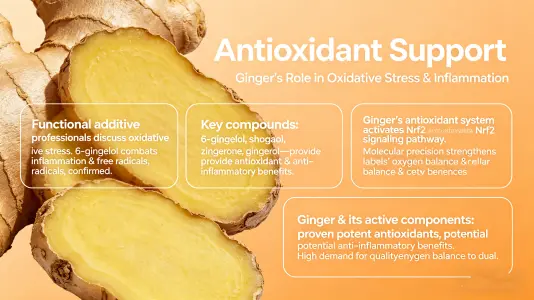
A lot of people in the functional additive space talk about oxidative stress. It is said that the substance 6-gingerol can fight inflammation and free radicals. At the cellular level, this action has been proven by several experimental tests.
Gingerol, shogaols, paradol, and zingerone are the chemicals that give it its antioxidant and anti-inflammatory benefits. The antioxidant system in ginger is connected to turning on the Nrf2 signalling pathway. For people who make supplements, this molecular precision gives label statements about oxygen balance and cell defence more weight.
Overall, ginger and its active ingredients have been shown to be powerful antioxidants that may also help lower inflammation. The high demand for quality health supplements is driven by their dual action as both antioxidants and anti-inflammatory aids.
Anti-Inflammatory Properties for Joint and Muscle Comfort
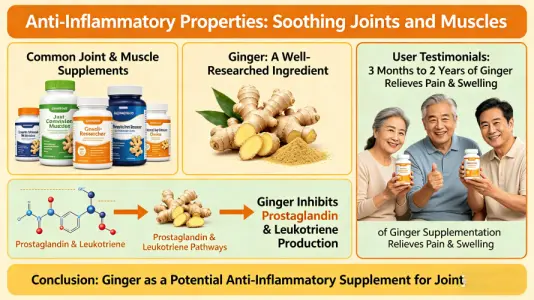
A big group of supplements are for joints and muscles. There is a lot of study on ginger-based ingredients in it. People with rheumatoid arthritis, osteoarthritis, or general muscle pain said that taking powdered ginger as a vitamin for 3 months to 2 years helped with their pain and swelling.
Prostaglandin and leukotriene pathways play a part in the process. Researchers think that the fact that ginger can stop the production of prostaglandins and leukotrienes might have something to do with its ability to reduce inflammation. This idea supports its use as a useful ingredient in supplements for joint pain relief.
Liver and Metabolic Support
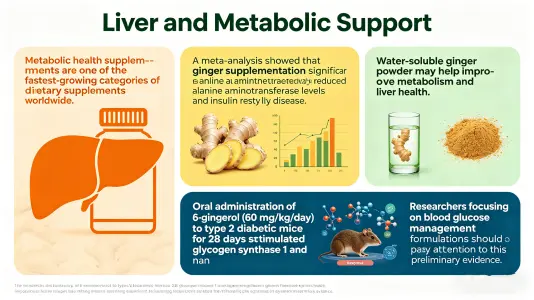
Metabolic health is one of the supplement groups that is growing the fastest around the world. A meta-analysis says that taking ginger supplements lowers alanine aminotransferase and insulin resistance in people with nonalcoholic fatty liver disease by a large amount. This result suggests that water-soluble ginger powder could be useful in formulas for metabolic support and liver health.
Giving type 2 diabetic mice 6-gingerol every day for 28 days increased glycogen storage levels in their muscles by stimulating glycogen synthase 1 and improving the presentation of GLUT4 cell membranes. People who work on formulas for managing blood sugar should pay attention to this preliminary evidence.
Immune Function and General Wellness
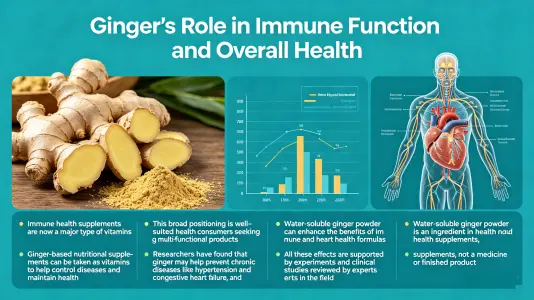
Immune health supplements are now a main type of vitamin. Nutraceuticals made from ginger can be taken as a vitamin to help control diseases and live a healthy life. This broad placement works well for multi-benefit products aimed at adult health customers.
Researchers have found that ginger may help keep you from getting chronic diseases like high blood pressure and congestive heart disease, and it also makes your defence system work better. Together with these studies, water-soluble ginger powder increases the benefits of immunity and heart health mixes.Digestive support:
l helps the stomach move; may help with motion sickness and nausea
l Antioxidant activity: removes free radicals by turning on the Nrf2 pathway Pain in the joints and muscles: can help lower inflammation signs by blocking prostaglandins
l Metabolic support: May help keep liver enzyme levels and insulin sensitivity healthy. In immune health, it helps the immune system work and improves signs of heart health.
All of the qualities mentioned come from experimental and clinical study that has been reviewed by experts in the field. Ginger powder that dissolves in water is an ingredient in health supplements. It is not a medicine or a finished health product.
Uses in Food and Functional Beverage Formulation
Functional Beverages: A Natural Fit
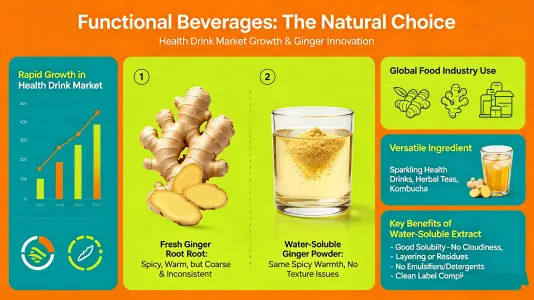
The market for healthy drinks has grown very quickly. Drinks that taste good and do something useful are what people want. Ginger powder that dissolves in water meets both needs at the same time. It tastes spicy and warm like fresh ginger root, but it doesn't have the rough texture or inconsistent quality of raw material.
Ginger is used all over the world as a spice and medicine in the food industry. Because it can be used as both a flavouring agent and a medicinal ingredient, it is very useful for people who are making drinks. sparkling health drinks, herbal teas, and kombucha that are high in ginger Water-soluble gingerol extract can be used as a normal, clean-label ingredient in drinks in this way.
Solubility in water is an important factor in making drinks. It's not a qualifying ingredient if it clouds, splits, or leaves a residue. The water-based extract mixes well. It doesn't need emulsifiers or detergents. That makes labelling easier and meets the standards for clean label making.
Bakery, Dairy, and Processed Food Applications
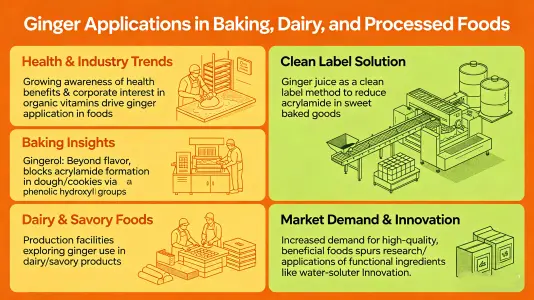
As people have become more aware of health benefits and businesses have become more interested in organic vitamins and useful ingredients, ginger and its byproducts have been used in many different food items. There is work going on in the bakery, dairy, and savoury production rooms.
In baked goods, gingerol does more than just add flavour; it also affects how cells work. Gingerols lowered the amount of acrylamide in dough and cookies by blocking it. The phenol hydroxyl group of gingerol was very important in this process. A process contaminant in sweet baked goods called acrylamide needs to be cut down. This is an ongoing recipe goal for many large-scale bread makers. Ginger juice is a clean-label way to get there.
As people become more aware of how to live a healthy life and what they eat every day, there is a growing movement toward better and more useful food items. As this topic becomes more well known, there are more opportunities to study and possibly use functional food ingredients and bioactive substances. When food companies use water-soluble ginger powder, they get ahead of the curve when it comes to what customers want.
Flavor Standardization Benefits
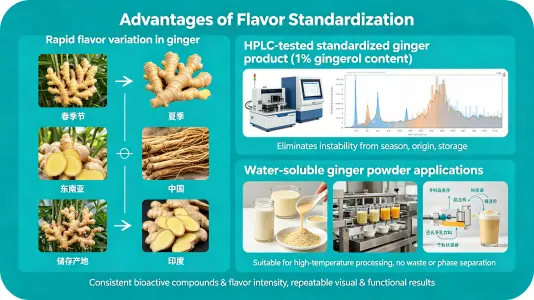
Ginger's flavour changes quickly. The spiciness of raw ginger changes with the season, where it comes from, and how it is stored. That lack of regularity is a problem for big food companies that make a lot of food. That variation is taken away by a standardised product at 1% gingerol, which has been tested by HPLC. Each batch has the same amount of bioactives and flavour strength. Production teams can count on visual and functional results that can be repeated.
Ginger powder that dissolves in water can also be used in heat-processing settings. It mixes into pasteurised dairy bases, spreads out in hot-fill beverage lines, and mixes into dry-mixed powder forms without leaving behind any waste or phase separation.
Uses in Cosmetics and Personal Care
Skincare Formulation: Antioxidant and Circulation-Promoting Activity
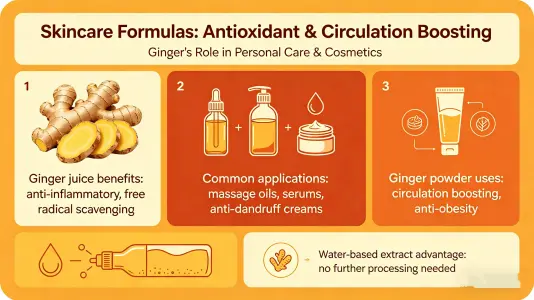
The personal care and cosmetics business has known for a long time that ginger juice is a useful plant. It is known to fight inflammation and free radicals. Ginger Root Extract is used to make skin and hair goods, such as massage oils, restoring serums, and anti-dandruff creams. These apps work with a lot of different types of personal care products.
In the beauty business, ginger powder is used to make body care products that improve circulation and fight obesity. The gingerols make heat sensors work. When thermogenic receptors are activated, they give the skin a localised heat feeling, which is something that massage gels, body wrap products, and other focused body care lines really like.
Massage oils, body lotions, and hair care items are common uses. Cosmetic scientists who work with water-based systems like the watery extract a lot because it mixes right into the water phase without needing to be processed further.
Hair Care: Scalp and Strand Applications
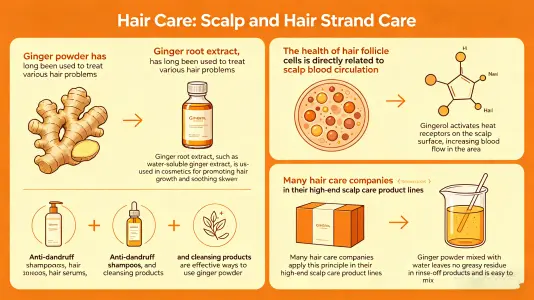
Ginger powder has also been used for a long time to treat hair problems. An product from ginger root, such as that from a water soluble ginger extract supplier, has been used in makeup because it helps hair grow and calms skin irritations. Shampoos that get rid of dandruff, serums for the hair, and cleansing treatments are all good ways to use them.
Hair cell health is directly linked to scalp blood. Gingerol activates heat sensors on the scalp's surface, which increases blood flow to that area. This is a process that hair care companies use in their high-end scalp treatment lines. When mixed with water, the format doesn't leave behind any greasy residue in rinse-off products and mixes easily into serums that you leave on.
Clean-Label Cosmetic Formulation
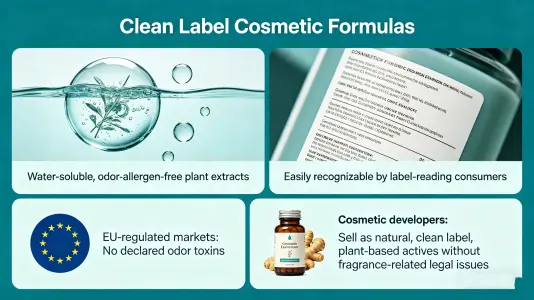
Consumers now strongly want chemical disclosure in personal care products as well. Botanical products that dissolve in water, don't contain smell allergens, and can be recognised by people who read labels have a clear benefit. The water-based extract doesn't contain any essential oils, which means it doesn't contain any smell toxins that have been declared. This is very important in EU-regulated markets where telling customers about smell allergens makes them hesitant.
Developers of cosmetics can market formulas that contain water-soluble ginger extract as naturally derived, clean-label, and botanically active, without the legal issues that come with extracts that contain flavour. In today's market, that mix of qualities is very valuable for business.
Water Soluble Ginger Extract Supplier: Rebecca Bio-Tech
It takes more than just comparing prices to find a trusted seller of food-grade water-soluble ginger extract. It needs a partner with a production system that can be checked, strict quality control, and a track record of knowing a lot about the science of plant extraction.
Rebecca Bio-Tech (Shaanxi Rebecca Bio-Tech Co., Ltd.) is a high-tech company that focuses on exports. They make, study, and sell plant extracts, separate herbs active ingredients, and do research on functional compounds used in traditional Chinese herbal medicine. Rebecca Bio-Tech serves customers all over the world in the pharmaceutical, health supplement, beverage, and skincare industries. It has three specialised production lines, a production capacity of more than 500 metric tonnes per year, and a product line of more than 100 plant extracts.
Rebecca Bio-Tech has the technical information, affordable bulk prices, and steady supply you need to make a new line of nutraceuticals, increase the amount of a functional beverage SKU, or find a clean-label cosmetic active. Our team is ready to help you with your recipe by giving you examples and full proof of compliance.
Email your question to information@sxrebecca.com right now.
FAQ
1. What is water soluble ginger extract used for in dietary supplements?
Water soluble ginger extract is widely used as a health supplement ingredient for digestive support, antioxidant activity, joint and muscle comfort, liver health, and immune wellness. Ginger and its metabolites accumulate in the gastrointestinal tract and exert their effects by relieving pain through anti-inflammatory effects, soothing the digestive system through carminative effects, and alleviating nausea. It is available as a raw material ingredient for capsule, tablet, powder, and functional food formulations.
2. Why is the water soluble form preferred over oil-based ginger extract?
Water soluble ginger extract disperses cleanly in aqueous systems — beverages, emulsions, water-phase cosmetic formulas, and capsule-fill solutions — without requiring emulsifiers or surfactants. The aqueous extract is free from essential oils and therefore free from declarable fragrance allergens, which simplifies regulatory compliance, especially in EU cosmetic markets. It also delivers consistent potency per batch when standardized and HPLC-verified.
3. What is gingerol, and why does its concentration matter?
[6]-Gingerol is the primary pungent ingredient in ginger rhizome, believed to exert a variety of remarkable pharmacological and physiological activities. Standardizing extract to Gingerol 1% — verified by HPLC — ensures that every production batch delivers identical bioactive concentration. This is critical for supplement manufacturers who need reproducible efficacy and consistent label claims across production runs.
4. What food and beverage applications are suitable for this ingredient?
The application of ginger and its derivatives has been broadly investigated in a wide range of food products including functional beverages, bakery, dairy, and processed foods. Water soluble ginger extract integrates into hot-fill beverage lines, dry-blend powder formats, and dairy bases without phase separation. It simultaneously contributes flavor and bioactive value — a dual function that clean-label product developers value highly.
5. How is water soluble ginger extract used in cosmetics?
In the cosmetics industry, ginger extract is used for circulation-promoting body care and anti-cellulite formulations, and the gingerols activate heat receptors. It is also used in scalp care, massage products, body gels, refirming preparations, and anti-dandruff hair care. The water soluble form blends directly into aqueous formulation systems with no greasy residue.
References
1. Bode, A.M., & Dong, Z. (2011). "The Amazing and Mighty Ginger." Herbal Medicine: Biomolecular and Clinical Aspects, 2nd ed. NCBI Bookshelf NBK92775.
2. Mao, Q.-Q., et al. (2019). "Bioactive Compounds and Bioactivities of Ginger (Zingiber officinale Roscoe)." Foods, 8(6), 185.
3. Rastogi, S., et al. (2023). "Ginger Bioactives: A Comprehensive Review of Health Benefits and Potential Food Applications." Antioxidants, 12(11), 2015.
4. Haniadka, R., et al. (2013). "A Review of the Gastroprotective Effects of Ginger (Zingiber officinale Roscoe)." Food & Function, 4(6), 845–855.
5. Mashhadi, N.S., et al. (2013). "Anti-Oxidative and Anti-Inflammatory Effects of Ginger in Health and Physical Activity." International Journal of Preventive Medicine, 4(Suppl 1):S36–S42.
6. Mohd Yusof, Y.A. (2024). "A Critical Review of Ginger's (Zingiber officinale) Antioxidant, Anti-inflammatory, and Immunomodulatory Activities." Frontiers in Nutrition.