Does all krill oil contain astaxanthin?
Astaxanthin is naturally found in almost all krill oil products. The real question is whether that amount works, is focused, or comes from the right place. The difference is very important for formulators and vitamin makers that need a stable, high-potency astaxanthin ingredient.
When people talk about supplements, the best krill oil with astaxanthin comes up quickly. It has phospholipids, omega-3 fatty acids, and astaxanthin, a colour that makes everything bright red, from birds to salmon. People often talk about these two nutrients together. People in the business, however, still think that krill oil is enough of a source of astaxanthin because of this pairing.
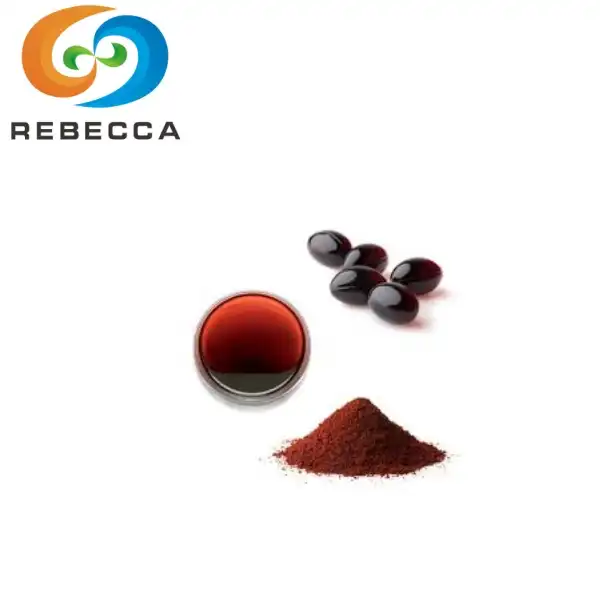
Best Krill Oil With Astaxanthin
astaxanthin oil
1.Astaxanthin Oil manufacturer and supplier
2.Raw Material:Haematococcus Pluvialis
3.Test Method: HPLC&UV
4.Specification: 2%,2.5%,3%,3.5%,5%
5.Years of Production and Export
6.Free Sample Avaialble
What Is Astaxanthin, and Why Does It Appear in Krill Oil?
The Carotenoid at the Heart of Marine Color
The Carotene at the Heart of Colour in the Sea
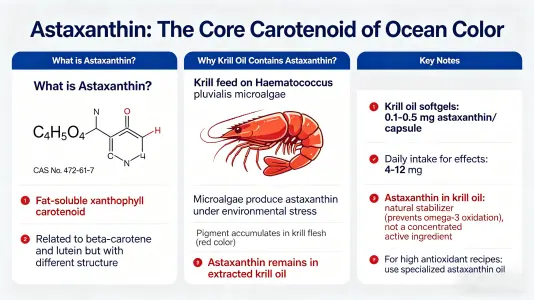
It is a xanthophyll carotenoid, which means it is a pigment. It is related to beta-carotene and lutein, but its structure is different. This chemical is CAS No. 472-61-7 and has the formula C₄H₅O₄. It dissolves in fat. It stands out because of how well it fights free radicals. As shown in Nutrients (2020) and several PubMed-indexed studies, astaxanthin is about 500 times more powerful as vitamin E as an antioxidant and 38 times more powerful than beta-carotene in some tests.
Krill live in the wild and eat microalgae, mostly Haematococcus pluvialis, which makes astaxanthin when it is stressed by its surroundings. The colour builds up in the krill's flesh, turning them a reddish colour. That astaxanthin stays with the krill oil when it is taken out. As a result, astaxanthin is found in natural krill oil. How much is the question.
The Concentration Problem in Standard Krill Oil
Most krill oil softgels you can buy have between 0.1 mg and 0.5 mg of astaxanthin per dose. Astaxanthin's anti-inflammatory and antioxidant effects have been studied in humans at amounts range from 4 mg to 12 mg per day. That gap is pretty big. If a formulator wanted krill oil to have meaningful astaxanthin activity, they would have to give enough of it so that the omega-3 content was the real active ingredient, not the astaxanthin.
Note for Researchers: A study released in PMC (NCBI) on the make-up of the **best krill oil with astaxanthin** shows that astaxanthin is a small part of it, present along with bigger parts like EPA, DHA, and phospholipids. Its main job in krill oil is as a natural stabiliser, keeping the omega-3 fatty acids from oxidising. It is not a concentrated active ingredient.
This isn't a problem with krill oil. It's just a reflection of the different roles these two materials play. Krill oil is a great way to get phospholipid-bound omega-3s to your body. If you want to make a recipe with a lot of antioxidant activity, you should use dedicated astaxanthin oil.
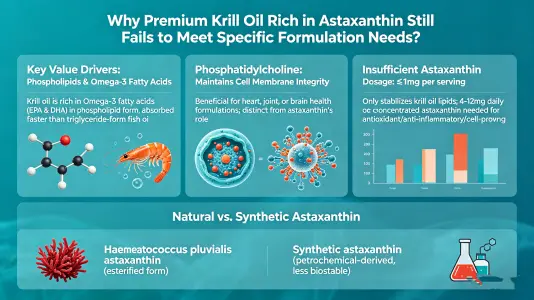
Why the Best Krill Oil with Astaxanthin Still Falls Short for Targeted Formulations
Phospholipids and Omega-3s Are the Primary Value Drivers
It is known for being good for you because it has omega-3s in it. This type of EPA and DHA is found in krill oil, not triglycerides, which is what most fish oils are made of. Some studies show that phospholipid-bound fatty acids are better absorbed, and blood concentration data suggests that they are taken in faster than triglyceride-form fish oil. One of the important phospholipids in krill oil is phosphatidylcholine, which also helps keep cell membranes intact.
These qualities are really helpful for people who are making finished products that are meant to help the heart, joints, or brain. But they are not the same as what astaxanthin does. You can't use one element instead of the other.
What Happens When Astaxanthin Is Underdosed
When "astaxanthin" from krill oil is listed on the label of a product, the amount in each serving is rarely more than 1 mg. At those amounts, astaxanthin's main job is to stabilise the lipids in the krill oil, which keeps it from going rancid and makes it last longer. That part is important. However, it doesn't have the antioxidant, anti-inflammatory, and cell-protective effects that experts have linked to daily amounts of 4–12 mg from concentrated sources.
The amount of astaxanthin in krill oil is mostly background noise for supplement makers that are trying to improve eye health, skin resistance, joint comfort, or reactive stress management, for example. It is necessary to use concentrated astaxanthin oil from Haematococcus pluvialis.
Natural vs. Synthetic Astaxanthin: A Critical Distinction
Not all best krill oil with astaxanthin has the same structure or function. Astaxanthin that comes from H. pluvialis is mostly found in an esterified form. Free-form manufactured astaxanthin, which is usually made from petrochemical sources and mostly used in farming, has not been shown to be as biologically stable as this form. Studies on Haematococcus pluvialis have shown that natural products are much better at fighting free radicals than manufactured ones.
This difference has effects on manufacturing, labelling, and market placing for B2B ingredient buyers in the nutrition, beauty, or pharmaceutical businesses. "Natural astaxanthin from Haematococcus pluvialis" stands out to customers and helps with clean labelling in a way that manmade astaxanthin does not.
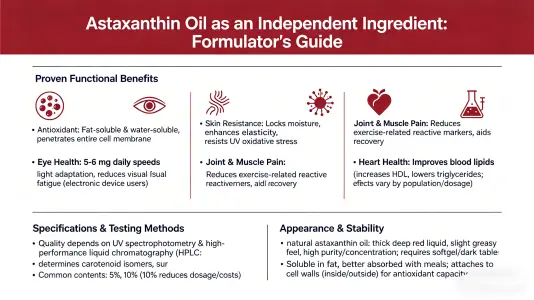
Astaxanthin Oil as a Standalone Ingredient: What Formulators Need to Know
Functional Benefits Supported by Research
Astaxanthin has been shown to work in a number of different body systems. Studies that have been published and reviewed by experts back up its role in the following
Astaxanthin is an antioxidant that works all through the cell membrane and in water-filled parts of the cell because it dissolves in both lipids and water. This is a rare trait in antioxidants, and it gives it a wider range of beneficial effects.
Support for eye health: Research has shown that astaxanthin may help speed up the process of adjusting to new light and reduce vision tiredness. This is especially important for people who use digital devices all day. In this case, doses of 5–6 mg/day have been looked at.
Regarding skin resistance, astaxanthin helps the skin keep water, be flexible, and fight off oxidative stress caused by UV light. Pain in the joints and muscles: There is evidence that astaxanthin may help lower reactive markers linked to physical activity, which can help the body heal after exercise.
Support for the heart: Some research shows that astaxanthin may improve lipid profiles by raising HDL cholesterol and lowering triglyceride levels, but the results depend on the study group and amount.
It's important to note that these benefits can only be seen at amounts that can be reached with specific astaxanthin oil ingredients, not with astaxanthin found by accident in krill oil.
The Role of Specification and Testing Method
For people who buy ingredients, the quality of astaxanthin oil is based on its specifications and the way it was checked, such as in the best krill oil with astaxanthin. The two main ways to test are UV spectrophotometry and HPLC (High-Performance Liquid Chromatography). HPLC is better for formulas that need to be accurate on the label and follow the rules because it gives more accurate amounts of each carotenoid isomer.
Standard market choices come in amounts of 5% and 10% astaxanthin. A 10% HPLC-verified astaxanthin oil lets formulators use smaller amounts per dose to get the right dosages, which lowers the cost per unit and gives formulators more options.
Appearance and Stability Considerations
Natural astaxanthin oil is a thick, dark red liquid that is greasy. Its bright colour is a sign of how pure and concentrated it is, not something that happened during processing. This quality is very important for formulators; the carotenoid should be put in softgels or dark pills to keep it from breaking down when exposed to light. The oil dissolves in fat, and taking it with food fats makes it easier for the body to absorb in finished products.
Astaxanthin is different from carotenoids like beta-carotene because it can attach to both the inside and outside of cell walls. This molecular feature is what makes it such an effective antioxidant, as shown in several peer-reviewed journals, such as Marine Drugs and MDPI Nutrients.
Best Krill Oil with Astaxanthin Supplier: Rebecca Bio-Tech
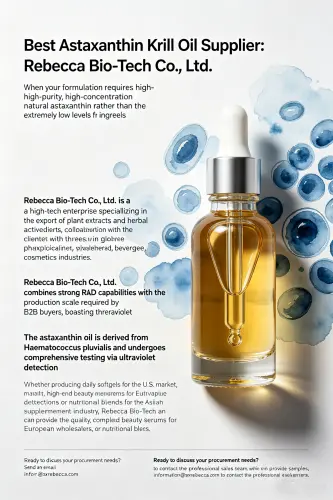
When your recipe needs highly pure and concentrated natural astaxanthin instead of the small amounts that are found in regular krill oil, the choice of where to get the ingredient becomes very important. Shaanxi Rebecca Bio-Tech Co., Ltd. is a high-tech company that focuses on exporting plant extracts and herbal active ingredients. They work with clients all over the world in the medicine, health supplement, beverage, and cosmetics industries.
Rebecca Bio-Tech combines strong R&D skills with the production scale that B2B buyers need. It has three production lines, a yearly output of more than 500 MTS, and a collection of more than 100 plant extracts.
Our astaxanthin oil comes from Haematococcus pluvialis and has been tested thoroughly using UV and HPLC to make sure it meets your exact needs, offering the best krill oil with astaxanthin.Rebecca Bio-Tech gives you the quality, paperwork, and supply stability that your business needs, whether you are making a daily softgel for the US market, a premium beauty serum for European wholesalers, or a nutritional mix for the Asian health industry.
Are you ready to talk about your buying needs? Email information@sxrebecca.com to get in touch with our expert sales team. We are happy to offer examples, proof of analysis, and help with unique specifications.
FAQ
1. Does all krill oil naturally contain astaxanthin?
Yes. Astaxanthin-making microalgae like Haematococcus pluvialis are what krill eat, so natural krill oil still has small amounts of astaxanthin in it. However, the amount in a dose is usually between 0.1 and 0.5 mg, which is much lower than the 4 to 12 mg levels used in clinical studies to look at astaxanthin's health effects. For specific supplement formulas, krill oil shouldn't be thought of as a main source of astaxanthin.
2. What is the best source of natural astaxanthin for supplement ingredients?
Up to 5% of the dry weight of the microalgae Haematococcus pluvialis is astaxanthin, making it the best natural source of this carotene that we know of. For making cosmetics and nutrition ingredients, this is the best option because it gives high amounts of natural, esterified astaxanthin, which is the biologically active form. There is also synthetic astaxanthin, which is different in how it is structured and how it is marketed.
3. How does astaxanthin oil differ from krill oil for B2B ingredient sourcing?
Krill oil is an omega-3 nutrient, and the EPA and DHA that are linked to phospholipids are what make it useful. Astaxanthin oil is a concentrated form of a carotene. They are used for different preparation tasks. Brands that want to help with skin, eyes, joints, or antioxidants should get astaxanthin oil in amounts that have been tested and proven to be 5% or 10% by UV or HPLC. Brands that want to use omega-3s to help the heart or brain should get krill oil separately.
4. What testing method is more reliable — UV or HPLC — for astaxanthin oil?
Both ways are used in business. UV spectrophotometry is quick and doesn't cost much, so it can be used for screening large batches of products. When regulatory paperwork, label claims, or research-grade purity are needed, HPLC is the best way to get a more accurate and thorough count of each carotenoid isomer and its ester form. The best companies that sell astaxanthin oil give their customers both choices so they can meet their needs.
5. Can astaxanthin oil be used in cosmetic formulations?
Yes. Astaxanthin oil from Haematococcus pluvialis is being used more and more as an active ingredient in skin care and beauty products. Its antioxidant features make it useful for fighting face ageing, UV damage, and uneven skin tone. The ingredient can be used in both oil-based and liquid formulas because it dissolves in fat. Its light sensitivity can be controlled with the right packaging or antioxidant co-formulation.
References
1. Andraka, J.M., Sharma, N., Marchalant, Y. (2019). "Can krill oil be of use for counteracting neuroinflammatory processes induced by high fat diet and aging?" Neuroscience Research.
2. AstaReal USA. "3 Distinct Benefits of Combining AstaReal® Astaxanthin & Krill Oil."
3. Cactus Botanics. "How Krill Oil Supplements Compare with Astaxanthin."
4. Davinelli, S., Nielsen, M.E., Scapagnini, G. (2018). "Astaxanthin in Skin Health, Repair, and Disease." Nutrients, 10(4), 522. PMC.
5. Grimmig, B. et al. (2017). "Neuroprotective mechanisms of astaxanthin." Genes & Nutrition, 12, 19.
6. Healthline. "Krill Oil vs Fish Oil: Which Is Better for You?" (Updated April 2025).