Does L carnitine help lose belly fat?
l carnitine powder may assist some individuals in losing abdominal fat – but the research indicates modest improvements, not a radical transformation. It's ideal for those with lower baseline values and always needs nutrition and activity on top of it. This article expounds the mechanism, the clinical numbers, the risks that most papers gloss over and practical counsel for anyone thinking about it.
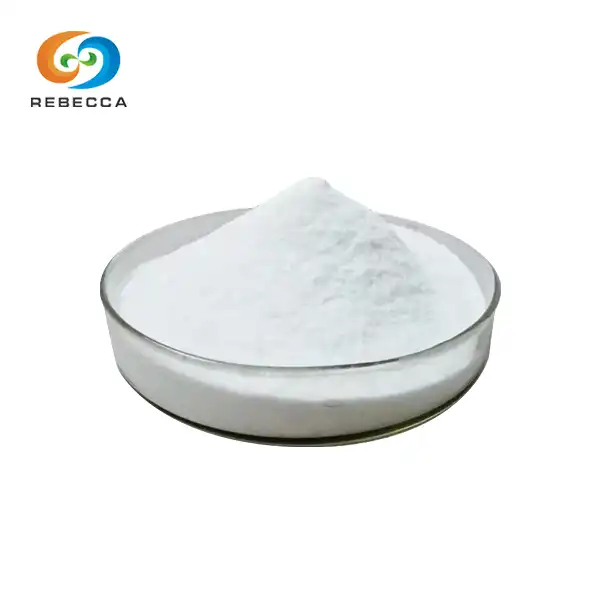
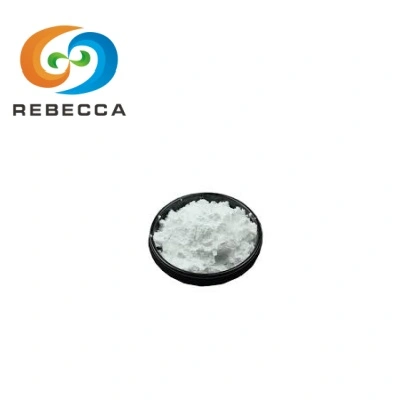
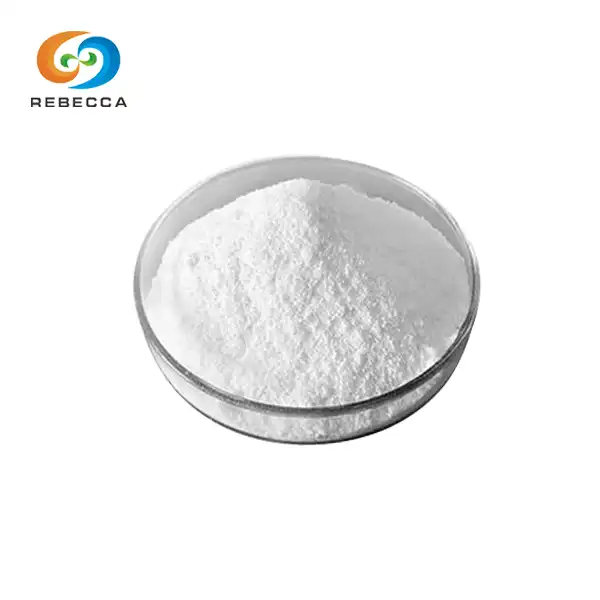
L Carnitine Powder
Product Name:L-carnitine
CAS No.:541-15-1
Specifications :L(-)-Carnitine,Min 99%
Test :HPLC
Appearance :White crystalline Powder
Applying:The safest nutritional supplement for weight loss without side effects.
How L-Carnitine Burns Fat (And Why Belly Fat Is Different)?
But before you can decide if l-carnitine is a good idea for belly fat, there are two things you should know—how it makes your body burn fat at the cellular level and why fat in your abdomen reacts differently than fat stored elsewhere.
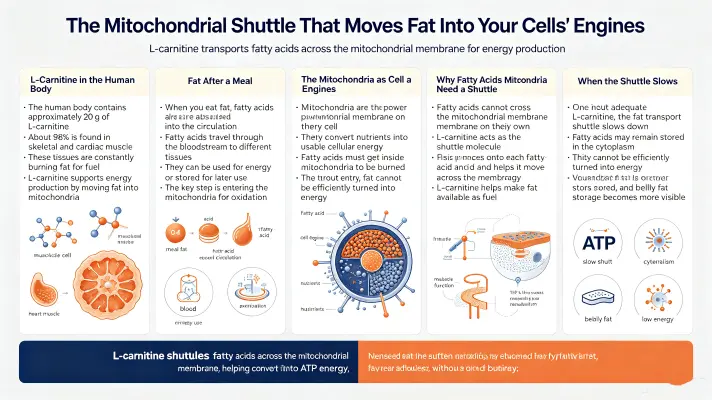
The Mitochondrial Shuttle That Moves Fat Into Your Cells' Engines
The human body has approximately 20 g of L-carnitine, 98% of which is found in skeletal and cardiac muscle (Rebouche, 2004). Something you learn from that place: These tissues are always burning fat for fuel.
Here’s the mechanism brief. When you eat fat fatty acids are absorbed into the circulation. They have to go inside the mitochondria, the power plants within every cell, to be burned for energy. But fatty acids cannot get across the mitochondrial membrane on their own. The shuttle is L-carnitine. It latches onto each fatty acid, shuttles it over the membrane and dumps it inside to be oxidized into ATP – the energy your cells actually need.
Without adequate L-carnitine powder, that shuttle slows. Fatty acids are stored in the cytoplasm. They cannot be turned into energy. Instead they are stored - usually as belly fat.
Why Visceral Fat Responds Differently?
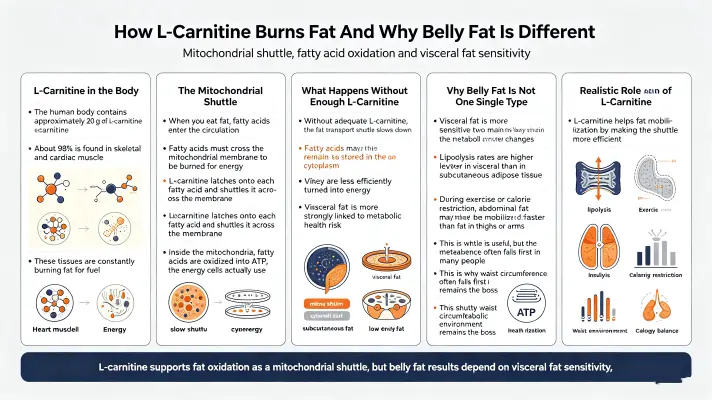
Belly fat isn’t a single thing. It contains two layers: subcutaneous fat (the soft layer underneath the skin) and visceral fat (the deeper fat that is wrapped around your organs). The health risk is visceral fat.
It is also a type that is more sensitive to metabolic alterations.
Lipolysis rates are higher in visceral than subcutaneous adipose tissue.
This means that when you are exercising or calorie restricting, when your metabolic conditions favor fat oxidation, your body prefers to mobilize the fat in your abdomen faster than the fat in your thighs or arms. That’s why waist circumference is usually the first measurement to fall.
carnitine helps this mobilization by making the shuttle more efficient. But it cannot *force* your body to preferentially burn visceral fat if your general metabolic state (insulin levels, cortisol, activity level) isn't supportive. The shuttle is useful. The environment is the boss.
The mechanics are evident. But mechanism itself doesn’t prove anything.”
What do real human experiments indicate when people use L-carnitine and try to lose belly fat?
What the Research Actually Shows About Belly Fat Loss?
The marketing says "fat burner." The science says "modest helper." Here are the real numbers from published clinical trials — no exaggeration, no spin.
The Meta-Analysis Numbers: What 900+ People Tell Us
The strongest evidence comes from a systematic review by Pooyandjoo and colleagues (2016). They pooled data from nine randomized controlled trials covering over 900 participants. The findings: mean weight reduction of 1.33 kg and a 0.26% decrease in body fat percentage versus placebo.
Those numbers are real. They are also small. 1.33 kg over weeks or months is not a transformation. But it is statistically significant, and it matters more for people starting at lower baseline carnitine levels.
|
Study Type |
Participants |
Dose |
Duration |
Key Result |
|
Meta-analysis (Pooyandjoo et al., 2016) |
900+ |
1–3 g/day |
Varied |
-1.33 kg weight, -0.26% body fat |
|
12-week exercise trial |
Overweight adults |
Split into 2 doses; one before exercise |
12 weeks |
-2.9 cm waist circumference |
|
PCOS trial (Samimi et al., 2016) |
Women with PCOS |
1 g/day |
12 weeks |
Reduced weight & insulin resistance |
The 2.9 cm waist circumference reduction from a 12-week trial stands out. That study combined 2 grams of L-carnitine powder daily with moderate aerobic exercise. The exercise was not optional — it was part of the protocol. This tells you something important: L-carnitine alone does not produce these numbers.
Why Some People See Results and Others Do Not?
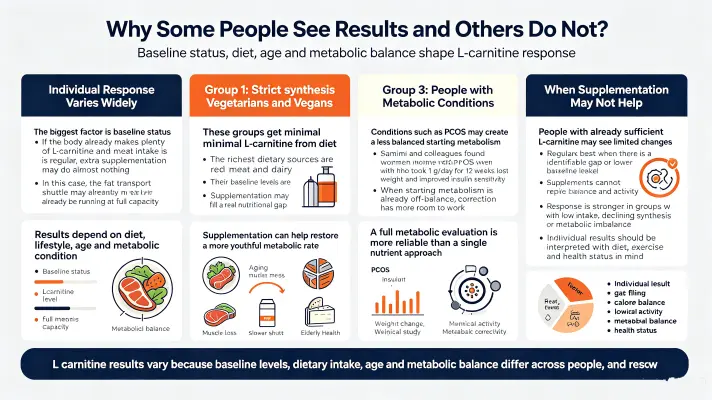
Individual response varies widely. The biggest factor is baseline status. If your body already makes plenty of L-carnitine and you eat meat regularly, adding more may do almost nothing. Your shuttle is already running at full capacity.
But three groups tend to respond better:
• Strict vegetarians and vegans — they get minimal L-carnitine from diet, since the richest sources are red meat and dairy. Their baseline levels are often lower, so supplementation fills a real gap.
• Older adults — carnitine synthesis declines with age. Muscle tissue concentrations drop, and the shuttle slows down naturally. Supplementation can restore a more youthful metabolic rate.
• People with metabolic conditions like PCOS — Samimi and colleagues (2016) found that women with PCOS who took 1 g/day for 12 weeks lost weight and improved insulin sensitivity. Their starting metabolism was already off-balance, so the correction had more room to work.
How Long It Takes to See a Difference?
Trials less than 8 weeks rarely reveal meaningful fat loss. The most successful research lasted between 12 and 24 weeks. This isn’t a quick fix supplement. It is a slow metabolic adaptation.
If you start taking L-carnitine today and measure your waist next week, you won’t see any difference. Give it 3 months of constant dose, frequent physical activity, and appropriate calorie management. Then measure again. That timeframe is consistent with what the clinical data truly supports.
The evidence is limited, but real. Most L-carnitine powder publications skip a safety conversation, including one concern that transformed how scientists view this chemical before you decide if you want to try it.

Conclusion
L-Carnitine: Does It Help You Lose Belly Fat? Yes, but the "help" is moderate, not extraordinary. Clinical data: Weight loss of about 1-2 kg and waist reduction of 2-3 cm over 12+ weeks with activity and sensible eating. The effect is true. It is also tiny enough that you should not expect to see visible change in the first month.
M-The molecule works best for vegetarians, older folks and people with metabolic disorders, such as PCOS, all of whom are likely to have lower baseline levels. If you’re a well-nourished omnivore who already produces plenty of carnitine, the added benefit may be minimal.
FAQ
How long before I see belly fat results?
Expect 8–12 weeks of consistent daily use plus exercise before measurable change. Shorter timelines do not show meaningful results in clinical trials. Give it 3 months, then check your waist measurement.
Do vegetarians benefit more from L-carnitine?
Yes. Plant-based diets provide almost no dietary L-carnitine, since the richest sources are red meat and dairy. Vegetarians often have lower baseline levels, so supplementation fills a real nutritional gap. That gap makes the metabolic shuttle work harder when you add it back.
Is L-carnitine safe for heart health?
Generally yes at standard doses, but there is a caveat. Gut bacteria can convert L-carnitine into TMAO, a compound linked to cardiovascular risk in some studies. Meat eaters produce more TMAO than vegetarians. If you have existing heart issues, talk to your cardiologist first.
Partner With Rebecca for Premium L-carnitine Supply
“We have a unique position among suppliers because of our vertically integrated production capability and our dedication to pharmaceutical-grade quality standards. With three dedicated production lines and an annual capacity exceeding 500 metric tons, we can reliably supply brands of any size, from growing supplement firms to large multinational enterprises.
We offer L-carnitine powder (CAS No. 541-15-1) at a minimum purity level of 99% (HPLC) in the form of a white crystalline powder, adhering to the highest international quality standards. Our production plant in Shaanxi is fully GMP and ISO 22000 certified and provides complete quality documentation including CoA’s, stability data and regulatory support files for FDA, EFSA and other global authorities. In addition to conventional requirements, our technical team offers customized formulation consultancy to help optimize dosing techniques and ingredient combinations for your unique target markets.
Whether you need bulk pricing for large-scale manufacturing, flexible MOQ arrangements for product development, or technical dossiers supporting regulatory submissions, our team delivers responsive service aligned with your procurement timeline. Contact our international sourcing specialists at information@sxrebecca.com to discuss your requirements, request product samples, or explore partnership opportunities with a trusted L-carnitine manufacturer committed to your success.
References
1. Pooyandjoo, M., Nouhi, M., Shab-Bidar, S., et al. (2016). The effect of (L-)carnitine on weight loss in adults: a systematic review and meta-analysis of randomized controlled trials. Obesity Reviews, 17(10), 970–976.
2. Rebouche, C. J. (2004). Kinetics, pharmacokinetics, and regulation of L-carnitine and acetyl-L-carnitine metabolism. Annals of the New York Academy of Sciences, 1033, 30–41.
3. Samimi, M., Forbes, S., & Rahnemay, R. (2016). Oral carnitine supplementation reduces body weight and insulin resistance in women with polycystic ovary syndrome: a randomized, double-blind, placebo-controlled trial. Clinical Endocrinology, 84(6), 851–857.
4. Vecchio, M., Zappia, G., & Lotti, L. (2020). L-Carnitine: metabolism, functions and role in human nutrition. Physiological Research, 69(2), 187–205.
5. Fielding, R., Riede, L., & Lott, J. (2018). L-Carnitine supplementation in recovery after exercise. Nutrients, 10(3), 349–365.
6. Koeth, R. A., Wang, Z., Levison, B. S., et al. (2013). Intestinal microbiota metabolism of L-carnitine, a nutrient in red meat, promotes atherosclerosis. Nature Medicine, 19(5), 576–585.