
How does apigenin work?
Buyers enter websites seeking clear answers. They read content that explains natural compounds. apigenin powder attracts attention because it comes from familiar plants. Many formulators want to understand its actions before they consider bulk purchases. This article examines how apigenin powder functions at the molecular level. Readers gain clear facts. They see evidence from research. Businesses learn why purity and quality matter for their final products.
Apigenin belongs to the flavone class of flavonoids. Manufacturers derive it primarily from celery seeds. The resulting light yellow powder serves as an ingredient in capsules, tablets, and functional blends. Scientists study its interactions inside cells. These interactions happen through specific pathways. Users never consume the powder directly. Instead, companies incorporate measured amounts into finished supplement formulas. Interest grows steadily among manufacturers who seek clean-label ingredients.
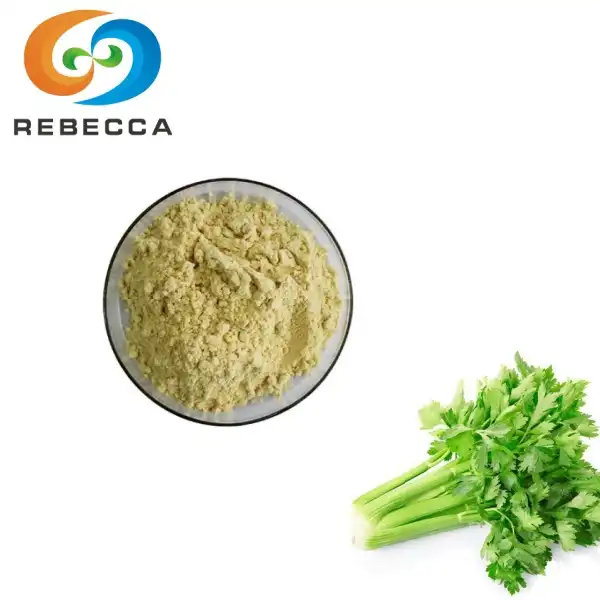
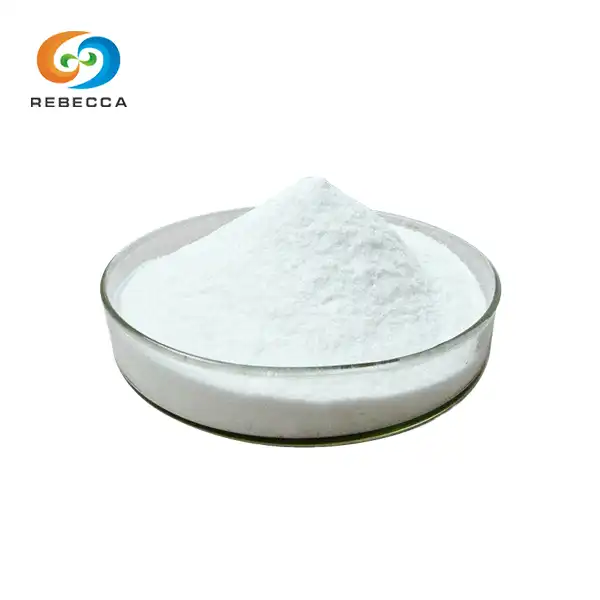
Apigenin powder
Product Name:Apigenin
Other Name:Celery seed extract
Active ingredients:Apigenin
Specification:98%
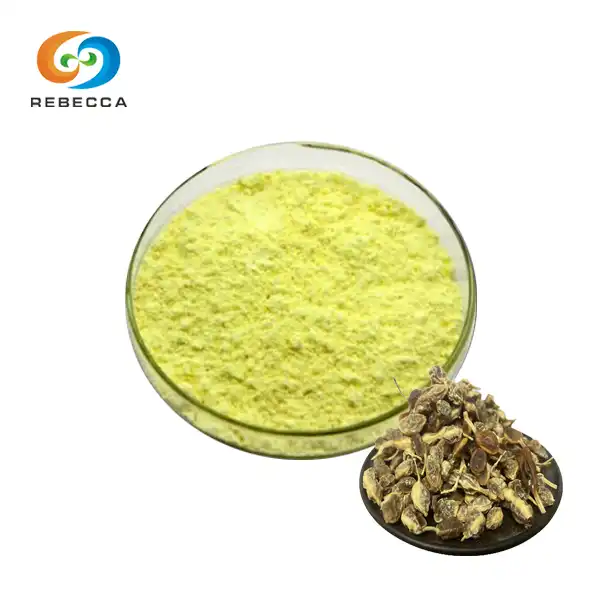
Appearance: Light Yellow Powder
Test Method: HPLC
Molecular Formula:C15H10O5
Molecular Weight: 270.237
CAS No.: 520-36-5
MOQ: 1kg
Sample: 20g
Delivery: FedEx, DHL, Ship by air, Ship by sea.
Certifications: ISO, HACCP, KOSHER, HALAL
Natural Sources of Apigenin Powder
What Plants Provide the Best Raw Material?
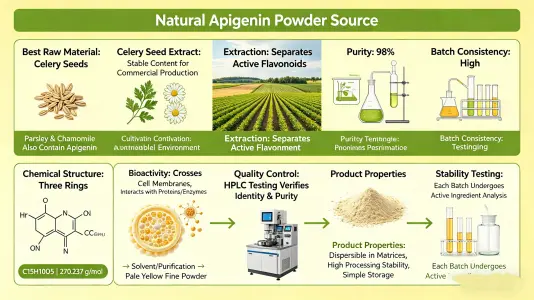
Celery seeds stand out as a rich source. Processors extract apigenin from these seeds through careful methods. The process yields a concentrated powder. Parsley and chamomile also contain apigenin. Yet celery seed extract delivers consistent levels suitable for commercial scale. Suppliers focus on this source because it allows high standardization. Farmers grow celery under controlled conditions. Modern extraction technology isolates the active flavone. The final product reaches 98% purity when manufacturers apply advanced techniques. Buyers appreciate this consistency across batches.
The chemical structure features three rings. Its molecular formula reads C15H10O5. Molecular weight equals 270.237. These details matter to formulators. The structure allows apigenin to cross cell membranes easily. Once inside cells, it interacts with proteins and enzymes. Researchers confirm these properties through laboratory analysis. HPLC testing verifies identity and purity. Companies that buy apigenin powder want documentation that confirms these characteristics.
From Plant to Standardized Powder
Extraction begins with dried celery seeds. Solvents and purification steps remove unwanted compounds. The result appears as a fine light yellow powder. This form disperses well in different matrices. Supplement makers value its stability during processing. Storage conditions remain simple compared to some other botanicals. Manufacturers test every lot. They confirm the active content stays stable. Such reliability builds confidence for long-term supply agreements.
The Molecular Mechanisms of Apigenin in the Body
Powerful Antioxidant Support Through Nrf2
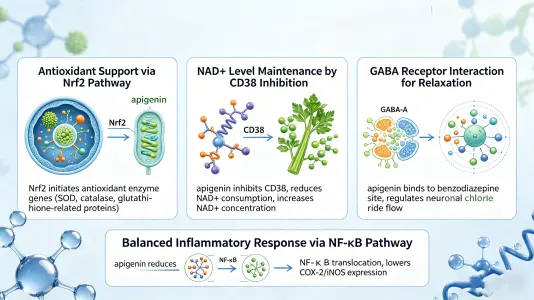
Apigenin powder activates the Nrf2 pathway inside cells. Nrf2 moves to the nucleus when triggered. It turns on genes that produce antioxidant enzymes. These enzymes include superoxide dismutase, catalase, and glutathione-related proteins. Researchers observed higher enzyme activity in models exposed to apigenin. Free radicals decrease as a result. Cells maintain better balance against oxidative challenges. Formulators like this mechanism because it supports overall cellular wellness in supplement formulas. One study demonstrated clear increases in these protective compounds.
The flavone structure enables direct scavenging of certain radicals too. Apigenin donates electrons in a controlled way. This action complements the enzyme boost. Manufacturers add it to antioxidant blends. Daily use formulas often combine it with other flavonoids. The combined effect promotes healthy redox balance. Scientists continue to map these interactions with modern tools. Evidence accumulates steadily from peer-reviewed work.
Preserving NAD+ Levels by Inhibiting CD38
CD38 enzyme consumes NAD+ as people age. Apigenin powder inhibits this enzyme effectively. Inhibition leaves more NAD+ available for cellular processes. NAD+ supports energy production and sirtuin activity. Researchers measured higher NAD+ concentrations in several models after apigenin exposure. The effect appears dose-dependent within normal ranges. Supplement developers appreciate this mechanism for vitality-focused products. Cells function with better efficiency when NAD+ levels stay higher. Studies confirm apigenin acts as a natural modulator of CD38.
This action occurs without disrupting other important pathways. Specificity makes apigenin attractive. Formulators can combine it with niacinamide or other precursors. The powder integrates smoothly. Manufacturers test final blends to ensure compatibility. Customers report interest in formulas that target healthy aging markers. Apigenin powder contributes one piece of that puzzle through its enzymatic interaction.
Interaction With GABA Receptors for Relaxation Support
Apigenin binds to the benzodiazepine site on GABA-A receptors. This binding modulates chloride flow in neurons. Many studies note calmer signaling patterns in relevant models. The interaction supports relaxation without strong sedative effects. Manufacturers include apigenin powder in evening wellness formulas. Users seek natural options for daily calm. The mechanism differs from pharmaceutical agents. Apigenin acts as a mild modulator. Research teams continue exploring receptor affinity using advanced techniques.
Supporting Balanced Inflammatory Responses
Apigenin powder influences NF-κB signaling. It reduces translocation of this transcription factor in challenged cells. Lower activity leads to decreased expression of certain enzymes like COX-2 and iNOS. Cytokine profiles shift toward balance. Researchers documented these changes across multiple cell types. The result helps the body maintain healthy responses. Supplement makers value this for general wellness products. Evidence comes from controlled laboratory experiments. Apigenin works through several parallel routes. This multi-target profile distinguishes flavonoids from single-action compounds.
Pathways overlap in complex ways. Apigenin affects MAPK and other kinases too. These actions occur at concentrations achievable through diet or supplementation. Bioavailability improves when manufacturers use proper delivery systems. Micronized powder or specific carriers help absorption. Formulators experiment with different approaches. They measure blood levels in pilot studies. Reliable suppliers provide technical data that speeds development.
Selecting Premium Apigenin Powder for Your Formulations
Importance of 98% Purity and Testing Standards
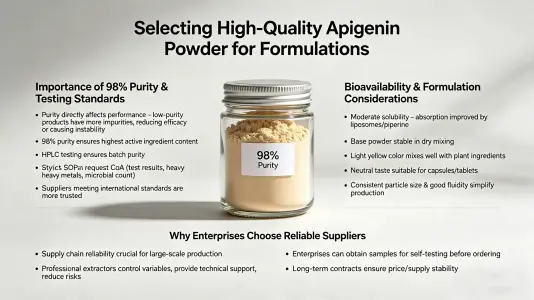
Purity directly impacts how well apigenin powder performs. Lower grades contain more impurities. These impurities may reduce effectiveness or cause variability. 98% specification ensures maximum active content. HPLC testing confirms this level batch after batch. Reputable producers follow strict SOPs. They maintain traceability from farm to finished powder. Buyers request certificates of analysis. These documents list assay results, heavy metals, and microbial counts. Trust grows when suppliers meet international standards.
Bioavailability and Formulation Considerations
Apigenin powder shows moderate solubility. Creative formulators overcome this challenge. Liposomal versions or piperine combinations sometimes improve uptake. The base powder remains stable in dry blends. Manufacturers test shelf life under accelerated conditions. Light yellow color blends well with other botanicals. Neutral taste profile suits capsules and tablets. These practical advantages speed product launches. Companies that buy in bulk want consistent particle size too. Good flow properties simplify manufacturing.
Why Businesses Choose Reliable Suppliers
Supply chain reliability matters for scale-up. Seasonal variation in plants can affect quality. Professional extractors control variables. They invest in research and development. Customers receive technical support. This partnership model reduces risk. Businesses hesitate until they verify quality. Samples allow testing in their own labs. Positive results lead to larger orders. Long-term contracts secure pricing and availability. The entire process builds confidence step by step.
Apigenin Powder For Sale: Rebecca Bio-Tech
Businesses seeking reliable apigenin powder turn to experts who understand plant extracts. Rebecca Bio-Tech produces, researches, and sells high-quality botanical ingredients. We operate as a high-tech export-oriented company. Our focus remains on pharmaceutical, health products, beverage, and cosmetic industries worldwide. Three advanced production lines support over 100 different plant extracts. Annual capacity exceeds 500 metric tons. Our Apigenin carries the alternative name celery seed extract. Active ingredient content reaches 98%. Appearance shows as light yellow powder. We verify potency through HPLC. Molecular formula is C15H10O5. Molecular weight equals 270.237. CAS number lists as 520-36-5. Minimum order quantity starts at 1 kg. Interested parties may request a 20 g sample. Delivery options include FedEx, DHL, air freight, or sea shipment. Certifications cover ISO, HACCP, KOSHER, and HALAL standards. These credentials assure global buyers of consistent quality and safety. Contact our team today to discuss specifications, pricing, or custom requirements. Send an email to information@sxrebecca.com. We respond quickly and provide full documentation. Partner with Rebecca Bio-Tech for dependable supply of apigenin powder that meets your exact formulation needs. Build trust through proven performance and transparent processes. Take the next step toward successful product development.
FAQ
1. What makes celery seed extract a preferred source for apigenin powder?
Celery seeds contain concentrated levels of the flavone. Extraction yields high-purity material with consistent profiles. Processors achieve 98% standardization easily. The resulting light yellow powder meets strict specifications. Many manufacturers prefer this source over leaf or stem material because of higher yield and better stability. HPLC testing confirms identity every time.
2. How does the purity of apigenin powder affect its mechanisms in supplement formulas?
Higher purity delivers more active molecules per gram. This allows precise dosing in final products. Impurities in lower-grade material can interfere with absorption or stability. 98% powder ensures reliable activation of Nrf2, CD38 inhibition, and receptor interactions. Formulators achieve consistent results across batches. Customers experience the intended properties more effectively.
3. Can apigenin powder be combined with other ingredients in wellness products?
Yes. Manufacturers blend it successfully with vitamins, other flavonoids, and adaptogens. Compatibility tests confirm stability. The mechanisms complement many common ingredients. Technical teams help optimize ratios for best performance. Regulatory teams verify compliance for target markets.
References
1. Salehi B, et al. The Therapeutic Potential of Apigenin. Int J Mol Sci. 2019.
2. Kramer DJ, et al. Apigenin: a natural molecule at the intersection of sleep and aging. Frontiers in Nutrition. 2024.
3. ScienceDirect review on Apigenin mechanisms and NF-κB pathway modulation.
4. Lifespan.io summary of apigenin research on NAD+ and antioxidant enzymes.
5. Additional peer-reviewed papers on flavonoid pathways and CD38 inhibition (PMC articles accessed via Google Scholar, 2023-2024).
6. Examine.com database entry on apigenin. Accessed for general mechanistic overview.
_1730079799361.webp)