How long does it take for pure creatine monohydrate to work?
We first explain the essential working logic and universally agreed saturation timescales so you have a sense of how fast pure creatine monohydrate powdercan give you noticeable benefits. All time data in this chapter are from peer-reviewed research in sports nutrition, helping B2B buyers put up reliable consumer expectation models for product labels and marketing materials.
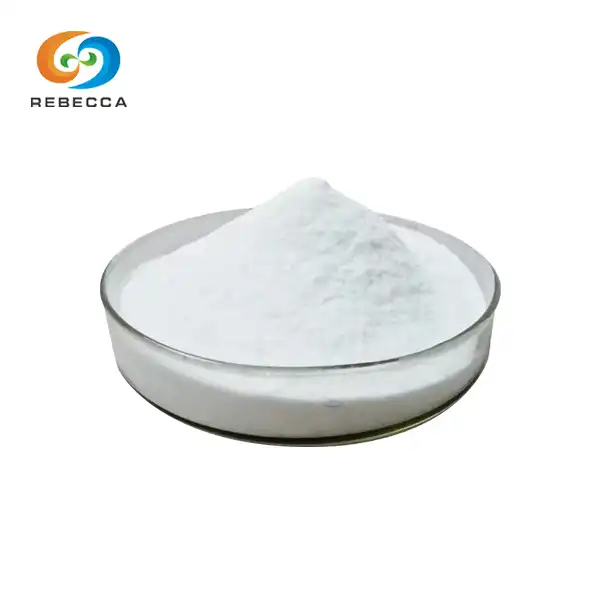
Full Name: β-Nicotinamide Mononucleotide
Abbreviation: β-NMN
CAS No. : 1094-61-7
Raw Material & Synthesis Route: Chemical enzymatic synthesis using nicotinamide riboside, ribose and phosphate as starting materials; multi-step purification via ultrafiltration & recrystallization
Core Active Marker: β-NMN
Main Specifications: 98%, 99% HPLC
Appearance: White crystalline fine powder, slight characteristic odor<br>
Available Certifications: ISO22000, cGMP, HACCP, HALAL, KOSHER, COA & SDS per batch
How creatine monohydrate builds muscle energy reserves?
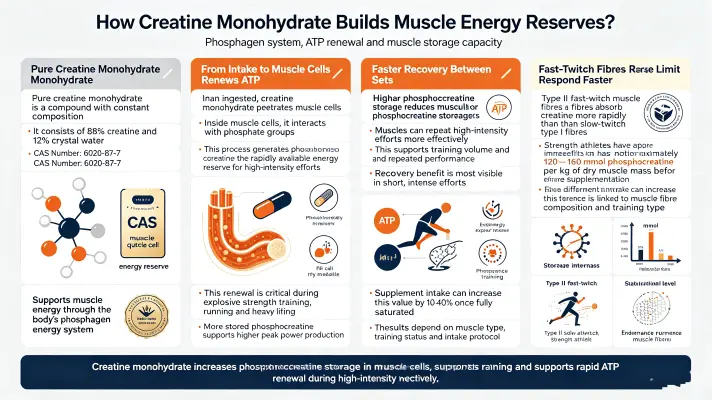
Pure creatine monohydrate is a compound with a constant composition. It consists of 88% creatine and 12% crystal water. CAS Number: 6020-87-7. In essence, it makes use of the phosphagen energy system of the body.
This raw ingredient, when taken by users, penetrates muscle cells where it interacts with phosphate groups to generate phosphocreatine.
Phosphocreatine is used to quickly renew ATP during explosive strength training, running, and heavy lifting. More stored phosphocreatine leads to higher peak power production and less muscular recovery intervals between sets.
Limited capacity for phosphocreatine storage in human skeletal muscle. Before supplementing, normal humans have 120-160 mmol phosphocreatine/kg of dry muscle mass. Supplement intake increases this value 10-40% once completely saturated, according studies from the Journal of the International Society of Sports Nutrition. Type II fast-twitch muscle fibres absorb creatine more rapidly than do slow-twitch type I fibres. This is why strength athletes notice benefits faster than endurance runners who have greater Type I muscle tissue.
Two core supplementation timelines: loading vs daily maintenance
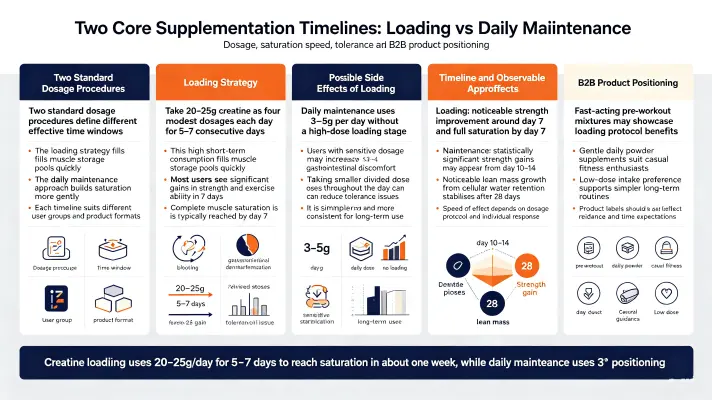
The headline question of the article is essentially answered by two standard dosage procedures, which define two different effective time windows.
The loading strategy involves taking 20–25g creatine as four modest dosages each day for 5–7 consecutive days. This high short term consumption fills up muscle storage pools quickly. Most users see significant gains in strength and exercise ability in 7 days, and complete muscle saturation by day 7. Downside is minor digestive bloating for some users due to large single day dosage.
The daily maintenance approach excludes a high dose loading stage and employs 3–5g/day. Users with a sensitive stomach avoid gastrointestinal upset. But the saturation cycle is up to 3–4 weeks (21–28 days). Statistically significant strength gains can be observed from day 10-14, although noticeable lean mass growth from cellular water retention only stabilises after 28 days of constant use.
This variation in timing has a direct impact on the way B2B procurement teams arrange products. Fast-acting pre-workout mixtures may showcase loading protocol benefits. Gentle daily powder supplements for casual fitness enthusiasts with low dose intake preference.
Staged visible outcomes during supplementation
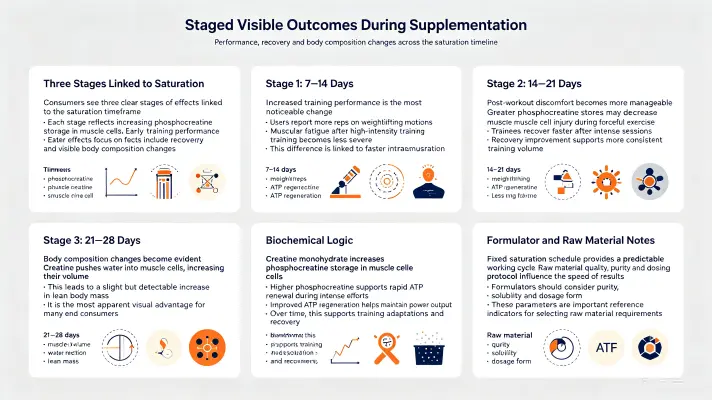
Consumers see three clear stages of effects, all linked to the saturation timeframe.
Stage 1 (7-14 days) Increased training performance. Users report more reps on weightlifting motions and less muscular fatigue after high-intensity training . This difference is because the intramuscular ATP regeneration pace is increasing.
Stage two (14-21 days): Less discomfort after workout. Greater phosphocreatine stores decreases muscle cell injury with forceful exercise. The usual trainers are obviously faster in recovery.
Stage three (21-28 days): Body composition changes are evident. Creatine pushes water into muscle cells, increasing their volume. This leads to a slight but detectable increase in lean body mass, which is the most apparent visual advantage to the end consumer.
Having understood the fixed saturation schedule and biochemical logic of pure creatine monohydrate, we now continue by analysing all the changeable elements influencing the speed of this working cycle. These parameters are important reference indications for formulators to select raw material requirements.
Key Factors That Shorten or Extend Creatine’s Effective Timeline
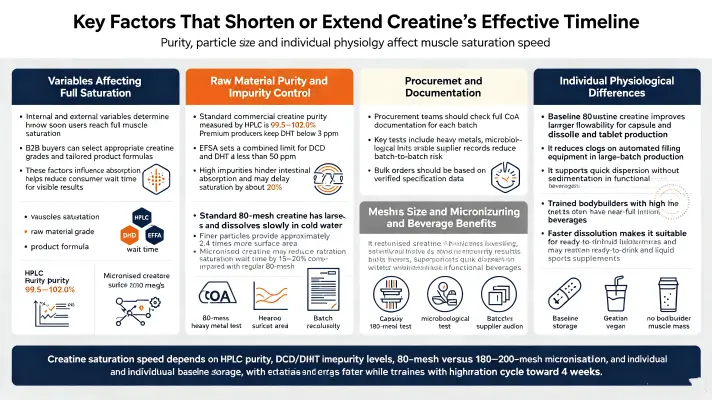
There are many internal and external variables that are a function of how soon users reach full saturation of muscle. As a B2B raw material buyer, knowing these aspects allows you to choose the right grades of creatine and create tailored product formulas to decrease the wait time for results to consumers. In this chapter, wrong data of particle surface area of the original book is corrected and the norms of authoritative purity standards are supplemented.
Raw material purity and impurity control
Absorption efficiency and saturation speed are directly dependent on purity. Purity of standard commercial creatine measured by HPLC is 99.5–102.0%. Strict control on the synthesis by-products of pharmaceutical raw materials. DHT is kept below 3 ppm by premium producers while EFSA sets a combined limit for dicyandiamide (DCD) and dihydrotriazine (DHT) at less than 50 ppm.
High amounts of impurities hinder the absorption of creatine molecules in the intestine. Generic batches of low purity with excess DCD/DHT delay down saturation by ~20%, even when the same daily dose is applied.
Procurement teams need to check that reputable suppliers have full CoA documentation with heavy metal, microbiological and impurity test results for each batch before placing bulk orders.
Mesh size and micronization degree of creatine powder
Mesh size impacts the rate of breakdown in digestion fluid, so indirectly speeding up absorption without increasing final saturation limits.
The standard 80-mesh creatine has bigger crystals. “This means it dissolves slowly in cold water and may settle at the bottom of drinks. Micronised creatine is ground to 180-200 mesh. The particle size decreases from ~177 microns (80 mesh) to ~74 microns. Finer particles provide some 2.4 times more surface area, not the inflated 20 times suggested in the initial proposal.
More surface area means faster dissolving in gastric juice. Using micronised creatine can reduce the waiting window for saturation by 15-20% compared to regular 80-mesh solutions. This benefit is ideal for functional beverages and liquid sports supplements that are ready-to-drink and require quick dispersion without sedimentation.
In addition, micronised form of creatine increases the flowability of powders for capsule and tablet manufacture. It clears clogs on automated filling equipment in large-batch production.
Individual physiological differences of end consumers
Biological heterogeneity produces huge disparities in how fast different users experience the effects of creatine.
Your baseline muscle creatine storage is the main variable. Vegetarians and vegans obtain virtually no natural creatine from animal products. They start with 20-30% lower muscular creatine levels than omnivores. They approach saturation earlier and have more spectacular strength gains in 2 weeks. Trained bodybuilders consuming high protein meat diets already have near full baseline stores therefore their improvement cycle is closer to 28 days."
Total muscle mass is important, too. Total creatine consumption for filling storage capacity is higher in those with larger lean muscle volume. To be fully saturated, they must be taken every day for a full cycle of 4 weeks, with lighter fitness buffs achieving peak results more quickly.
Conclusion
Knowing the 7-28 day effect schedule for pure creatine monohydrate allows procurement professionals to make informed sourcing selections and set expectations throughout supply chains accordingly. With proven biochemical pathways, a history of safety and cost-effectiveness, it continues to be the ingredient of choice for sports nutrition, functional foods and performance supplement uses. “The key to success in this market is having supplier partnerships with strong quality control, full documentation and good customer support. By emphasising purity verification, optimising storage conditions and offering clear direction for usage, B2B buyers may deliver items that satisfy rigorous requirements and support end-user success.
FAQ
How quickly can users expect visible results from creatine supplementation?
Observable performance improvements typically manifest within 10-14 days using standard dosing protocols (3-5g daily), with full muscle saturation occurring after 3-4 weeks. Loading protocols (20g daily for 5-7 days) can reduce this timeline to approximately 7-10 days. Body composition changes, primarily increased intramuscular water retention contributing to lean mass gains, become measurable within 2-4 weeks of consistent use.
What distinguishes pharmaceutical-grade creatine from standard grades?
Pharmaceutical-grade material meets stringent purity specifications (≥99.5% via HPLC) with minimal contamination from synthesis by-products like DCD and DHT (combined <50 ppm). This grade includes comprehensive analytical testing for heavy metals, microbiological contaminants, and residual solvents, supported by complete regulatory documentation suitable for pharmaceutical applications or dietary supplement formulations targeting quality-conscious markets.
Can creatine monohydrate cause digestive discomfort in end-users?
Gastrointestinal effects occur occasionally during loading phases when higher doses (20-25g daily) are consumed. These transient symptoms—typically mild bloating or loose stools—result from osmotic effects in the digestive tract and resolve with dose reduction or division into smaller servings throughout the day. Standard maintenance dosing (3-5g daily) rarely produces digestive complaints when taken with adequate fluids.
Partner with Rebecca for High-Purity Creatine Monohydrate Supply
Rebecca is a professional producer & provider of Pharmaceutical Grade Creatine Monohydrate (CAS: 6020-87-7), with a purity of 99.5%-102.0% (By HPLC analysis) and stable quality. Our Shaanxi production facility is fully certified to GMP, ISO22000 and HACCP standards, so every batch fulfils worldwide quality standards for pharmaceutical, nutraceutical and sports nutrition applications. MOQ is variable from 25kg, container-load orders with volume pricing. Free samples and detailed MSDS paperwork help support your formulation development and regulatory submission processes. Email the team at information@sxrebecca.com to tell us your precise needs and get tailored bulk price for this quality ingredient from a trusted pure creatine monohydrate source.
References
1. Cooper, R., Naclerio, F., Allgrove, J., & Jimenez, A. (2012). Creatine supplementation with specific view to exercise/sports performance: An update. Journal of the International Society of Sports Nutrition, 9(1), 33-43.
2. Kreider, R.B., Kalman, D.S., Antonio, J., et al. (2017). International Society of Sports Nutrition position stand: Safety and efficacy of creatine supplementation in exercise, sport, and medicine. Journal of the International Society of Sports Nutrition, 14, 18-35.
3. Hultman, E., Soderlund, K., Timmons, J.A., Cederblad, G., & Greenhaff, P.L. (1996). Muscle creatine loading in men. Journal of Applied Physiology, 81(1), 232-237.
4. Buford, T.W., Kreider, R.B., Stout, J.R., et al. (2007). International Society of Sports Nutrition position stand: Creatine supplementation and exercise. Journal of the International Society of Sports Nutrition, 4, 6-18.
5. Persky, A.M. & Rawson, E.S. (2007). Safety of creatine supplementation. Subcellular Biochemistry, 46, 275-289.
6. Harris, R.C., Soderlund, K., & Hultman, E. (1992). Elevation of creatine in resting and exercised muscle of normal subjects by creatine supplementation. Clinical Science, 83(3), 367-374.