How to control the quality of echinacea purpurea herb extract?
echinacea purpurea herb extract is a mainstream raw material for nutraceuticals, immune-support supplements, functional drinks and skincare products. Its quality directly decides product efficacy, market compliance and batch stability. Scientific quality control covers raw material management, standardized production, full-index testing and compliance operation. It aims to stabilize core active ingredients, avoid contamination risks and meet global pharmacopeia standards. This article sorts out targeted quality control systems, common quality obstacles and standardized solutions for commercial production.
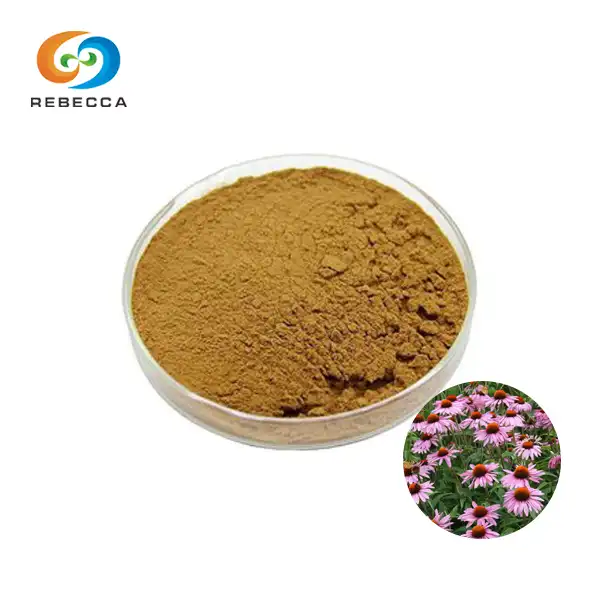
Echinacea Purpurea Herb Extract
English name: Echinacea purpurea extract
Latin Name: Echinacea purpurea
CAS No.: 90028-20-9 /70831-56-0
Molecular forula:C22H18O12
Molecular Weight:474.37
Active ingredients: Polyphenols
Specification: Polyphenols 4%
Use Part : flower
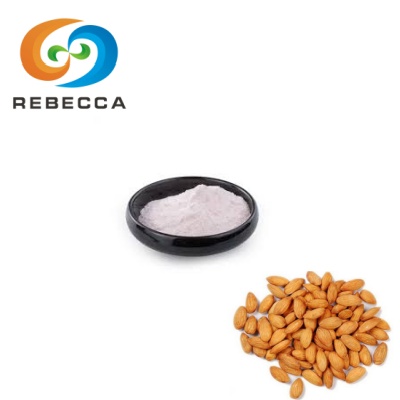
Appearance: yellow brown powder
Mesh size:80 Mesh
Test Method: UV
Core Quality Risks Restricting Echinacea Purpurea Extract Stability
Before formulating targeted quality control schemes, manufacturers and buyers need to clarify inherent quality risks in the whole industrial chain. These risks run through planting, raw material circulation and processing. They are the core reason for inconsistent extract efficacy and unqualified batches.
Natural Variability From Raw Botanical Materials
Wild and scattered cultivated echinacea purpurea has unstable ingredient content. Multiple external factors change its secondary metabolite synthesis. Geographical soil fertility, annual rainfall and daily temperature difference change phenolic acid accumulation in plant tissues. Pest infestation and irregular irrigation bring subtle ingredient differences to the same echinacea variety.
Harvest period acts as the most influential manual control factor. Plants harvested at full flowering stage own high cichoric acid and total polyphenol content. Premature picking reduces active compound content by nearly 30 percent. Post-bloom aging will cause natural degradation of heat-sensitive alkylamides. Most small suppliers fail to record unified harvest time, which leads to fluctuated raw material potency.
Human-Induced Contamination and Adulteration Risks
Heavy metal pollution is a long-term safety hidden danger. Planting bases near industrial zones absorb lead, arsenic, cadmium and mercury via soil and irrigation water. These heavy metals accumulate in flower and aerial parts permanently. Conventional farm pesticide residues also remain on plant epidermis. The residues fail to meet organic raw material standards for European and American markets.
Species confusion and intentional adulteration damage extract authenticity seriously. Echinacea angustifolia has similar appearance to echinacea purpurea, but owns lower medicinal value. Some low-cost suppliers mix cheap plant powder or diluted filler into finished extracts. This behavior cuts production cost but breaks regulatory requirements and reduces immune-boosting efficacy.
Unstandardized Processing Caused Quality Defects
Extraction parameter changes alter final chemical composition greatly. Solvent proportion, heating temperature and extraction time will change polyphenol dissolution rate in Echinacea purpurea herb extract. Non-fixed production parameters create extracts with different active content even from the same batch raw materials.
Post-production handling errors accelerate ingredient failure. Excessive drying temperature destroys phenolic structures. Unsealed storage exposes powder to oxygen and moisture. Hygroscopic extract powder breeds bacteria and mold rapidly. It shortens shelf life and makes finished products fail microbial detection standards.
The above chain risks require unified, step-by-step quality control rules. Only standardized whole-process operation can offset botanical natural differences. The following systematic control measures match USP and European Pharmacopoeia requirements for mass commercial production.

Standardized Whole-Process Quality Control Workflow for Echinacea Purpurea Extract
This workflow follows GMP and ISO unified production norms. It connects raw material access, extraction processing and post-treatment links. Every link sets clear judgment standards to guarantee fixed 4% total polyphenol content tested by UV spectroscopy.
Multi-Dimensional Raw Material Authentication and Access Inspection
Raw material inspection is the first barrier of quality control. Formal suppliers adopt three joint identification methods to avoid species mixing. Staff conduct macroscopic observation on flower shape and stem texture firstly. Microscopic cellular structure analysis verifies plant tissue characteristics secondly. DNA barcoding molecular testing completes accurate species confirmation lastly.
Fixed raw material access standards must be executed strictly. Qualified raw materials adopt echinacea purpurea flowers as the only extraction part. Planting origin, organic cultivation records and full-bloom harvest logs must be archived completely. Every incoming batch carries matched COA reports. The reports mark moisture content, foreign impurity rate and preliminary visual screening results. Unqualified raw materials will be rejected directly to avoid production waste.
Parameter-Fixed Extraction and Post-Drying Processing
Two mainstream extraction technologies are applied in commercial production with unified control parameters. Water-ethanol solvent extraction fits large-scale cost-effective production. Factories fix material-solvent ratio, constant extraction temperature and circulating extraction times. It maximizes cichoric acid recovery and controls solvent residue within pharmacopeia limits.
Supercritical CO₂ extraction serves high-end pharmaceutical and cosmetic-grade orders. It works under fixed pressure and temperature. It leaves no organic solvent residue. It protects heat-sensitive alkylamides and volatile active ingredients effectively. Though with higher equipment cost, it realizes ultra-high batch consistency for export high-standard orders.
Spray drying is the unified final processing step. Production teams stabilize inlet and outlet drying temperature. It balances moisture removal and thermal ingredient degradation. Finished powder keeps unified 80-mesh particle size, stable yellow-brown color and 24-month storage stability.
Full-Item Batch Detection Before Factory Delivery
Every finished batch of Echinacea purpurea herb extract needs independent third-party and in-lab double detection. HPLC quantitative detection analyzes individual phenolic acid content. It monitors cichoric acid, caftaric acid and chlorogenic acid to meet European Pharmacopoeia index limits. UV spectrophotometry completes fast total polyphenol verification to reach the minimum 4% qualified standard.
Safety detection covers pollution and microbial risk screening. ICP-MS technology detects trace heavy metal content to fit USP safety thresholds. GC-MS multi-residue testing quantifies pesticide components for organic certification application. Microbial detection counts aerobic bacteria, yeast, mold and harmful pathogens. Qualified batches keep aerobic microbial count below 1000 CFU/g with no salmonella or staphylococcus aureus detected.
Complete detection data lays the foundation for global market compliance. Meanwhile, standardized operation needs official certification supervision to reduce manual operation errors in long-term production.

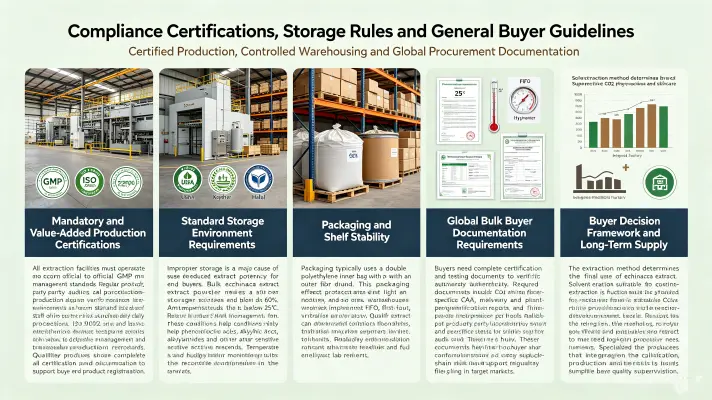
Compliance Certification, Storage Rules and Buyer Common Guidance
Production compliance and later warehouse management consolidate final extract quality. Clear buyer operation guidance also avoids quality failure caused by improper use and storage.
Mandatory and Value-Added Production Certification Requirements
All extraction workshops must run under official GMP management norms. Third-party regular audits calibrate production equipment, purify workshop environment and standardize staff operation. It cuts artificial contamination risks in daily processing. Basic ISO 9001 and ISO 22000 certifications are essential for cross-border food-grade raw material export.
Value-added certifications expand market applicability. USDA Organic, Kosher and Halal certifications meet segmented customer demands. Each certification requires independent workshop partition, exclusive planting management and traceable production records. Qualified manufacturers complete all certification filing to support buyers’ terminal product registration.
Standard Shipping and Warehouse Storage Specifications
Improper storage is the top cause of efficacy attenuation for end buyers. Bulk echinacea extract powder needs constant storage environment. Ambient temperature should stay below 25℃. Relative humidity must be controlled under 60% all year round.
Packaging adopts double-layer polyethylene inner bags and outer fiber drums. The packaging blocks light, moisture and peculiar smell effectively. Warehouses implement FIFO inventory management. Standard qualified extracts maintain stable active ingredients for 24 months under regulated conditions.
Global Bulk Buyers
Buyers need complete certification and testing documents to verify extract authenticity. Required files include batch-specific COA reports, molecular botanical identification reports, heavy metal and pesticide detection reports, and complete qualification certificates. Reliable manufacturers provide third-party test reports and detailed specification sheets for supplier audit.
Extraction methods of Echinacea purpurea herb extract decide end-use application scenarios. Solvent extraction fits cost-sensitive functional food and beverage production. Supercritical CO₂ extraction fits high-purity pharmaceutical and skincare formula development. Buyers can confirm processing technology according to budget and market regulatory rules.
After solving quality control difficulties, global buyers need stable certified suppliers to match long-term procurement demands. Professional manufacturers integrate planting, production and testing to simplify buyer quality supervision work.
FAQ
What documentation should I request to verify extract authenticity?
Request comprehensive documentation including Certificate of Analysis with batch-specific test results, botanical identification reports employing microscopic or molecular methods, heavy metal and pesticide screening data, and microbiological testing results. Supplier quality certifications including GMP, ISO 22000, and relevant organic certifications provide additional validation. Reputable suppliers willingly provide detailed specification sheets outlining analytical methods, acceptance criteria, and typical values. Third-party laboratory testing reports offer independent verification, particularly valuable during initial supplier qualification.
How does extraction method affect final product quality?
Supercritical CO₂ extraction produces high-purity extracts preserving heat-sensitive compounds without solvent residues, ideal for pharmaceutical applications demanding ultra-clean ingredients. Traditional solvent extraction using water-ethanol mixtures remains widely employed, offering cost-effectiveness and scalability while delivering excellent polyphenol recovery. Both methods achieve quality standards when properly controlled, though supercritical extraction typically demonstrates superior batch-to-batch consistency. The choice depends on application requirements, budget constraints, and purity specifications.
What storage conditions preserve extract potency during shipping and warehousing?
Store bulk extract powder in cool, dry environments below 25°C with relative humidity under 60%. Light-protective, moisture-barrier packaging—typically double-lined polyethylene bags within fiber drums—prevents degradation. Avoid exposure to direct sunlight, temperature fluctuations, and strong odors that may contaminate hygroscopic powders. Under proper conditions, quality extracts maintain specification potency for 24 months with minimal degradation. Implementing first-in-first-out inventory rotation ensures materials remain within optimal freshness windows.
Certified Echinacea Purpurea Extract Supply and Quality Support From Rebecca Biotechnology
Shaanxi Rebecca Biotechnology is a professional GMP-certified echinacea purpurea extract manufacturer based in Shaanxi China. It targets global pharmaceutical enterprises, supplement brands, functional beverage factories and cosmetic formula teams. The brand builds closed-loop quality control covering standardized planting, fixed-parameter extraction and full-index batch testing.
Fixed Quality Standard of Rebecca Finished Extract
All finished products reach unified export standard. The extract is yellow-brown 80-mesh flower powder with 4% total polyphenols tested by UV method. Every batch passes ICP-MS heavy metal detection, GC-MS pesticide residue screening and full microbial inspection. It meets FDA, EFSA and European Pharmacopoeia unified access rules. The team archives full production trace data to support cross-border customs clearance and product filing.
Buyer-Oriented Service and Supply Chain Advantage
Rebecca provides one-stop quality supporting services for cooperative clients of Echinacea purpurea herb extract. It offers targeted formula guidance for immune supplements, oral drinks and plant skincare products. The brand supports customized packaging and flexible MOQ. It serves small-batch R&D orders and large-scale commercial bulk orders synchronously. The annual output reaches 500 metric tons to guarantee stable delivery cycle.
Clients can obtain complete COA files, stability test data and compliance guidance documents. For customized quality index demands, the technical team adjusts extraction parameters to meet personalized standards. Contact information@sxrebecca.com for batch sample application and quality scheme consultation. Visit sxrebecca.com to view full botanical extract product lines.

References
1. Barnes J, Anderson LA, Gibbons S, Phillipson JD. Echinacea species (Echinacea angustifolia, E. pallida, E. purpurea): a review of their chemistry, pharmacology and clinical properties. Journal of Pharmacy and Pharmacology, 2005.
2. Manayi A, Vazirian M, Saeidnia S. Echinacea purpurea: Pharmacology, phytochemistry and analysis methods. Pharmacognosy Reviews, 2015.
3. Cech NB, Eleazer MS, Shoffner LT, Crosswhite MR, Davis AC, Mortenson AS. High performance liquid chromatography/electrospray ionization mass spectrometry for simultaneous analysis of alkamides and caffeic acid derivatives from Echinacea purpurea extracts. Journal of Chromatography A, 2006.
4. Senchina DS, McCann DA, Asp JM, Johnson JA, Cunnick JE, Kaiser MS, Kohut ML. Changes in immunomodulatory properties of Echinacea spp. root infusions and tinctures stored at 4°C for four days. Clinica Chimica Acta, 2005.
5. Thomsen MO, Fretté XC, Christensen KB, Christensen LP, Grevsen K. Seasonal variations in the concentrations of lipophilic compounds and phenolic acids in the roots of Echinacea purpurea and Echinacea pallida. Journal of Agricultural and Food Chemistry, 2012.
6. European Pharmacopoeia Commission. European Pharmacopoeia Monograph: Echinaceae purpureae radix. European Directorate for the Quality of Medicines & HealthCare, 9th Edition, 2017.