Lycopene Extract Benefits
Lycopene is a naturally occurring carotenoid present in tomatoes and other red foods. There is much research on its antioxidant qualities and its possible involvement in human health. But the levels of scientific evidence varied across health sectors and not all the stated advantages are equally backed by clinical data. In the next chapters we will try to structure and improve the debate on lycopene extract by considering its composition, manufacture, health significance, concerns for use and quality control.
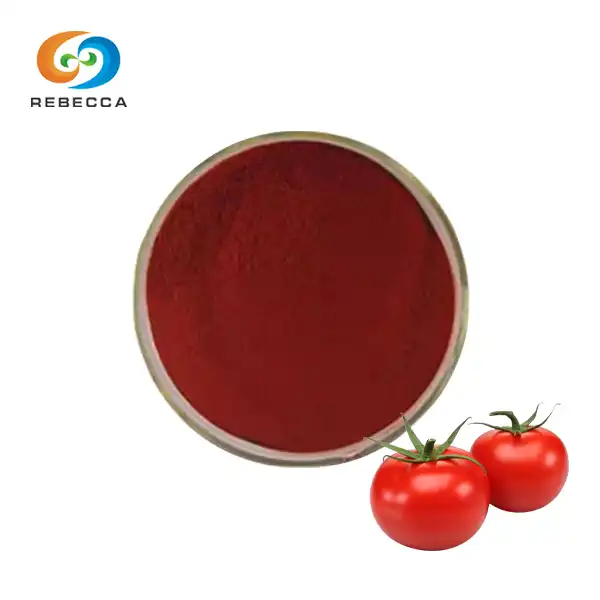
【English name】: Tomato Extract
【Latin Name】: Lycopersicon esculentum
【CAS No.】:502-65-8
【Molecular Formula】: C40H56
【Molecular Weight】: 536.87
【Test Method】: HPLC
【Use Part】: Fruit
【Main Ingredient】: lycopene
【Specification】: 5%~98%
【Appearance】: Dark Red Powder
【Delivery】:FedEx, DHL, Ship by air, Shipr
Mesh size:80 Mesh
Test Method: HPLC
Lycopene Extract Powder: Composition and Production
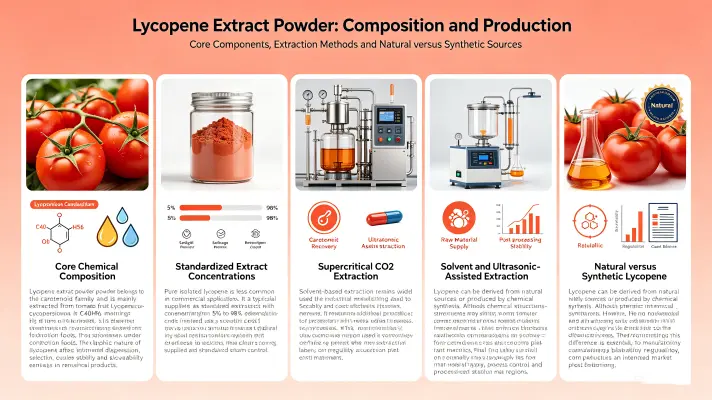
Understanding the core composition of lycopene extract
Lycopene extract powder is a carotenoid belonging to the lycopene family and is mostly obtained from tomato fruit (Lycopersicon esculentum). Its chemical composition (C40H56) means it is fat-soluble, that is, it dissolves in oils, not in water. This property has a great influence on its formulation in supplements and functional foods.
The usage of pure isolated lycopene in commercial applications is unusual. Instead it is provided as an extract standardised to particular concentrations, which are commonly in the range of 5% to 98%. The difference relies on the intended application, formulation cost and delivery mode, such as capsules, softgels and drinking systems.
Production methods and processing considerations
The quality of lycopene powder is influenced by different extraction processes. Extraction using supercritical CO 2 is often believed to be cleaner since it does not require organic solvents. It is performed under regulated pressure and temperature to extract carotenoids with less chemical residues.
The scalability and economic effectiveness of solvent-based extraction technologies have led to their continued widespread usage in industrial manufacturing. However, they need further purifying operations to meet pharmaceutical or food-grade requirements. Each approach has trade-offs in cost, purity, stability and scalability.
Ultrasonic-assisted extraction is occasionally used to increase the efficiency of the yield, particularly when dealing with complicated plant matrices. While these technologies may improve extraction efficiency, the ultimate quality still relies on raw material supply, process control and post-processing stability management.
Natural versus synthetic lycopene
Lycopene may be derived from natural sources as well as via chemical synthesis. Consumer impression of “natural origin” generally favours tomato-derived lycopene over its molecular isomer, despite similar chemical structures. Synthetic lycopene is consistent in purity and content but may have labelling restrictions in certain areas.
From a functional point of view, there is no compelling evidence to support the idea that synthetic and natural lycopene vary greatly in biological activity. However, bioavailability may be different, based on the kind of formulation, the oil dispersion technique and the particle size distribution in the final product.
Understanding these distinctions is critical for the manufacturers that need to balance regulatory compliance, cost structure, and intended market positioning.
As we go from industrial science to biological relevance, it is crucial to make the distinction between laboratory results and clinically confirmed outcomes. In the following part we examine what current research really supports in terms of health benefits.
Health Benefits of Lycopene Extract Powder
Scientific evidence and general antioxidant function
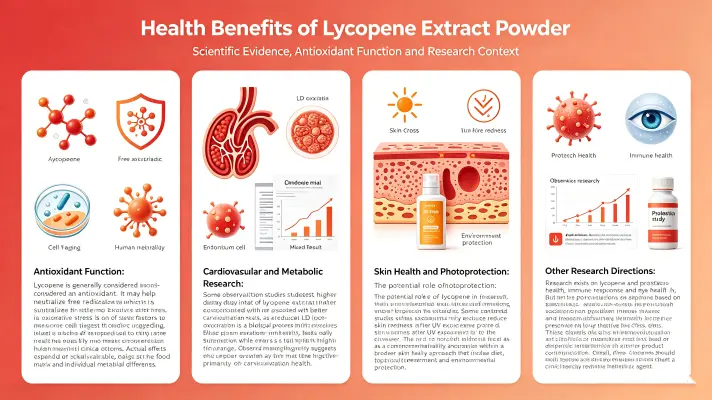
Lycopene is generally recognised as an antioxidant. It is believed to help neutralise free radicals, unstable chemicals linked with oxidative stress. One of several variables that are believed to contribute to cellular ageing and some chronic diseases is oxidative stress.
However, it should be noted that antioxidant activity measured in vitro does not necessarily immediately correlate with demonstrable clinical results in people. The actual world effects are dependent on bioavailability, dose, content of the food and individual metabolic variations.
Cardiovascular and metabolic research context
Some observational studies have shown that a greater dietary intake of lycopene extract powder is associated with better cardiovascular indicators such as reduced levels of LDL oxidation. Oxidation of LDL is a biological process that is associated with the formation of arterial plaque, although it is just one of several factors in cardiovascular health.
Clinical experiments in this area have had mixed outcomes. The findings include some reports of moderate improvements in endothelial function and others showing minimal or no statistically meaningful changes. The observed heterogeneity shows that lycopene may have a supporting function in cardiovascular health initiatives, not a major role.
Skin health and photoprotection insights
Lycopene has been examined for its possible function in skin health, especially UV-induced oxidative damage. Some controlled research suggest that eating lycopene may somewhat decrease skin redness after UV exposure.
However, it should not be regarded as a substitute for sunscreen or topical photoprotective treatments. Instead, it might serve as a complimentary nutritional ingredient in a wider skin health approach of food, topical treatment, and protection from the environment.
Other areas of research interest
Research exists into lycopene and prostate health, immunological response, and eye health, however these conclusions frequently are based on observations rather than solid clinical causation. Population studies have, for example, shown associations between increased lycopene consumption and prostate health indicators, although this does not always imply direct preventative or therapeutic benefits.
Similarly, statements on immune modulation or anti-inflammatory pathways are mostly based on preclinical or mechanistic research. These results are scientifically fascinating, but should be read with care regarding product claims.
In conclusion, lycopene should be considered as a dietary adjunct rather than a clinically established therapeutic medication.
To further convert these scientific discoveries to practical applications, the right use and safety factors should be well understood, which is covered in the following section.
Usage Guidelines and Safety Considerations
Recommended dosage and formulation logic
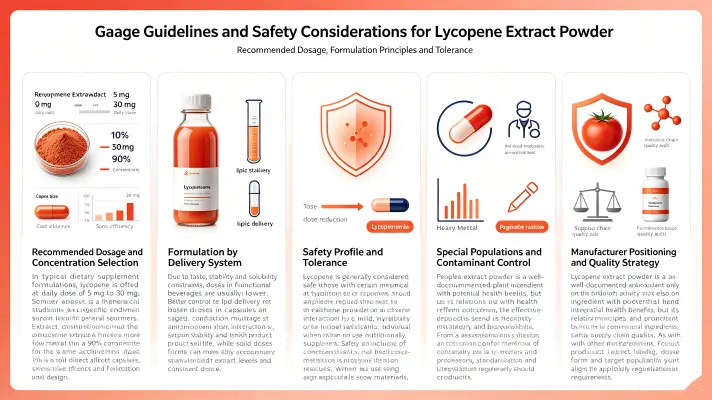
Lycopene is used in typical dietary supplement formulations at doses of 5 mg to 30 mg per day. Higher doses have been studied in certain clinical trials but they are generally done under restricted circumstances and not intended for the average consumer.
The concentration of the extract has to be carefully determined when making goods. For example, with a 10% lycopene extract the amount of raw material needed is much more than that of a 90% concentrate for an equivalent active dosage. This has a direct influence on capsule size, cost efficiency and formulation design.
Taste, stability and solubility limits often result in smaller doses in functional drinks. Better control over lipid-based delivery methods has made larger dosage applications more feasible in capsules and softgels.
Safety profile and tolerability
Lycopene is usually regarded as safe when ingested in typical dietary or supplement amounts. Side effects reported are infrequent and often moderate. Lycopenodermia, a recognised but benign disorder, is a transient orange discolouration of the skin due to excessive ingestion, which reverses following dose decrease.
Unlike certain beneficial chemicals, lycopene is not well proven to cause significant toxicity at frequently used dosages. But this does not mean appropriate formulation and regulatory guidance are no longer needed.
Regular consumption is recommended for those on medication for lipids or with certain medical problems and medical advice should be obtained as needed. The interactions may be modest but individual considerations are always necessary in nutritional supplements.
Safety assessment should involve control of contaminants, e.g. heavy metals and pesticide residues , particularly when agricultural raw materials are used as sources.
Lycopene extract powder is a proven antioxidant botanical element with potential, but not uniformly clear, health correlations. Performance is strongly dependent on formulation quality, dose strategy and bioavailability concerns.
From a business point of view, the effectiveness of lycopene use depends not only on its biological potential, but also on the efficiency of its processing, standardisation and integration into completed goods.
Formulation choices guided by a balanced grasp of science, safety and supply chain quality.
FAQ
What is the recommended daily dosage of lycopene extract powder for supplement formulations?
Clinical evidence supports daily lycopene intake between 5-30 mg for general wellness applications, with cardiovascular-focused formulations commonly providing 10-20 mg per serving. When calculating raw material requirements, account for your extract concentration—a 10% powder requires 100 mg to deliver 10 mg active lycopene, while a 50% grade needs only 20 mg. Regulatory frameworks in the United States don't establish upper limits for lycopene, though we recommend staying within clinically studied ranges to support label claims.
How can I verify the purity and authenticity of lycopene extract powder from suppliers?
Request comprehensive Certificates of Analysis employing HPLC methodology for lycopene quantification. Authentic COAs specify testing methods, detection limits, and include chromatogram data. Third-party laboratory verification provides additional assurance—send samples to independent testing facilities for confirmatory analysis. Reputable suppliers maintain ISO, GMP, and HACCP certifications with audit trails demonstrating quality system effectiveness. Visit manufacturing facilities when feasible to assess equipment capabilities and process controls directly.
Partner With Rebecca for Premium Lycopene Extract Powder
Rebecca specialises in providing pharmaceutical quality tomato extract standardised to your requirements, with lycopene levels from 5% to 98%. Our Shaanxi-based manufacturing plant has three specialised lines with a capacity of over 500 metric tonnes annually, which allows us to provide a stable supply for expanding brands and bulk buyers. As a reputable lycopene extract powder provider, we offer full documentation packages such as COAs, heavy metal reports, pesticide screening and microbiological testing findings to assist your regulatory filings.
Our R&D team provides free bespoke formulation help, stability testing advice and application development assistance. Our technical professionals develop solutions for your product needs, whether it a water-dispersible powder for functional drinks, a high concentration substance for softgel applications, or organic certified components for natural product lines. Contact our team at information@sxrebecca.com for samples, to discuss requirements or to explore collaboration possibilities with a reputable lycopene extract powder manufacturer devoted to quality, compliance and prompt service.
References
1. Story, E. N., Kopec, R. E., Schwartz, S. J., & Harris, G. K. (2010). An update on the health effects of tomato lycopene. Annual Review of Food Science and Technology, 1, 189-210.
2. Rao, A. V., & Rao, L. G. (2007). Carotenoids and human health. Pharmacological Research, 55(3), 207-216.
3. Giovannucci, E., Ascherio, A., Rimm, E. B., Stampfer, M. J., Colditz, G. A., & Willett, W. C. (1995). Intake of carotenoids and retinol in relation to wellness in male health professionals. Journal of the National Institute of Medicine, 87(23), 1767-1776.
4. Palozza, P., Parrone, N., Simone, R. E., & Catalano, A. (2010). Lycopene in atherosclerosis prevention: An integrated scheme of the potential mechanisms of action from cell culture studies. Archives of Biochemistry and Biophysics, 504(1), 26-33.
5. Stahl, W., & Sies, H. (2012). Photoprotection by dietary carotenoids: Concept, mechanisms, evidence and future development. Molecular Nutrition & Food Research, 56(2), 287-295.
6. Erdman, J. W., Ford, N. A., & Lindshield, B. L. (2009). Are the health attributes of lycopene related to its antioxidant function? Archives of Biochemistry and Biophysics, 483(2), 229-235.