How to use WS 23 cooling agent correctly?
ws 23 cooling agent, (N,2,3-Trimethyl-2-isopropylbutanamide, CAS:51115-67-4) is a widely adopted synthetic cooling agent. It delivers clean cooling sensation without mint flavour. Proper use relies on rational dosing, correct dissolution and ingredient compatibility. Improper operation easily triggers crystallization, uneven cooling or off-taste. This guide sorts out standardized application methods for different scenarios, compares alternative cooling materials and shares procurement & troubleshooting suggestions for formulators and purchasers.
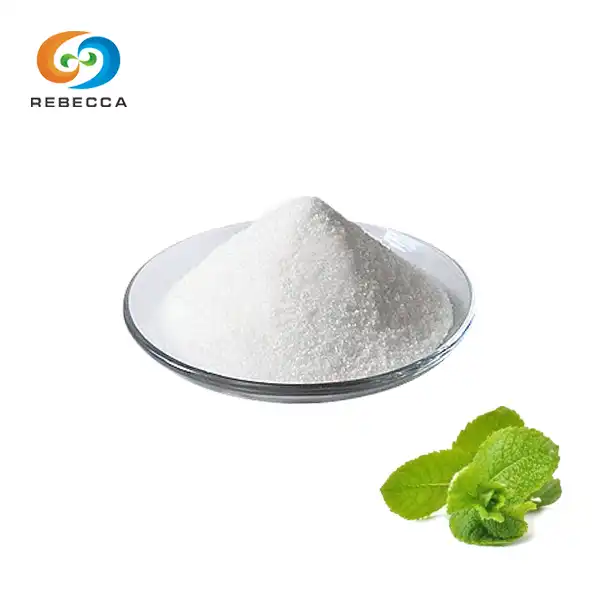
WS 23 Cooling Agent
【English name】: WS-23 Cooling Agent
【CAS No.】: 51115-67-4
【Molecular Formula】: C10H21NO
【Active ingredients】: 99%
【Specification】: WS-23, WS-3, WS-5, WS-12.
【Appearance】: White Crystalline Powder
【Test Method】: HPLC
【Certification】:MSDS、CE、ISO、COA
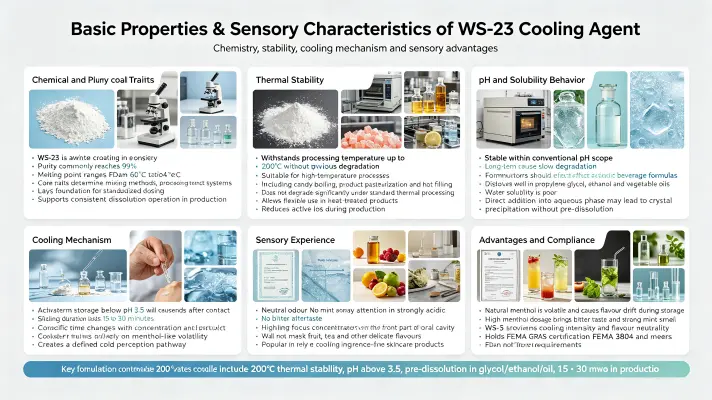
Basic Properties & Sensory Characteristics of WS-23 Cooling Agent
Before developing formulations with WS-23, developers need to master its core physical and chemical traits. These features determine mixing methods, processing temperature and applicable product systems. It lays a foundation for standardized dosing and dissolution operation in later production.
Chemical properties and stability performance
WS-23 is white crystalline powder with purity commonly reaching 99%. Its melting point ranges from 60°C to 64°C. It owns prominent thermal stability and can withstand processing temperature up to 200°C without obvious degradation. This advantage makes it suitable for high-temperature processes, including candy boiling, product pasteurization and hot filling.
The material keeps stable within conventional pH scope. Long-term storage under environment below pH 3.5 will cause slow degradation. Formulators should pay attention when developing strongly acidic beverage formulas. WS-23 dissolves well in propylene glycol, ethanol and vegetable oils. Its water solubility is poor. Direct addition into aqueous phase will lead to crystal precipitation without pre-dissolution treatment.
Cooling mechanism and sensory experience
WS-23 cooling agent activates cold-sensitive TRPM8 receptors on skin and oral mucosa. It brings rapid cooling effect within several seconds after contact. The cooling duration lasts 15 to 30 minutes. Specific time changes with concentration and product matrix.
Different from natural menthol, WS-23 has neutral odour. It has no mint aroma and bitter aftertaste. The cooling focus concentrates on the front part of oral cavity. It will not mask fruit, tea and other delicate flavours. This feature makes it popular in fruit drinks, e-liquids and fragrance-free skincare products.
Core advantages compared with traditional cooling agents
Natural menthol has obvious defects. It is volatile and causes flavour drift during storage. High dosage brings bitter taste and strong mint smell. WS-3 provides mild cooling with slow onset. WS-5 shows medium cooling intensity.
WS-23 balances cooling intensity and flavour neutrality. It supports long-term shelf stability. It holds FEMA GRAS certification (FEMA 3804) for food use and meets FDA notification requirements. It can be applied in food, oral care, cosmetics and e-cigarette products that need clean cooling perception.
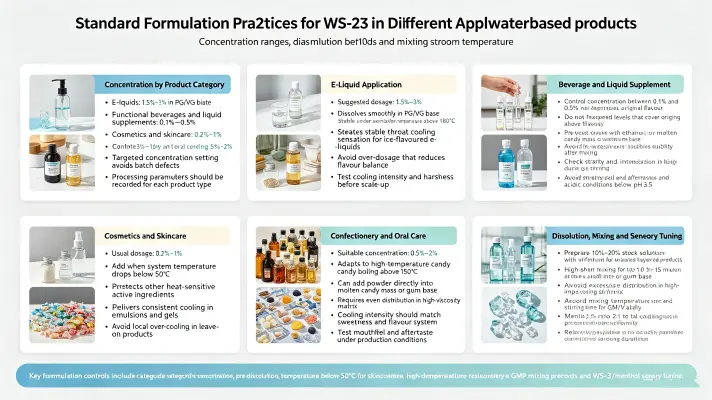
Standard Formulation Practices for WS-23 in Different Applications
Understanding basic characteristics helps formulators select suitable processing parameters. On this basis, targeted concentration setting, dissolution operation and mixing standards can avoid batch defects. The following content summarizes mature operation standards for mainstream application fields.
Recommended concentration range by product category
E-liquids: Suggested dosage is 1.5%–3%. WS-23 cooling agent dissolves smoothly in PG/VG base. It remains stable under atomization temperature above 180°C, creating stable throat cooling sensation for ice-flavoured e-liquids.
Functional beverages and liquid supplements: Control concentration between 0.1% and 0.5%. The dosage must not be too high to prevent covering original flavour. Pre-dissolve WS-23 with ethanol or propylene glycol before adding into water system.
Cosmetics and skincare products: Usual dosage is 0.2%–1%. Add WS-23 when system temperature drops below 50°C. This protects other heat-sensitive active ingredients. Pre-dispersion in oil phase helps achieve uniform cooling effect in emulsions and gels.
Confectionery and oral care goods: Suitable concentration stands at 0.5%–2%. It adapts to high-temperature candy boiling above 150°C. Users can add the powder directly into molten candy mass or gum base.
Effective dissolution and mixing techniques
For water-based products, prepare 10%–20% stock solution with ethanol in advance. This method improves dosing accuracy and prevents crystal separation. Use high-shear mixing for 10–15 minutes under room temperature. Avoid excessive air bubbles during stirring.
Enterprises with mass production need to record mixing temperature and stirring time. Operators should check undissolved particles visually. Complete mixing records satisfy GMP audit requirements and guarantee consistency between batches.
Skills to adjust cooling intensity and duration
Formulators can mix WS-23 cooling agent with WS-3. The ratio of WS-23:WS-3 from 2:1 to 3:1 forms layered cooling experience. WS-23 offers fast front-mouth cooling, and WS-3 extends lasting effect.
Adding a small amount of menthol (accounting for 5%–10% of total cooling agents) can prolong cooling time. Users must carry out sensory tests repeatedly. Prevent extra mint flavour from interfering with product positioning.
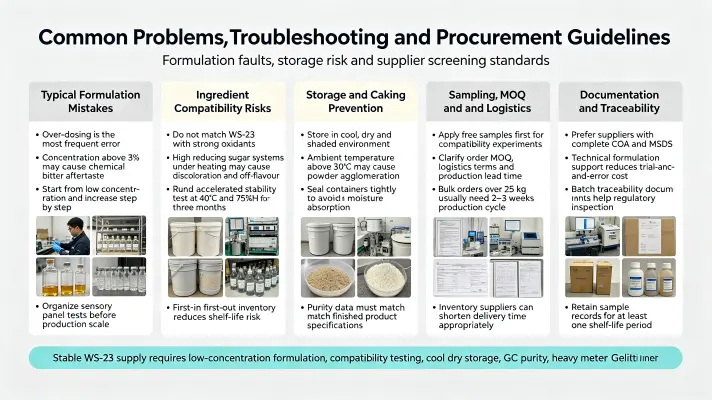
Common Problems, Troubleshooting and Procurement Guidelines
Even with standard formulation schemes, developers may encounter unstable taste, raw material agglomeration and compliance risks. Besides formulation technology, standardized supplier selection also ensures stable production. This chapter collects frequent faults and key points of raw material sourcing.
Typical formulation mistakes and solutions
Over-dosing is the most frequent error. Once concentration exceeds 3% in most formulas, consumers may feel chemical bitter aftertaste. Formulation optimization should start from low concentration. Increase dosage step by step and organize sensory panel tests.
Pay attention to ingredient compatibility. Do not match WS-23 with strong oxidants. High reducing sugar systems under heating may trigger discoloration and off-flavour. Accelerated stability test (40°C, 75%RH for three months) can verify compatibility risks before formal launch.
Storage conditions affect raw material quality. Store WS-23 cooling agent in cool, dry and shaded environment. Ambient temperature higher than 30°C causes powder agglomeration. Seal containers tightly to avoid moisture absorption.
Key standards for WS-23 supplier screening
Qualified suppliers provide GC test reports to confirm 99% purity. Heavy metal detection data should meet industry safety limits: lead below 3 ppm and arsenic below 2 ppm. Residual solvent test needs to follow ICH Q3C guidelines.
Buyers can apply free samples first to run compatibility experiments. Clarify order MOQ, logistics terms (FOB/CIF/DDP) and production lead time. Bulk orders over 25 kg usually need 2–3 weeks production cycle. Inventory suppliers can shorten delivery time appropriately.
Priority should be given to suppliers that supply complete COA, MSDS documents and technical formulation support. Batch traceability documents help enterprises cope with global regulatory inspection.
FAQ
1. What safety requirements should be followed when using WS-23?
WS-23 obtains FEMA GRAS (3804) qualification for food applications. Users must strictly follow recommended concentration limits. Cosmetic finished products need to complete safety evaluation to confirm skin compatibility. Complete MSDS, toxicology documents help enterprises finish global regulatory declaration.
2. Can WS-23 mix with natural menthol?
Mixing is feasible. Most schemes set WS-23 as the main cooling component (70%–90%), supplemented by a small amount of menthol. The combination creates richer cooling layers. But developers need to watch out for extra mint flavour in fruit-flavour products.
3. Why does WS-23 produce crystal precipitation in aqueous formula?
WS-23 has poor water solubility. Direct addition into water phase without pre-dissolving causes crystallization. The effective solution is preparing concentrated glycol or ethanol stock solution before adding into aqueous systems.
4. Are there regional differences in WS-23 food regulatory policies?
FEMA GRAS applies to the US market. Different regions such as EU, China have independent food additive management rules. Enterprises engaged in cross-border sales need to confirm local allowed application scope before formula development.
Partner with Rebecca for Premium WS-23 Cooling Agent Supply
Rebecca provides pharmaceutical-grade WS-23 cooling agent manufactured in certified 100,000-grade cleanrooms, ensuring the additive-free, non-GMO quality that demanding R&D managers require. Our 99% purity specification verified through gas chromatography testing delivers the batch consistency pharmaceutical companies, health supplement brands, and cosmetic formulators depend on. With production capacity exceeding 500 metric tons annually and comprehensive certifications including GMP, ISO22000, and HACCP, we support projects ranging from small-scale product development (1kg minimum order) to large-scale commercial production.
We understand that procurement decisions involve more than price comparisons. Our technical team offers formulation guidance helping innovation managers optimize cooling agent integration across diverse applications—from water-soluble beverage formulations to thermally-stable confectionery systems. Free samples enable thorough compatibility testing before commitment, while flexible payment terms and multiple shipping options (FOB/CIF/DDP) accommodate international buyers' specific logistics requirements.
As an established WS-23 cooling agent supplier serving North American, European, and Asia-Pacific markets, Rebecca combines advanced extraction technology with rigorous quality control spanning raw material verification through finished product delivery. contact us at information@sxrebecca.com or visit sxrebecca.com to discuss your cooling agent requirements, request technical specifications, or arrange sample delivery. Our responsive customer service team addresses inquiries within 24 hours, supporting the tight development timelines your projects demand.
References
1. Wisdom K S, Watson H R, Carr R W. Synthetic cooling compounds: Structure-activity relationships and mechanisms[J]. Flavour and Fragrance Journal, 2007, 22(6): 469-479.
2. Sherkheli M A, Vogt-Eisele A K, Bura D, et al. Characterization of selective TRPM8 ligands and their structure activity response (S.A.R) relationship[J]. Journal of Pharmacy and Pharmaceutical Sciences, 2010,13(2):242-253.
3. Eccles R, Du-Plessis L, Dommels Y, et al. Cold pleasure: Why we like ice drinks, ice-lollies and ice cream[J]. Appetite, 2013,71:357-360.
4. Kamatou G P P, Vermaak I, Viljoen A M, et al. Menthol: A simple monoterpene with remarkable biological properties[J]. Phytochemistry, 2013,96:15-25.
5. Wei E T, Seid D A. AG-3-5: A chemical producing sensations of cold[J]. Journal of Pharmacy and Pharmacology, 1983,35(2):110-112.
6. Patel T, Ishiuji Y, Yosipovitch G. Menthol: A refreshing look at this ancient compound[J]. Journal of the American Academy of Dermatology, 2007,57(5):873-878.