Is all creatine monohydrate the same?
There is a substantial amount of variation among creatine monohydrate products in terms of purity, manufacturing quality, particle size, and regulatory compliance. At first look, the answer seems to disagree. Despite the fact that the molecular structure does not change, factors like as micronization, the mode of production, and the control of contamination have direct effects on the solubility, bioavailability, and safety of the substance. In situations where batch-to-batch consistency and regulatory documentation are non-negotiable, such as when choosing raw materials for pharmaceutical formulations, nutritional supplements, functional drinks, or cosmetic applications, these characteristics are of tremendous importance.
Creatine Monohydrate: Is It Really the Same Across Products?
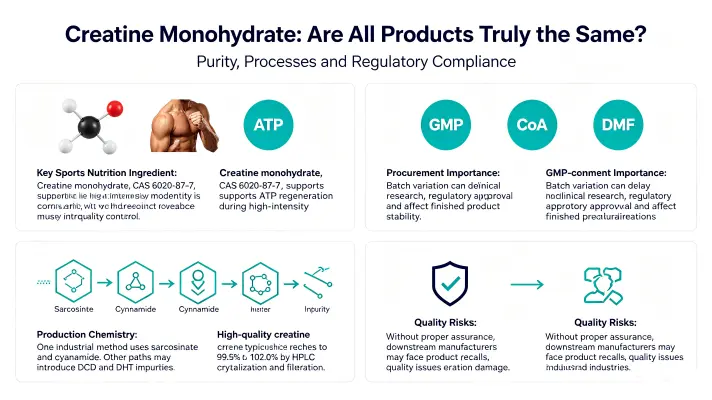
In sports nutrition, creatine monohydrate (CAS: 6020-87-7) is an essential component that plays a pivotal role in facilitating the regeneration of adenosine triphosphate (ATP) during high-intensity muscular contractions. Although the molecular identification of this compound, which is N-(aminoiminomethyl)-N-methyl glycine monohydrate, is consistent across all applications, the quality of the final product might vary greatly depending on the synthesis routes, purification processes, and quality control protocols that are used.
The Chemistry Behind the Ingredient
The Sarcosinate and Cyanamide technique and alternate paths that may add contaminants such as dicyandiamide (DCD) or dihydrotriazine (DHT) are the two industrial approaches that are usually followed in the production of creatine. High-performance liquid chromatography (HPLC) is used to verify that the test values of premium-grade creatine are between 99.5% and 102.0%. This is accomplished via the completion of a stringent purification process that includes crystallisation and filtering processes. When using alternatives of lower quality, it is common practice to skip these processes, which leads to a decrease in purity and the possible presence of residual solvents or heavy metals.
Why Purity and Manufacturing Matter for Procurement?
Unique obstacles are faced by B2B buyers in the pharmaceutical research and development and supplement formulation industries. As a result of batch variation, clinical studies may be derailed, regulatory clearances can be delayed, and the stability of completed products can be compromised. Compliance with the Food and Drug Administration (FDA), European Food Safety Authority (EFSA), and other worldwide requirements may be ensured by a raw material supplier that provides GMP-certified manufacturing, transparent Certificates of Analysis (CoA), and assistance for Drug Master Files (DMF). Product recalls, quality problems, and a tarnished reputation for the brand are all risks that downstream producers face if they do not get these guarantees.
Key Differences Among Creatine Monohydrate Products: A Dimensional Analysis
For the purpose of satisfying the specific requirements of the production process as well as the anticipations of the end-user, the procurement teams are obligated to conduct an analysis of the raw materials for creatine across a number of characteristics. Having a grasp of these distinctions makes it feasible to use that knowledge to make informed sourcing decisions that are in conformity with the technical requirements and regulatory duties that are in place.
Purity Levels and Analytical Verification
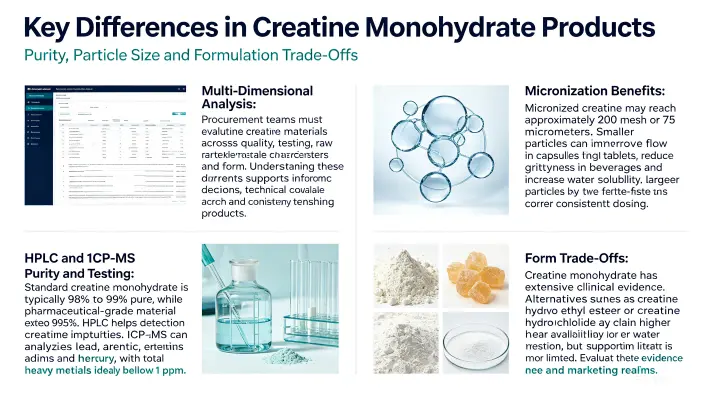
In general, the purity of standard creatine monohydrate is between 98% and 99%, although the purity of pharmaceutical-grade materials is higher than 99.5%. The lack of creatinine, which is a result of deterioration, is confirmed by HPLC testing, which ensures that the substance will remain stable throughout the storage and formulation processes. The detection of heavy metals like lead, arsenic, cadmium, and mercury may be accomplished by trace contamination analysis using inductively coupled plasma mass spectrometry (ICP-MS). These heavy metals must be kept at a concentration of less than 1 ppm collectively in order to fulfil international safety standards.
Micronization and Particle Size Engineering
Mechanical processing is applied to micronised creatine in order to reduce the particle size to around 200 mesh, which is comparable to 75 microns or less. This goal is accomplished by reducing the particle size. This transformation enhances flowability during encapsulation or tableting, it decreases the amount of grittiness that is present in finished beverages, and it raises the substance's solubility in water. All of these benefits are achieved by various transformations. Because larger particles have a tendency to settle out more rapidly, the difference becomes extremely crucial when it comes to the manufacture of functional drinks. This is because larger particles tend to settle out more quickly, which results in visual defects and inconsistent dose across production batches.
Alternative Creatine Forms and Application Trade-Offs
Alternatives such as creatine ethyl ester or creatine hydrochloride promise higher bioavailability or decreased water retention, despite the fact that creatine monohydrate is the most common form of creatine due to the abundant clinical evidence supporting its usage among consumers. On the other hand, when compared to the decades of research that have been undertaken on monohydrates, the current body of scientific literature that supports these assertions is still rather limited. It is important for procurement professionals to take into account marketing narratives in addition to data based on evidence-based techniques of efficacy when conducting an analysis of formulation strategies.
Conclusion
There is a significant amount of variation across creatine monohydrate products with regard to purity, manufacturing quality, particle engineering, and regulatory compliance. In addition to price comparisons, choices about procurement should also take into account analytical verification, certifications of suppliers, optimisation of packaging, and the possibility of long-term partnerships when possible. It is possible for business-to-business buyers to acquire high-quality ingredients that are in compliance with severe manufacturing standards and regulatory requirements by using rigorous assessment frameworks that are backed by transparent documentation and technological cooperation. The strategic procurement of pharmaceutical-grade creatine monohydrate puts companies in a position to maintain a competitive edge in international marketplaces.
FAQ
What factors determine creatine monohydrate quality?
Purity levels that are validated by HPLC analysis, the absence of heavy metal contamination that are found by ICP-MS testing, particle size distribution that affects solubility, and production certifications (GMP, ISO 22000) are all factors that jointly influence quality. The selection of the synthesis technique has an effect on the impurity profiles, and the use of appropriate packaging helps to minimise moisture-induced deterioration via storage and transportation.
How does micronization improve creatine performance?
The process of micronization brings the particle size down to around 200 mesh, which improves the solubility of the substance in water and prevents sedimentation in liquid formulations. The elimination of grittiness, which has a detrimental influence on the customer experience in powdered drinks or ready-to-drink goods, is accomplished by this procedure, which also enhances bioavailability by increasing the surface area used for gastrointestinal absorption.
Can creatine monohydrate degrade during storage?
When creatine is exposed to moisture, it is converted into creatinine, which is an inactive metabolite. For a period of twenty-four to thirty-six months, stability may be maintained by the use of nitrogen-flushed packing and storage in settings that are low in humidity (below sixty percent relative humidity). Long-term stability in regular warehousing circumstances may be predicted by accelerated ageing experiments carried out at a temperature of 40 degrees Celsius and a relative humidity of 75%.
What certifications should B2B buyers verify?
In order to guarantee that production quality processes are up to pharmaceutical requirements, GMP certification is required. Both HACCP and ISO 22000 are used to validate the methods for food safety management. The correctness of the CoA is validated by independent testing carried out by certified labs. There are unique market needs that are addressed by organic, kosher, and halal certifications. Submissions to regulatory agencies for pharmaceutical applications are made easier by the availability of DMF.
Partner with Rebecca for Certified Creatine Monohydrate Supply
Rebecca provides pharmaceutical-grade creatine monohydrate with a concentration range of 99.5% to 102%. This product is made in our Shaanxi plant in accordance with GMP, ISO 22000, and HACCP certifications. These three specialised manufacturing lines provide more than 500 metric tonnes yearly, which ensures a supply that can be scaled up to meet the needs of makers of pharmaceuticals, supplements, and beverages all over the world. Your procurement process will be simplified with the help of customisable purity criteria, flexible packaging choices ranging from 25 kg to 500 kg, and extensive regulatory assistance via documents such as DMF, CoA, and MSDS. There is the possibility of receiving free samples and technical help. Connect with our team by sending an email to information@sxrebecca.com or by visiting sxrebecca.com in order to discuss the needs you have for your creatine monohydrate provider.
References
1. Kreider, R.B., et al. (2017). "International Society of Sports Nutrition Position Stand: Safety and Efficacy of Creatine Supplementation in Exercise, Sport, and Medicine." Journal of the International Society of Sports Nutrition, 14(1), 18.
2. Hultman, E., Söderlund, K., Timmons, J.A., Cederblad, G., & Greenhaff, P.L. (1996). "Muscle Creatine Loading in Men." Journal of Applied Physiology, 81(1), 232-237.
3. Harris, R.C., Söderlund, K., & Hultman, E. (1992). "Elevation of Creatine in Resting and Exercised Muscle of Normal Subjects by Creatine Supplementation." Clinical Science, 83(3), 367-374.
4. Jäger, R., Purpura, M., Shao, A., Inoue, T., & Kreider, R.B. (2011). "Analysis of the Efficacy, Safety, and Regulatory Status of Novel Forms of Creatine." Amino Acids, 40(5), 1369-1383.
5. Persky, A.M., & Rawson, E.S. (2007). "Safety of Creatine Supplementation." Subcellular Biochemistry, 46, 275-289.
6. Wyss, M., & Kaddurah-Daouk, R. (2000). "Creatine and Creatinine Metabolism." Physiological Reviews, 80(3), 1107-1213.