Is turmeric powder or extract better?
I have over 10 years experience obtaining botanical ingredients for businesses on three continents. In practically every turmeric inquiry, the turmeric powder-versus-extract debate arises. It all depends what you are creating, and to whom you are selling. This tutorial is about the distinctions that matter for purchasing choices, not simply the textbook terminology.
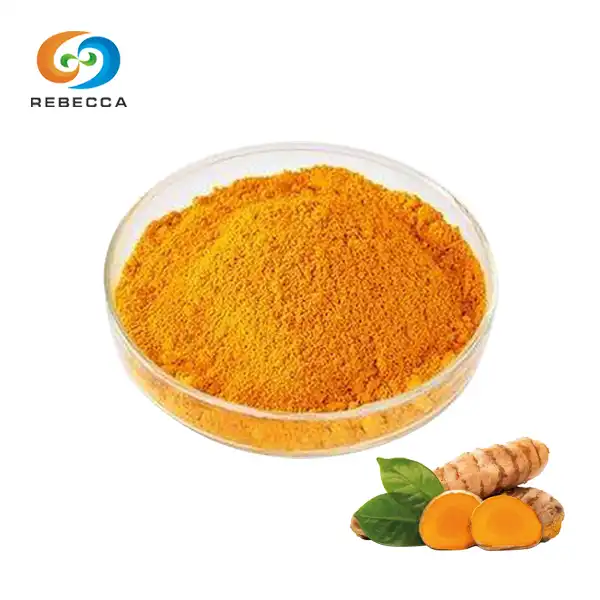
Product name: Curcumin
Latin Name: Curcuma longa L.
CAS No.: 458-37-7
Molecular Formula: C21H20O6
Active ingredients: Curcumin, demethoxycurcumin, bisdemethoxycurcumin.
Specification: Curcuminoids 10%~ 95%
Use Part : Subterranean rhizome
Appearance: Orange yellow powder
Mesh size:80 Mesh
Test Method: HPLC
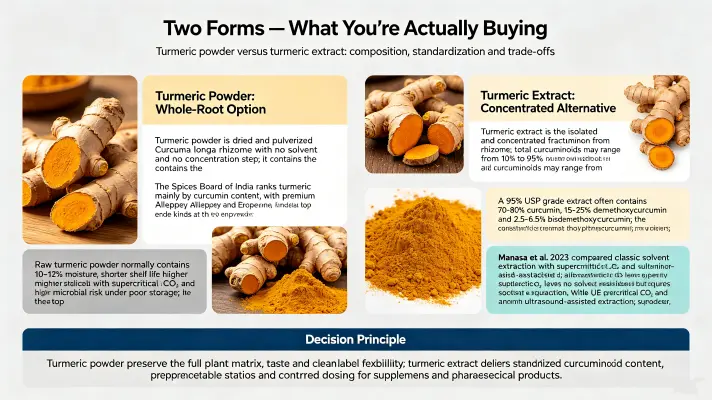
Two Forms — What You're Actually Buying
Turmeric Powder: The Whole-Root Option
Turmeric powder is nothing but the dried and pulverized rhizome of Curcuma longa. No solvent. No focus step. What you receive is what the plant is producing.
Commercial turmeric powder contains usually between 2 and 6 % curcuminoid. This range is important because it affects how much active chemical ends up in the final product. Indian procurement guidelines do acknowledge this heterogeneity. The Spices Board of India ranks turmeric mainly by the proportion of curcumin it contains, with the premium Alleppey and Erode kinds at the top end.
In addition to the curcuminoids the powder contains the natural fiber, and the volatile oils (turmerone and zingiberene) and minerals of the root. For food makers of spice mixes or ready-to-eat meals, these secondary chemicals provide taste and fragrance that an extract just cannot mimic.
Moisture content is a practical concern. Raw turmeric powder normally contains 10-12% moisture. This results in a shorter shelf life than extracts and a greater susceptibility to microbial development under poor storage conditions. I have had shipments refused at the port because moisture crept over spec during transportation in a humid climatic zone.
Turmeric Extract: The Concentrated Alternative
Turmeric extract is the portion isolated and concentrated from the rhizome which contains the curcuminoids. The finished product may comprise from 10% to 95% of total curcuminoids depending on the technique of extraction and the objective for standardization as confirmed by HPLC analysis.
When made to pharmacopoeial standards, the three curcuminoids in the extract, curcumin, demethoxycurcumin and bisdemethoxycurcumin, are present in a constant ratio. A 95% extract (USP grade) will often include 70-80% curcumin, 15-25% demethoxycurcumin, and 2.5-6.5% bisdemethoxycurcumin. It is this reproducibility that makes extracts appropriate for clinical trials and controlled pharmaceutical products.
Extraction technique impacts quality and cost. A 2023 review by Manasa et al. published in ACS Omega compared classic solvent extraction to modern technologies like as supercritical CO₂ extraction and ultrasound-assisted extraction (UAE). Supercritical CO2 leaves no solvent residues but needs costly equipment. UAE gives similar yields with a shorter processing time. The technique of choosing influences the residual solvent profile and thermal degradation level of the extract, both important to pharmaceutical customers.
Core Differences at a Glance
The powder preserves the full plant matrix. The active portion is isolated by extract. That one difference makes every downstream choice regarding formulation, labelling and regulatory compliance different.
The amount of curcuminoids in the powder depends on the crop, the location and the season. The extract provides precisely what the certificate of analysis promised. Powder works FOR clean-label marketing, not AGAINST it. Extract delivers the exact dosage that supplement facts panels need. Neither is superior overall. The proper option relies on what you are going to do next in your manufacturing process.
The beginning stage is knowing what each form includes. The tougher issue is what trade-offs can your firm live with?
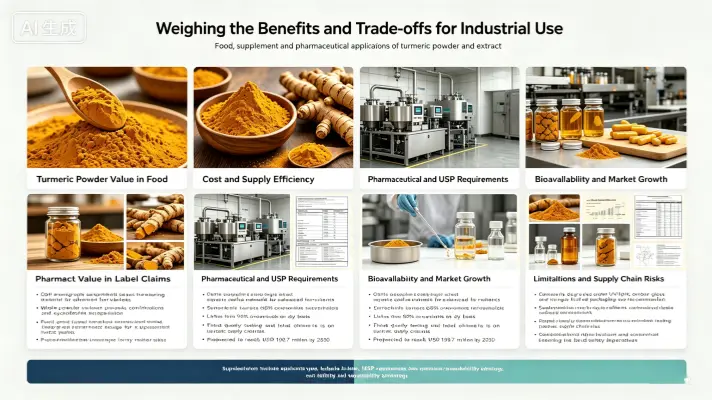
Weighing the Benefits and Trade-offs for Industrial Use
Where Turmeric Powder Delivers Value
Food makers rely on turmeric powder because it doubles as a natural colorant and spice. A curry mix or a mustard sauce requires the earthy warmth of turmeric — not simply its bright hue. You get both in one ingredient, the complete powder.
Clean-label positioning is an increasing business benefit. Retailers and customers are increasingly turning away from ingredient lists that seem like chemical inventories. The label only says “turmeric” or “turmeric powder.” This turmeric powder is in line with the minimally processed posture that luxury food businesses base their profits on.
Cost is also an issue at scale. Regular turmeric powder is a quarter of the cost per kilo of standardised extracts. For a sauce maker utilizing 0.5-2% by weight turmeric in formulas running in the hundreds of tons per year, the price differential adds up quickly. Functional advantages are not lost and the Bill of Materials is kept manageable using powder.
Where Turmeric Extract Takes the Lead
If a product label has a quantifiable health claim – ‘500 mg curcuminoids per serving’ – it has to come from an extract. However, inherent variance in entire powder precludes accurate dosage at capsule or tablet size. Supplement makers rely on standardized extracts to make label claims and to pass third party testing.
Pharmaceutical applications increase the threshold much more. USP-monograph curcuminoid extract has to fulfill stringent identity, purity and potency standards. The United States Pharmacopeia requires that powdered turmeric extract contain not less than 95% curcuminoids (on a dry basis) and specifies limitations for related chemicals and residual solvents. Food-grade powder is not effective under these limits.
Bioavailability is another distinguishing factor. Plain curcumin is poorly absorbed, an often-quoted restriction that has spurred creativity in extract preparation. All the three systems- phospholipid complexes, piperine combinations and cyclodextrin encapsulation- use a standardised extract as the starting material. These improved formulations currently represent a considerable share of the curcumin market, which Grand View Research estimated at USD 98.9 million in 2024 and projected to reach USD 199.7 million by 2030.
Limitations You Can't Ignore
Every raw material has its limitations. Extracts continue to suffer from light sensitivity. Curcumin degrades under UV light, changing from brilliant orange-yellow to a dismal reddish-brown. In my experience amber glass containers and nitrogen flushed packing are not optional. They are the least to retain potency in overseas delivery.
Formulation compatibility demands attention too. Curcuminoids are hydrophobic in nature. They are insoluble in water. Manufacturers of functional beverages wishing to use turmeric extract in a ready-to-drink format must add emulsifiers or solubilizers. These additions may affect clean-label positioning and increase expense. However, not all 95% extracts are created equal when it comes to final goods. In fact, a 2023 research published by Slaček et al. in Foods proved that extraction technique has a major influence on curcuminoid production and antioxidant potential.
Turmeric powder has its own trials. Adulteration is an issue well recognized in the worldwide supply chain. A scoping examination across six continents identified the usage of synthetic dyes including metanil yellow and lead chromate to boost the yellow shade of poor quality turmeric. In 2019, Forsyth et al. found that lead chromate adulteration was common in South Asian turmeric supply chains, prompting regulatory action in Bangladesh that cut contamination from 47% of samples to almost zero in two years . This history emphasizes why supplier verification is not a formality for B2B buyers—it’s a food safety imperative.
The choice between powder or extract is not a theoretical choice. It does happen in actual supply chains with real ramifications for product quality and regulatory status. The following section describes how to make that call for your particular task.
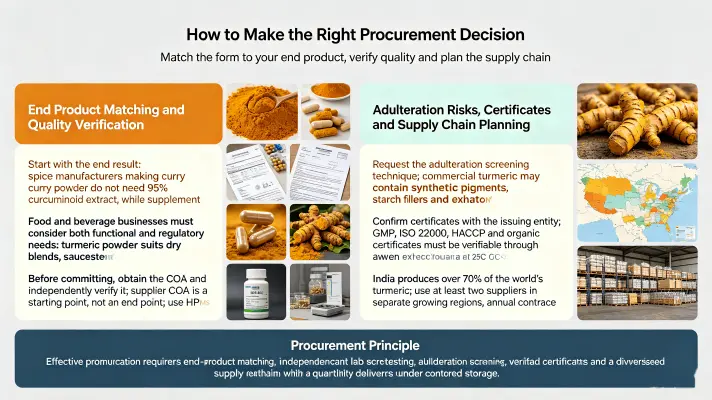
How to Make the Right Procurement Decision
Match the Form to Your End Product
Start with the end result. A spice manufacturer that blends curry powder has no need — and should not have to pay for — a 95% curcuminoid extract. If a supplement company claims to have 500 mg of curcuminoids per capsule, they cannot just utilize whole turmeric powder and yet match the standard. The application decides the raw material.
Food and beverage businesses must consider both functional and regulatory needs. Turmeric powder is good for dry blends, sauces and gourmet goods where the taste of the spice is part of the selling pitch. Turmeric extract is more appropriate for functional drinks and fortified meals where taste neutrality and dose accuracy are prioritized above the whole-plant tale.
Cosmetic formulators have an intriguing middle ground to navigate. Turmeric powder may be an alternative to a natural skincare brand but it needs more careful dispersion work and microbiological control. Extracts are easier to create with – they dissolve more easily and allow for accurate claims around antioxidant activity – but they might push a product away from a “100% natural” posture that some consumers prefer.
Verify Quality Before You Commit
Here are three must-do tests before you place your first purchase with any turmeric source.
First, get the certificate of analysis and independently check it.The in-house COA from a supplier is a beginning point, not an end point. For extracts: Submit a retention sample to a third-party lab for HPLC confirmation of curcuminoid concentration. For powder, the same lab should test for heavy metals (lead, arsenic, cadmium, and mercury) and pesticide residues by ICP-MS and GC-MS respectively.
Secondly, request the adulteration screening technique.A 2019 study by Sasikumar et al. in the Journal of Spices and Aromatic Crops reported on the many adulterants discovered in commercial turmeric, including synthetic pigments, starch fillers, and leftover turmeric (material from which curcuminoids have previously been extracted). A reputable provider should be able to explain their screening techniques in each area. If they can’t, that’s a huge red flag.
3. Confirm certificates with the issuing entity.GMP, ISO 22000, HACCP, organic certificates – these papers are meaningless if they can’t be tested. Accredited certification bodies each have a database that may be searched. Check your own records to verify the certificate number and expiry date for compliance evidence.
Plan Your Supply Chain for the Long Haul
India produces over 70% of the world's turmeric, according to the Spices Board of India, the government body. The concentration offers potential but also danger. Monsoon patterns, crop output and changes in export policy all cause prices to fluctuate. The single-source method makes buyers vulnerable.
I would suggest to have contacts with at least two competent suppliers in separate growth areas. It distributes the risk of crops and maintains the prices competitive. It also gives you power if the quality of one supplier drops – a backup source means you are not compelled to accept bad material to keep production going.
Contracts for a year, with deliveries every quarter, find a sweet spot between price stability and freshness of the goods. The lower shelf life of turmeric powder (12 to 18 months under good circumstances) implies more frequent, smaller shipments. Extracts are available in bigger quantities owing to their 24-month stability window - but only if storage conditions are managed. Standard storage criteria are temperatures below 25°C and relative humidity below 65% for both forms.
Conclusion
The decision of turmeric powder vs turmeric extract should be made with a full understanding of application needs, regulatory constraints and economic implications. Powders provide whole-food nutrition and clean-label appeal for food items and holistic supplements, while extracts provide standardized bioactivity required for pharmaceutical applications and functional drinks. Effective procurement achieves a delicate balance: quality assurance by thorough supplier screening, cost efficiency by targeted volume commitments, and supply chain resilience by diverse sourcing. The turmeric ingredient market is evolving, with new advancements in bioavailability enhancement, sustainable farming practices, and traceability technologies that enable procurement professionals in the pharmaceutical, nutraceutical, beverage, and cosmetic industries to make informed decisions.
FAQ
1. Can turmeric powder replace extracts in medicinal formulations?
Turmeric powder cannot be readily substituted for extracts in pharmaceutical formulations that need accurate curcuminoid dose and pharmacopeial compliance. Natural variability in curcumin in powder (2-6%) affects the uniformity needed for clinical studies and regulatory applications. For pharmaceutical use, HPLC-verified potency, generally 95% curcuminoid extracts matching USP or EP monograph standards, is needed to ensure batch-to-batch consistency and therapeutic effectiveness.
2. The curcumin content is a clue for the right dose.
Dosage recommendations are based on curcuminoid content and bioavailability improvement. For general health, standard extracts (95% curcuminoids) are normally 500-1000mg daily, whereas improved formulations with piperine or phospholipid complexation may lower effective dosages to 200-400mg. Powder-based supplements need larger dose sizes (2-4g) to attain a similar curcuminoid consumption, making it difficult to count capsules and maintain customer compliance.
3. How can purchasers ensure the legitimacy of the source and quality of the product?
Buyers perform multi-step due diligence to authenticate suppliers, including requesting current GMP / ISO certificates validated by the accreditation body, third party lab testing for identity (HPLC), purity (heavy metals by ICP-MS) and adulterant screening (C14 radiocarbon dating), and on-site facility audits when the volume justifies the investment. Reputable suppliers are proactive in providing Certificates of Analysis, allergies declarations and pesticide residue studies.
Partner with Rebecca for Premium Turmeric Ingredients
Rebecca is one of the top Turmeric Powder Suppliers in China, situated in Shaanxi, China. We are equipped with 3 professional production lines and have an annual capacity of over 500 metric tons, providing standardized botanical extracts from 10% to 95% curcuminoid standards, tested by HPLC. We use supercritical CO₂ extraction and ultrasonic-assisted processing at our GMP-certified facility to maintain batch-to-batch uniformity and integrity of active ingredients. Full compliance paperwork including HACCP, ISO 22000 and pharmacopoeial certifications are in place with comprehensive quality control from raw material procurement to completed product delivery. Rebecca’s R&D team offers unique formulation assistance for pharmaceutical, nutraceutical, beverage and cosmetic applications, with variable MOQ choices and DDP logistics to North America and Europe. To discuss specification needs or to see how our turmeric ingredients might help your product development activities, contact our technical consultants for samples at information@sxrebecca.com.
References
1. Grand View Research. (2024). Curcumin Market Size, Share & Trends Analysis Report By Application (Pharmaceutical, Food, Cosmetics), By Region And Segment Forecasts, 2025 - 2030. 9781680384314
2. Manasa, P. S. L., Kamble, A. D., & Chilakamarthi, U. . (2023). A Comprehensive Review of Various Extraction Techniques of Curcumin.ACS Omega 8 (39), 35523–35537.
3. Slaček, G., Kotnik, P., Osmić, A., Postružnik, V., Knez, Ž., Finsgar, M., & Knez Marevci, M. (2023). Extraction, Separation and Identification of Curcuminoids from Turmeric (Curcuma longa)Foods, 12(21), 4000.
4. Sasikumar, B., Swetha, V.P., Parvathy, V.A., & Sheeja, T.E. . (2019). Advances in Adulteration and Authenticity Testing of Turmeric (Curcuma longa L.)Journal of Spices and Aromatic Crops, 28(2): 96-105.
5. Forsyth J.E., Nurunnahar S., Islam S.S., Baker M., Yeasmin D., Islam M.S., ... & Luby, S. P. ( (2023). Food safety policy initiatives decreased lead chromate adulteration of turmeric in Bangladesh.Environmental Research, 218, 114962
6. U.S. Pharmacopeia.USP–NF. Monograph. Turmeric Extract, Powder USP Reference Standards: Curcumin, Desmethoxycurcumin, Bisdesmethoxycurcumin, Curcuminoids