How do you use curcumin powder?
The best technique to utilize curcumin powder completely relies on your formulation objectives and application setting. The standardized extract of curcumin, including up to 95% total curcuminoids, needs careful matrix integration owing to its lipophilicity and sensitivity to pH, heat, and light. When creating a supplement, combine it with piperine or lipid carriers to increase absorption. Water soluble forms or nano-emulsion method are important in beverage applications. Stabilizing agents and regulated pH conditions are useful for cosmetic formulations. Dosage varies from 500 mg per day in wellness products to precise dosages in topical treatments, always verified by stability testing and adherence to pharmacopeial standards.
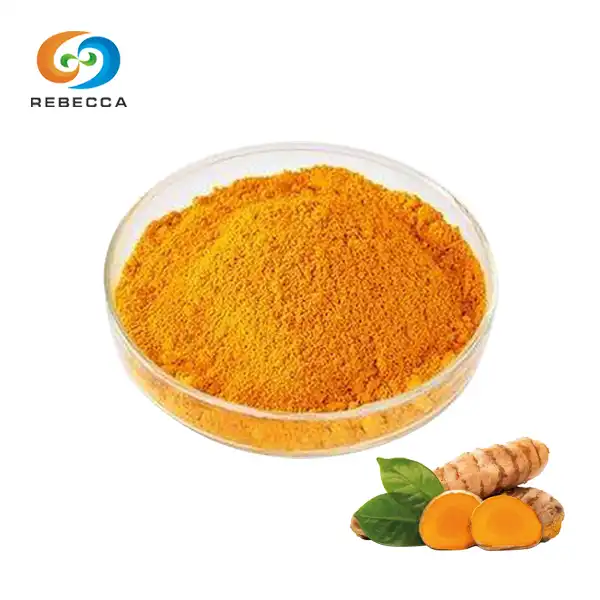
Product name: Curcumin
Latin Name: Curcuma longa L.
CAS No.: 458-37-7
Molecular Formula: C21H20O6
Active ingredients: Curcumin, demethoxycurcumin, bisdemethoxycurcumin.
Specification: Curcuminoids 10%~ 95%
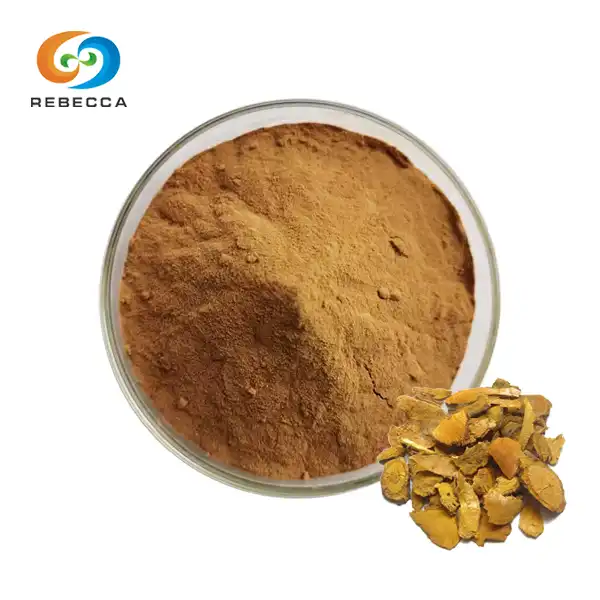
Use Part : Subterranean rhizome
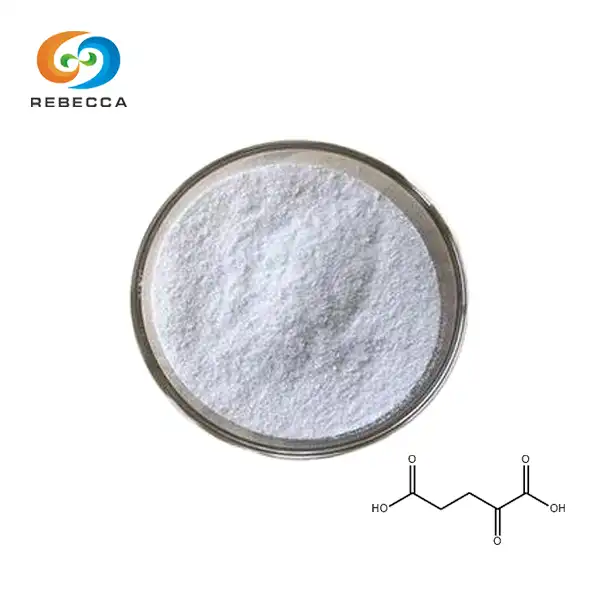
Appearance: Orange yellow powder
Mesh size:80 Mesh
Test Method: HPLC
Curcumin Powder’s Formulation Properties and Challenges
What Makes Standardized Curcumin Powder Different from Raw Turmeric
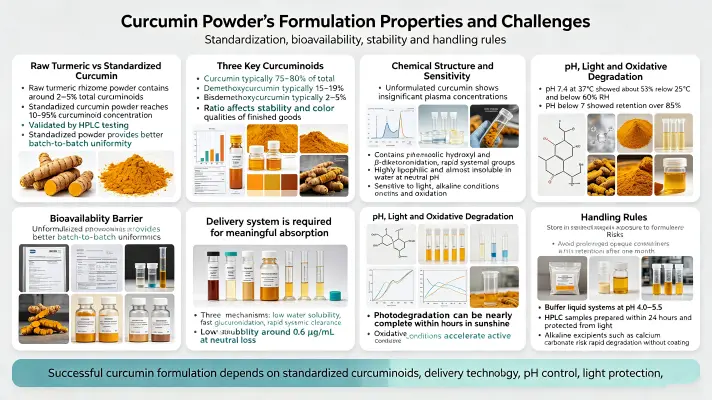
The raw turmeric rhizome powder contains around 2 to 5% of total curcuminoids (w/w). Standardized curcumin powder concentrates this to 10%-95% curcuminoid concentration, as validated by HPLC testing. It’s not only the strength disparity. The standardized powder gives a batch to batch uniformity that the raw turmeric does not have. When I audit a supplier’s certificate of analysis, I search for three particular curcuminoids: curcumin (usually 75–80% of the total), demethoxycurcumin (15–19%) and bisdemethoxycurcumin (2–5%). Their ratio is important for the stability and color qualities of the final goods.
The molecule curcumin (C21H20O6, CAS 458-37-7) comprises phenolic hydroxyl and β-diketone functional groups. These functional groups are responsible for its bioactivity and the formulation headaches it presents. The chemical is extremely lipophilic and is almost insoluble in water at neutral pH and sensitive to light, alkaline conditions and oxidation. If a formulation team does not take these qualities into consideration, the final product will show color alterations, active degradation or inadequate absorption.
The Bioavailability Barrier: Why Raw Powder Fails Alone
The most significant problem with curcumin formulation is bioavailability. Several pharmacokinetic investigations have shown that unformulated curcumin results in insignificant plasma concentrations, even with oral dosages of as high as 12 grams per day. The issue is linked to three mechanisms: low water solubility (about 0.6 μg/mL at neutral pH), quick intestinal and hepatic glucuronidation, and fast systemic clearance. The apparent effectiveness barrier for product producers is a chemical that seldom gets into the blood stream and exits it fast.
This is why the question “how do you use curcumin powder” cannot be addressed without the consideration of delivery. Evidence does not support just putting curcumin in capsules and expecting therapeutic outcomes. To be successful, every formulation must tackle the absorption issue via the use of one or more bioavailability augmentation techniques.
Physical and Chemical Stability: The Handling Rules
Curcumin is prone to degradation under three circumstances including alkaline pH, UV/visible light and oxidative conditions. Kharat et al. revealed that the retention of curcumin content was only approximately 53% after one month in aqueous solutions with pH 7.4 at 37◦C , but the retention was over 85% under pH 7 . In sunshine, photodegradation is almost complete within hours.
These stability properties impose restrictions for practical management. Curcumin powder should be kept in sealed opaque containers, at temperatures less than 25 °C and relative humidity less than 60 %. Avoid extended exposure to the alkaline excipients during formulation. Buffer liquid systems at pH 4.0–5.5, where curcumin is stable in its keto form. Samples for HPLC analysis should be prepared within 24 h after preparation and kept from ambient light. These are not theoretical precautions: I have seen whole pilot batches go down the drain because a formulator blended curcumin with calcium carbonate (an alkaline excipient) without an intermediary coating process.
Knowing why curcumin is hard to deal with is merely the beginning. The true art is in choosing the correct integration technique and distribution mechanism for each product type.
Incorporation of Curcumin Powder in Oral Supplement Formulations
Capsule and Tablet Manufacturing Methods
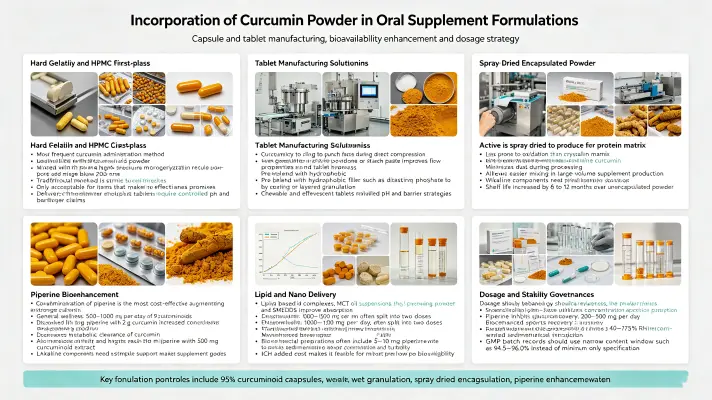
The most frequent curcumin administration method is hard gelatin or HPMC capsules filled with powder. The traditional way is simple: mix the curcumin powder (usually 95% curcuminoids) with flow agents such as microcrystalline cellulose and magnesium stearate and encapsulate. This method nevertheless has the lowest bioavailability and is only acceptable for items that make no promises about effectiveness.
Tablet manufacturing introduces additional complexity. Curcumin powder is difficult to compress and has the tendency to cling to punch faces during direct compression. A wet granulation stage using a binder solution of povidone or starch paste increases flow properties and tablet hardness. I would suggest pre-blending the curcumin with a hydrophobic filler like dicalcium phosphate to minimize the absorption of water which causes deterioration. For chewable or effervescent tablets, alkaline components need to be physically isolated from curcumin by coating or layered granulation to avoid deterioration of the tablets during storage.
The active is spray dried to produce a free flowing powder encapsulated in a carbohydrate or protein matrix, which is less prone to oxidation than crystalline curcumin. This form is widely sought after for producing supplements at huge volumes since it allows for mixing, minimizes dust during processing and increases shelf life by 6 to 12 months over unencapsulated powder.
Bioavailability Enhancement: The Three Proven Approaches
The co-administration of piperine remains the most cost-effective augmentation approach. In their seminal pharmacokinetic research, Shoba et al. showed that the addition of 20 mg of piperine to a 2 g dosage of curcumin led to an approximately 2,000% increase in the concentration of curcumin in human plasma compared to curcumin alone . Piperine inhibits glucuronidation enzymes in the gut and liver, decreasing the metabolic clearance of curcumin. Typical commercial preparations include 5–10 mg of piperine combined with 500 mg of curcuminoid extract. The added ingredient cost is little therefore this is a feasible method for mid-market supplement goods
Lipid based delivery techniques harness the lipophilic characteristic of curcumin. Phospholipid complexes (phytosomes), medium-chain triglyceride (MCT) oil suspensions and self-microemulsifying drug delivery systems (SMEDDS) all improve absorption by keeping curcumin in a dissolved lipid phase that utilizes the intestinal lymphatic absorption pathway, partially avoiding first-pass liver metabolism. A 2018 study of emulsion-based curcumin delivery methods indicated that nanoemulsions with droplet sizes in the range of 50-200 nm provide the most consistent increases in bioavailability across trials .
Reduction of particle size to nanoscale dimensions (below 200 nm) enhances dissolving rate and membrane permeability via larger surface area The major industrial approaches are wet media milling and high-pressure homogenization. The trade-off is cost: Nano-formulations may add $8-15/kg to raw material prices that need to be justified by premium product positioning or demonstrable effectiveness differential.
Dosage Determination Across Product Categories
Dosage should be based on clinical evidence, not marketing convention. Published studies of general wellness supplements for antioxidant support have used effective dosages of 500-1000 mg per day of 95% curcuminoid extract, in one or two split doses. Joint health formulations generally include 1,000–1,500 mg per day, frequently divided into two doses to achieve more constant plasma levels. Bioenhanced formulations in sports recovery products may utilize lower dosages (200-500 mg) since the absorption multiplier compensates for decreased intake.
The dosage difficulty for functional meals and drinks is a distinct one. A 250 to 350 mL beverage serving cannot contain a 500 mg powder dosage without sedimentation, turbidity or an unpleasant mouthfeel. The useful range for nano-emulsified or water-soluble forms of curcumin is 50–200 mg per serving. The increased bioavailability of the nano-delivered form compensates for the lower absolute dosage.
GMP batch records should include a narrow window for curcuminoid content (e.g., 94.5-96.0% vs. a nominal 95% product) rather than a minimum-only specification. This avoids over-filling which wastes active ingredient, and under-filling which risks violating label claims. I also advocate evaluating curcuminoid retention at 3, 6, 12 and 24 months under ICH accelerated settings (40°C/75% RH) to confirm shelf life claims before to commercial introduction.
The sector of oral supplements dominates the curcumin market but two emerging segments, functional drinks and topical treatments, need different formulation approaches and help extend use cases for curcumin powder beyond traditional applications.
Curcumin Powder in Specialty Applications: Beverages and Topicals
Liquid and Functional Beverage Formulation
The most technically hard use is the incorporation of curcumin into aqueous drinks, since it combines all the weaknesses of curcumin at the same time, i.e. insolubility, pH sensitivity and photodegradation. Three formulation techniques have been shown to be feasible at production scale.
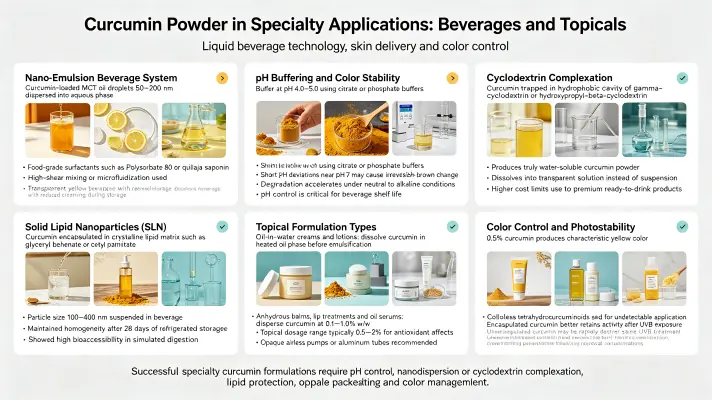
The nano-emulsion approach involves dispersing curcumin-loaded MCT oil droplets (50–200 nm) into the aqueous phase using food-grade surfactants such as Polysorbate 80 or quillaja saponin by high-shear mixing or microfluidization. The resultant beverage is transparent yellow rather than turbid, and the droplets are tiny enough that they will not cream while storage on the shelf. pH should be buffered at 4.0–5.0 using citrate or phosphate buffers, since even short deviations from pH 7 induce irreversible color changing from yellow to reddish-brown and acceleration of degradation.
The cyclodextrin complexation technique traps separate molecules of curcumin in the hydrophobic cavity of gamma-cyclodextrin or hydroxypropyl-beta-cyclodextrin. The outcome is a really water soluble curcumin powder which dissolves into a transparent solution instead of a suspension. The limiting factor is cost, with cyclodextrin-complexed curcumin being priced at 3–5 times the cost per active milligram of normal powder, confining its application to premium ready-to-drink products.
The solid lipid nanoparticle (SLN) technique involves encapsulating curcumin in a crystalline lipid matrix (e.g., glyceryl behenate or cetyl palmitate) to produce particles of 100–400 nm suspended in the beverage. A beverage stability study demonstrated that SLN-encapsulated curcumin maintained homogeneity of particle size and did not significantly lose curcumin after 28 days of refrigerated storage. In simulated digestion, SLN-encapsulated curcumin also had the greatest bioaccessibility of all evaluated delivery methods.
Topical and Cosmetic Product Development
Curcumin powder has antioxidant and anti-inflammatory effects, making it appealing for skin care formulations. The regulations of use are fundamentally different from oral medications. A 2016 comprehensive review of clinical evidence of turmeric and curcumin for skin health found excellent results for acne, atopic dermatitis, and photoaging, with few side effects at topical dosages of 0.5–2%.
For oil in water emulsions (creams and lotions) dissolve the curcumin powder in the heated oil phase (jojoba oil, squalane or caprylic/capric triglyceride) before emulsification. This phase prior to dissolution avoids grit from particles that have not dissolved. The oil phase also protects curcumin against alkaline breakdown in the aqueous phase, which happens in common cream bases (pH 5.5–7.0).
For anhydrous formulations (balms, lip treatments, oil serums), curcumin powder may be directly disseminated at 0.1–1.0% w/w. Hydrolysis is not a degradation process in the absence of water, however photodegradation still remains a worry. Packaging in opaque airless pumps or aluminum tubes is necessary. Suwannateep et al. (2012) showed that encapsulated curcumin in topical lotions retained antioxidant activity following UVB exposure, but unencapsulated curcumin was totally destroyed under the same treatment.
The most important aesthetic difficulty for topical products is color control. A characteristic yellow color is produced with 0.5% curcumin. This may be a feature for businesses selling "turmeric brightening" goods. If brands want undetectable application, they must either decrease concentration or utilize colorless tetrahydrocurcuminoids, a hydrogenated derivative with limited staining potential. To check colour acceptability I recommend clients do consumer perception panels for topical curcumin concentrations before finalisation.
FAQ
1. How to improve supplement formulations for better curcumin absorption
There are three main ways to improve bioavailability: co-administration with piperine (5-10 mg per 500 mg dosage of curcuminoids), use of lipid-based delivery methods such as phytosomes or nano-emulsions, and decrease of the particle size to the nanoscale. Each strategy tackles the lipophilicity and fast metabolism of curcumin in a different way with selection based on product positioning and cost considerations. Pharmacokinetic studies that clinically validate your unique formulation boost effectiveness claims.
2. What qualifications do you need to purchase bulk curcumin powder?
Priority certifications include GMP (pharmaceutical manufacturing standards), ISO 22000 (food safety management) and organic credentials (USDA/EU) for targeting natural product markets. Also, confirm analytical testing capabilities via technique validation documentation for HPLC curcuminoid detection, heavy metal screening and pesticide residue analysis. Rebecca has several accreditations and is subject to yearly third party audits to provide evidence and batch specific paperwork for regulatory filings in international markets.
3. Can I use curcumin powder straight in water based products?
The native curcumin powder is lipophilic (aqueous solubility ~11 ng/mL) and cannot be directly introduced into water-based systems without modification. The solutions include high shear mixing of nano-emulsion technology with food-grade surfactants or water soluble versions (usually 10-20% curcuminoid concentration) by cyclodextrin complexation. Rebecca’s technical team assists with application testing and improves delivery methods for beverage clarity, heat stability and processing compatibility.
Partner with Rebecca for Premium Curcumin Powder Supply
Rebecca offers pharmaceutical quality curcumin powder that is prepared to GMP and ISO 22000 standards, with a specification of 10% to 95% curcuminoid concentration, as determined by HPLC analysis. The Shaanxi plant has an annual capacity of over 500 metric tons, and can enable bulk purchase for regulatory filings and product scalability with batch-to-batch consistency. From the need of standardized extracts for supplement formulations, to water soluble variants for functional beverages or a cosmetic grade with full safety documentation, our technical team works on application specific solutions including bioavailability strategies and stability optimization.
Pharmaceutical R&D managers, supplement brand heads of procurement, and cosmetic developers are welcome to explore our bespoke curcumin powder options. Request samples, complete specification sheets and price for curcumin powder supplier partnerships at information@sxrebecca.com or visit sxrebecca.com. We have various MOQ structures to suit both established manufacturers as well as developing companies. We provide full support including DMF assistance, organic certification papers and worldwide shipping coordination via FOB, CIF or DDP terms.
References
1. Anand, P., Kunnumakkara, A.B., Newman, R.A., & Aggarwal, B.B. (2007). Bioavailability of curcumin: Problems and promises. Molecular Pharmaceutics, 4(6), 807–818.
2. Ansari, M.J., Ahmad, S., Khan, A., et al. (2018). Stability-indicating HPLC method development and validation for curcuminoids: Degradation kinetics under stress conditions. Food Science and Biotechnology, 27(4), 1063–1071.
3. Kharat, M., Du, Z., Zhang, G., & McClements, D.J. (2017). Physical and chemical stability of curcumin in aqueous solutions and emulsions: Impact of pH, temperature, and molecular environment. Journal of Agricultural and Food Chemistry, 65(8), 1525–1532.
4. Shoba, G., Joy, D., Joseph, T., et al. (1998). Influence of piperine on the pharmacokinetics of curcumin in animals and human volunteers. Planta Medica, 64(4), 353–356.
5. Araiza-Calahorra, A., Akhtar, M., & Sarkar, A. (2018). Recent advances in emulsion-based delivery approaches for curcumin: From encapsulation to bioaccessibility. Trends in Food Science & Technology, 71, 155–169.
6. Vaughn, A.R., Branum, A., & Sivamani, R.K. (2016). Effects of turmeric (Curcuma longa) on skin health: A systematic review of the clinical evidence. Phytotherapy Research, 30(8), 1243–1264.