L carnitine liquid vs powder
When obtaining l carnitine powder raw materials, B2B ingredient sourcing teams are faced with a fundamental decision: whether to purchase the powder or liquid form of the amino acid. The efficiency of the workshop's production, the stability of the batches, the compliance of the terminal product, and the total cost of procurement are all directly impacted by this option. L-carnitine is a significant metabolic raw ingredient that is used by the nutraceutical, pharmaceutical, beverage, and cosmetic sectors. Each delivery type has its own set of physical characteristics, application restrictions, and expenses associated with the supply chain. The purpose of this book is to provide verifiable and peer-reviewed comparative insights for global buyers, with a particular emphasis on providing focused procurement assistance for commercial formulation assignments.
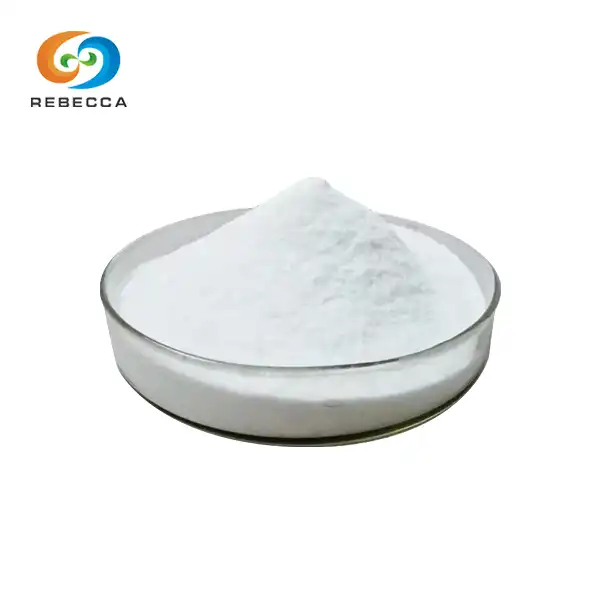
L Carnitine Powder
Product Name:L-carnitine
CAS No.:541-15-1
Specifications :L(-)-Carnitine,Min 99%
Test :HPLC
Appearance :White crystalline Powder
Applying:The safest nutritional supplement for weight loss without side effects.
Basic Functions, Core Classification and Fundamental Traits of L-Carnitine
Buyers need to first have a solid understanding of the fundamental chemical characteristics, metabolic functions, and several popular commercial versions of L-carnitine before they can make a reasonable form decision. The establishment of a professional basis for later performance comparison and scenario matching between powder and liquid goods is accomplished via this.
Natural Metabolic Function and Industry Application Scope
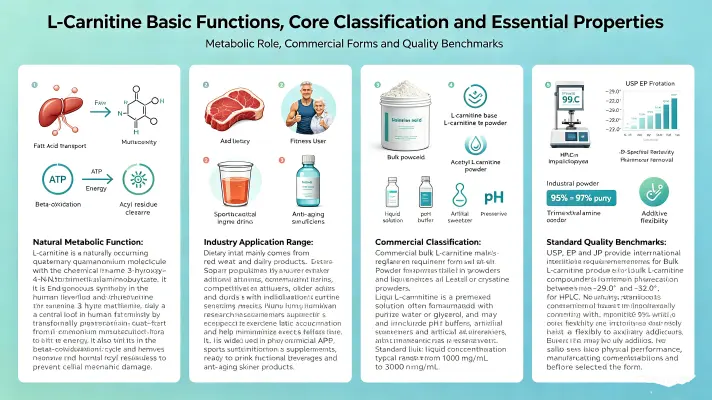
L-carnitine is a naturally occurring quaternary ammonium molecule with the chemical name 3-hydroxy-4-N,N,N-trimethylaminobutyrate. It is synthesised in the human liver and kidneys endogenously from lysine and methionine. It performs the role of central fat metabolism in human cells. It shuttles long-chain fatty acids into mitochondria. It produces ATP energy for the body’s functions and helps the beta-oxidation cycle. It also eliminates harmful acyl residues and prevents cellular metabolic damage.
In human metabolic study published (Pekala et al., 2011) daily dietary intake is mostly from red meat and dairy products. Special crowds need more input from the outside. These include professional athletes, fitness populations, ageing groups and persons with congenital carnitine synthesis deficit. L-carnitine supplementation enhances aerobic exercise capacity, decreases post-exercise lactate accumulation and minimises exercise exhaustion (Stephens et al., 2007). It is often included into pharmaceutical APIs, sports nutrition supplements, ready-to-drink functional drinks and anti-aging skincare products globally.
Commercial Classification: Powder and Liquid L-Carnitine Variants
Commercial bulk L-carnitine is separated into synthetic biocatalytic fermentation type and pure chemical synthesis type. Natural plant extracted L-carnitine cannot be produced at an industrial scale. That is why it is so uncommon to get organic certified L-carnitine ingredients in the world raw material markets.
L-carnitine powder has three common industrial variants. It is only l-carnitine base powder, L-carnitine L-Tartrate powder and Acetyl-L-Carnitine powder. All subtypes are white crystalline solid. High-purity powder goods have no additional carriers, flavourings or preservatives. The particles are changeable and custom-made with a stable stereochemical structure.
Commercial liquid L-carnitine is premixed final solution. The raw carnitine is mixed with purified water or glycerin by the manufacturers. A lot of liquid formulae include pH buffering agents, artificial sweeteners and antimicrobial preservatives. Standard bulk liquid concentration is from 1000mg to 3000mg per ml. It is pre-dissolved for straight filling without additional processing .
Standard Quality Benchmark for Qualified Bulk L-Carnitine
USP, EP and JP pharmacopoeias provide common worldwide access requirements for bulk L-carnitine compounds. Qualified pharmaceutical grade powder has minimum 99% HPLC confirmed assay. Its specific optical rotation is constant between -29.0° and -32.0°. This index is quite successful in removing the inactive D-isomer contaminants.
Industrial grade powder retains 95%-97% purity. It may include trace impurities of trimethylamine which give off a slight fishy odour. There is no universal guideline for the concentration of L-carnitine in liquid form. Liquid formulae include auxiliary additives, therefore the impurity limit is more flexible than powder raw materials.
In addition to verifying the fundamental qualities of ingredients, full-dimensional comparison on physical performance, production adaptability and safety performance is important. The comparison allows the buyer to swiftly remove inappropriate types according to the requirements of production in the facility.
Full Comparative Analysis: L-Carnitine Powder VS Liquid
This chapter compares two forms with respect to physical property, manufacturing flexibility, bioavailability, shelf stability and cost of procurement. All figures are based on the 2025 global standard for the bulk raw material market and peer approved clinical test findings. It avoids one-sided marketing orientated judgements towards objective B2B reference.
Physical Property, Solubility and Formula Compatibility
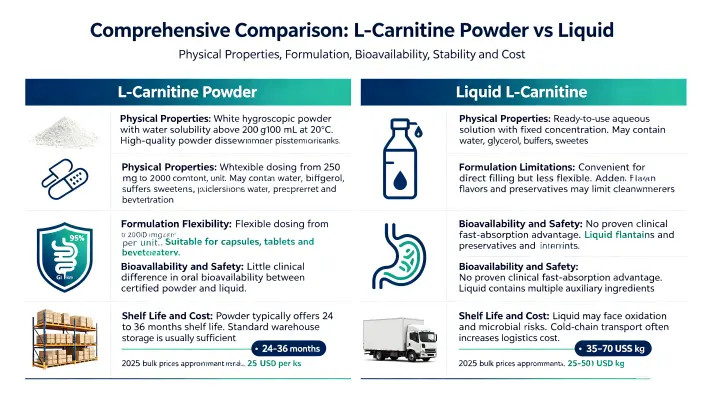
M-carnitine powder is a white crystal powder, hygroscopic. It is soluble in water more than 200 g/100 ml at the usual temperature (20℃). High quality foundation powder rapidly dissolves in cold water, fruit juice and protein beverage. Stirring briefly will not generate sediment or turbid residue. L-carnitine L-Tartrate powder dissolves a little slowly but works well on most beverage premix manufacturing processes.
Ultra-high formula flexibility with powder. Production teams may alter serving dose from 250mg to 2000mg per unit. It is suitable for capsule pressing, tablet granulation, sachet packing and customer beverage premix processing. It maintains the pH neutral to the acid beverage matrix and is stable during high temperature pasteurisation process.
Liquid L-carnitine is an aqueous solution in ready-to-use form. No secondary operation of dissolution is needed. But you cannot alter its fixed concentration at will. Added flavouring agents and preservatives restrict its use. It cannot be utilised for clean-label, allergy free and organic certified finished goods. The pH value of liquid formula is susceptible to temperature change.
Bioavailability, Safety and Daily Dosage Performance
Research from Obesity Reviews shows that clinical evidence reveals little discrepancies in oral bioavailability between the certified powder and liquid L-carnitine. Both versions are degraded and metabolised to release active L-carnitine in the human gastrointestinal system. Absorption efficiency is determined by individual physical metabolic pace, not ingredient form.
In practice, liquid products do not show any evident quick absorption benefit. The claim of rapid absorption is mostly consumer-oriented marketing PR, not a confirmed clinical result. The recommended safe dose for adults is between 500mg and 2000mg a day. Daily consumption exceeding 3g might cause some transient stomach discomfort in sensitive individuals.
Powder is safer and better in controlling allergens. Pure 99% powder has no gluten, soy additives or synthetic sweeteners. Liquid L-carnitine contains a series of adjunct ingredients. These substances increase the danger of allergens and irritate the intestines for sensitive people.
Shelf Stability, Storage Rules and Supply Chain Cost
High quality sealed L-carnitine powder is stable for a lengthy period of time. Its shelf life is valid for 24-36 months in a cold warehousing environment with continuous humidity. It needs simply standard warehouse storage and no additional transit conditions.
There are two significant quality hazards for storage and transportation of Liquid L-carnitine. During storage, ingredient oxidation occurs with time. Unsealed environment allows fast proliferation of microbes.
Whole-process cold chain transportation is needed for bulk liquid freight. It creates additional logistical and packaging costs vs. powder products.
2025 worldwide bulk purchasing price creates obvious cost difference. An average L-carnitine powder might vary from $25 to $50 per kilogram. Liquid L-carnitine may cost up to $35-$70 per kg. Extra liquid is expensive because of solvent preparation, preservative addition, aseptic filling and cold-chain distribution. Official volume discount for large-batch purchase exceeding 500kg from certified vendors.
The two kinds have clear performance differences that dictate exclusive relevant circumstances. Buyers may match ingredient form to terminal product location and manufacturing process, helping to reduce production risk and optimise input costs.
Scenario-Based Selection Guide for Global B2B L-Carnitine Buyers
Besides the above comparison statistics, this chapter gives the segmented selection advice for food beverage, nutraceutical, cosmetic and pharmaceutical industries. It leverages industry compliance requirements to enable buyers to make low risk procurement choices rapidly.
Food and Functional Beverage Production Selection
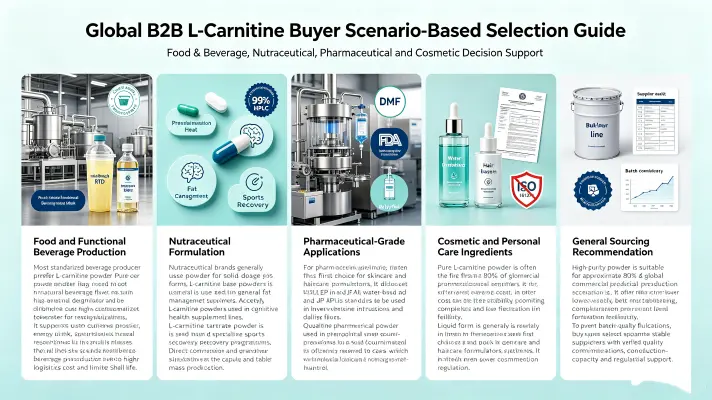
L-carnitine powder is favoured by most of the standardised beverage makers. Pure powder will not modify the natural flavour of the beverage. It can endure high temperature pasteurisation processes. It allows unique dose creation for energy drinks, pre exercise beverages and meal replacement shake. It’s a good match for clean label product development.
Liquid L-carnitine is only appropriate for small batch, ready-to-drink shots. It streamlines filling operations and reduces labour cost of dissolving. The high logistical cost and limited shelf life make large-scale standardised beverage manufacturing not desirable.
Nutraceutical and Pharmaceutical Formulation Selection
Brands of nutraceutical supplements use powder to manufacture solid dosages. L-carnitine base powder is used for general fat-management supplements. Acetyl-L-Carnitine powder is used in cognitive health supplement lines. L-carnitine L-Tartrate powder is for professional sports recovery supplement programs. Direct compression granulation for capsule and tablet mass manufacturing is suitable for powder.
For pharmaceutical grade applications, 99% HPLC certified L-carnitine powder must be chosen. It complies with USP/EP/JP API. It may combine IV feeding liquid and dialysis solution. Qualified pharmaceutical powder vendors have full submission documentation of DMF for FDA regional compliance registration. Liquid carnitine is utilised for pharmaceutical sterile preparation very infrequently, for hard-controlled microbiological contaminants.
Cosmetic Personal Care Raw Material Selection
Pure L-carnitine powder is preferred by skincare and hair care formulators. It is freely soluble in both water and oil based serum bases and dissolves uniformly. It maintains natural ingredient properties to fulfil ISO 16128 natural cosmetic ingredient requirements. It has stabilising effects on the antioxidant and skin metabolism regulation. The use of commercial liquid carnitine in cosmetics is restricted due to the presence of synthetic chemicals that are banned in cosmetic products.
In general, the high-purity powder adapts about 80% of the worldwide commercial production situations. It combines cost, stability, compliance and formulation flexibility. Only specialised portable terminal product lines are suitable for liquid form. To prevent batch quality fluctuation, validate purchase form customers need to select compliant, steady suppliers.
FAQ
Which form absorbs faster, powder or liquid L-Carnitine?
Absorption rates differ minimally between properly formulated powder capsules and liquid variants. Both convert to free L-Carnitine during digestion, with gastrointestinal transit times and individual metabolism exerting greater influence than form. Liquid marketing emphasizes convenience rather than proven bioavailability advantages.
Can L-Carnitine powder dissolve directly in cold beverages?
Yes, high-purity L-Carnitine base powder dissolves rapidly in cold water or juice, making it suitable for shake mixes and functional drinks. L-Carnitine L-Tartrate dissolves slightly slower but remains beverage-compatible. Proper agitation ensures complete dissolution without sediment.
What certifications should bulk L-Carnitine powder have?
Pharmaceutical and nutraceutical buyers require GMP, ISO 22000, and HACCP certifications. Exporters benefit from kosher, halal, and organic certifications depending on target markets. USP/EP/JP compliance ensures pharmacopeial-grade quality, while DMF support facilitates FDA regulatory filings.
How does pricing compare between powder and liquid forms?
Powders cost $25-$50/kg, while liquids range $35-$70/kg due to processing and packaging expenses. Volume purchases (500kg+) unlock discounts. Total cost analysis includes logistics, storage, and handling—factors favoring powders in large-scale operations.
Certified Production Strength of Shaanxi Rebecca
Shaanxi Rebecca is a specialized bulk L-carnitine powder manufacturer with standardized GMP production workshops. It supplies high-purity L-carnitine powder with CAS No.: 541-15-1. All finished powder achieves ≥99% HPLC assay, fully complying with USP and EP pharmacopeia criteria.
The factory holds valid ISO 22000, HACCP, Kosher and Halal certifications. It provides complete DMF registration files, batch CoA test reports and third-party audit certificates. Annual production capacity reaches 500 metric tons. It guarantees stable batch supply and unified impurity control for long-term bulk orders.
Rebecca professional R&D team provides exclusive supporting services. It includes formula debugging, powder particle size customization, product stability testing and regional regulatory consultation. The brand sets flexible MOQ to support small-batch R&D trial orders and large-scale commercial bulk orders. It supports FOB, CIF and DDP global trade terms to simplify customs clearance procedures.
Global buyers can send email to information@sxrebecca.com to apply free powder samples, get official quotation and download full compliance documents. Visit sxrebecca.com to check full metabolic raw material product catalog and build long-term stable ingredient supply partnership.
References
1. Fielding, R., Riede, L., Lugo, J.P., & Bellamine, A. (2018). L-Carnitine Supplementation in Recovery after Exercise. Nutrients, 10(3), 349.
2. Pekala, J., Patkowska-Sokoła, B., Bodkowski, R., Jamroz, D., Nowakowski, P., Lochyński, S., & Librowski, T. (2011). L-Carnitine—Metabolic Functions and Meaning in Humans Life. Current Drug Metabolism, 12(7), 667-678.
3. Stephens, F.B., Constantin-Teodosiu, D., & Greenhaff, P.L. (2007). New Insights Concerning the Role of Carnitine in the Regulation of Fuel Metabolism in Skeletal Muscle. The Journal of Physiology, 581(2), 431-444.
4. Hongu, N., & Sachan, D.S. (2003). Carnitine and Choline Supplementation with Exercise Alter Carnitine Profiles, Biochemical Markers of Fat Metabolism and Serum Leptin Concentration in Healthy Women. The Journal of Nutrition, 133(1), 84-89.
5. Karlic, H., & Lohninger, A. (2004). Supplementation of L-Carnitine in Athletes: Does It Make Sense? Nutrition, 20(7-8), 709-715.
6. Rebouche, C.J. (2004). Kinetics, Pharmacokinetics, and Regulation of L-Carnitine and Acetyl-L-Carnitine Metabolism. Annals of the New York Academy of Sciences, 1033(1), 30-41.