Pure Creatine Monohydrate Powder Benefits
As one of the most researched products in the sports nutrition business, pure creatine monohydrate powder is a top choice. Years of scientific study and extensive commercial use have proven creatine monohydrate as one of the most reliable chemicals to enhance exercise performance, promote muscle growth, and assist with recovery. Creatine monohydrate provides an unparalleled blend of effectiveness, formulation flexibility and cost efficiency for supplement brands, contract manufacturers and functional foods makers.
As the demand for evidence-based sports nutrition products continues to rise, procurement teams are paying more attention to ingredient quality, regulatory compliance and supply chain stability. By understanding how creatine monohydrate works, companies can make smarter choices about their suppliers and build goods that really benefit the people who buy them.
Understanding Pure Creatine Monohydrate Powder
It is crucial to understand why creatine monohydrate has become the standard ingredient against which all other creatine forms are judged before we look at formulation prospects and supply tactics.
Chemical Structure and Functional Mechanism
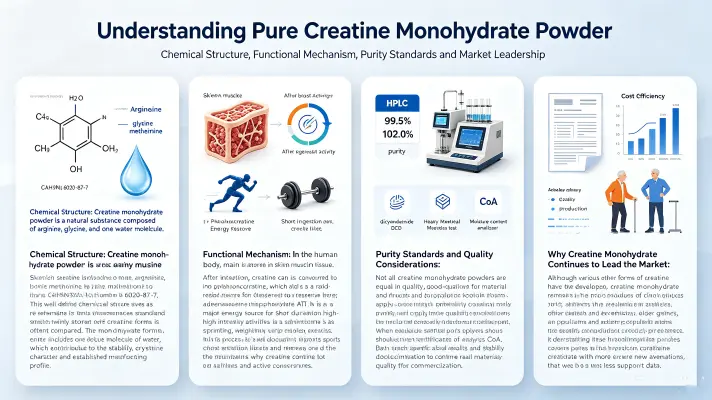
Creatine monohydrate powder is a natural substance consisting of arginine, glycine, methionine and one molecule of water. Its chemical formula is C4H9N3O2·H2O and it is known internationally by CAS No. 6020-87-7.
In the human body, creatine is stored predominantly in skeletal muscle tissue. Once ingested it is transformed to phosphocreatine which acts as a fast reserve for the regeneration of adenosine triphosphate (ATP). ATP is the body’s main energy currency for brief, explosive activity like sprinting, weightlifting and athletic motions.
Creatine supplementation improves phosphocreatine availability to assist sustain energy production during repeated bouts of high intensity exercise. This process is well established in sports nutrition literature and remains one of the fundamental reasons for creatine's ongoing appeal with athletes and active consumers.
Purity Standards and Quality Considerations
Not all creatine monohydrate powders are created equal. The substance is of good grade and often assayed between 99.5% and 102.0% on High Performance Liquid Chromatography (HPLC).
Purity is not only a marketing criterion for B2B buyers. It has a direct impact on product uniformity, formulation performance and regulatory compliance. Quality control techniques, such as testing for creatinine, dicyandiamide (DCD), heavy metals, microbiological contamination and moisture content are enforced by reliable suppliers.
When vetting prospective suppliers, procurement teams should acquire Certificates of Analysis (CoA), batch-specific lab results and stability files to confirm ingredient quality before going commercial.
Why Creatine Monohydrate Continues to Lead the Market?
Several other forms of creatine have been created but monohydrate still is the most popular and well supported type. Hundreds of clinical investigations with athletes, leisure exercise users, elderly persons and specialised demographics have proven its usefulness.
Its established safety profile, production scalability and cost-effectiveness are especially appealing to supplement companies seeking stable product performance over the long run.
These are the basic properties of creatine monohydrate that are helpful to know when comparing it to newer alternatives that tend to be more costly and less supported by data.
Comparing Creatine Monohydrate with Other Creatine Types
As the market continues to flood with new creatine derivatives, businesses are often left to determine if other forms have any real benefits. Why creatine monohydrate remains number one worldwide demand is explained by a deeper look at the existing facts.
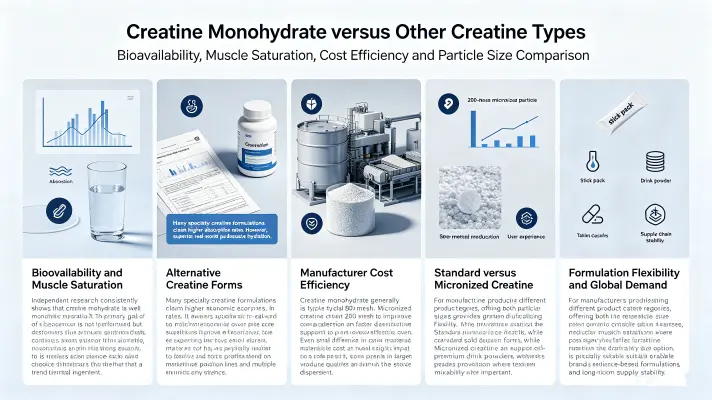
Bioavailability and Muscle Saturation
Many speciality creatine formulations claim better absorption. Independent research, however, continually reveals good absorption of creatine monohydrate when taken with proper fluid intake.
The main goal of supplementing isn't quick absorption but efficient muscle saturation. Clinical trials show that creatine monohydrate consistently increases intramuscular creatine reserves, frequently similar to or better than other, more costly choices.
This makes monohydrate a sensible option for firms that prefer evidence-backed formulas over trendy ingredient choices.
Cost Efficiency for Manufacturers
From a commercial standpoint, ingredient economics are of fundamental importance in product development.
Creatine hydrochloride, creatine citrate and buffered creatine products tend to have similar performance results but elevated raw material prices compared to monohydrate. This benefit enables manufacturers to be competitive in price and yet achieve effectiveness.
Even small decreases in ingredient costs may have a huge impact on profit margins across a wide product range in high-volume manufacturing scenarios.
Micronized Versus Standard Creatine Powder
Particle size is one of the most essential technical concerns throughout the purchase process.
Standard creatine monohydrate is usually 80 mesh specs. Micronised grades typically use 200 mesh particle sizes for enhanced dispersion and quicker disintegration.
Here are some practical advantages of micronised creatine: It produces a more uniform beverage body, lowers sedimentation and enhances the user experience in powdered supplement applications. Many premium sports nutrition firms favour micronised grades since they increase the quality of the product without affecting the active component.
Manufacturers working in different product categories may appreciate having access to both mesh specs for further formulation flexibility.
Following the selection of ingredients, the subsequent stage is to evaluate the integration of creatine monohydrate into product forms with commercial success.
Integrating Pure Creatine Monohydrate into Product Lines and End-User Solutions
Creatine monohydrate is a very versatile substance that lends itself to inclusion in a broad variety of sports nutrition and functional wellness solutions. “Understanding how products work technically and what consumers want are keys to successful formulation.
Applications Across Multiple Product Categories
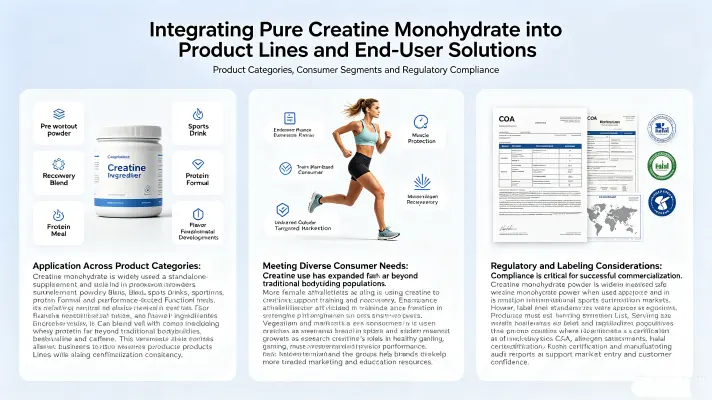
Creatine monohydrate is widely utilised as a stand-alone supplement, in pre-workout powders, recovery blends, sports beverages, protein formulas and performance-focused functional meals.
The somewhat neutral taste profile allows for easier flavour development. It also works well with common additives including whey protein, branched-chain amino acids (BCAAs), electrolytes, beta-alanine and caffeine.
This versatility allows businesses to produce a variety of product lines while retaining uniformity in formulation.
Meeting the Needs of Different Consumer Segments
The creatine industry now is considerably beyond the conventional bodybuilding crowds.
More female athletes are turning to creatine to assist with training performance and recuperation. Strength development regimens for endurance athletes typically use Creatine. Vegetarians and vegans often use supplements since plant-based diets provide few natural creatine sources.
In addition, the older adult market is rising as research continues to examine the role of creatine in healthy ageing, muscular preservation and physical function.
Understanding these different customer segments enables firms to create more focused marketing tactics and instructional resources.
Regulatory and Labeling Considerations
Compliance is a key part of the successful commercialisation of a product.
Creatine monohydrate powder is widely considered as safe when used correctly and is approved in the main international sports nutrition markets. However, the labelling standards differ from area to region.
Producers must verify that ingredient lists, serving sizes and health claims meet the requirements of the relevant legislation in the countries where they promote their products. Supporting paperwork like as CoAs, allergy declarations, Halal certificates, Kosher certifications and production audits will facilitate the entrance into the market and customer approval procedures.
Supplier openness is becoming more and more vital as businesses grow worldwide. Often, the successful running of a formulation project depends on the availability of reliable technical assistance.
Choosing a Reliable Creatine Monohydrate Supplier
No matter how great the ingredient is, if the quality in the supply chain is variable, it might fail to deliver commercially. Thus, the choice of a supplier is a strategic procurement decision, not a simple purchase transaction.
Evaluating Manufacturing Standards
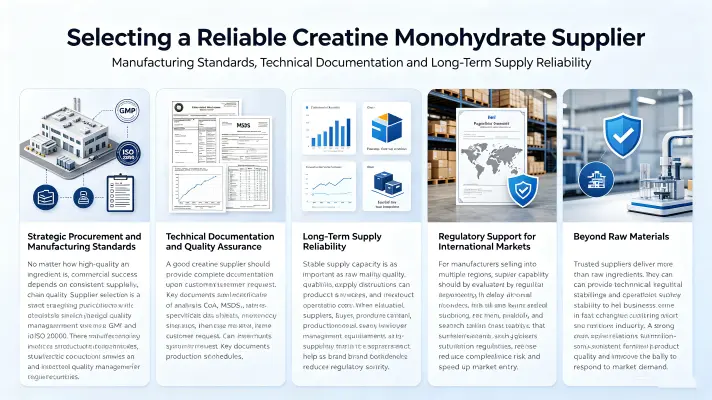
Buyers should choose providers with established quality management systems such as GMP, ISO 22000. These certifications are indicative of established production controls and documented quality practices.
Further assurance may be obtained when vetting new suppliers via facility audits, production capacity reviews and traceability systems.
Manufacturers with foreign markets should additionally verify if suppliers have the ability to provide export paperwork and regulatory requirements in target countries.
Technical Documentation and Quality Assurance
A good creatine provider should give full documentation when requested. Key documents would normally include Certificates of Analysis, Material Safety Data Sheets (MSDS), specification sheets, stability data, microbiological reports and heavy metal tests.
With this information, procurement teams may analyse product consistency and meet client qualification needs.
Transparency in the supply chain also helps to increase brand confidence and avoid regulatory risk.
Long-Term Supply Reliability
Consistent availability, however, is no less vital than ingredient quality. Supply disruptions may disrupt production schedules, delay product introductions, and raise operating expenses.
Buyers need to evaluate yearly production capacity, inventory management, lead times, packaging alternatives and scalability for future development when assessing suppliers.
A reputable supplier is a strategic partner for the long run. In addition to raw ingredients, they provide technical knowledge, regulatory assistance and operational stability to keep companies competitive in a fast-changing sports nutrition industry.
FAQ
How quickly can users expect performance improvements from creatine supplementation?
Muscle saturation typically occurs within 7-14 days using loading protocols, or 21-28 days with consistent low-dose intake. Strength gains become measurable after 2-3 weeks of saturated supplementation, with continued improvement throughout 8-12 week cycles.
Does creatine monohydrate cause water retention or bloating?
Creatine increases intracellular water within muscle tissue—a beneficial mechanism for cell volumization. This differs from subcutaneous water retention. Adequate hydration and avoiding excessive loading doses minimizes gastrointestinal discomfort some users report.
What distinguishes 200-mesh from 80-mesh creatine specifications?
The 200-mesh grade dissolves faster in liquids, ideal for powder blends and ready-to-mix products. The 80-mesh variant flows better through automated encapsulation equipment, suiting tablet and capsule manufacturing workflows.
Can creatine monohydrate be combined with other active ingredients?
Creatine stacks effectively with beta-alanine, BCAAs, and caffeine without interaction concerns. It remains chemically stable in multi-ingredient formulations when protected from excessive moisture during storage and transportation.
Partner with Rebecca for Premium Creatine Monohydrate Supply
Rebecca supplies pharmaceutical-grade creatine monohydrate powder (CAS 6020-87-7, 99.5%-102.0% HPLC test) for demanding B2B applications. Our Shaanxi manufacturing plant is GMP and ISO22000 built and produces yearly over 500 metric tonnes with customisable mesh parameters. As a trusted creatine monohydrate supplier, we provide full paperwork including batch CoAs, MSDS and stability data to help speed up your regulatory clearances.
For free samples, pricing on larger orders, or help with unique formulations, contact our procurement experts at information@sxrebecca.com. See why worldwide supplement companies trust Rebecca for dependable creatine monohydrate procurement at sxrebecca.com.
References
1. Kreider, R.B., Kalman, D.S., Antonio, J., et al. (2017). International Society of Sports Nutrition position stand: safety and efficacy of creatine supplementation in exercise, sport, and medicine. Journal of the International Society of Sports Nutrition, 14(18).
2. Antonio, J., & Ciccone, V. (2013). The effects of pre versus post workout supplementation of creatine monohydrate on body composition and strength. Journal of the International Society of Sports Nutrition, 10(36).
3. Buford, T.W., Kreider, R.B., Stout, J.R., et al. (2007). International Society of Sports Nutrition position stand: creatine supplementation and exercise. Journal of the International Society of Sports Nutrition, 4(6).
4. Persky, A.M., & Rawson, E.S. (2007). Safety of creatine supplementation. Subcellular Biochemistry, 46, 275-289.
5. Jäger, R., Purpura, M., Shao, A., Inoue, T., & Kreider, R.B. (2011). Analysis of the efficacy, safety, and regulatory status of novel forms of creatine. Amino Acids, 40(5), 1369-1383.
6. Cooper, R., Naclerio, F., Allgrove, J., & Jimenez, A. (2012). Creatine supplementation with specific view to exercise/sports performance: an update. Journal of the International Society of Sports Nutrition, 9(33).