Taro Powder VS Taro Flour
There is taro flour and taro powder . Both come from the same root that is high in starch. Each one looks like a fine powder. At first glance, the difference seems small—maybe a taste for names or an area norm. But for B2B users of ingredients who are making drinks, health pills, baked goods, or useful foods, picking the wrong form can really affect production.
The way the two goods are made, how the starch behaves, how the particles work, and what they are meant to be used for are all different. Taro flour and powder are not the same thing. Because it is starchy, taro flour is often used in baking. On the other hand, taro powder is often used to add flavour to drinks. That one difference affects things like compatibility, solubility, shelf life, and the need for labels.
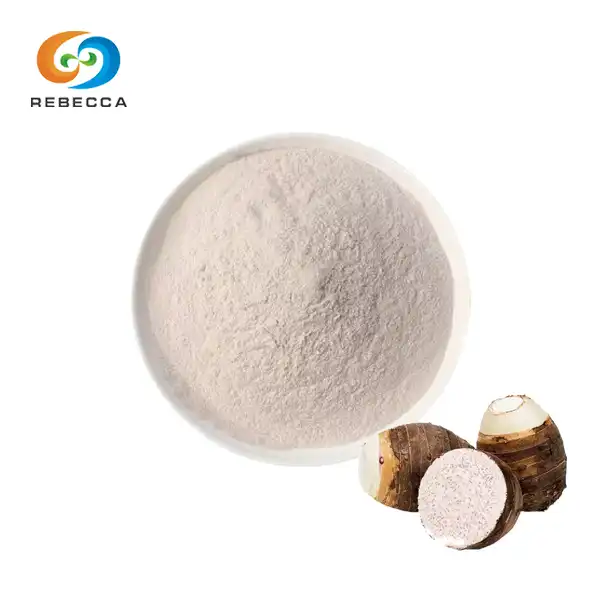
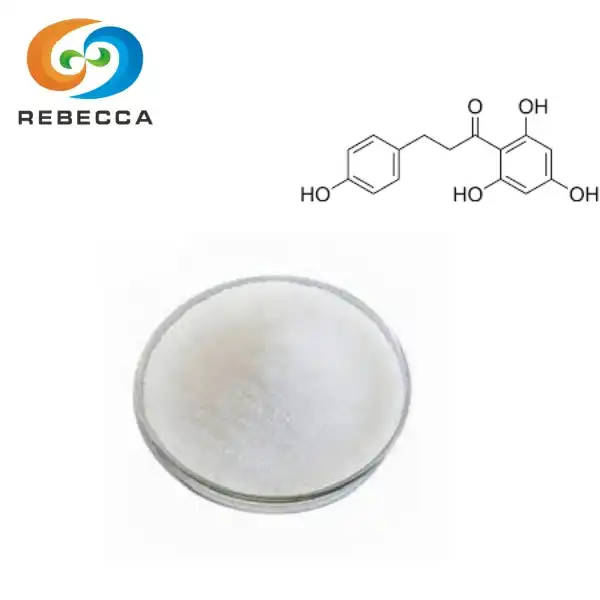
Product Name:Taro powder
Latin Name: Henry Steudnera Tuber
Part used:Root
Specification: Straight Powder
Appearance: Light Purple Powder
Odor & Taste: Characteristics
Particle size:100% pass 80 mesh
Grade:Food/Pharm grade
Taro Powder and Taro Flour: Definitions and Origins
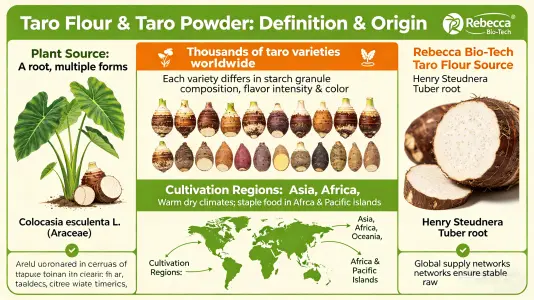
The Botanical Source: One Root, Many Forms
The taro plant is in the Araceae family. Taro (Colocasia esculenta L.) is a widely important root crop that has sparked new scientific interest because it is full of nutrients, beneficial substances, and can be used for many different things. The taro powder made by Rebecca Bio-Tech comes from the root of Henry Steudnera Tuber, which is another grown type of taro. There are thousands of different kinds of taro, and each one has a slightly different starch granule profile, flavour strength, and colour expression.
Around the world, people grow thousands of different kinds of taro. People in African and Pacific Island countries eat a lot of taro. It is grown in warmer and drier areas in Asia, Africa, Oceania, and the Americas. This makes it one of the world's most regionally diverse foods. That global base is important for the reliable supply of ingredients and the stability of seasonal products.
What Is Taro Powder?
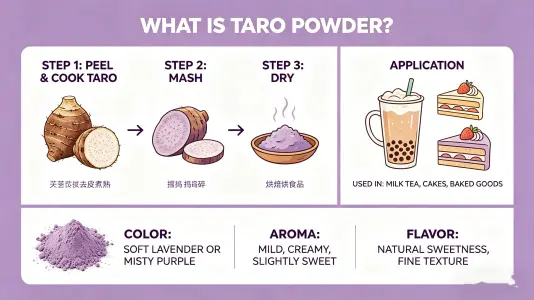
When you grind up the root vegetable taro into a powder, you get taro powder. To make a fine powder, the taro root is peeled, cooked, mashed, and then dried out. It is added to food and drinks to make them taste better and thicken them up.
Taro powder is now used in many foods and drinks around the world, especially in Asia-Pacific markets and Western markets that are growing quickly. It is used a lot in milk tea, cakes, baked goods, and useful foods because it tastes naturally sweet and has a smooth texture. Its colour is light purple. That light purple colour that only comes from pure taro root powder is a key visual difference in product development, especially for candy and drink lines.
Good powder has a light soil smell and a soft lavender or beige-purple colour. It is this taste profile that ingredient makers buy when they need powder for colour and flavour uses. The smell is typical of taro root: it's soft, creamy, and slightly sweet, not sharp or artificial.
What Is Taro Flour?
Making taro flour is done in a different way. Instead of focusing on flavour concentration, taro flour focuses on how well the starch works. The root is dried, usually without cooking it, and then ground up very fine to make a starchy powder that is mostly useful for how it bakes and how the dough stretches.
Taro flour is a flexible food that can be used in place of wheat flour in recipes for bread, cakes, cookies, and doughs in a 1:1 ratio. That straight replacement ratio makes it very useful for people who are making gluten-free products and need to make sure that the products work the same without having to change the recipe a lot.
The main reason taro flour behaves differently in baking is that it doesn't have any gluten protein in it. The starch particles in taro are very small. The average particle size for the different types of taro is between 1 and 5.19 μm. Food scientists say that taro-derived starches are easy to digest because the granules are so small. This is what makes taro flour different from root flours like cassava or plantain, which are bigger.
Key Differences: Processing, Composition, and Functionality
Processing Routes: How They Diverge
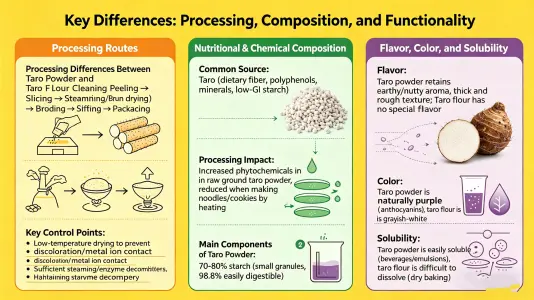
The difference between taro powder and taro flour starts with how they are made. When making powder, the calcium oxalate crystals that make raw taro annoying are turned off while the flavour and colour are kept. Both usually start with washing, then peeling, then slicing, then steaming or blanching, then drying (spray drying or drum drying), then grinding, then screening, and finally packing.
But the key control points are very different. For taro powder, the drying temperature is kept low (usually ≤70°C) to keep it from discolouring and coming into touch with metal ions. The bitter and unpleasant taste that comes from saponins and calcium oxalate crystals needs to be removed by steaming the powder well or using enzymes to break it down. These preparation choices have a direct effect on the finished ingredient's ability to keep its colour, taste, and fit for use in products that people will buy.
Taro flour, on the other hand, focuses on keeping the structure of the starch. The goal is to keep the starch grains whole so that they properly gelize during baking, hold together dough systems that are wet, and build the structure network that gives bread and pastries their shape. Drying at lower temperatures or freezing helps keep these useful qualities of starch.
Nutritional and Chemical Composition
They both come from the same basic food source. New research has shown that taro has a special make-up that includes dietary fibre, polyphenols (like flavonoids and anthocyanins), and minerals like potassium, calcium, and iron. It also has high-quality starch with a low glycaemic potential.
The nutritional value of taro is very high. It has a lot of fibre, which helps digestion and keeps your gut healthy. It also has antioxidants that help fight free radicals and important vitamins and minerals like potassium, vitamin C, and vitamin E.
How this nutritional value gets into the finished item depends on how it was processed. The phytochemicals in raw taro tend to get stronger when it is ground into a taro powder, but they weaken when it is used to make noodles and cookies. This is because heat can change the colour, texture, nutrients, and phytochemicals that are good for you. Because of this, the lower-heat method used to make taro powder tends to keep more of the beneficial part than the higher-heat method used to make taro flour.
The makeup of taro flour is mostly made up of useful starch. Taro corm is known to have 70–80% starch by dry weight, which can be recognised by its small grains. Because its granules are only a tenth the size of a potato's, 98.8% of its starch is easily digested. This makes it perfect for people who have trouble digesting food. Based on these success numbers, taro flour is a great starch ingredient for recipes that need to be both easy to digest and keep their shape.
Flavor, Color, and Solubility Profile
For formulators, these three functional factors make the difference between the two ingredients the clearest.
Pure taro powder still has the earthy and slightly nutty smell that comes from taro. In contrast to other types of sweetness, this flavour is more delicate and rich. When you put taro flour in your mouth, it feels more dense and has a "rough" taste. When powder is handled at lower temperatures, it usually turns into a smoother, more soluble product that works best in drinks and thin emulsions.
Taro powder gives foods and drinks a beautiful natural purple colour, which makes it a nice addition to smoothies, sweets, and even savoury meals. This natural colour, which comes from the anthocyanin in the root, is a big plus for clean-label product makers who want to use natural colourants instead of manmade ones. Taro flour, on the other hand, has a more uniform off-white colour and acts as a starch without adding colour.
Solubility is probably the most important difference for business. Taro powder is prepared in a way that makes it easy to mix with liquids. Instant taro drink mix melts quickly, which speeds up service. This is not a quality that taro flour, which is made for dry baking systems, prioritises. When taro powder is mixed with water, it mixes in much more easily.
Industrial Applications: Which Ingredient Fits Which Use Case?
Taro Powder in Beverages and Functional Foods
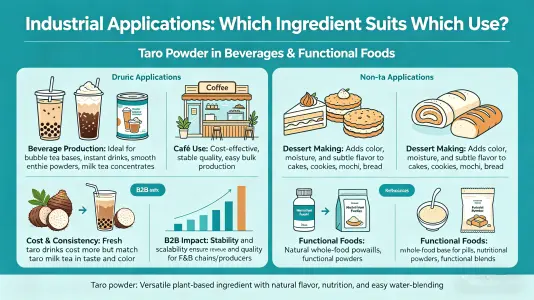
When it comes to making drinks, taro powder really shines. This powder is a flexible plant-based food that is liked for its natural taste, nutritional value, and ability to be used in many different ways. It's a big part of how new foods are made today, from bubble tea to useful foods.
Because it can be mixed with water easily, this ingredient is a top choice for bubble tea bases, quick drink mixes, smoothie powders, and milk tea concentrates. Taro powder is used by many cafés because it's cheap, reliable, and easy to make more of. Fresh taro-based recipes cost more per cup than taro milk tea. The taste and colour stay the same. That stability and scaling has a direct effect on earnings and quality assurance for B2B buyers who sell to food service chains or beverage makers.
In addition to being useful for drinks, it can also be used in desserts. Cakes, cookies, mochi, and breads get colour, wetness, and a light flavour from it. With colour, wetness, and flavour, it's more of a versatile ingredient than a flavouring agent that can only be used for one thing. Taro root powder is a natural, whole-food base used to make health supplements like pill fills, nutritional powders, and functional food mixes.
Taro Flour in Baking and Starch-Based Processing
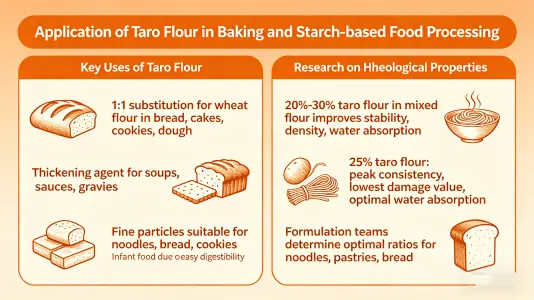
You can use taro flour to make things where the quality of the result depends on how the starch behaves. Taro flour is a flexible food that can be used in place of wheat flour in recipes for bread, cakes, cookies, and doughs in a 1:1 ratio. It's also great for making soups, sauces, and gravies thicker.
Because its particles are so small,taro powder starch can be used in many ways to make foods like noodles, bread, and cookies. It is also often used to make baby food because its starch is easy for the body to digest. The use in baby feeding is especially important because it shows how easily taro flour can be digested and how it has been used in the past in situations where digestion was sensitive.
A lot of research has been done on the rheological effects of taro flour. According to research, adding taro flour in amounts between 20% and 30% makes mixed flour systems more stable, improves the density, and makes the paste absorb more water. The peak consistency was greatest when 25% taro powder was added, and the damage value was lowest. This showed that the mixed powder with 25% powder had the best ability to absorb water. Formulation teams use these specific factors to find the best inclusion rate for uses in noodles, pastries, and bread.
Shared Applications and Nutritional Positioning
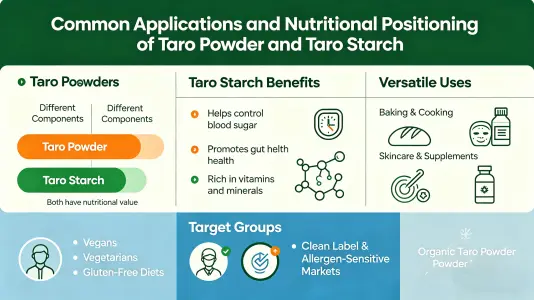
Even though they are different, taro powder and taro flour have one thing in common: they are both nutritionally placed. Taro starch is very good for you because it helps control blood sugar, supports gut health, and is full of vitamins and important minerals. Because of these things, it is an important useful food ingredient. In addition to its useful physical and chemical qualities, taro starch can make food more nutritious. This makes it an adaptable and useful ingredient in many food recipes.
Taro has a lot of fibre and vitamins, which are good for your gut health, help lower cholesterol, and reduce swelling. Its tough starch level is especially good for digestion. You can eat taro without worrying about gluten because it comes from plants. This makes it perfect for vegan, vegetarian, and gluten-free diets. Both ingredients have good health stories that can help B2B buyers who are making products for clean-label, allergen-conscious, or plant-forward markets.
Organic and natural materials are becoming more and more popular, so many companies are looking to organic taro root powder to meet their customers' needs. This item can be used in a lot of different ways, from baking and cooking to skin care and vitamin supplements. Cosmetic formulators are a new group of people who are using taro. Its antioxidant and skin-conditioning qualities are starting to show up in face masks, body scrubs, and nourishing skin bases.
Selecting the Right Form for Your Formulation
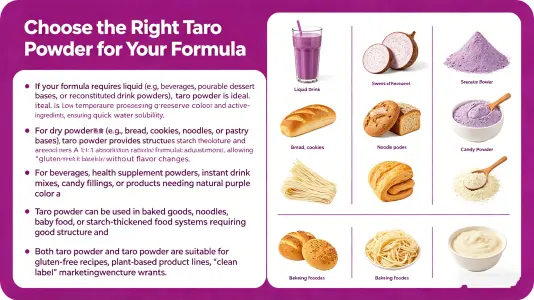
It all comes down to the program setting. Taro powder is the right standard if your recipe calls for a liquid, like a drink, a treat base that can be poured, or a drink mix that has been revived. Its low-temperature processing keeps the colour, keeps the bioactives, and makes sure that it dissolves quickly in water.
If you're making something dry and cooked, like a base for bread, cookies, noodles, or pastries, taro flour gives you the starch structure and rheology that taro powder can't do on a large scale. The 1:1 replacement ratio makes it easier to change the recipe and allows labelling as gluten-free without changing the taste.If you make drinks, health supplement powders, quick drink mixes, candy fillings, or other things that need a natural purple colour and flavour boost, taro powder is the way to go.
Use taro flour when making baked goods, noodles, baby feeding products, or starch-thickened food systems that need to have good structure and rheological properties. Both can be used for gluten-free recipes, plant-based lines of products, "clean label" marketing, and functional food ingredient bases that make claims about gut and nutritional health.
Taro Powder Supplier: Rebecca Bio-Tech
The first step is to know the difference between powder and taro flour. The second step is to find the right grade from a source that has the infrastructure, paperwork, and stability from batch to batch that global production needs.
Rebecca Bio-Tech (Shaanxi Rebecca Bio-Tech Co., Ltd.) is a high-tech company that focuses on exports. They make, study, and sell plant extracts, separate herbs active ingredients, and do research on functional compounds used in traditional Chinese herbal medicine. Rebecca Bio-Tech has over 100 plant extracts in its catalogue and three specialised production lines that can make more than 500 metric tonnes of products every year. It works with companies in the pharmaceutical, health supplement, beverage, and skincare industries all over the world.
Our taro powder is made to strict standards for both food and medicine. It can be bought from other businesses as a basic raw material ingredient:
Particle Size: 100% pass 80 mesh
Grade: Food / Pharm Grade
Whether you are scaling a new functional beverage SKU, developing a gluten-free bakery ingredient line, or sourcing for a health supplement powder blend, Rebecca Bio-Tech provides technical documentation, competitive bulk pricing, and consistent supply chain performance. Our team is ready to support your formulation with samples and full compliance documentation.
Send your inquiry today: information@sxrebecca.com
FAQs
1. What is the main difference between taro powder and taro flour?
Taro flour and taro powder are not the same thing. Because it is starchy, taro flour is often used in baking. On the other hand, taro powder is often used to add flavour to foods and drinks. At the processing stage, taro powder is dried out at a lower temperature to keep its flavour, colour, and medicinal substances. Taro flour is dried in a way that makes the starch structure better, which helps with baking and making dough.
2. Is taro powder the same as taro root powder?
Yes, the terms are used the same way when talking about where to get ingredients. When you dry out taro root and grind it into a fine powder, you get taro powder. Different suppliers may have different requirements for the variety, processing method, and particle size. When making an order, always double-check the Latin name, part used, and mesh size.
3. Can taro flour replace wheat flour in baking?
Yes, and in very clear language. Taro flour is a flexible food that can be used in place of wheat flour in recipes for bread, cakes, cookies, and doughs in a 1:1 ratio. The main problem is that taro flour doesn't have gluten protein in it. Adding it to mixed flour weakens the gluten property, making the gluten network structure weaker than in raw wheat flour. When formulators use taro flour in recipes that need a lot of gluten, they might need to add a binding or gluten replacer.
4. What nutritional profile does taro powder carry?
Fibre, resistant starch, and micronutrients like vitamin C and potassium are all found in taro powder. It also has a lot of polyphenols and flavonoids, which help fight free radicals and keep cells healthy while lowering inflammation. The exact nutritional value changes depending on how it was processed and the type of plant used, so always ask your provider for a certificate of analysis (COA).
5. Is taro powder gluten-free and suitable for allergen-sensitive formulations?
Gluten is not found in pure taro powder. Because taro is gluten-free, safe, and easy to stomach, it could be used as an alternative source of carbohydrates in food production that adds nutrients and might have health effects. Cross-contamination limits should be checked with the seller, especially for approved allergen-free formulas.
References
1. Alcantara, R.M., Hurtada, W.A., & Dizon, E.I. (2013). "The Nutritional Value and Phytochemical Components of Taro [Colocasia esculenta (L.) Schott] Powder and its Selected Processed Foods." Journal of Nutrition & Food Sciences, 3:207.
2. Frontiers in Nutrition (2025). "From starch to bioactives: emerging trends in taro (Colocasia esculenta L.) research on composition, functionality, health benefits, and sustainable food potential."
3. PMC / NCBI (2025). "From starch to bioactives: emerging trends in taro (Colocasia esculenta L.) research." Frontiers in Nutrition, PMC12454381.
4. SciELO Brazil (2022). "Effects of taro powder on the properties of wheat flour and dough." Ciência e Tecnologia de Alimentos.
5. Science Publishing Group (2025). "Nutritional & Anti-Nutritional Quality of Taro (Colocasia Esculenta); A Review." Innovation, Vol. 6(1).
6. KimEcopak (2025). "Taro Powder: Complete Guide to Nutrition, Uses, Benefits & How to Choose."