What is the importance of the mesh size in pure curcumin powder?
Mesh size is a core industrial technical parameter for botanical powder processing. It refers to the number of screen openings per linear inch of a standard industrial sieve. This index directly defines the particle diameter distribution of pure pure curcumin powder and serves as the basic standard for B2B procurement quality inspection and batch consistency verification.
In the global ingredient industry, 80 mesh is recognized as the universal standard grade for high-purity curcumin powder. Strict industrial specifications clarify that 80 mesh curcumin means over 95% of powder particles pass through an 80-opening-per-inch sieve, with a maximum qualified particle diameter of 177 microns. A tiny number of oversized particles within the industrial tolerance range do not affect product performance, which is a key detail that distinguishes standard industrial parameters from absolute numerical definitions.
Pure curcumin powder is extracted from the rhizomes of Curcuma longa. Its active ingredients include curcumin, demethoxycurcumin, and bisdemethoxycurcumin. Precision mechanical milling and sieve screening determine the final mesh size of the product. Regular mesh grades for commercial curcumin powder are divided into three categories. The coarse grade is 40–60 mesh, the standard industrial grade is 80 mesh, and the ultra-fine grade is 100–120 mesh. Each grade has fixed particle size characteristics and applicable industrial scenarios, laying a foundation for subsequent formulation application and quality control.
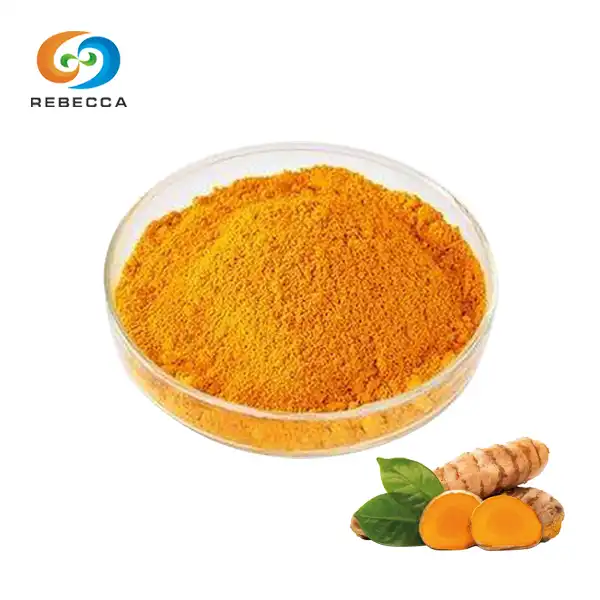
Pure Curcumin Powder
Product name: Curcumin
Latin Name: Curcuma longa L.
CAS No.: 458-37-7
Molecular Formula: C21H20O6
Active ingredients: Curcumin, demethoxycurcumin, bisdemethoxycurcumin.
Specification: Curcuminoids 10%~ 95%
Use Part : Subterranean rhizome
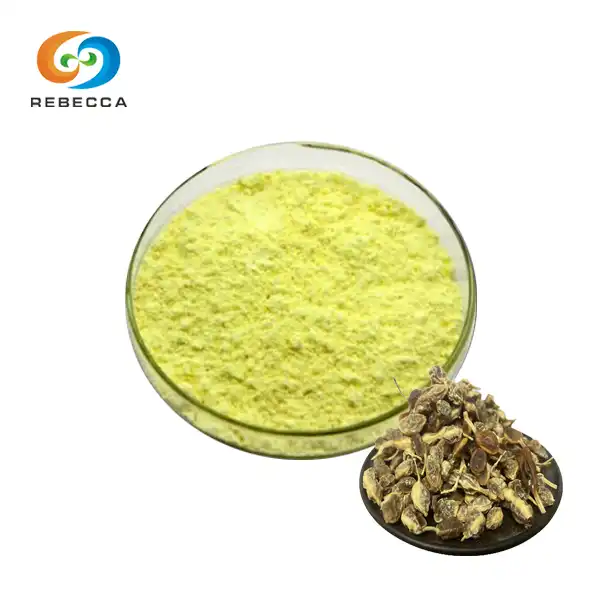
Appearance: Orange yellow powder
Mesh size:80 Mesh
Test Method: HPLC
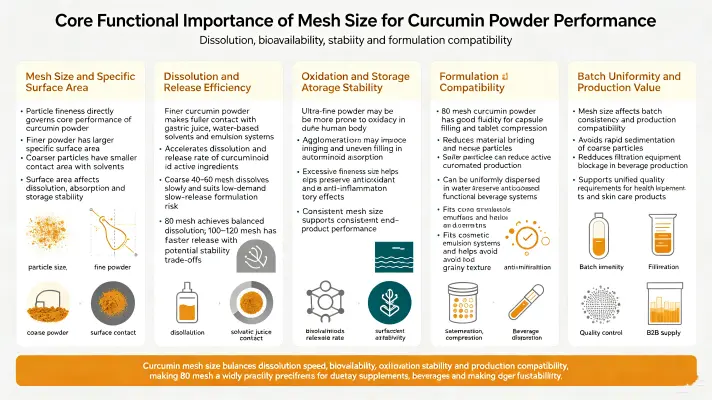
Core Functional Importance of Mesh Size for Curcumin Powder Performance
On the basis of clear mesh size standards, particle fineness directly governs the core performance of curcumin powder. It acts on dissolution efficiency, bioavailability, and formulation stability. These functional indicators are the key concerns of B2B procurement managers, R&D personnel, and quality assurance teams.
Dissolution and release efficiency
Particle surface area is inversely proportional to particle size. Finer curcumin powder has a larger specific surface area. It can make full contact with gastric juice, water-based solvents, and emulsion systems. This significantly accelerates the dissolution and release rate of curcuminoid active ingredients.
Coarse 40–60 mesh curcumin powder has large single particles and a small contact area with solvents. Its dissolution speed is slow, and active ingredients cannot be released quickly. It is only suitable for low-demand slow-release formulations. The 80 mesh standard powder achieves a balanced dissolution effect. It avoids the slow dissolution defect of coarse powder and maintains stable release efficiency. Ultra-fine 100–120 mesh powder has the fastest dissolution speed, but its performance advantages are limited by natural material characteristics.
Bioavailability and efficacy stability
Bioavailability determines the actual efficacy of curcumin products in human bodies. Although ultra-fine powder has a larger specific surface area, excessive fineness increases the surface activity of curcumin particles. It makes the powder prone to oxidation and agglomeration during storage. This will reduce the content of active curcuminoids and weaken the actual absorption effect.
The 80 mesh specification is the optimal balance for industrial application. It effectively improves intestinal absorption efficiency compared with coarse powder. It also avoids the stability risks of ultra-fine powder. It can stably exert the antioxidant and anti-inflammatory effects of curcumin, ensuring consistent therapeutic effects of end products such as health supplements and skin care products.
Formulation compatibility and batch uniformity
Mesh size is the core factor affecting production compatibility and batch consistency. In capsule filling and tablet compression processes, 80 mesh curcumin powder has good fluidity. It will not cause material bridging or uneven filling, adapting to high-speed automated production lines.
In functional beverage production, 80 mesh powder can be uniformly dispersed in water-based systems. It avoids rapid sedimentation of coarse particles and does not block production filtration equipment. In cosmetic emulsion formulations, it can be fully fused with emulsion systems. It eliminates grainy texture and ensures smooth skin feel of topical products, meeting the unified quality requirements of batch production.
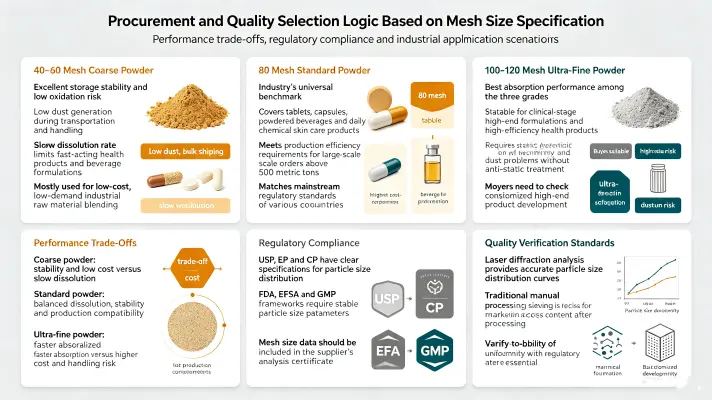
Procurement and Quality Selection Logic Based on Mesh Size Specification
Different mesh sizes correspond to different performance advantages and application limitations. For B2B global procurement, selecting the appropriate mesh size according to product positioning is the core of balancing quality, cost and production efficiency. Combined with global regulatory standards and industrial application scenarios, the selection logic of curcumin powder mesh size is clear and targeted.
Performance trade-offs of different mesh grades
The 40–60 mesh coarse powder has excellent storage stability and low oxidation risk. It has low dust generation during transportation and handling, which is suitable for long-distance international shipping and bulk warehousing. However, its slow dissolution rate limits its application in fast-acting health products and beverage formulations. It is mostly used for low-cost, low-demand industrial raw material blending.
The 80 mesh standard powder is the industry’s universal benchmark. It covers almost all application scenarios of curcumin products, including tablets, capsules, powdered beverages, and daily chemical skin care products. It meets the production efficiency requirements of large-scale orders above 500 metric tons. It also matches the mainstream regulatory standards of various countries, with the highest cost-performance ratio for bulk procurement.
The 100–120 mesh ultra-fine powder has the best absorption performance. It is suitable for clinical-stage high-end formulations and high-efficiency health products. But it requires specialized processing technology, resulting in higher production costs. Meanwhile, it is prone to static electricity and dust problems in production without anti-static treatment, so it is only used for customized high-end product development.
Regulatory compliance and quality verification standards
Global mainstream pharmacopoeia standards such as USP, EP, and CP have clear specifications for the particle size distribution of curcumin powder. FDA, EFSA and GMP production frameworks require food and cosmetic raw materials to have stable particle size parameters to ensure batch-to-batch uniformity.
In B2B procurement, mesh size data must be included in the supplier’s analysis certificate. Professional suppliers use laser diffraction analysis instead of traditional manual sieving. This method can accurately output particle size distribution curves and verify the stability of curcuminoid content after processing. Buyers need to check the consistency of mesh size data with regulatory filing documents to ensure product market access compliance.
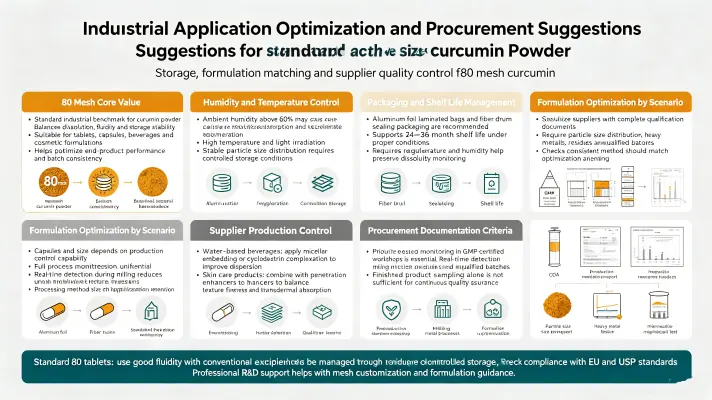
Industrial Application Optimization and Procurement Suggestions for Standard Mesh Size Curcumin Powder
On the premise of mastering mesh size performance and selection rules, standardized use and scientific procurement management can maximize the value of 80 mesh curcumin powder. Reasonable storage, formulation matching and supplier screening can effectively avoid quality risks and optimize end-product performance.
Scientific storage and handling specifications
Mesh size stability directly affects powder performance. Environmental humidity and temperature are key factors causing particle failure. When the ambient humidity exceeds 60%, 80 mesh curcumin powder is prone to moisture absorption and agglomeration. This changes the original particle size distribution and reduces dissolution efficiency.
High temperature and light irradiation will accelerate the oxidation of curcumin active ingredients. Standard industrial storage methods use aluminum foil laminated bags and fiber drum sealing packaging. It is necessary to control constant temperature and humidity storage conditions. During the 24–36 month shelf life, regular moisture detection and color stability monitoring are required to ensure consistent mesh size and efficacy.
Scenario-based formulation optimization suggestions
Different application scenarios need to match targeted processing methods to exert the advantages of 80 mesh powder. For capsule and tablet products, the good fluidity of 80 mesh powder can be matched with conventional excipients to improve compression uniformity and production yield.
For water-based beverage products, curcumin’s natural lipophilicity leads to limited water solubility. On the basis of 80 mesh particle size stability, micellar embedding and cyclodextrin complexation processes can be used to improve dispersion. For skin care products, combining 80 mesh powder with penetration enhancers can balance texture fineness and transdermal absorption effect.
High-quality supplier selection core criteria
Stable mesh size quality depends on the supplier’s production control capability. Excellent suppliers implement full-process mesh size monitoring in GMP-certified production workshops. They conduct real-time detection in the milling process, rather than only sampling finished products, to avoid unqualified batches.
In B2B procurement, buyers should prioritize suppliers with complete qualification documents. The supporting documents include particle size distribution test reports, heavy metal detection, pesticide residue detection, and microbial detection reports that meet EU and USP standards. At the same time, suppliers with professional R&D teams can provide mesh size customization and formulation technical guidance, which helps enterprises optimize product competitiveness.
Conclusion
Mesh size is not a simple technical parameter of curcumin powder. It is a key indicator that runs through product quality, production compatibility, efficacy performance and regulatory compliance. Among all industrial grades, 80 mesh curcumin powder has comprehensive advantages in dissolution efficiency, bioavailability, production adaptability and cost control. It is the most suitable specification for global B2B bulk procurement and large-scale industrial production. Mastering the correlation between mesh size and product performance can help procurement and R&D teams avoid quality risks, select high-quality raw materials, and lay a foundation for the stable output of high-standard curcumin end products.
FAQ
Does finer mesh size always guarantee better absorption?
Not necessarily. While smaller particles increase surface area, absorption depends on multiple factors including curcumin's inherent lipophilic nature, gastrointestinal transit time, and presence of bioavailability enhancers. An 80 mesh specification provides practical absorption benefits without the manufacturing complications of ultra-fine grades. Excessive fineness can also trigger faster oxidative degradation during storage, potentially reducing curcuminoid content before consumption.
How does particle size influence curcumin's effectiveness in formulations?
Particle size affects dissolution kinetics and dispersion uniformity. In supplement capsules, 80 mesh powder dissolves predictably within gastric fluid residence times, ensuring consistent ingredient release. In topical applications, appropriate particle size enables smooth texture and epidermal layer penetration. However, therapeutic effectiveness ultimately depends on total curcuminoid concentration (10%-95% specifications) and formulation synergies rather than mesh size alone.
What mesh size balances cost with quality for bulk purchasing?
The 80 mesh standard represents optimal value positioning. It meets pharmaceutical and food-grade requirements across major regulatory jurisdictions while maintaining production efficiency that controls per-kilogram costs. Bulk buyers negotiating orders exceeding 100 kilograms benefit from this specification's universal acceptance and supplier availability. Custom mesh requests below 60 or above 100 typically incur surcharges due to specialized processing requirements and reduced production throughput.
Partner with Rebecca for Premium Curcumin Powder Solutions
Shaanxi Rebecca specializes in delivering high-purity curcumin extracts standardized to 80 mesh specifications, meeting the exacting demands of global pharmaceutical, nutraceutical, and cosmetic industries. Our GMP-certified production lines process over 500 metric tons annually, ensuring scalable supply for bulk procurement while maintaining batch-to-batch consistency verified through HPLC testing methods.
We understand the complexities of international ingredient sourcing. Our streamlined communication channels and flexible terms—from FOB to DDP—simplify procurement logistics for distributors and manufacturers worldwide. Contact information@sxrebecca.com today to request certificates of analysis, arrange sample testing, or discuss how our curcumin powder solutions can elevate your product development initiatives. Visit sxrebecca.com to explore our complete botanical extract portfolio and discover why leading brands trust Rebecca as their curcumin powder manufacturer for mission-critical applications.
References
1. Hewlings S J, Kalman D S. Curcumin: A Review of Its Effects on Human Health[J]. Foods, 2017, 6(10): 92. (Verifies the correlation between curcumin particle fineness, dissolution performance and human absorption efficacy)
2. Anand P, Kunnumakkara A B, Newman R A, et al. Bioavailability of Curcumin: Problems and Promises[J]. Molecular Pharmaceutics, 2007, 4(6): 807-818. (Analyzes the influence of particle size distribution on curcumin bioavailability defects and optimization space)
3. Prasad S, Gupta S C, Tyagi A K, et al. Curcumin, a component of golden spice: From bedside to bench and back[J]. Biotechnology Advances, 2014, 32(6): 1053-1064. (Supports the practical application value of standard particle size curcumin in functional health products)
4. Amalraj A, Pius A, Gopi S, et al. Biological activities of curcuminoids, other biomolecules from turmeric and their derivatives[J]. Journal of Traditional and Complementary Medicine, 2017, 7(2): 205-233. (Confirms the stable efficacy advantage of moderately fine curcumin particles in anti-inflammatory and antioxidant applications)
5. Nelson K M, Dahlin J L, Bisson J, et al. The Essential Medicinal Chemistry of Curcumin[J]. Journal of Medicinal Chemistry, 2017, 60(5): 1620-1637. (Elaborates on the physical property changes of curcumin powder caused by particle size difference)
6. European Pharmacopoeia Commission. Particle Size Distribution Estimation by Analytical Sieving[S]. European Pharmacopoeia 10th Edition, 2019, Chapter 2.9.38. (Defines industrial sieve detection standards and qualified particle size distribution specifications for botanical powder raw materials)