
What is the relationship between vitamin B12, nerve function, and metformin?
vitamin B12 (cyanocobalamin) helps keep your nerves healthy and convey impulses effectively. At the same time, metformin — one of the most often given drugs for type 2 diabetes — may slowly knock down your B12 levels over time. This poses a concealed danger of nerve injury that might be misdiagnosed as a symptom of diabetes itself. Learning how these three things are connected will help you take the correct actions to safeguard your health.

1. Product Name:Vitamin B12 (Cyanocobalamin)
2. CAS No.:68-19-9
3. Specification: 99%
4. Test Method: HPLC
Vitamin B12 and Nerve Function
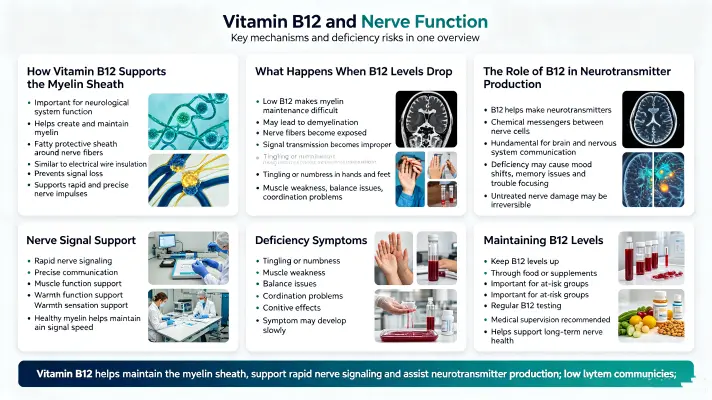
How Vitamin B12 Supports the Myelin Sheath
Vitamin B12 (cyanocobalamin) is important for the functioning of your neurological system. One of its most crucial tasks is to help in the creation and maintenance of myelin, a fatty, protective sheath surrounding nerve fibers. Myelin is similar to the plastic insulation around an electrical line. It avoids signal loss and helps nerve impulses flow rapidly from one region of your body to another.
With enough vitamin B12, your body can use it to produce and repair myelin effectively. This allows for rapid and precise nerve signals. This fast transfer is what makes everything go from working your muscles to experiencing warmth. When myelin is unhealthy, the speed of electrical communication between your brain and body slows down or becomes disturbed.
What Happens When B12 Levels Drop
When vitamin B12 (cyanocobalamin) levels go too low, the body can’t easily maintain the myelin coating. Over time , this may lead to a process called demyelination when the protective coating surrounding nerves starts to break down . This exposes the nerve fibers and causes improper signal transmission.
Symptoms of demyelination typically start quietly. You may have a tingling or numbness in your hands and feet. With increasing deficit, one may have muscular weakness, balance issues, and trouble coordinating movement. In extreme circumstances, subacute combined degeneration of the spinal cord may ensue. This causes widespread injury to the spinal cord, and may lead to severe walking problems and cognitive impairment.
The Role of B12 in Neurotransmitter Production
Vitamin B12 (cyanocobalamin), together with myelin, helps to make neurotransmitters — the chemical messengers that convey impulses from one nerve cell to another. These molecules are fundamental for communication inside the brain and throughout the nervous system.
Deficiency of B12 might affect the production of neurotransmitters. This might cause mood shifts, memory issues and trouble focusing. Symptoms develop slowly and so are often overlooked or attributed to age. But frequently they are an indicator of some underlying nutritional deficiency that may be put right.
What makes it so frightening is the steady progression of B12 nerve damage. Mild early signs. But if untreated the harm might be irreversible. That’s why it’s important to keep your B12 levels up, either by food or supplements, particularly if you’re at greater risk.
Vitamin B12 is so crucial for nerve function that it’s important to know what might interfere with its absorption. One of the most frequent suspects is a commonly prescribed diabetic drug: metformin.
How Metformin Affects Vitamin B12 Absorption
What Metformin Does in the Body
Metformin is the first-line medicine for the treatment of type 2 diabetes. It lowers the amount of sugar produced by your liver, and helps your body's cells respond better to insulin. This helps to keep blood sugar under control. Metformin is often given because to its well-established safety and demonstrated efficacy.
One well-documented negative effect of long-term usage of metformin is decreased absorption of vitamin B12 (cyanocobalamin). “Many of these patients are on metformin for years, if not decades, so you’re accumulating risk over time,” he said.
The Mechanism: How Metformin Blocks B12 Absorption
To appreciate this condition, it is helpful to understand how vitamin B12 (cyanocobalamin) is routinely absorbed. In the stomach, dietary B12 is released from protein transporters. It subsequently attaches to a protein called intrinsic factor (IF). This B12-IF complex is then transported to the terminal ileum – the final part of the small intestine – where it binds to a receptor known as cubilin and is absorbed into the circulation.
The attachment mechanism is calcium dependent. For effective activity, the cubilin receptor requires calcium ions on the surface of the cell. Metformin interrupts this process. Research indicates that the metformin molecule with a positive charge causes the electrostatic repulsion of calcium ions on the surface of the ileal cell membrane. Absorption is hampered without enough calcium at the membrane because the B12-IF complex cannot bind to its receptor.
Interestingly, investigations have demonstrated that calcium supplementation may partly correct metformin-induced B12 malabsorption supporting this calcium-dependent mechanism.
How Common Is This Problem?
More than many understand, the influence of metformin on the absorption of vitamin B12 (cyanocobalamin) is more widespread. Studies have shown that 10-30% of long-term metformin users had demonstrably reduced levels of B12. This may happen even in persons who consume a diet high in foods containing B12, since the problem is with absorption, not ingestion.
The danger is both dose-dependent and time-dependent. The risk of developing a deficit increases with higher daily dosages and with longer duration of therapy. Other risk factors include:
· Age > 65
· Diet of vegetarian or vegan
· Existing digestive disorders (such as celiac disease or inflammatory bowel disease)
· Duration of metformin use >5 years
This is because deficiency may take several years to develop, and patients and clinicians may not recognize it until a major symptom burden occurs.
This takes us to the important crossroad: when metformin-induced B12 deficiency intersects with the nerve damage that diabetes itself may cause. This association is important for correct diagnosis and management.

The Connection: Why This Matters for Diabetic Patients
B12 Deficiency vs. Diabetic Neuropathy: A Diagnostic Challenge
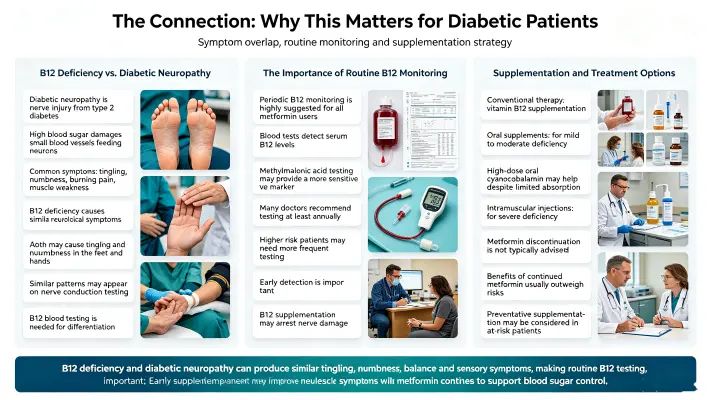
Diabetic neuropathy is a kind of nerve injury that may happen as a complication of type 2 diabetes. This is because excessive amounts of sugar in the blood over time damage the tiny blood vessels that feed the neurons. It often starts in the feet and hands, producing tingling, numbness, searing pain and muscular weakness.
The trouble is that nerve injury from a shortage of vitamin B12 (cyanocobalamin) creates very similar symptoms. Both diseases may result in tingling and numbness in the extremities, a loss of balance and an enhanced sensitivity to touch. Similar patterns are also seen on nerve conduction testing . Again, without precise blood tests for B12 levels it is impossible to differentiate between the two.
This overlap is perilous. If the patient’s symptoms are simply labeled as diabetic neuropathy, the underlying B12 deficiency might be overlooked and neglected. Meanwhile, the nerve damage continues to worsen. If B12 insufficiency is not treated in time, some of its neurological symptoms might become permanent.
The Importance of Routine B12 Monitoring
Given these overlapping hazards, periodic monitoring of vitamin B12 (cyanocobalamin) levels is highly suggested in all patients on metformin. The most easy way is blood testing that detect serum B12 levels. Sometimes they may additionally test for methylmalonic acid (MMA) levels, which will be elevated when B12 is low, giving a more sensitive marker of insufficiency.
How frequently do you have to test? Many doctors urge that metformin users be tested for B12 at least annually. Those with other risk factors, such older age, plant-based diets or gastrointestinal issues, may benefit from more regular testing. Early detection is important. If diagnosed early, B12 supplementation may arrest the course of nerve damage and in many instances correct the symptoms.
Supplementation and Treatment Options
The conventional therapy if a deficit is found is vitamin B12 (cyanocobalamin) supplementation. There are a few possibilities for you:
• Oral supplements – for mild to moderate deficiency High dosage oral cyanocobalamin may be useful even in the setting of limited absorption.
Intramuscular injections: Usually used in more severe insufficiency or when oral absorption is severely impaired.
·Nasal sprays: A different way that could be helpful for certain people.
Note that metformin discontinuation is not typically advised as a therapy for B12 insufficiency. Metformin remains a very efficient blood sugar management drug. The advantages of continuous usage usually exceed the hazards of B12 insufficiency, especially with the use of supplements.
Some healthcare practitioners advocate starting preventative B12 supplementation in individuals starting metformin, particularly those with risk factors for insufficiency. This may be a proactive way to prevent insufficiency from occurring.
For all people who are in need of a good vitamin B12 supplement, finding a high quality product is a crucial factor.
Choosing a High-Quality Vitamin B12 (Cyanocobalamin) Source
Why Purity Matters
Not all vitamin B12 (cyanocobalamin) supplements are the same. The efficacy of supplementation is directly affected by the purity and quality of raw material. This is particularly true for those who take B12 supplements to prevent or cure deficiency, including metformin users who may have reduced absorption.
whether you’re taking a B12 supplement, search for pharmaceutical-grade cyanocobalamin and find out whether it’s been tested for purity. Third-party testing and conformity with accepted quality standards (such as GMP certification) give further peace of mind.
Rebecca Bio-Tech: A Trusted Cyanocobalamin Supplier
Rebecca Bio-Tech, one of the largest vitamin B12 (cyanocobalamin) producers in China. Their product has a minimum purity of 99% and an annual manufacturing capacity of over 1,000kg. Such a high purity means each dosage has a guarantyd and strong quantity of B12.
Rebecca Bio-Tech provides the quality raw material you want whether you are a supplement maker, healthcare distributor or research organization.
Get High-Purity Vitamin B12 (Cyanocobalamin) From Rebecca Bio-Tech
You need pharmaceutical grade cyanocobalamin, min. 99% purity? Dependable supply and constant quality, Rebecca Bio-Tech is here to serve you.
Please contact us at information@sxrebecca.com.
Request a product spec sheet, price information or free sample. Our staff usually answers within 24 hours.
Conclusion
“The association between vitamin B12 (cyanocobalamin), nerve function and metformin is a clinically important one and warrants further exploration.” You need vitamin B12 to keep the myelin sheath healthy and to make neurotransmitters. Insidious nerve damage may occur and may be permanent if levels are not enough.
Metformin, which is very successful in controlling type 2 diabetes, may interfere with B12 absorption by inhibiting calcium-dependent activities in the ileum. This generates a concealed risk of deficiency, which may mimic or aggravate diabetic neuropathy. The answer is not to quit metformin, but test B12 levels frequently and supplement as required.
Understanding this link and being proactive will help patients and healthcare professionals optimize metformin treatment advantages and protect nerve health.
FAQ
1. Can metformin harm nerves?
Metformin doesn't harm nerves directly. However, with long-term usage, your body may absorb less vitamin B12 (cyanocobalamin), which is important for nerve function. If the amount of B12 drops far enough, then the secondary effect may be nerve injury.
2. How quickly does metformin reduce vitamin B12 levels?
Metformin usage causes slow B12 depletion. Studies show it might take years of frequent usage before levels decline dramatically. Patients with other risk factors, however, may develop deficient earlier. It is advised to monitor regularly from the first year of therapy.
3. Signs and symptoms of vitamin B12 deficiency?
Common symptoms include tingling and numbness of the hands and feet, muscular weakness, weariness, balance issues, difficulty remembering, and mood changes. Symptoms may develop slowly and might be confused for other illnesses, including diabetic neuropathy.
4. Is it ok to quit metformin if my B12 is low?
No. It’s a really essential drug for type 2 diabetes, very effective. If your B12 is low, the advice is to stay on metformin but add a vitamin B12 (cyanocobalamin) supplement. Your health care professional can help you choose the right dosage and approach.
5. Are calcium supplements effective for B12 insufficiency caused by metformin?
Yes. Calcium supplementation may restore metformin-induced B12 malabsorption, as shown in research. This is because metformin inhibits calcium dependent mechanisms in the ileum that are needed for the absorption of B12. Talk to your doctor about calcium supplements.
References
1. Aroda, V. R., Edelstein, S. L., Goldberg, R. B., et al. (2016). Long-term Metformin Use with Vitamin B12 Deficiency in the Diabetes Prevention Program Outcomes Study The Journal of Clinical Endocrinology & Metabolism 101(4): 1754–1761.
2. Bauman WA, Shaw S, Jayatilleke E, Spungen AM, Herbert V. Higher calcium consumption corrects vitamin B12 malabsorption from metformin. Diabetes Care, 23(9), 1227-1231.
3. Green, R., Allen, L. H., Bjørke-Monsen, A. L., et al. Vitamin B12 insufficiency Nature Reviews Disease Primers 3, 17040.
4. Niafar, M., Hai, F., Porhomayon, J., & Nader, N. D. 2015. Vitamin B12 insufficiency with metformin: a meta-analysis review. Internal and Emergency Medicine, 10(1), 93–102.
5. Ahmed, M. A. (2016). Metformin with Vitamin B12 Deficiency: Where Are We Now? Journal of Pharmacy and Pharmaceutical Sciences. 19(3):382-398.
6. Niazi, A. K., & Niazi, S. K. (2021). Metformin-induced vitamin B12 insufficiency and related neurological complications: a review Postgraduate Medical Journal, 97(1153), 734-740.