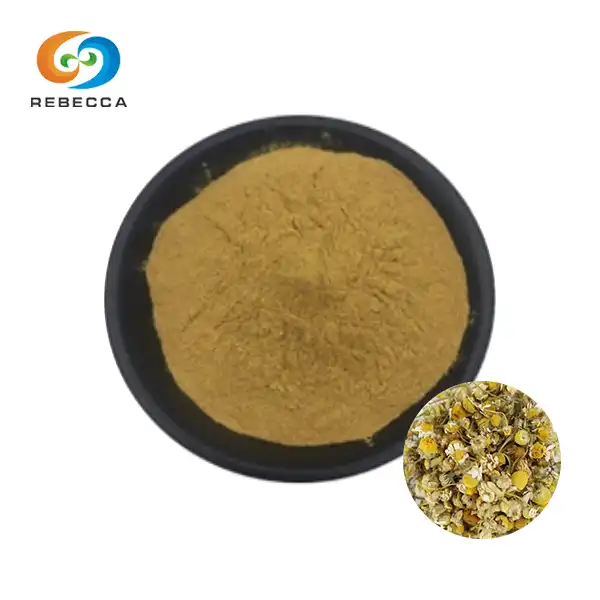

Chamomile Extract: Premium German Chamomile Flower Extract for Global B2B Partners
Our Chamomile Extract is ONLY from the flower heads of real Matricaria chamomilla L. and is never contaminated with Roman chamomile, stalks or low-grade weeds. Certified organic, nutritional and pharmaceutical grades of chamomile are standardised for consistent quantities of apigenin, luteolin and volatile oils for usage in nutraceuticals, cosmetics and functional foods and to prevent contamination and pesticide residues.
Technical Specifications of Chamomile Extract
|
Parameter |
Specification |
||
|
Latin Name |
Matricaria chamomilla L. |
||
|
Active Markers |
Apigenin 0.3%, 0.5%, 0.8%, 1.2%, 3%, 98% |
||
|
Test Method |
HPLC / HPTLC |
||
|
Extract Ratios |
4:1, 10:1, 20:1 |
||
|
Appearance |
Yellow-brown fine powder |
||
|
Mesh Size |
100% pass 80 mesh; 200 mesh ultrafine available |
||
|
Moisture |
≤5% |
||
|
Ash Content |
≤5% |
||
|
Solubility |
Ethanol/propylene glycol soluble; cyclodextrin-encapsulated water-soluble option |
||
|
pH Stability |
4.5–7.0 |
||
|
Shelf Life |
24 months (vacuum-sealed, light-proof, ≤25℃) |
||
|
Test Item |
Standard Requirement |
Test Result |
Judgment |
|---|---|---|---|
|
Appearance |
Yellow-brown Powder, uniform color, no visible foreign impurities |
Yellow-brown Powder, clean & uniform |
Complies |
|
Odor & Taste |
Characteristic chamomile floral odor, mild taste |
Conforms to typical sensory properties |
Complies |
|
Identification (TLC) |
Consistent with Matricaria Recutita reference standard |
Positive match |
Complies |
|
Apigenin Content (HPLC) |
≥1.20% |
1.28% |
Complies |
|
Loss on Drying |
≤5.0% |
2.73% |
Complies |
|
Total Ash |
≤8.0% |
4.05% |
Complies |
|
Acid Insoluble Ash |
≤2.0% |
0.69% |
Complies |
|
Particle Size |
100 mesh pass rate ≥98% |
99.6% |
Complies |
|
Solubility |
Partially soluble in water, soluble in ethanol |
Conforms |
Complies |
|
Lead (Pb) |
≤2.0 ppm |
0.38 ppm |
Complies |
|
Arsenic (As) |
≤2.0 ppm |
0.21 ppm |
Complies |
|
Cadmium (Cd) |
≤0.3 ppm |
Not Detected |
Complies |
|
Mercury (Hg) |
≤0.1 ppm |
Not Detected |
Complies |
|
Pesticide Residues |
Complies with food safety regulations |
Complies |
Complies |
|
Total Aerobic Bacteria |
≤1000 CFU/g |
49 CFU/g |
Complies |
|
Molds & Yeasts |
≤100 CFU/g |
Not Detected |
Complies |
|
Escherichia Coli |
Negative |
Negative |
Complies |
|
Salmonella |
Negative / 25g |
Negative |
Complies |
|
Staphylococcus Aureus |
Negative |
Negative |
Complies |
Why Choose Us
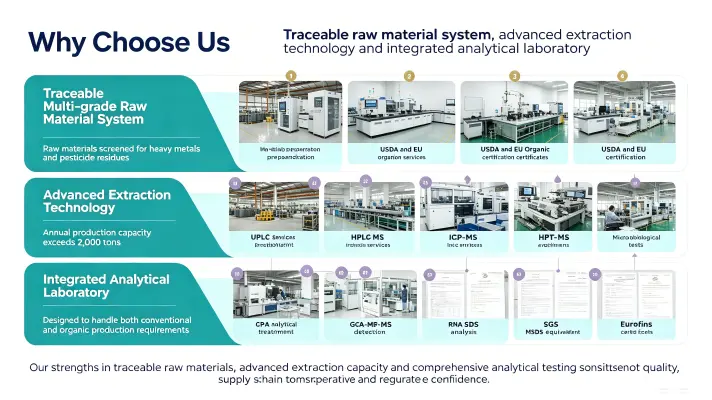
Traceable Multi-Grade Raw Material System
Eastern Europe, Gansu, Xinjiang, and Egypt are the places from where German chamomile is derived. Premium flower heads, screened for heavy metals and pesticides, produce cosmetic and pharmaceutical extracts. USDA/EU-certified organic materials are processed on separate lines to prevent cross-contamination.
Cutting-Edge Extraction Technology
With an annual capacity of more than 2,000 tonnes, our plant runs three specialised manufacturing lines. To conserve volatile oils and flavonoids, we use two extraction methods: water extraction (4:1 ratio) and 50% ethanol reflux (10:1, 20:1, standardised flavonoids), together with D101 macroporous resin purification and low-temperature vacuum drying (60°C).
Comprehensive Laboratory for Analysis
We confirm apigenin content, heavy metals, pesticide residues, and microbiological limits using UPLC, HPLC, GC-MS, ICP-MS, and HPTLC. COA and MSDS are included in every batch, and SGS and Eurofins provide third-party re-inspection assistance.
ISO9001, ISO22000, FSSC22000, HACCP, HALAL, KOSHER, cGMP, non-GMO, NOP, and EOS organic certifications are examples of quality certifications.
Sources of Raw Materials and Traceability
Origin & Variety
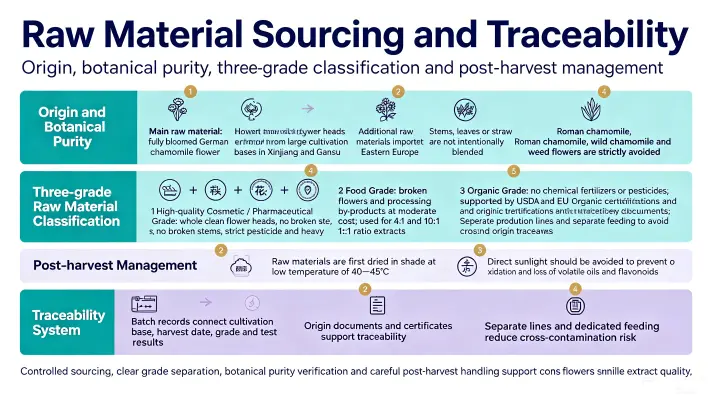
In addition to imported batches from Egypt and Eastern Europe, our primary raw material is fully bloomed German chamomile (mother chamomile) flower heads from large-scale bases in Xinjiang and Gansu. We never combine branches, leaves, or straw, and we firmly avoid cheap Roman chamomile, wild chamomile, and weed flowers.
Three-Tier Raw Material Grading
① High quality cosmetic/pharmaceutical grade: Whole pure flower heads, zero damaged stems, strictly checked for pesticides and heavy metals. Used for 3% total flavonoid standardised extracts.
② Food grade: Broken flowers and processing waste are moderately priced and utilised to make 4:1 and 10:1 ratio extracts.
③ Organic grade: No chemical fertilisers or pesticides, USDA and EU organic certifications and origin traceability paperwork. Separate manufacturing line, separate feeding, to avoid cross contamination.
Post Harvest Management
Collecting and drying the raw materials in the shade at a low temperature of 40-45℃ is the first step. To keep volatile oils and flavonoids from oxidising and losing their potency, stay out of direct sunshine.
Stability and Solubility
How Soluble Substances Are
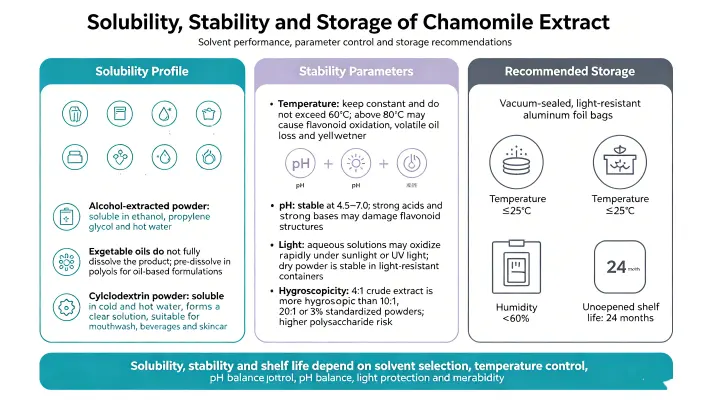
A powder that has been extracted using alcohol: Ethanol, propylene glycol, and heated water dissolve it.It becomes hazy since it's hardly soluble in cold water.Vegetable oils do not dissolve it properly.Dissolve it in polyols before using it in oil-based goods.
cyclodextrin powder that dissolves to provide clear solutions in both hot and cold water. Ideal for use in mouthwashes, drinks, and skin care products.
Profiling Stability
The temperature must remain constant and not go over 60 degrees.The powder becomes yellow due to flavonoid oxidation and the loss of volatile oil at high temperatures (>80°C).
pH range: steady, 4.5 to 7.0. Strong acids and alkalis can degrade the flavonoid nucleus.
Light: Water-based solutions quickly oxidize when exposed to daylight or UV light, but dry powder stays stable in light-proof containers.
The hygroscopicity of a 4:1 crude extract is greater than that of a 10:1, 20:1, or 3% standardized powder. The danger of absorbing moisture rises with an increase in polysaccharide content.
Storage Conditions
Vacuum-sealed, light-proof aluminum foil bags for Chamomile Extract; temperature ≤25℃, humidity <60%; unopened shelf life 24 months.
Manufacturing Process
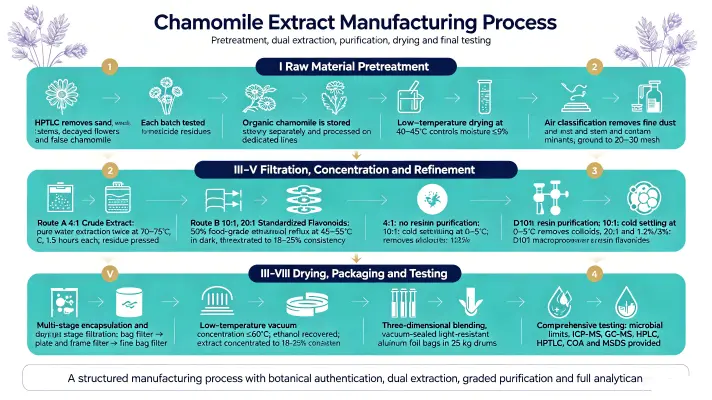
I. Raw Material Pretreatment
• HPTLC thin-layer chromatography removes sand, weeds, twigs, rotten flowers, and Roman chamomile to identify authentic items.
• All batches were tested for heavy metals and pesticide residues.
• Organic chamomile is fed into different production lines after being preserved separately.
• Moisture is kept to ≤9% with low-temperature drying (40–45°C).
• Air classification eliminates fine dust and stem contaminants; grinding to 20–30 grit enhances solvent contact.
II. Dual Extraction Routes
• Route A (4:1 Crude): Purified water extraction at 70–75℃, twice for 1.5 hours each; press residue to recover liquid.
• Route B (10:1, 20:1, Standardised Flavonoids): 50% food-grade ethanol reflux extraction at 45–55℃ in the dark; three times (first 2 hours, second/third 1.2 hours each); solvent recovery and recycling.
III. Multi-level filtration
Coarse bag filtration -> plate-and-frame filtration -> precision bag filtration for a clean, impurity-free extract.
IV. Vacuum Concentration at Low Temperatures
Temperature regulated ≤60℃; ethanol recovered under negative pressure; extract concentrated to 18-25% viscous consistency.
V. Graded Refining
• 4:1: No resin purification; direct spray drying retains all polysaccharides.
• 10:1: Low-temperature sedimentation (0–5℃, 12 hours) removes colloids.
• 20:1 + 1.2%/3% Standardized: Flavonoids are enriched by D101 macroporous resin gradient purification; secondary resin chromatography is used to the 3% grade.
VI. Optional Encapsulation & Drying
• Conventional powder (4:1, 10:1, 20:1): output of 80–120 mesh; spray drying (inlet 145–155°C, outflow ≤72°C).
• Standardized high-purity (1.2%/3%): Vacuum dry at 42–48°C in the dark to retain flavonoids and volatile oils.
• Water-soluble derivative: β-Cyclodextrin encapsulation using quick homogenization and spray drying.
VII. Sieving, Mixing & Packaging
• Grading: 80–100 mesh (capsules/tablets), 200 mesh ultrafine (liquids/toners).
• Batch uniformity ensured via three-dimensional mixing.
• Sealed in light-proof vacuum aluminum foil bags + 25kg cardboard drums.
VIII. Complete Testing
Testing for microbiological limits, heavy metals (ICP-MS), pesticide/solvent residues (GC-MS), apigenin (HPLC), and total flavonoids (HPTLC) followed by authenticity. The third party re-inspection was supported, and full COA and MSDS were delivered.
Benefits and Uses
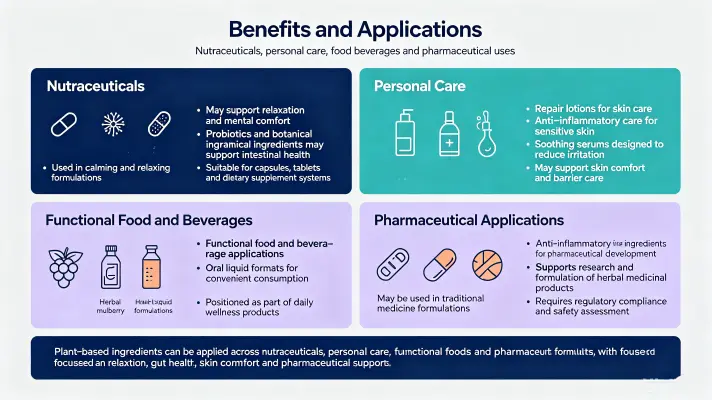
• Nutraceuticals: sedatives, relaxants, and probiotics for gut health
• Personal care items, such as healing lotions, anti-inflammatory tonics, and soothing serums
• Foods and Beverages with Functional Properties Herbal Mulberries, Oral Liquids
• Medications: Anti-inflammatory active substances, traditional medicine formulations
Assuring High-Quality
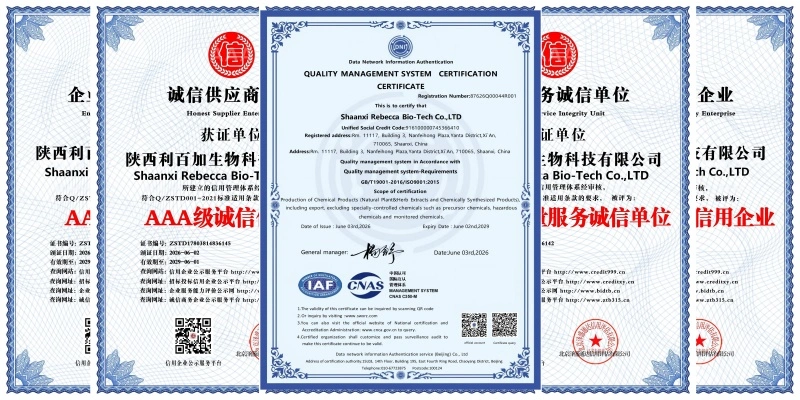
• Occupancy certifications: FSSC22000, ISO9001, HACCP, cGMP, Non-GMO, NOP, EOS
HPTLC, IR, UPLC, UV, GC-MS, ICP-MS, ELISA, PPSL, microbiological
• Full product traceability, beginning with the farm and ending with the consumer, with features such as a certificate of analysis (COA), material safety data sheet (MSDS), and third-party verification (SGS, Eurofins)
Packing and Shipping
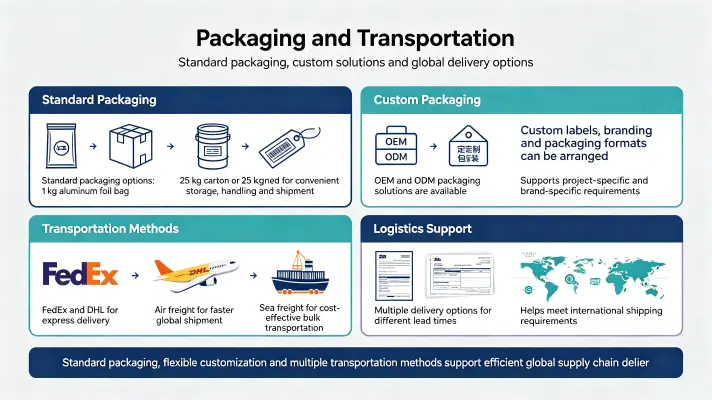
• Standard: 1 kilogram aluminium foil packets, 25 kg cartons / drums
• Custom: OEM/ODM packaging options available
• Shipment: Fedex, DHL, Air freight, Sea freight
FAQ
Q: What is the difference between 4:1, 10:1, 20:1 and 3% flavonoids standardised? Which is better for oral supplements and skin care?
A: 4:1 water extracted powder contains more contaminants and is cheaper and is used for compound herbal mixtures. 10:1 alcohol extract powder maintains volatile oils, and has optimum cost-performance for calming capsules/tablets. 20:1 is somewhat purified by resin, acceptable for oral liquids. 3% standardised flavonoids, highly refined, suitable for luxury toners and restorative serums.
Q: Is water-soluble modified powder available?
A: The powder encapsulated in β-cyclodextrin may be readily dissolved in hot or cold water, which makes it suitable for use in beverages, toners, and oral solutions. For emulsified creams, pills, and capsules, regular powder works well.
Q: Will it dissolve in vegetable oils or soft capsule matrices?
A: A. Conventional extracts have poor lipid solubility. Add emulsifiers and dissolve in propylene glycol to create ointments and oil capsules. Items that are soluble in water are easier to encapsulate.
Q: What's the maximum safe processing temperature?
A: Stable at or below 60 degrees Celsius. Flavonoids become yellow and volatile oils degrade when exposed to temperatures over 80°C for long periods. The ideal pH is between 4.5 and 7.0. Active compounds may be degraded by strong acids and alkalis.
Q: Will high-humidity ocean shipping cause clumping?
A: Our light-proof vacuum aluminium foil bags and cardboard drums can avoid absorbing moisture. High purity and low hygroscopicity guarantee no caking throughout 24 month sealed shelf life.
Contact Us
Ready to Elevate Your Chamomile Extract Formulations? contact us for samples, technical support, and customized formulations at information@sxrebecca.com.