Is octacosanol an antioxidant?
Octacosanol is an aliphatic long-chain alcohol found in the natural waxes of plants like sugar cane, wheat germ and rice bran. It has exploded in popularity in the health and wellness business in recent years. It is generally associated with increased exercise endurance, less physical weariness and healthier cholesterol level. But a new debate has developed among the scientific community: Is it really an antioxidant?
The human body is continually exposed to oxidative stress. It arises when unstable chemicals, called free radicals, outweigh the normal defensive mechanisms in the body. These free radicals may cause damage to the cells and lead to weariness, aging and many health problems. People are looking to antioxidants to fight this. But where does our subject come in this picture? We'll investigate the science that behind it in this piece, examine how it works with the human body and define its real potential in the battle against cellular damage.
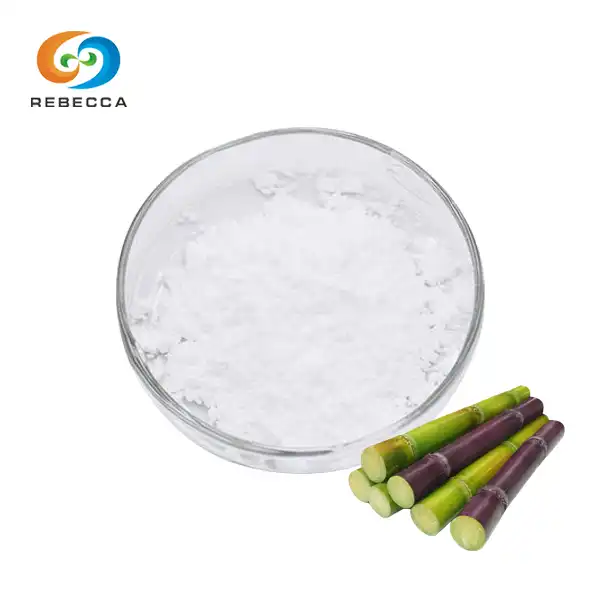

【English name】: Octacosanol(Policosanol)
【Alternative name】::Policosanol/Sugarcane Extract
【Latin Name】: Saccharum officinarum
【CAS No.】: 557-61-9
【Molecular Formula】: C28H58O
【Active ingredients】: Octacosanol
【Specification】: 5%~95%
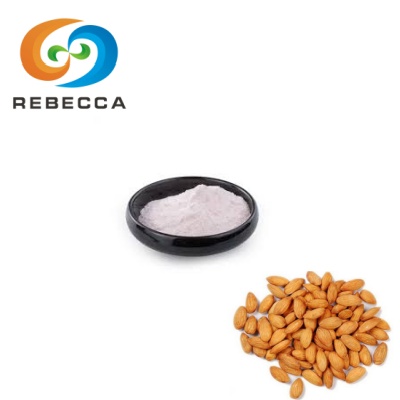
【Use Part】 : The stalks of sugar cane
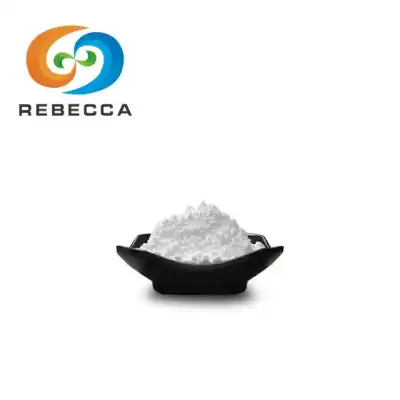
【Appearance】: Off-white to White Fine Powder
【Mesh size】:80 Mesh
【Test Method】: GC
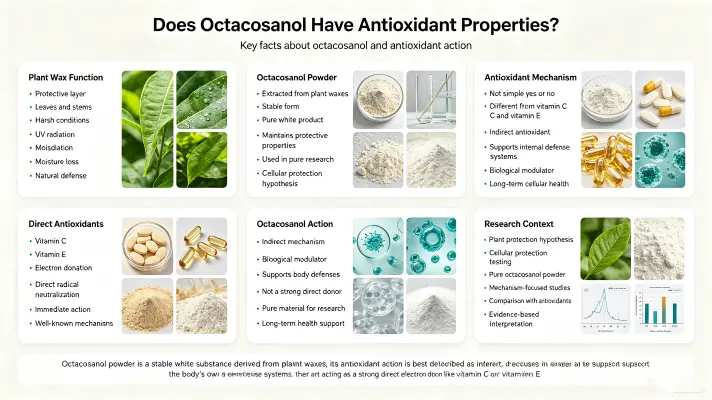
Does Octacosanol Have Antioxidant Properties?
But before we can really appreciate what it can do, we need to look at where it came from and what the current scientific consensus says about its fundamental features. Let’s start with the basics.
The Role of Plant Waxes in Nature
In nature, plant waxes are a protective layer. They protect leaves and stems from severe external conditions, UV radiation, and moisture loss. Scientists extract these chemicals and change them into a stable form, typically known as octacosanol powder. This pure white product maintains many of the protecting properties of the natural product. Scientists have long pondered whether the protection it gives plants extends to cellular protection in people. These hypotheses may be tested by scientists in laboratory settings , where they can use pure octacosanol powder without any additional plant material .
What the Science Says So Far
It’s not a straightforward yes/no inquiry about its antioxidant capacity. The method is somewhat different, say, compared to renowned direct antioxidants like Vitamin C or Vitamin E. Vitamin C immediately neutralizes free radicals by donating an electron. High grade octacosanol powder usually does not function as a direct electron donor in the same forceful way. Instead, research show it operates more like a biological manager. Internally, octacosanol seems to kickstart the body’s own internal defensive systems rather than going head to head with free radicals. This makes it a “indirect” antioxidant, which may be very beneficial for long-term cellular health.
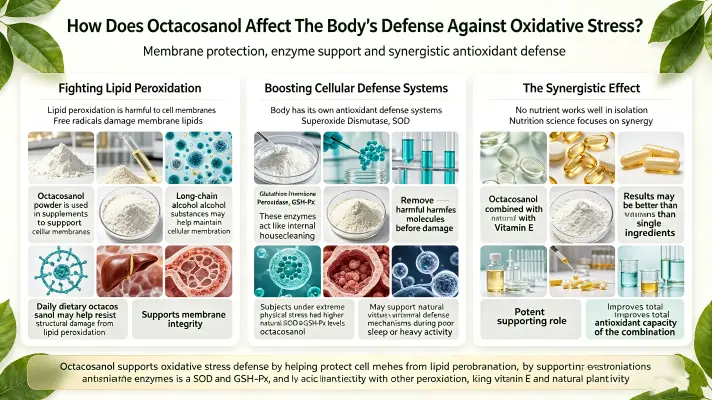
How Does Octacosanol Affect The Body's Defense Against Oxidative Stress?
Now that we have a fundamental idea of how it works indirectly, let’s dig in. How precisely does this substance affect our cells on a microscopic level?
Fighting Lipid Peroxidation
Lipid peroxidation is harmful. It’s like the “rusting” of your cell membranes. Free radicals damage the fats (lipids) that comprise the outer layer of your cells and weaken them. Formulators commonly utilize octacosanol powder to make supplements to stop this process. Research suggests that substances containing long-chain alcohols may be used to help maintain these cellular membranes. The octacosanol usage in daily diet may help the body to resist the damages in structure induced by lipid peroxidation . This is very crucial for liver cells and muscular tissue.
Boosting Cellular Defense Systems
Your body contains its own antioxidant factories. The most essential of them are named Superoxide Dismutase (SOD) and Glutathione Peroxidase (GSH-Px) enzymes. These enzymes are like an internal housecleaning service, grabbing up harmful molecules before they can do any damage. In animal research these enzymes have shown interesting outcomes. Subjects under extreme physical stress, who were given supplements of octacosanol, had considerable increases in their natural levels of SOD and GSH-Px. Therefore, consuming octacosanol powder could be an ideal way to stimulate the natural cellular defense mechanisms of the body, especially in times of lack of sleep or heavy physical activity.
The Synergistic Effect
No nutrient functions properly in isolation. Nutrition Science is all about synergy. When several chemicals work together for a more powerful impact. Numerous premium health solutions mix octacosanol powder with other popular antioxidants. For example when you combine it with Vitamin E or natural plant oils, typically the outcomes are better than taking each ingredient on its own. This physical structure enables for good incorporation of fat-soluble vitamins. This synergy makes it a potent supporting role, improving the total antioxidant capacity of a nutritional supplement combination.
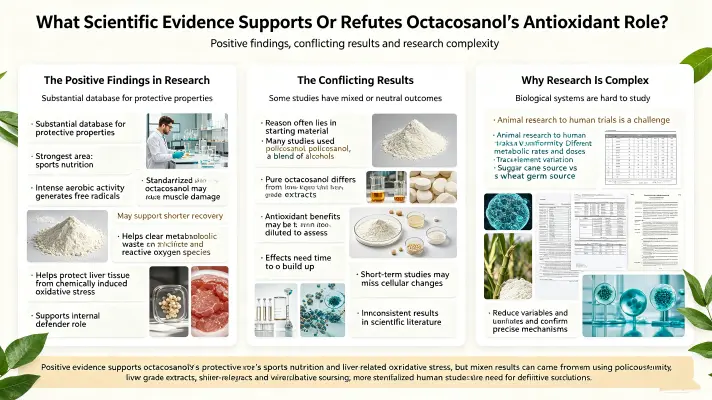
What Scientific Evidence Supports Or Refutes Octacosanol's Antioxidant Role?
Good to know the theory, but let's look at the concrete facts. But what do the actual lab findings say regarding this ingredient? And why is the research sometimes conflicted?
The Positive Findings in Research
The chemical has a substantial data base for protective properties, most notably in the area of sports nutrition. Intense aerobic activity generates large quantities of free radicals in athletes. Some studies have shown that patients given a standardized dosage had less muscle damage and shorter recovery durations. These results imply that the octacosanol powder helped to clean out the metabolic waste and reactive oxygen species created by heavy breathing and muscular straining. There are also studies specifically on liver health that demonstrate how it helps protect liver tissue from oxidative stress caused by chemicals, so it really earns its stripes as an internal defender.
The Conflicting Results
However, other research had mixed or neutral outcomes. What is going on here? The solution is often in the original material. In several clinical studies, researchers employed a blend of different alcohols called "policosanol," rather than pure octacosanol. If a research is using a low-grade extract as opposed to a highly pure octacosanol powder, the antioxidant benefits may be too diluted to adequately assess. Also, octacosanol is an indirect antioxidant, thus it’s effects take some time to build up. Short-term studies do not capture the cellular advances and so lead to inconsistent results in the scientific literature.
Why Research is Complex
It is always a hard undertaking to study biological systems. One of the main obstacles in this sector is the shift from animal research to human clinical trials. The dose required is different, i.e. metabolic rates are different between a rat and a person. The supplement sector also lacks uniformity, which is problematic. If one study group is using an octacosanol powder produced from sugar cane and another is using one extracted from wheat germ, the trace elements will vary. The scientific community needs to do additional big human studies with a completely standardized, extremely pure powder to achieve conclusive answers. This is the only approach to remove variables and verify its precise antioxidant mechanisms.
Premium Solutions For Your Formulation Needs
For supplement manufacturers, formulators and scientific researchers, deciphering this complicated science needs a trusted starting point. Here the final determining element is the quality of the material.
Overcoming Formulation Challenges
Having a great concept for a dietary supplement is not enough; one needs extraordinarily stable raw ingredients to create a profitable supplement. Being waxy in nature, it is hard to use this element in capsules, tablets or functional meals without the correct requirements. It is important to get a finely milled octacosanol powder to ensure adequate absorption and bioavailability in the human digestive system. The danger of uneven dosage and diminished effectiveness comes with using a poorly refined product. A quality octacosanol powder may address these formulation issues with consistent particle size, high stability and simple mixing with additional synergistic substances like vitamins and botanical extracts.
Why Choose Rebecca Bio-Tech
Whether your goal is to manufacture a cutting-edge sports nutrition product or a next-generation cellular health supplement, Rebecca Bio-Tech is your trusted partner. We manufacture ultra-pure octacosanol powder, suitable for the most stringent needs of researchers and high-end B2B customers. Our sophisticated extraction process guaranties that our octacosanol is free from any hazardous solvents or heavy metals. Each batch is supplied with detailed Certificates of Analysis (COA) confirming the highest standards of purity and consistency. Choosing the right raw ingredients can help put your product up for success, ensuring that your clients enjoy the real, uncompromised advantages of this remarkable compound.
Conclusion
So is octacosanol an antioxidant? The answer is a qualified yes. It is an important indirect antioxidant, however it may not operate as a direct free-radical scavenger like Vitamin C. It provides deep cellular protection by preventing lipid peroxidation, enhancing the body’s natural enzyme defenses such as SOD, and functioning in synergy with other nutrients. It is a crucial element in today’s wellness scene because of its potential to enhance workout recovery and liver function. If companies and researchers are going to reap these advantages, then it is vitally essential that they begin with a high-purity octacosanol powder.
FAQ
1. How is octacosanol powder different from policosanol?
Policosanol is a general term for a natural mixture of several long-chain fatty alcohols (including hexacosanol, triacontanol, etc.). Octacosanol is the most prominent and active single compound within that mixture. When you buy pure octacosanol powder, you are getting an isolated, highly concentrated version of the most beneficial molecule, rather than a broad mixture.
2. Can I take octacosanol powder with other antioxidant supplements?
Yes, absolutely. In fact, research suggests that taking it alongside other fat-soluble antioxidants, such as Vitamin E or CoQ10, can create a synergistic effect. This combination can enhance the overall cellular defense against oxidative stress better than taking them separately.
3. Is octacosanol powder safe for daily consumption?
Yes, it is widely considered safe and well-tolerated. It is derived from natural food sources like wheat germ and sugar cane. However, as with any concentrated supplement ingredient, it is recommended to follow the dosage guidelines provided by the product manufacturer or consult with a healthcare professional before starting a new regimen.
4. What are the best applications for this ingredient in supplements?
Due to its mechanisms of action, it is highly popular in sports nutrition formulas for endurance and fatigue reduction. It is also increasingly used in cardiovascular health blends, liver support supplements, and anti-aging cellular health products.
Contact Rebecca Bio-Tech
Are you ready to elevate your next supplement formulation with an ingredient backed by science and manufactured to perfection? Don't let inferior raw materials hold your brand back. Rebecca Bio-Tech offers industry-leading purity and reliability.
contact us today to request a free sample, download our detailed COA, or discuss bulk pricing. Email our expert team directly at information@sxrebecca.com and let us help you build a superior health product!
References
1. Ohta, Y., Ohashi, K., Matsura, T., Tokunaga, K., Kitagawa, A., & Yamada, K. (2008). Octacosanol attenuates disrupted hepatic reactive oxygen species metabolism associated with acute liver injury progression in rats intoxicated with carbon tetrachloride. Journal of Clinical Biochemistry and Nutrition, 42(2), 118-125.
2. Menéndez, R., Amor, A. M., Rodeiro, I., González, R. M., González, P. C., Alfonso, J. L., & Más, R. (2001). Policosanol modulates in vitro and in vivo macrophage physiology. British Journal of Clinical Pharmacology, 52(4), 411-420.
3. Kim, H., Park, S., Han, D. S., & Park, T. (2003). Octacosanol supplementation increases running endurance time and improves biochemical parameters after exhaustion in trained rats. Journal of Medicinal Food, 6(4), 345-351.
4. Arruzazabala, M. L., Carbajal, D., Mas, R., Garcia, M., & Fraga, V. (1994). Effect of policosanol on platelet aggregation in type II hypercholesterolemic patients. International Journal of Tissue Reactions, 16(4), 135-141.
5. Kabir, Y., & Kimura, S. (1993). Tissue distribution of (8-14C)-octacosanol in liver and muscle of rats after serial administration. Annals of Nutrition and Metabolism, 37(1), 33-38.
6. Hargrove, J. L., Greenspan, P., & Hartle, D. K. (2004). Nutritional significance and metabolism of very long chain fatty alcohols and acids from dietary waxes. Experimental Biology and Medicine, 229(3), 215-226.