
Quercus Robur Bark Extract Antioxidant Benefits
An extract of Quercus robur bark is obtained from the bark of the European oak, also known as Quercus robur L., which is a plant that is widely dispersed throughout Europe and has historically been appreciated for the high tannin content it contains. Standardisation of the extract is often performed to determine the polyphenolic chemicals present, which may include ellagitannins, condensed tannins, and specific flavonoids.
Quercus robur bark extract is predominantly used in industrial applications as a functional botanical ingredient. It is utilised in situations where oxidative stability, astringency, and polyphenol-driven bioactivity are important. This is especially true in cosmetic formulations, nutraceutical blends, and certain functional food systems.
Instead of functioning as a single-molecule active, the extract operates as a complex polyphenolic system, which means that numerous component classes contribute to the overall antioxidant behaviour of the extract.
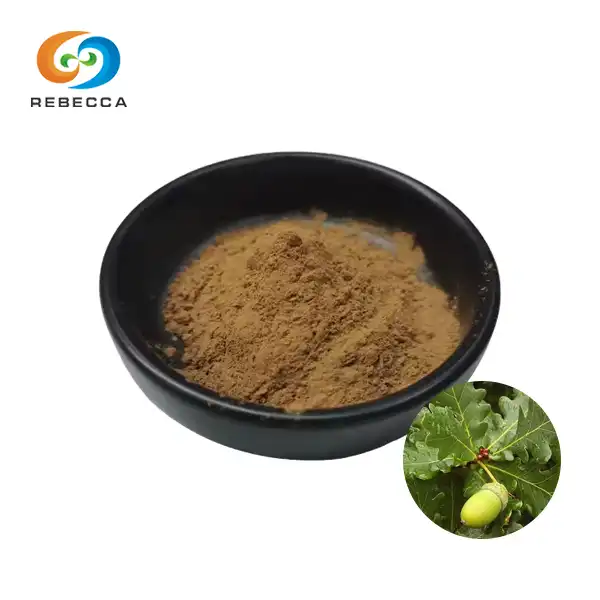
Product Name:quercus robur root extract
Botanical name:Quercus robur L.
Part used: Root
Active ingredients:Total Saponins
Specification:Total Saponins 3%;
Appearance:Brown Fine Powder
Shelf Life: 2 years
Minimum Order Quantity: 1 kg
Samples: Free samples available
Certifications: GMP, ISO, HACCP, KOSHER, and HALAL.
Payment: Various payment methods accepted.
Advantages: Manufactured in a 100,000-grade cleanroom, our products are additive-free, non-GMO
Inner Package: Double PE Bags; Net 5kg/Bag
Outside Package: Paper Drums, Net 25kg/Drum
Storage:Store in a cool, dry place away from Light and Heat.
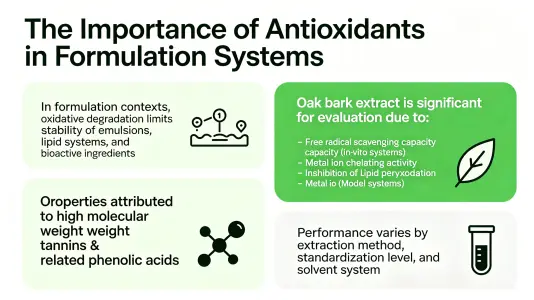
Antioxidant relevance in formulation systems
As far as formulation is concerned, oxidative degradation continues to be a limiting issue in emulsions, lipid-based systems, and the stability of bioactive ingredients. The capacity of Quercus robur bark extract to contribute to the following is a typical reason for its evaluation:
· Radical scavenging in in vitro systems
· Metal ion chelation activity
· Lipid peroxidation inhibition in model systems
Generally speaking, these features are connected to the high molecular weight tannins and associated phenolic acids that it contains; yet, the performance of the material varies depending on the extraction procedure, the level of standardisation, and the solvent system.
Bioactive Composition and Antioxidant Mechanisms
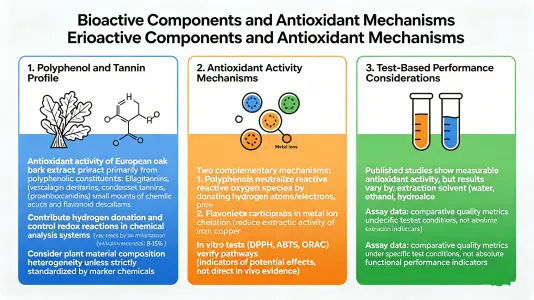
Polyphenolic and tannin profile
The antioxidant behavior of Quercus robur bark extract is primarily associated with its polyphenolic fraction. Key constituents typically include:
· Ellagitannins (e.g., vescalagin, castalagin derivatives)
· Condensed tannins (proanthocyanidins)
· Minor phenolic acids and flavonoid derivatives
In chemical assay systems, these substances make a contribution to the ability to donate hydrogen and to the control of redox reactions. In general, the reported tannin concentration in standardised extracts varies within a wide range (about 8–15%), which is determined by the source of the raw material and the circumstances under which the extraction was performed.
The presence of compositional heterogeneity in botanical materials is something that should be taken into consideration, unless the materials are closely standardised to certain marker chemicals.
Mechanisms of antioxidant activity
The antioxidant effects observed in laboratory assays are typically explained through two complementary mechanisms:
First, polyphenols have the ability to stop radical chain reactions in chemical systems by donating hydrogen atoms or electrons to neutralise reactive oxygen species. This is accomplished by neutralising reactive oxygen species.
Second, there is a possibility that certain flavonoid structures are involved in the process of metal ion chelation. This leads to a decrease in the catalytic activity of transition metals like iron and copper, which are responsible for oxidative processes.
In vitro chemical tests, such as DPPH, ABTS, or ORAC systems, are the primary means by which these pathways are established. These assays should be considered as predictive of possible action rather than as direct evidence of effectiveness in vivo.
Assay-based performance considerations
Published studies on oak-derived extracts indicate measurable antioxidant activity in standardized assay systems. However, results vary significantly depending on:
· Extraction solvent (water, ethanol, hydroalcoholic systems)
· Degree of polymerization of tannins
· Standardization markers used for comparison
Therefore, rather than being utilised as absolute functional performance measures across applications, assay data should be used as comparative quality indicators within the testing settings that have been specified.
Applications in Cosmetics, Nutraceuticals and Functional Systems
Cosmetic formulation applications
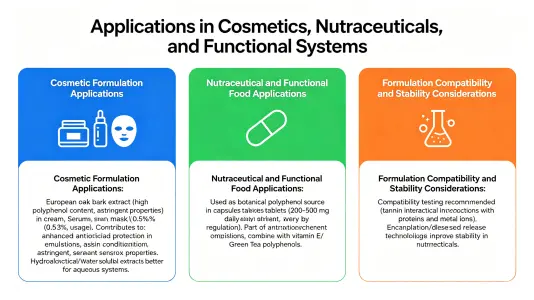
Because of its high polyphenol content and astringent nature, Quercus robur bark extract is often used in personal care and cosmetic products. In formulations such as creams, serums, and masks, when oxidative stress reduction is a supporting functional claim, it is integrated into the formulation.
Inclusion levels are often found in the range of 0.5 percent to 3 percent, with the exact amount being determined by the kind of formulation and the intended sensory effect.
From a formulation standpoint, the extract may contribute to:
· Supporting antioxidant protection in emulsions
· Complementary skin-conditioning effects
· Astringent sensory profile in topical products
The use of hydroalcoholic or water-soluble extract formats often results in a better level of compatibility with water-based systems.
Nutraceutical and functional food applications
When it comes to dietary supplement systems, oak bark extract is used as a source of botanical polyphenols, and it is often administered in the form of capsules or tablets. In most cases, its function is positioned as a component of more comprehensive antioxidant compositions, rather than as an independent active ingredient.
In completed goods, the typical use levels typically lie somewhere between 200 and 500 mg/day equivalent consumption. However, these values might vary depending on the regulatory environment and formulation design.
It is commonly coupled with other antioxidant compounds, such as vitamin E or tea polyphenols, depending on the positioning of the product and the regulatory permits that are available.
Formulation compatibility and stability considerations
Formulation compatibility testing is often necessary, particularly in complex emulsions or multi-active systems, due to the fact that tannin-rich extracts have the potential to interact with proteins and metal ions.
Within the realm of nutraceutical systems, the use of encapsulation or controlled-release technologies has the potential to enhance stability and effectively regulate sensory qualities.
Conclusion
Quercus robur bark extract is a botanical component that is high in polyphenols and has been shown to have considerable antioxidant activity in in vitro systems. Additionally, it has a wide range of applications in the creation of cosmetics and nutraceuticals. Despite the fact that its performance is highly reliant on standardisation and extraction methods, its functional value is principally derived from the tannin and flavonoid content of the substance.
When it comes to industrial usage, it is vital to have consistent quality control, verified analytical data, and well specified application criteria in order to guarantee predictable performance in completed formulations. Following the appropriate standardisation process, the extract has the potential to function as a flexible component in product development strategies that are focused on antioxidants.
Partner with Rebecca for Premium Quercus Robur Bark Extract Supply
Rebecca provides botanical extracts of pharmaceutical grade, which are supported by complete quality assurance and technological experience to help the success of your product development endeavours. We are a well-established producer of quercus robur bark extract, and we maintain direct contacts with recognised European harvesters. This allows us to guarantee both the traceability of our raw materials and the quality of our products. In addition to providing comprehensive analytical data for each shipment, our ISO-certified processing facilities are responsible for the production of standardised extracts that are in accordance with USP and EP criteria. Whether you need sample quantities for the development of a formulation or multi-ton supply agreements for commercial production, our procurement professionals are able to offer immediate help that is suited to the constraints of your timetable and budget. If you would like to discuss the particular application needs you have, seek certificates of analysis, or make arrangements for sample testing, please get in touch with our team at information@sxrebecca.com.
FAQ
What are the main antioxidant compounds in Quercus robur bark extract?
The dominant bioactive molecules include ellagitannins such as vescalagin and castalagin, condensed tannins in the 8-15% range, and flavonoid compounds including quercetin derivatives and catechins. These polyphenolic constituents work synergistically to neutralize free radicals through hydrogen donation and metal ion chelation mechanisms, providing comprehensive oxidative protection.
How does Quercus robur bark extract compare with other oak extracts in antioxidant strength?
Comparative ORAC testing and DPPH radical scavenging assays demonstrate that Quercus robur extract consistently outperforms Quercus alba (White Oak) by 15-25% in standardized antioxidant capacity measurements. This performance difference stems from higher ellagitannin concentrations and the presence of species-specific roburin compounds unique to European Oak.
What safety considerations apply when formulating with this extract?
Quality extracts demonstrate excellent safety profiles when used within recommended concentration ranges. Cosmetic applications typically incorporate 0.5-3%, while dietary supplement dosages range from 200-500 mg daily. Heavy metal screening and microbial testing should confirm each batch meets applicable standards. Buyers should request allergen declarations and ensure suppliers maintain appropriate documentation supporting product safety claims across intended applications.
References
1. Sanna, D., Delogu, G., Mulas, M., Schirra, M., & Fadda, A. (2012). Determination of free radical scavenging activity of plant extracts through DPPH assay: An EPR and UV-Vis study. Food Analytical Methods, 5(4), 759-766.
2. Pizzi, A., & Cameron, F. A. (1986). Flavonoid tannins—structural wood components for drought-resistance mechanisms of plants. Wood Science and Technology, 20(2), 119-124.
3. Vivas, N., Nonier, M. F., Vivas de Gaulejac, N., Absalon, C., Bertrand, A., & Mirabel, M. (2004). Differentiation of proanthocyanidin tannins from seeds, skins and stems of grapes (Vitis vinifera) and heartwood of Quebracho (Schinopsis balansae) by matrix-assisted laser desorption/ionization time-of-flight mass spectrometry and thioacidolysis/liquid chromatography/electrospray ionization mass spectrometry. Analytica Chimica Acta, 513(1), 247-256.
4. Fraga, C. G., Galleano, M., Verstraeten, S. V., & Oteiza, P. I. (2010). Basic biochemical mechanisms behind the health benefits of polyphenols. Molecular Aspects of Medicine, 31(6), 435-445.
5. Scalbert, A., & Williamson, G. (2000). Dietary intake and bioavailability of polyphenols. Journal of Nutrition, 130(8), 2073-2085.
6. Hagerman, A. E., Riedl, K. M., Jones, G. A., Sovik, K. N., Ritchard, N. T., Hartzfeld, P. W., & Riechel, T. L. (1998). High molecular weight plant polyphenolics (tannins) as biological antioxidants. Journal of Agricultural and Food Chemistry, 46(5), 1887-1892.