What's the difference between turmeric and turmeric curcumin?
"Turmeric" and "turmeric curcumin " are commonly used synonymously in talks about health, nutrition, and supplements. But they are not the same thing. Confusing the two may lead to wrong formulation decisions, uneven product performance and misinterpretation of clinical findings.
This article explains the distinction in a practical and science-based method. It focuses on the behaviour of each of them, where they are employed and how the pros classify them in actual product development. The objective is to get enough differentiation to make better selections for nutraceutical, medicinal, culinary and cosmetic applications.
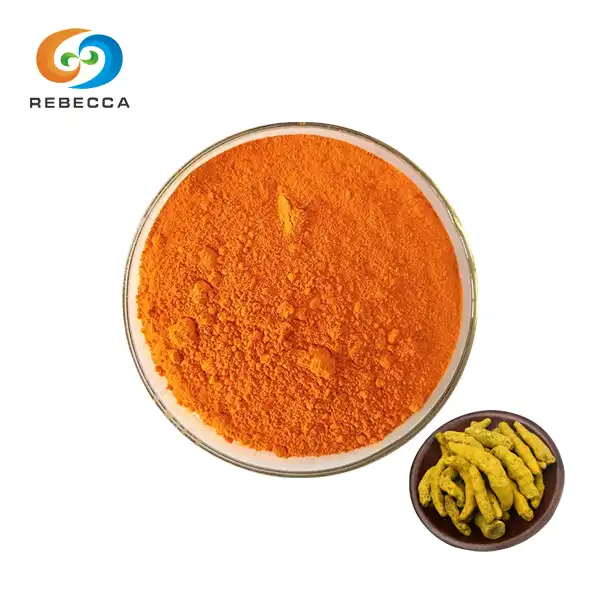
turmeric curcumin
English name: Curcumin
Latin Name: Curcuma longa L.
CAS No.: 458-37-7
Molecular Formula: C21H20O6
Active ingredients: Curcumin, demethoxycurcumin, bisdemethoxycurcumin.
Specification: 10%~ 95% CP/EP/USP
Use Part: Subterranean rhizome
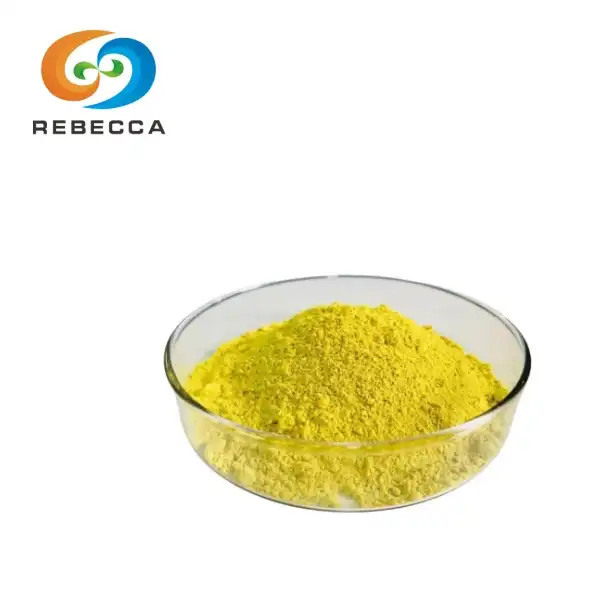
Appearance: Orange yellow powder
Mesh size:80 Mesh
Test Method: HPLC
Shelf Life: 2 years
Minimum Order Quantity: 1 kg
Samples: Free samples available
Certifications: GMP, ISO, HACCP, KOSHER, and HALAL.
Payment: Various payment methods accepted.
Advantages: Manufactured in a 100,000-grade cleanroom, our products are additive-free, non-GMO
Inner Package: Double PE Bags; Net 5kg/Bag
Outside Package: Paper Drums, Net 25kg/Drum
Storage:Store in a cool, dry place away from Light and Heat.
Understanding the Fundamental Difference Between Turmeric and Curcumin
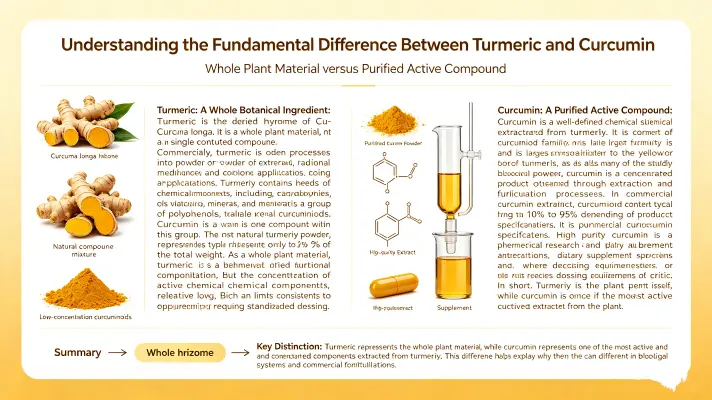
Turmeric as a whole botanical ingredient
Turmeric is the dried rhizome of the plant Curcuma longa, of the ginger family. It’s an entire plant material, not an isolated ingredient. Commercially, turmeric is often processed into powder or extracts for usage in food, traditional medicine and colouring purposes.
Turmeric has hundreds of chemical components in it. These compounds include carbohydrates, volatile oils, proteins, minerals, and a group of polyphenols called curcuminoids. Curcumin is only one of these group. Curcuminoids usually account about 2-5% of the total weight in most natural turmeric powders.
Turmeric is a full plant material and hence has a wider range of nutrients. However, the concentration of the active chemical is rather low which restricts the reproducibility of its administration that requires standardised dosage.
Curcumin as a purified active compound
Curcumin is a pure, well-characterized chemical substance that is derived from turmeric. It is a member of the curcuminoid family and is largely responsible for turmeric's yellow colour and many of its biological properties that have been researched.
Unlike turmeric powder, turmeric is intensified by extraction and purification methods. Commercial curcumin extract powder includes 10 to 95% curcuminoids, depending on the specification. The high-purity grades are widely employed in pharmaceutical research and nutritional supplements where the dosage must be precise.
To put it simply, turmeric is the plant and curcumin is one of the most active ingredients inside it when extracted.
Having established this fundamental difference, the next step is to understand why they act so differently in biological systems and in commercial formulations.
Chemical Behavior and Bioavailability: Why the Difference Matters
Structural differences and functional impact
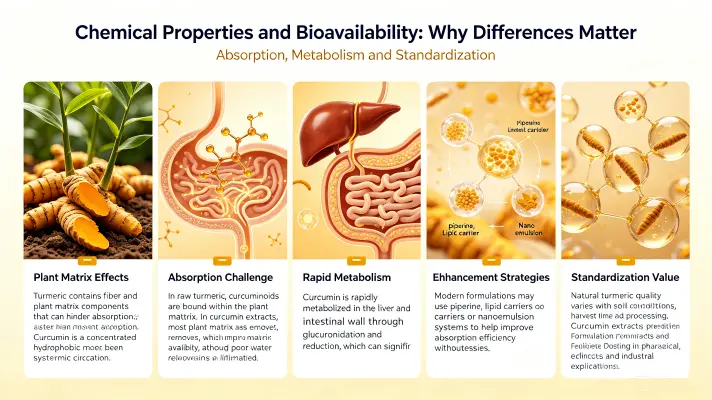
The way turmeric and curcumin are combined chemically causes them to act differently in your body. Turmeric includes fibre and plant matrix parts that impede absorption. However curcumin is a concentrated hydrophobic molecule that interacts with digestive and metabolic processes in a distinct manner.
This is significant because biological activity relies not only on content but also on the extent to which a chemical may actually reach systemic circulation.
Raw turmeric contains curcuminoids bound in plant matter. This affects their absorption efficiency. Most of this plant matrix is removed in curcumin extracts, boosting its availability, although it still has problems because of its poor water solubility.
Bioavailability limitations
One of the most highlighted concerns in the study into curcumin is its bioavailability. Curcumin is quickly metabolised in the liver and intestinal wall. It undergoes reactions like glucuronidation and reduction, which greatly reduce its active content in the plasma.
Turmeric’s bioavailability is significantly lower since the curcumin is diluted in the plant matrix. This implies that you’d have to eat a lot of turmeric to obtain the same level of systemic exposure as you would from a little dosage of a standardised curcumin extract.
Therefore, current formulations often include augmentation methods, such as the inclusion of piperine, lipid-based carriers, or nano-emulsion systems. These techniques try to enhance the efficiency of absorption without modifying the active molecule.
Why standardization is essential?
Consistency is more crucial than variability for industrial applications. Natural turmeric varies a lot based on soil conditions, harvest timing and processing processes. Curcumin extracts provide a defined concentration level, enabling producers to formulate predictably.
This is particularly important in pharmaceutical and clinical research settings where dosage precision and repeatability are essential.
When we look at this chemical and biological backdrop, it is simpler to comprehend the utilisation of turmeric and curcumin in diverse product categories.
Applications and Use Cases in Industry
Food and traditional applications of turmeric
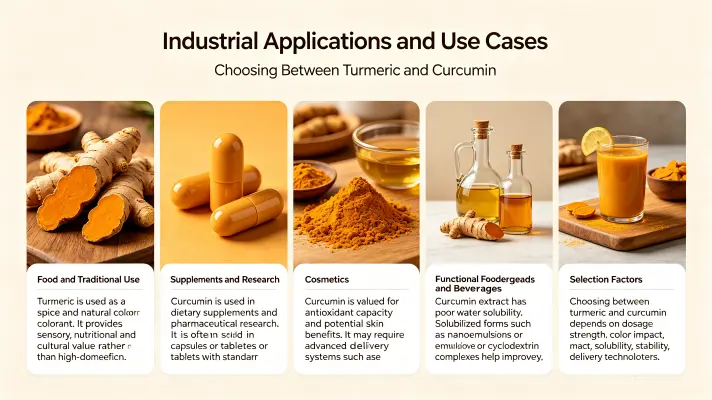
Turmeric is commonly utilised in food systems as a spice and natural colourant. It has a bright yellow colour and lends itself well to food and beverage applications. For centuries, traditional systems of medicine have employed turmeric for supporting overall wellbeing.
The aim in such cases is not to obtain high-dose pharmacological action. Instead, turmeric gives sensory, nutritional and cultural value. Its fibre and essential oil components also add to its functional character.
However, turmeric is less suited when accurate therapeutic effects or standardised doses are needed.
Curcumin in supplements and pharmaceutical research
Curcumin is a distinct story in current health research. It has been extensively explored for its possible impacts on inflammatory pathways, oxidative stress and cellular signalling processes.
Supplement manufacturing Curcumin is commonly sold as a supplement in capsule or tablet form with standardised quantities. Typical formulations are moderate to high purity extracts based on goal placement and cost structure.
In pharmaceutical research, greater purity grades are desired to guarantee repeatability in clinical trials. Researchers can isolate effects and assess mechanisms with fewer variables .
Cosmetic and functional product applications
In cosmetic compositions, curcumin is appreciated for its antioxidant capabilities and possible impacts on the skin look. But it is difficult to formulate since it is unstable to light and alkaline environments .
Turmeric is sometimes used in natural cosmetic formulas for colour and moderate antioxidant properties but is less powerful. To improve stability and avoid staining, more sophisticated delivery techniques such as encapsulation or emulsification are required for curcumin.
This distinction is typically a deciding factor for formulators in choosing turmeric-based extracts or pure curcumin derivatives.
Functional foods and beverages
The food and drink industry has issues of its own, Curcumin extract powder's weak water solubility makes it hard to add to clear liquids without changing the drink.
To overcome this, producers utilise solubilised forms such as nano-emulsions or cyclodextrin complexes. They increase the dispersion and stability of the liquid systems.
The turmeric powder is more stable in solid meals, but does not provide the same amount of bioactive concentration necessary for the specified functional claims.
At this stage, the choice between turmeric and curcumin is more about the functional needs and formulation limits than preference.
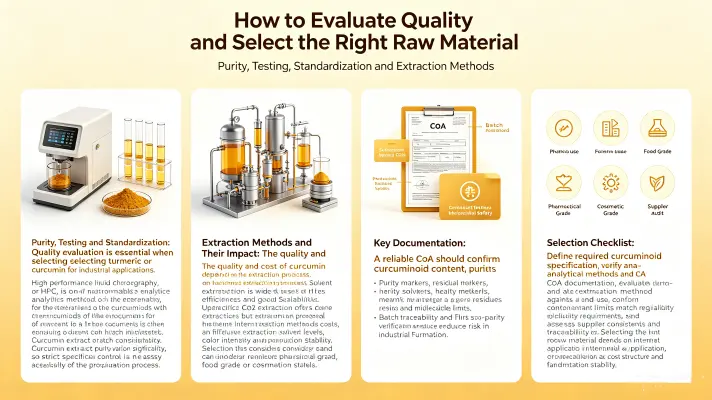
How to Evaluate Quality and Choose the Right Material?
Purity, testing, and standardization
Quality assessment is a crucial step in choosing turmeric or curcumin for industrial applications. HPLC (excellent-Performance Liquid Chromatography) is one of the most dependable analytical procedures for the determination of individual curcuminoid concentration with excellent precision.
Certificates of Analysis (CoA) are often used to validate criteria such as curcumin percentage, contaminant levels and microbiological safety. These papers are important for batch-to-batch uniformity.
For curcumin extracts, purity levels may vary substantially, making specification control a major procurement necessity.
Extraction methods and their implications
The quality and cost depends on the process of extraction of curcumin. The effectiveness and scalability of solvent extraction has led to its widespread application. Supercritical CO2 extraction is cleaner but would add to manufacturing costs.
Different procedures also affect quantities of residual solvents, intensity of colour, and stability of compounds. These elements must be taken into account depending on the ultimate use (pharmaceutical, food-grade or cosmetic).
Conclusion
Turmeric and curcumin are related, but not the same thing. Turmeric is a complex natural substance with extensive nutritional characteristics, whereas curcumin extract powder is a concentrated active molecule with precision and power.
The difference matters for everything from absorption and stability to regulatory compliance and product composition. For developers and procurement teams, it is not just a scientific choice, but a practical one that influences cost, performance and end-user experience.
A good knowledge of both constituents enables better material selection and more successful product creation in the food, supplement, cosmetic, and pharmaceutical sectors.
FAQ
What dosage of curcumin extract is recommended for joint health formulations?
Clinical studies supporting joint comfort typically use 500-1000 mg daily of 95% curcumin extract, often paired with 5-10 mg piperine to enhance absorption. Supplement brands targeting this application should calculate raw material requirements based on dosing regimen, capsule size limitations (usually 500-750 mg fill weight), and desired potency claims. Pharmaceutical developers pursuing investigational new drug pathways require dose-escalation safety data and pharmacokinetic profiles, necessitating suppliers capable of providing reference standards and analytical method validation packages.
Can curcumin interact with medications, and how does this affect product liability?
Curcumin is anti-platelet and may increase the effects of anticoagulants if taken with NSAIDs or blood thinners. Good supplement companies will have warning labels telling people to check with their doctors before they start taking the supplement especially if they are on medications. From the B2B perspective, procurement managers should verify that ingredient suppliers hold product liability insurance and are able to provide safety dossiers including summaries of interaction studies, so that downstream manufacturers can make appropriate risk assessments and meet adverse event reporting obligations under the FDA and EMA frameworks.
How does piperine improve curcumin bioavailability, and what are formulation considerations?
Piperine inhibits glucuronidation enzymes of the liver and intestine, which quickly metabolise curcumin, hence increasing the plasma half-life and systemic exposure up to 20-fold. Good formulations are piperine extract 95% at 3-5% of the dosage of curcumin. Procurement requirements should include possible interactions: piperine also inhibits metabolism of other co-formulated chemicals and hence stability tests and dissolution testing are needed. Other techniques (phytosomes, liposomes, nano-emulsions) avoid piperine-related interactions but need specialised manufacturing skills and higher ingredient prices, impacting overall formulation economics and competitive positioning.
Partner with Rebecca for Reliable Turmeric Curcumin Supply Solutions
Shaanxi Rebecca offers pharmaceutical quality turmeric curcumin extracts that meet the stringent demands of R&D managers, procurement directors and product developers worldwide. We have over 500 metric tonnes per year manufacturing capacity on 3 GMP-certified lines, vertically integrated, guaranteeing batch consistency and scalable supply for pharmaceutical APIs, health supplement formulations, functional drinks and cosmeceutical applications. We provide customisable requirements from 10% to 95% curcuminoids content validated by HPLC along with ISO 22000, HACCP and organic certifications to simplify your regulatory paths in North American and European markets.
Our R&D team provides technical support encompassing solubility enhancement, stability testing, and custom formulation development, backed by comprehensive documentation including DMF files, safety dossiers, and application testing data. Whether you require ethanol-extracted standard powders, water-soluble nano-emulsions for clear beverages, or phytosome-enhanced bioavailable formats, Rebecca delivers flexible MOQs and FOB/CIF/DDP logistics tailored to your procurement timelines. Contact our team at information@sxrebecca.com to discuss your specific requirements, request certificates of analysis, or arrange sample evaluation—positioning your brand with a dependable turmeric curcumin supplier committed to quality, compliance, and long-term partnership success. Visit sxrebecca.com for detailed product specifications and technical resources.
References
1. Aggarwal BB, Harikumar KB. Potential therapeutic effects of curcumin, the anti-inflammatory agent, in neurodegenerative, cardiovascular, pulmonary, metabolic, autoimmune and neoplastic diseases. International Journal of Biochemistry & Cell Biology, 2009;41(1):40-59.
2. Hewlings SJ, Kalman DS. Curcumin: A Review of Its Effects on Human Health. Foods, 2017;6(10):92.
3. Prasad S, Gupta SC, Tyagi AK, Aggarwal BB. Curcumin, a component of golden spice: From bedside to bench and back. Biotechnology Advances, 2014;32(6):1053-1064.
4. Shoba G, Joy D, Joseph T, et al. Influence of piperine on the pharmacokinetics of curcumin in animals and human volunteers. Planta Medica, 1998;64(4):353-356.
5. Nelson KM, Dahlin JL, Bisson J, et al. The Essential Medicinal Chemistry of Curcumin. Journal of Medicinal Chemistry, 2017;60(5):1620-1637.
6. Kocaadam B, Şanlier N. Curcumin, an active component of turmeric (Curcuma longa), and its effects on health. Critical Reviews in Food Science and Nutrition, 2017;57(13):2889-2895.