Capsaicin Synthesis From Vanillin Steps
Most people know capsaicin as the compound that makes chili peppers hot. Fewer know that the same pungency can be built from scratch — starting with vanillin, the aromatic aldehyde that gives vanilla its familiar scent. This synthesis pathway is exactly how nonivamide-powder">nonivamide powder, the commercially dominant synthetic capsaicinoid, is manufactured today. Understanding the chemistry behind it helps ingredient buyers, formulators, and R&D teams make better purchasing decisions and appreciate why synthetic production delivers so much more consistency than plant extraction ever could.
This article walks through the main chemical steps involved, explains why nonivamide's route diverges from natural capsaicin, and shows what those differences mean for the ingredient's quality profile in real-world formulation work.
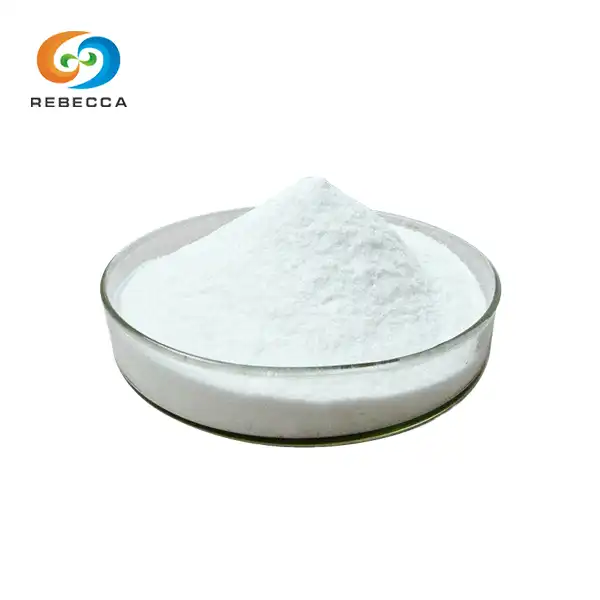
Nonivamide powder
1.Product Name: Nonivamide powder, Synthetic Capsaicin,
Pelargonic acid vanillylamide, Synthetic N-Vanillylnonamide
2.Specification: 70%, 98%, 99%, HPLC
3.Nonivamide CAS 2444-46-4
4. Nonivamide Professional Manufacturer and Supplier
5. Free Sample Available, MSDS Available
From Vanillin to Vanillylamine: The Foundation of Capsaicinoid Synthesis
Why Vanillin Is the Logical Starting Point
Vanillin (4-hydroxy-3-methoxybenzaldehyde) sits at the heart of capsaicinoid chemistry. In nature, it is an intermediate in the phenylpropanoid pathway inside Capsicum fruits, where the enzyme vanillin aminotransferase converts it into vanillylamine. That vanillylamine then condenses with a fatty acid derivative to form the final capsaicinoid — capsaicin, dihydrocapsaicin, or nonivamide, depending on which acid is used.
For industrial synthesis, vanillin is an attractive starting material for a different reason: it is cheap, commercially available in large quantities, and chemically well-behaved. It does not require refrigerated transport. It is derived from natural lignin or petrochemical guaiacol, giving manufacturers flexible sourcing options. These practical realities make vanillin the undisputed entry point for synthetic capsaicin production.
Step 1 — Oxime Formation
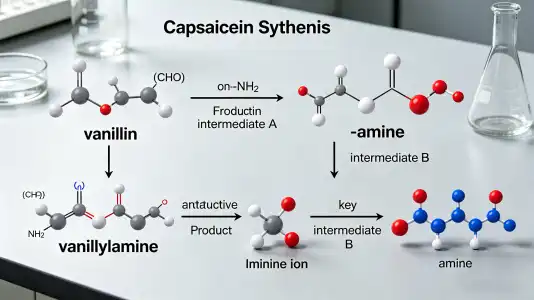
The first reaction converts vanillin into vanillin oxime. This happens when vanillin reacts with hydroxylamine hydrochloride in the presence of a base, typically in a methanol or methanol/water solvent system. The aldehyde group on vanillin reacts with the hydroxylamine nitrogen, expelling water and forming the C=N–OH oxime linkage.
In continuous flow synthesis research published in ACS Sustainable Chemistry & Engineering, this oxime formation step achieves yields of up to 98% and productivities reaching 13.1 g/h — a striking demonstration of how modern flow chemistry can push this foundational step well beyond what batch processing typically achieves. The oxime is crystalline, stable, and easy to handle before the next reduction step.
Vanillin + Hydroxylamine HCl → Vanillin Oxime + H₂O
Solvent: MeOH or MeOH/H₂O | Typical yield: ~98%

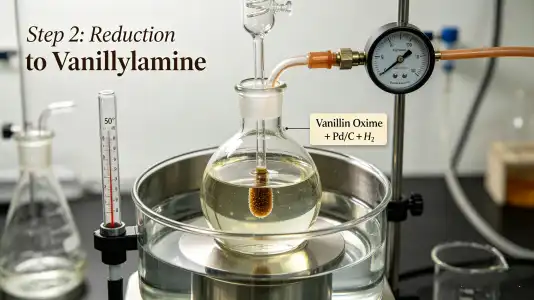
Step 2 — Reduction to Vanillylamine
Vanillin oxime must then be reduced to vanillylamine — the amine precursor that will eventually form the amide bond in the final capsaicinoid structure. This reduction is most commonly performed by catalytic hydrogenation. Palladium on carbon (Pd/C) under acidic conditions is a standard industrial choice, yielding vanillylamine hydrochloride at around 74% efficiency.
Older batch methods used zinc in acetic acid for this step. Those approaches generated zinc acetate waste and showed lower atom economy. Modern continuous flow systems instead pass the oxime solution through a hydrogen-pressurized bed of palladium catalyst — a cleaner, faster, and more scalable approach. The product, vanillylamine (or its hydrochloride salt), is the critical bifunctional intermediate: it carries both the aromatic phenol group and the primary amine needed for N-acylation.
Vanillin Oxime + H₂ → Vanillylamine (hydrochloride)
Catalyst: Pd/C | Conditions: Acidic, pressurized H₂ | Typical efficiency: ~74%
The N-Acylation Step: Where Nonivamide Powder Diverges From Capsaicin
Choosing the Right Acyl Chain
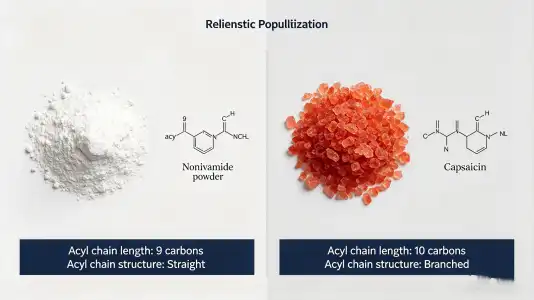
Here is where the synthesis of nonivamide powder parts ways with the synthesis of natural capsaicin. Both molecules share the vanillylamine fragment. The difference lies entirely in the fatty acid half of the molecule. Capsaicin uses 8-methyl-6-nonenoic acid — an unsaturated, branched-chain acid derived from valine metabolism in Capsicum plants. Nonivamide uses nonanoic acid (pelargonic acid) — a straight-chain, fully saturated nine-carbon fatty acid.
Nonanoic acid is commercially abundant. It derives from natural fats and oils, including castor oil oxidation, making it an accessible, renewable raw material. Its straight-chain, saturated structure is also far more chemically stable under heat than capsaicin's conjugated double bond — and that is exactly why the finished nonivamide powder is more heat-stable than natural capsaicin, a fact confirmed by Wikipedia's chemical entry on the compound.
Step 3 — N-Acylation to Form the Amide Bond
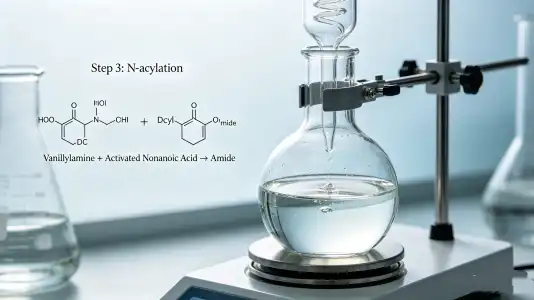
The final bond-forming step reacts vanillylamine with an activated form of nonanoic acid. The acid must be activated to make it reactive enough to couple with the amine. The most common activation strategies used industrially are the acid chloride route and carbodiimide-based coupling.
In the acid chloride method — described in Chinese Patent CN105859572A — vanillylamine hydrochloride reacts with pelargonyl chloride (the acid chloride of nonanoic acid) in a dichloromethane/water mixture with a base. Heating drives the reaction to completion. The crude product crystallizes on cooling, and washing with dilute acid and base purifies the solid. This method is operationally simple and well-suited to industrial reactors.
The carbodiimide method (using EDCI and HOBT as coupling agents) achieves better yields in some reports but introduces more expensive reagents and generates additional waste streams. Yan and colleagues demonstrated that this approach can yield nonivamide at improved rates, though with somewhat lower atom economy compared to the acid chloride route.
Vanillylamine + Pelargonyl Chloride (or activated nonanoic acid) → Nonivamide + HCl
Solvent: Dichloromethane/water | Base: NaOH or K₂CO₃ | Temperature: 70 °C (flow) or room temp (batch)
Flow Synthesis: The Industrial Evolution
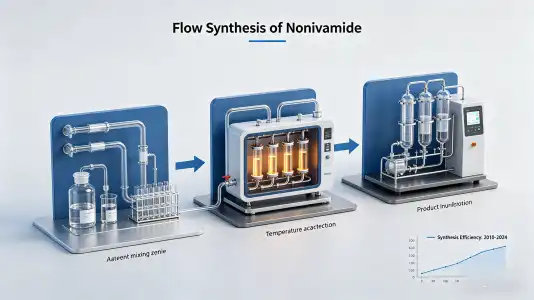
Research published in ACS Omega and ACS Sustainable Chemistry & Engineering has demonstrated pilot-scale continuous flow synthesis of nonivamide using all three steps in sequence — oxime formation, hydrogenation, and N-acylation — coupled in a semicontinuous flow system. The N-acylation step in flow conditions requires a temperature of 70 °C to proceed, achieved by placing the 3D-printed reactor in a water bath.
In these flow experiments, nonivamide synthesis achieved 73–77% yield at the N-acylation stage, with overall conversion comparable to batch methods but significantly reduced reaction time and waste generation. Green metrics including atom economy (AE) and E-factor values confirm that flow synthesis is cleaner and more resource-efficient than earlier batch approaches.
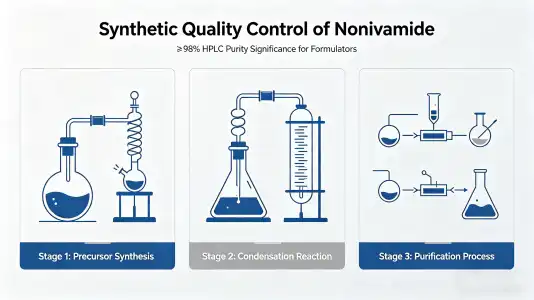
Synthesis Quality Control and What ≥98% HPLC Purity Means for Formulators
How Synthesis Design Controls Final Purity
Each of the three synthesis steps can introduce impurities if not tightly controlled. Incomplete oxime formation leaves residual vanillin. Incomplete hydrogenation may leave oxime or generate over-reduced by-products. Poorly controlled N-acylation produces unreacted vanillylamine or acyl dimers. Premium nonivamide powder at ≥98% HPLC purity reflects tight control across all three stages — not simply efficient purification at the end.
HPLC (high-performance liquid chromatography) analysis is the industry-standard method for quantifying capsaicinoid purity. It separates nonivamide from its structural analogs and synthesis by-products with high resolution. A ≥98% HPLC specification means that at least 98% of the material detected is the target compound, leaving no more than 2% for all combined impurities. For a B2B ingredient used in health supplement formulations or personal care products, this level of purity is the minimum reliable standard.
Natural vs. Synthetic: A Purity Comparison Worth Understanding
Early extraction methods for natural capsaicin from chili pepper oleoresin routinely yielded material with purity below 50%. Natural variability — cultivar differences, soil quality, harvest timing, extraction efficiency — all contribute to this inconsistency. In contrast, synthetic nonivamide produced via the vanillin route starts with defined, pure reactants and follows controlled reaction conditions.
The result is not just higher purity. It is reproducible purity. For a formulator building a health supplement ingredient blend, the difference between a 70% and a 98% purity capsaicinoid is the difference between calculating an approximate dose and calculating a precise one. Precise dosing means consistent product performance — and that is the practical value of the synthesis route described in this article.

Emerging Biosynthesis Routes: A Growing Alternative
Beyond chemical synthesis, researchers have explored biosynthetic production of nonivamide from vanillin using engineered yeast. A study published in Frontiers in Chemical Engineering (Muratovska & Carlquist, 2023) engineered Saccharomyces cerevisiae to carry out a two-step conversion: first, reductive amination of vanillin to vanillylamine; then, amide formation with nonanoic acid, mediated by an N-acyltransferase/CoA-ligase enzyme cascade. The yeast strain achieved production of nonivamide in bioreactor conditions, demonstrating proof of concept for fermentation-based capsaicinoid synthesis.
Current titers from these biosynthetic approaches remain modest — approximately 10.6–10.7 mg/L — compared to chemical synthesis. However, the research direction is significant. It points toward a future where nonivamide and related capsaicinoids could be produced from renewable substrates, including plant-derived vanillin and natural fatty acids, with reduced reliance on petrochemical inputs. For sustainability-focused buyers, this trajectory is worth monitoring.

Nonivamide Powder Manufacturer: Rebecca Bio-Tech
Shaanxi Rebecca Bio-Tech is a high-tech, export-oriented company dedicated to the production, research and development, and sales of plant extracts, herbal active ingredient separation, and traditional Chinese herbal medicine functional compound research. Three specialized production lines, a portfolio of over 100 plant extracts and active ingredients, and an annual production capacity exceeding 500 metric tons define our manufacturing scope. We supply pharmaceutical, health products, beverage, and cosmetic ingredient buyers worldwide.
Our synthetic capsaicin — also identified as nonivamide powder, pelargonic acid vanillylamide, and synthetic N-Vanillylnonamide — is produced via a controlled chemical synthesis route and delivers the purity profile that B2B ingredient buyers require. The synthesis process described in this article is the same foundational chemistry behind every batch we manufacture. Each production run is tested against strict HPLC specifications before release.
Whether you are evaluating a new capsaicinoid ingredient for a formulation project, require technical documentation for regulatory submission, or want to run comparative testing against your current supplier's material, our team is ready to assist. Reach out to us directly at information@sxrebecca.com to request a free sample, obtain a COA or MSDS, or discuss volume pricing.
FAQs
Q1: What raw materials are needed to synthesize nonivamide powder from vanillin?
A: The three primary reagents are vanillin (the aromatic aldehyde starting material), hydroxylamine hydrochloride (for oxime formation), and nonanoic acid or its acid chloride derivative (pelargonyl chloride) for the final N-acylation. A palladium catalyst is needed for the hydrogenation step. Solvents such as methanol, water, and dichloromethane are used across the three stages. A base — typically sodium hydroxide or potassium carbonate — is required to neutralize the hydrochloride salt of vanillylamine during the acylation step.
Q2: How does the synthesis of nonivamide differ from the synthesis of capsaicin?
A: Both syntheses share the vanillin-to-vanillylamine pathway (Steps 1 and 2). The difference lies in Step 3. Capsaicin requires 8-methyl-6-nonenoic acid — an unsaturated, branched-chain fatty acid — which is less commercially available and more reactive. Nonivamide uses nonanoic acid (pelargonic acid), a straight-chain saturated acid that is readily available and chemically stable. That structural difference also explains why nonivamide is more heat-stable than capsaicin in the finished powder form.
Q3: What does ≥98% HPLC purity mean for a nonivamide powder ingredient?
A: HPLC (high-performance liquid chromatography) measures the proportion of the target compound relative to all other detectable substances in the sample. A ≥98% HPLC purity rating means at least 98% of the measured content is confirmed nonivamide, with all combined impurities below 2%. For B2B ingredient buyers, this purity level ensures consistent dosing accuracy, clean safety documentation, and reliable regulatory compliance across markets.
Q4: Is continuous flow synthesis of nonivamide commercially relevant?
A: Yes. Peer-reviewed research in ACS Sustainable Chemistry & Engineering and ACS Omega has demonstrated pilot-scale continuous flow synthesis of nonivamide with yields of 73–77% at the N-acylation step and oxime formation yields approaching 98%. Flow synthesis reduces reaction time, minimizes chemical waste (lower E-factor), and improves scalability relative to traditional batch methods. These advantages make it an increasingly attractive industrial approach for manufacturers seeking higher throughput and more consistent output.
Q5: Can nonivamide be produced from plant-based sources without chemical synthesis?
A: Biosynthetic routes exist but are still in the research stage. Studies published in Frontiers in Chemical Engineering and ScienceDirect have demonstrated the production of nonivamide in engineered yeast (S. cerevisiae) using vanillin and nonanoic acid as substrates. Current titers are around 10.6–10.7 mg/L — far below commercial chemical synthesis levels. For now, high-purity nonivamide powder at ≥98% specification for B2B industrial use is produced almost exclusively via chemical synthesis.
References
- ACS Sustainable Chemistry & Engineering. "Flow Synthesis of Capsaicin and Capsaicinoid Analogues."
- ACS Omega. "Pilot-Scale Continuous Flow Synthesis of Capsaicinoids and Their Formulation with Cyclodextrins."
- Muratovska N & Carlquist M (2023). "Recombinant yeast for production of the pain receptor modulator nonivamide from vanillin." Frontiers in Chemical Engineering.
- ScienceDirect. "Production of capsaicinoid nonivamide from plant oil and vanillylamine via whole-cell biotransformation."
- Google Patents. CN105859572A — "New synthesis method of capsaicin."
- Wikipedia. "Vanillylamine."