How much piperine is safe per day?
Supplement formulators and bulk ingredient purchasers need precise, research-backed piperine powder dose advice to develop compliance, consumer-safe nutraceutical products. The black pepper piperine extract is a strong bioavailability enhancer in high purity, but wrong daily dosage leads to gastrointestinal problems, and severe medication interactions. This book dissects verified safe intake levels, formulation guidelines, regulatory standards and recognised sourcing best practices to address essential safety issues for B2B botanical ingredient partners.
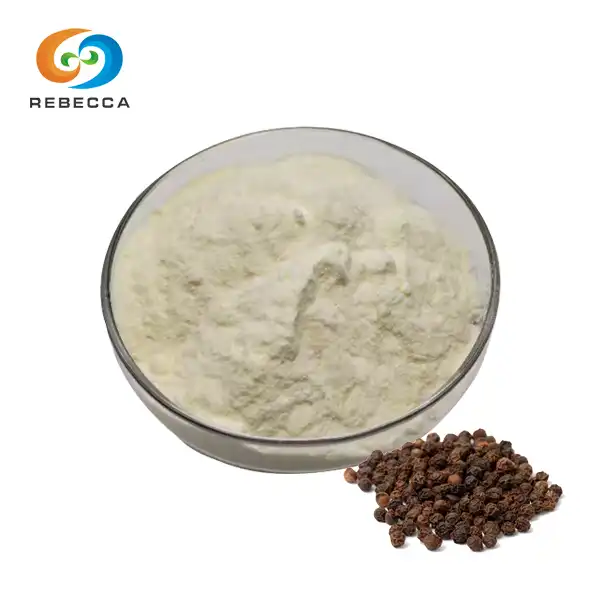
Piperine Powder
【English name】: Piperine Powder
【Latin Name】: Piper nigrum L.
【CAS No.】: 94-62-2
【Molecular Formula】: C17H19NO3
【Active ingredients】: piperine
【Specification】: piperine 95% 98%
【Use Part】 : Fruit
【Appearance】: Light yellow powder
【Mesh size】:80 Mesh
【Test Method】: HPLC
Evidence-Based Safe Daily Piperine Dosage & Population Safety Rules
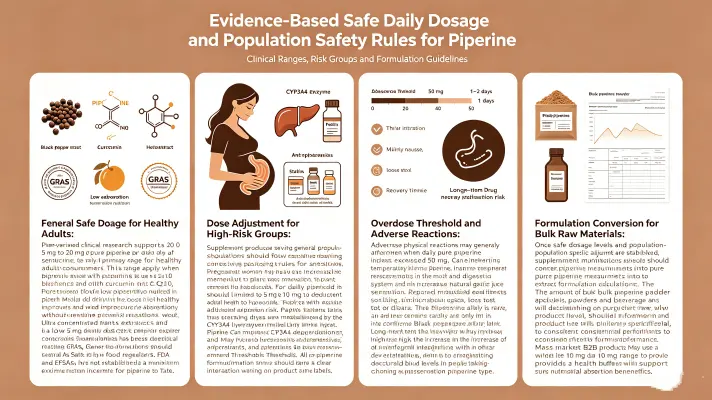
Definition of an acceptable and effective piperine daily serving quantity is the starting point of every completed supplement recipe. Clinical human studies and international food authority standards provide set dose levels for adult consumers, with specific modifications for sensitive user groups. These ranges provide the advantages of absorption yet with a minimum of adverse effects for mass market supplement lines.
Core Safe Adult Dosage Window for General Use
The main safe range for healthy adult consumers is 5 mg to 20 mg of pure piperine per day, as confirmed by peer-reviewed clinical studies. This dose tier is for piperine used as a bioenhancer with curcumin, CoQ10, herbal extracts and other low-absorption nutrients. In a major human study published in Planta Medica, a complete 20mg daily dosage of piperine was examined in healthy individuals. Researchers observed increased absorption of curcumin and no adverse physiologic responses. Ultra-concentrated plant extracts and smaller 5 mg daily dosages of piperine provide steady boosting power. Synergistic herbal mixtures boost piperine's absorptive actions, enabling formulators to reduce quantities of the pure alkaloid while still maintaining product efficacy.
Standardised black pepper extracts containing piperine have been classified as Generally Recognised as Safe (GRAS) by food authorities within limited limits of use. To date, neither FDA nor EFSA has established a defined upper acceptable consumption level for piperine. It is not capped since it is a secondary bioenhancer and not a primary needed ingredient that is used in large daily amounts.
Dosage Adjustments for High-Risk Consumer Demographics
Supplement makers for the general public must follow conservative dose regulations for sensitive end users. Pregnant women are more sensitive to plant alkaloids metabolically. For prenatal wellness lines, manufacturers should limit the total amount of piperine per day to somewhere between 5 mg and 10 mg to reduce extra exposure risk. Those with active stomach ulcers or a persistent sensitivity to gastric conditions are more likely to suffer minor digestive discomfort from the stimulation of piperine. The 5 mg daily dosages are the standard for gut support and digestive supplement compositions.
Users of prescription drugs metabolised by the CYP3A4 liver enzyme should strictly restrict piperine intake. Piperine reduces the degradation of CYP3A4 in the body for a short time. The change elevates circulation levels of drugs over recommended therapeutic thresholds for statins, blood pressure medications, antidepressants and oral antibiotics. All formulations containing piperine are to be marked with conspicuous interaction warnings on the product labels.
B2B businesses creating mass retail supplements need to keep to a restricted 5mg-10mg piperine band each day. This narrower window gives the typical consumer a healthy buffer while still enjoying the full advantages of nutrient absorption. Procurement teams should bake desired dose ranges into supplier material specifications to nail down consistent formula performance.
Side Effect Thresholds of Excessive Daily Piperine Intake
Almost often, negative bodily effects occur when the daily dose of pure piperine exceeds 50 milligrams. It stimulates thermoreceptors in the mouth and digestive system, and enhances natural production of stomach secretions. Some moderate side reactions have been reported, including throat burning, light nausea and loose stool or diarrhoea. These symptoms completely disappear after one to two days of discontinuing excessive piperine ingestion.
True allergy to piperine is quite uncommon. They only appear on the surface in persons who already have black pepper food sensitivities. It also raises longer-term risks of interfering with the metabolism of other drugs, leading to persistently dangerous levels of medicine in the blood for those who regularly use prescription medication.
Once safe dose levels and population-specific changes are evident, the next step for supplement producers is to convert measurements of pure piperine into real-world extract formulation maths. The amount of bulk piperine powder companies put in capsules, powders and drinks varies with purity levels, delivery forms and product type.
Formulation Calculations, Product Format Rules & 98% High-Purity Piperine Benefits
In bulk B2B supply, raw piperine extract is not available as 100% separated alkaloid. The suppliers supply a standardised powder rated at 95 or 98% piperine. Formulators will have to change inclusion rates according to the quality of the extract and reformulate for various delivery methods ranging from hard capsules to liquid functional beverages.
Purity Conversion Math for Standardized Piperine Powder
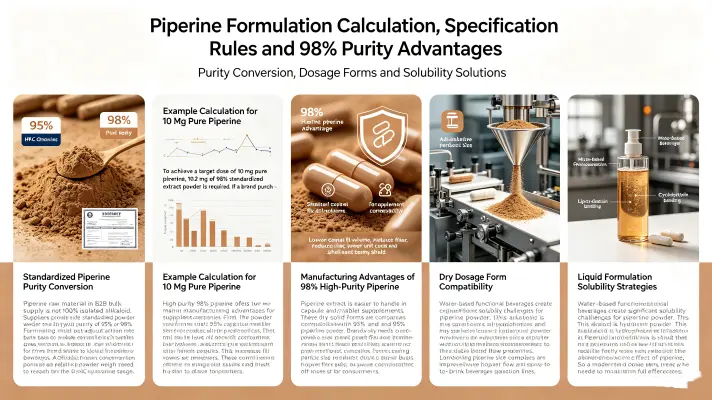
Official piperine concentrations are determined by HPLC lab testing for every batch of bulk extract. Simple conversion arithmetic may be used to compute the precise powder weight required to achieve desired pure piperine dosages by R&D teams. For a target serving of 10 mg of pure piperine you need 10.2 mg of 98% standardised extract powder. If a brand buys cheaper 95% purity material, the same 10 mg pure piperine aim requires 10.5 mg bulk powder per serving. Lower purity classes need larger inclusion rates of powders in completed capsules.
Higher 98% piperine standardisation provides supplement companies with two major manufacturing benefits. Each capsule shell has less volume powder. This minimises the amount of filler ingredients and decreases the production cost per unit. The recipe also has lower levels of inactive plant contaminants that might negatively impact final product shelf stability or cause harsh off-notes for customers. All bulk shipments of piperine must come with a complete Certificate of Analysis from third party HPLC testing to verify purity listed matches real alkaloid content.
Delivery Format Limitations and Customized Formulation Fixes
Piperine extract is handled with few technological difficulties in capsule and tablet supplements. These dry solid forms are compatible with piperine powder 95% and 98%. Brands only change mix flow qualities by adjusting powder mesh size with their raw material provider.
Water-based functional drinks pose severe solubility issues for raw piperine powder. The alkaloid is water-repellent and readily separates in liquid beverages without further processing. Microencapsulation is a process that coats piperine particles in protective water-soluble coatings, resulting in stable liquid dispersions. Liposomal piperine complexes also are compatible with ready-to-drink beverage lines. Another approach for solubilisation in liquid formulations is cyclodextrin binding. Formulators should be aware that these changed forms might somewhat decrease the bioenhancement strength of piperine, necessitating minor dosage increases to preserve complete performance.
Trusted Piperine Powder Manufacturing Partnership
Global B2B nutraceutical, cosmetic and functional beverage businesses are looking for long term piperine suppliers with constant purity, comprehensive compliance paperwork and flexible bespoke formulation assistance. Rebecca Bio-Tech offers pharmaceutical quality standardised black pepper piperine extract developed to meet worldwide market specifications with comprehensive logistical support across North America, Europe and the Asia-Pacific regions.
End-to-End Manufacturer Support for B2B Buyers
All bulk piperine powder from Rebecca Bio-Tech has a 98% piperine concentration fixed and validated by independent HPLC examination. All orders include all compliance documentation necessary including digital copies of GMP, ISO 22000 and HACCP certificates. Free formulation advice for new product releases by in-house research & development team. The lab team changes the mesh size of powders to improve the flowability of capsules or creates entirely water-dispersible versions of piperine for use in beverages, depending on the proprietary brand formulations.
Conclusion
The gold standard safe daily dose for adult supplement bioenhancement usage is 5 mg to 20 mg of pure piperine per day. This range is confirmed by decades of human clinical research and is consistent with worldwide FDA and EFSA regulatory recommendations. Extracts are added at certain rates, which formulators vary according to the purity of the bulk powder, the format of the final product, and the target demographics of consumers, to reduce gastrointestinal discomfort and harmful interactions with prescription drugs.
To source piperine successfully, you need correct formulation maths, thorough third party lab testing and comprehensive cross market regulatory compliance paperwork. Partnering with a qualified, specialised botanical extract producer facilitates bespoke recipe formulation, worldwide shipping logistics and continuous quality assurance monitoring for B2B nutraceutical businesses. Global procurement teams can provide a dependable, high-value bioavailability booster in capsules, tablets and customised functional beverage products by matching technical ingredient requirements with stringent safety standards.
FAQ
What makes 98% piperine powder superior to lower concentrations?
Higher standardization levels provide greater formulation precision and reduced excipient requirements. A 98% purity extract requires smaller inclusion rates to achieve target dosages compared to 95% alternatives, improving capsule fill efficiency and cost-effectiveness. This concentration also minimizes inactive compound content that could interfere with stability or sensory profiles in finished products.
Can piperine powder be used in beverage formulations?
The compound's poor water solubility presents challenges for aqueous applications. Successful beverage incorporation requires specialized delivery systems such as microencapsulation or liposomal technologies to achieve stable dispersion. Water-soluble derivatives or complexation with cyclodextrins offer alternative strategies, though these may affect bioavailability enhancement properties and require additional formulation development.
How should procurement managers verify supplier authenticity?
Request third-party laboratory analysis confirming piperine content and contaminant screening. Cross-reference supplier business licenses and manufacturing permits through local regulatory databases. Conduct facility audits either directly or through independent quality assurance firms. Evaluate customer references from established brands in your target market segment. These multi-layered verification steps substantially reduce counterfeit material risks.
Partner with a Trusted Piperine Powder Manufacturer
Rebecca Bio-Tech specializes in delivering pharmaceutical-grade botanical extracts to global B2B clients across nutraceutical, cosmetic, and functional beverage industries. Our piperine powder maintains 98% standardization verified through HPLC, supported by complete compliance documentation including GMP, ISO 22000, and HACCP certifications. The dedicated R&D team provides formulation consultation and customization services, adapting specifications to your precise application requirements—whether adjusting mesh size for improved flowability or developing water-dispersible formats. With established supply networks reaching North America, Europe, and Asia-Pacific markets, we ensure reliable logistics under FOB, CIF, or DDP terms. Contact information@sxrebecca.com to discuss your piperine powder supplier needs and receive detailed technical specifications tailored to your procurement objectives.
References
1. Shoba, G., Joy, D., Joseph, T., Majeed, M., Rajendran, R., & Srinivas, P. S. (1998). Influence of piperine on the pharmacokinetics of curcumin in animals and human volunteers. Planta Medica, 64(4), 353-356.
2. Srinivasan, K. (2007). Black pepper and its pungent principle-piperine: A review of diverse physiological effects. Critical Reviews in Food Science and Nutrition, 47(8), 735-748.
3. Dudhatra, G. B., Mody, S. K., Awale, M. M., Patel, H. B., Modi, C. M., Kumar, A., & Kamani, D. R. (2012). A comprehensive review on pharmacotherapeutics of herbal bioenhancers. The Scientific World Journal, 2012, Article 637953.
4. Badmaev, V., Majeed, M., & Prakash, L. (2000). Piperine derived from black pepper increases the plasma levels of coenzyme Q10 following oral supplementation. Journal of Nutritional Biochemistry, 11(2), 109-113.
5. Meghwal, M., & Goswami, T. K. (2013). Piper nigrum and piperine: An update. Phytotherapy Research, 27(8), 1121-1130.
6. Hiwale, A. R., Dhuley, J. N., & Naik, S. R. (2002). Effect of co-administration of piperine on pharmacokinetics of beta-lactam antibiotics in rats. Indian Journal of Experimental Biology, 40(3), 277-281.