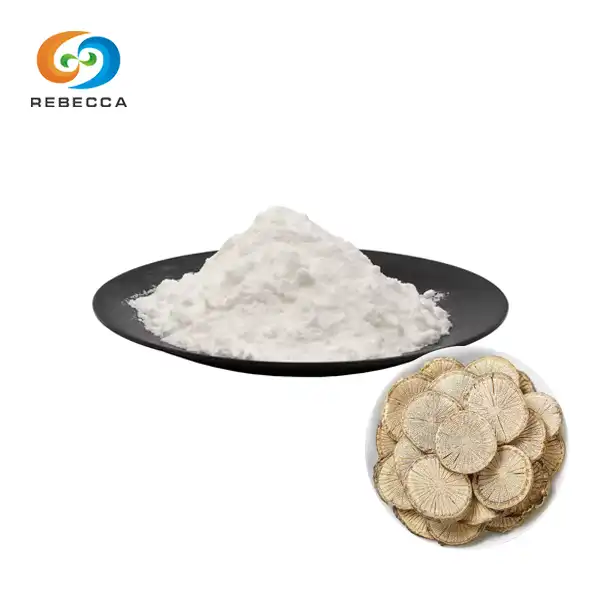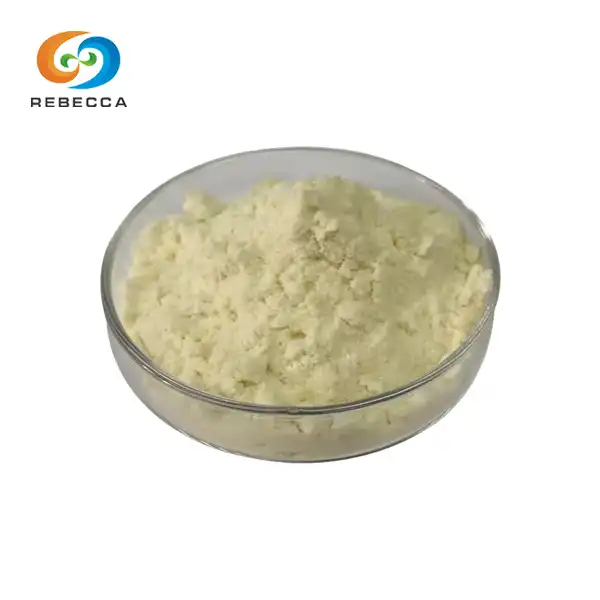
What Is Pure Curcumin Powder?
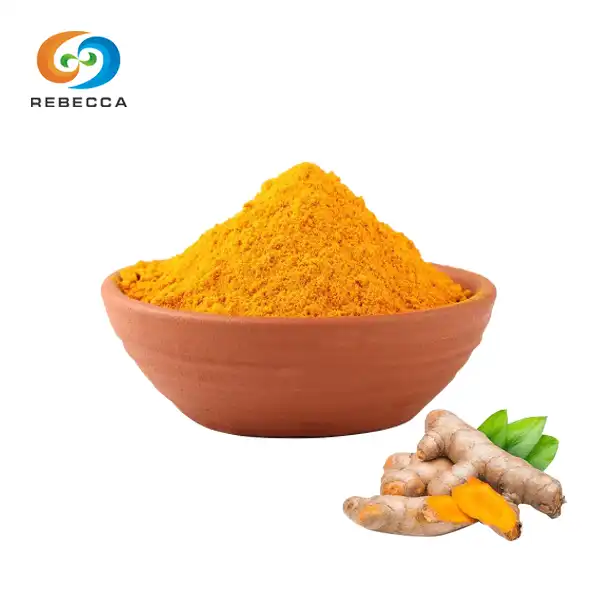
pure curcumin powder is a polyphenolic extract from the dried rhizomes of Curcuma longa. Its chemical formula is C₂₁H₂₀O₆ and CAS number is 458-37-7. The extract contains three closely related curcuminoids: curcumin (usually 70–80% of the total), demethoxycurcumin and bisdemethoxycurcumin. Together they give the powder its characteristic orange-yellow hue.
One source of confusion is that when a provider says a product is “95% curcuminoids,” that number refers to the overall curcuminoid content, not the amount of pure curcumin alone. If you want a formulation with a curcumin content of >98%, this must be specified on the purchase order. It’s important to study the fine print because many CoA documents list “curcuminoids” as a single line item.
The powder is processed to 80 mesh particle size generally. This fineness allows it to be blended into capsules, pills, creams, and functional beverages without any grit. Colour intensity varies with purity: 10% extract is pale ochre, 95% extract is a rich, almost rust-coloured orange.
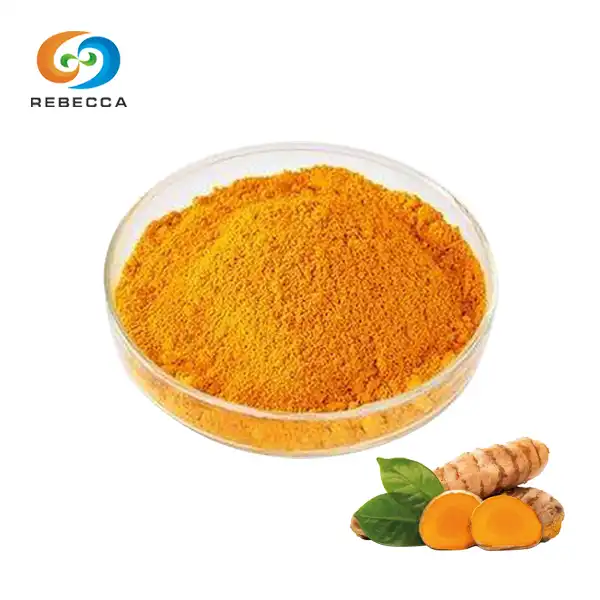
Pure Curcumin Powder
Product name: Curcumin
Latin Name: Curcuma longa L.
CAS No.: 458-37-7
Molecular Formula: C21H20O6
Active ingredients: Curcumin, demethoxycurcumin, bisdemethoxycurcumin.
Specification: Curcuminoids 10%~ 95%
Use Part : Subterranean rhizome
Appearance: Orange yellow powder
Mesh size:80 Mesh
Test Method: HPLC
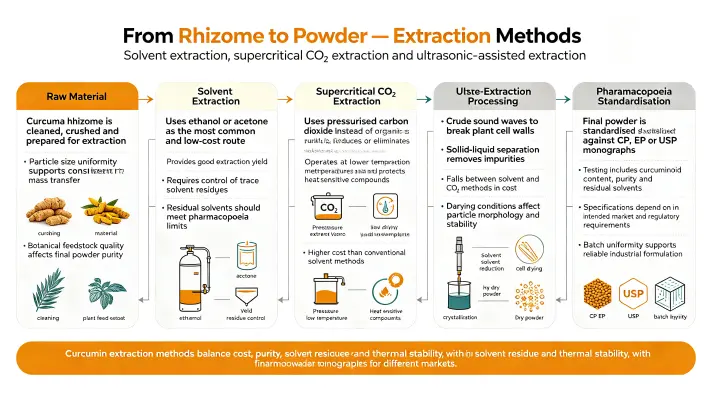
From Rhizome to Powder — Extraction Methods
Manufacturers utilise three main extraction routes. The most popular and cheapest method is solvent extraction with ethanol or acetone. It affords good yields but leaves trace solvent residues which should be under pharmacopoeia limitations.
Supercritical CO2 extraction is based on pressurised carbon dioxide instead of organic solvents. This procedure completely removes solvent residues. It also operates at lower temperatures, protecting heat sensitive chemicals that are degraded during conventional processing. The biggest drawback is expense, since supercritical CO₂ extraction can be two to three times more expensive than solvent-based techniques.
Ultrasonic-assisted extraction is intermediate It uses sound waves to break down the walls of cells in plants, speeding up extraction and using less solvent. Some firms achieve a sweet spot for purity, yield and processing cost by using ultrasonic with ethanol extraction.
After extraction the crude material is crystallised, filtered and spray dried. The final powder is standardised against pharmacopoeia monographs – CP, EP or USP, depending on the intended market.
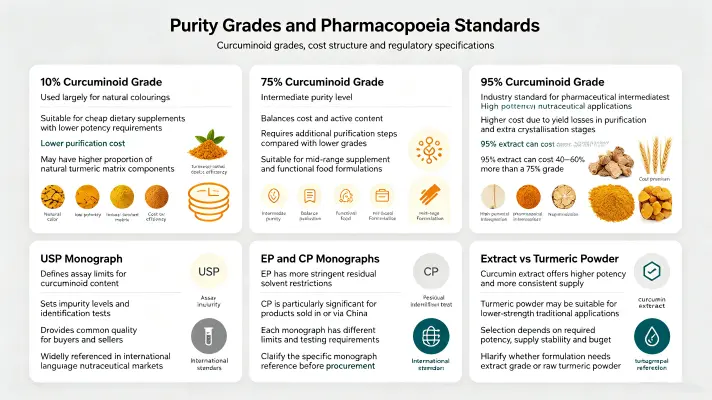
Purity Grades and Pharmacopoeia Standards
Commercial curcuminoid extracts range from 10–95% purity. The 10% grade is used largely for natural colourings, and cheap dietary supplements. The 95% grade is the industry standard for pharmaceutical intermediates and high potency nutraceuticals.
Each level of purity adds expense. A 95% extract can cost 40-60% more than a 75% grade. The premium results from yield losses in purification and extra crystallisation stages.
Pharmacopoeial compliance gives a common language for buyer and seller. The USP monograph defines assay limits and impurity levels and identification tests. The EP has more stringent residual solvent restrictions. The CP is particularly significant for products sold in or via China. If a supplier says “pharmacopoeia grade” without clarifying which one, they are being ambiguous, so ask for the specific monograph reference.
From a chemistry perspective it is helpful to know what pure curcumin powder is. For most buyers though, the question is more straightforward: do I buy a curcumin extract, or utilise turmeric powder? It is contingent upon how much potency you require, how steady your supply needs to be and what your budget is.
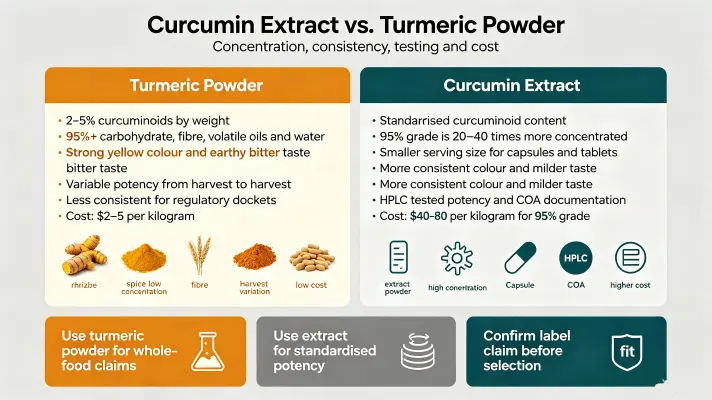
Pure Curcumin Powder vs. Turmeric Powder — Concentration, Consistency, and Cost
Why Concentration Matters?
Turmeric powder is simply the crushed and dried rhizome of Curcuma longa, the spice available in grocery stores. It has 2–5% curcuminoids by weight. The rest 95%+ is carbohydrate, fibre, volatile oils and water.
A 95% curcuminoid extract is 20 to 40 times more concentrated. If a supplement says 500 mg of curcuminoids per serving, then you’d need about 10–25 grams of turmeric powder to get the same active amount. That’s not workable in a capsule form.
Concentration also impacts formulation. Turmeric powder gives any product a deep yellow colour and an earthy, slightly bitter taste. It can be difficult to disguise such flavour in beverage or candy applications. A refined extract offers a more gentle taste profile and consistent colour behaviour.
The Standardization Advantage
The one thing that is most underappreciated when comparing these two chemicals is batch-to-batch consistency. The turmeric powder you get from one harvest can be very different from the next. The rainfall, the soil and the post-harvest management affect the amounts of curcuminoids.
The answer to this dilemma is standardised extracts. Each batch is tested by HPLC at GMP-certified manufacturers and potency is adjusted to label claim. When you get 95% curcuminoids, you get 95% — not 89% and not 102%. This repeatability is a must for pharmaceutical and nutraceutical companies who file regulatory dockets.
Routine step extract producers take missing from turmeric powder is heavy metal and pesticide testing protocol. Extracts are delivered with a Certificate of Analysis. Spice merchant turmeric powder doesn't very often.
When to Use Which?
If precision is required, extracts can be used in products such as capsules, tablets, softgels and functional shots. They are also suitable for topical preparations when a standardised active concentration is required for stability and efficacy claims.
Turmeric powder is useful. Supplement brands selling “full-spectrum turmeric” as a whole-food may prefer it, as it preserves the natural essential oils, whereas dietary fibre extracts eliminate. It is also much cheaper – turmeric powder costs roughly $2-5 per kilogram compared to $40-80 per kilogram for 95% extract.
It’s what your label says it needs. powder works, if the claim is “with turmeric.” If the claim is 'standardised to 95% curcuminoids' then an extract is sufficient.
Having chosen a curcumin extract, the following question is not chemical but biological. The difficulty with curcumin is well recognised – the human body absorbs relatively little of it. That truth informs every decision on dosage, formulation and application.”
Bioavailability, Safety, and Real-World Applications
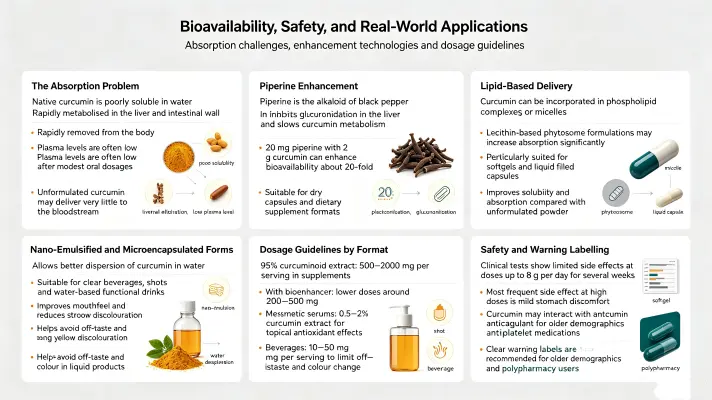
The Absorption Problem
Native curcumin has limited absorption. It is poorly soluble in water, rapidly metabolised in the liver and intestinal wall, and rapidly removed from the body. Serum concentrations of up to 1–2 μg/mL have been reported by Anand et al. (2007) following oral administration of dosages up to 2 g/kg in rats [3]. In humans, plasma levels are generally below the detection limit after modest oral dosages.
This is not a peripheral scholarly problem. This means a supplement containing 500 mg of unformulated curcumin may deliver little to the bloodstream. You cannot neglect bioavailability and expect efficacy.”
Enhancement Technologies That Work
This absorption problem has spawned several technologies. They're not all the same and each one fits distinct product formats.
The simplest, best-studied technique is piperine, the alkaloid of black pepper. This inhibits glucuronidation in the liver, which slows the metabolism of curcumin. Shoba et al. (1998) demonstrated that the addition of 20 mg piperine to a 2 g dosage of curcumin enhanced bioavailability about 20-fold.
Curcumin is incorporated in phospholipid complexes or micelles in lipid-based delivery methods . In the human tests, a 29-fold greater absorption of Indena’s Meriva® (lecithin-based phytosome formulation) as compared to unformulated curcumin was shown [4]. These formats are particularly suited for softgels and liquid filled capsules.
Nano-emulsified and microencapsulated forms allow dispersion of curcumin in water. They are the go-to for clear beverages, shots and water-based functional drinks. And they also work to improve mouthfeel and cut down on the yellow discolouration that affects unformulated powders.
When considering technologies, fit distribution system to your product format. A dry capsule of a piperine-curcumin mix makes sense. Nano-emulsions are a great option for a ready-to-drink wellness injection. There is no ideal technology, only the best technology for your application.
Dosage Guidelines by Format
Dosage depends on type of product and claim. For dietary supplements, typical dosages of pure curcumin powder with 95% curcuminoid extract are 500–2,000 mg per serving and provide 475–1,900 mg of active curcuminoids Lower doses (200–500 mg) are standard with the extract when used with a bioenhancer.
Cosmetic items employ very much lower doses. For a brightening serum, 0.5-2% of curcumin extract may be included. At these dosages, topical antioxidant activity and skin-tone-evening effects are the focus, not systemic absorption.
Beverage manufacturers utilising water soluble forms use 10–50 mg per serving. Consumers observe off-tastes and obvious colour changes at higher concentrations.
The safety data allows some leeway for formulators. In clinical tests, side effects have been limited at doses up to 8 g per day for several weeks [6]. The most frequent side effect at high doses is mild stomach discomfort. Just one word of caution: curcumin can interact with anticoagulant and antiplatelet medications. Clear warning labels should be added to products targeting older demographics where polypharmacy is widespread.
Conclusion
Pure curcumin powder is a potent, versatile and extensively researched substance. It has a steady strength that powder turmeric cannot provide. It allows precision formulation in medications, vitamins, cosmetics, and functional foods. And it has a bioavailability difficulty that formulators need to solve on the front end.
When getting curcumin extract at scale, three things matter: proof of purity via third-party HPLC data, full pharmacopoeia compliance, and a bioavailability format that works for your product (not the one that works for the supplier’s catalogue). If those three are true, much of the risk of getting curcumin is eliminated.
Partner with Rebecca for Premium Curcumin Powder Supply
Rebecca is here to help with your ingredient sourcing needs We provide high purity curcuminoid extracts for use in pharmaceuticals, nutraceuticals, cosmetics and functional foods. Our Shaanxi-based GMP certified plant leverages state-of-the-art extraction technologies including supercritical CO₂ and ultrasonic processes along with stringent quality control systems from raw material traceability to final product delivery. We provide pure curcumin powder specs from 10% to 95% purity, fulfilling CP, EP and USP standard. We also provide customisable water soluble formats and flexible packaging solutions.
Our professional R&D team offers formulation guidance, stability testing support and bioavailability enhancement tactics that integrate seamlessly with your product portfolio. Rebecca has a successful history of exporting across North America, Europe and the Asia-Pacific, providing dependable logistics, full regulatory documentation including CoA, allergen declarations and organic certifications and prompt client support. We provide flexible MOQs and clear pricing to suit a range of company needs, whether you’re looking for bulk orders for large-scale manufacturing or pilot batches for product development.
If you would like to discuss your requirements, sample or complete specification sheets please contact our team on information@sxrebecca.com. Learn why top curcumin powder producers turn to Rebecca to meet their ingredient requirements. Discover our comprehensive selection of botanical extracts at sxrebecca.com and start sourcing today.
References
1. Hewlings, S. J., & Kalman, D. S. (2017). Curcumin: A Review of Its Effects on Human Health. Foods, 6(10), 92.
2. Nelson, K. M., Dahlin, J. L., Bisson, J., Graham, J., Pauli, G. F., & Walters, M. A. (2017). The Essential Medicinal Chemistry of Curcumin. Journal of Medicinal Chemistry, 60(5), 1620–1637.
3. Anand, P., Kunnumakkara, A. B., Newman, R. A., & Aggarwal, B. B. (2007). Bioavailability of Curcumin: Problems and Promises. Molecular Pharmaceutics, 4(6), 807–818.
4. Jamwal, R. (2018). Bioavailable curcumin formulations: A review of pharmacokinetic studies in healthy volunteers. Journal of Integrative Medicine, 16(6), 367–374.
5. Stohs, S. J., Chen, O., Ray, S. D., Ji, J., Bucci, L. R., & Preuss, H. G. (2020). Highly Bioavailable Forms of Curcumin and Promising Avenues for Curcumin-Based Research and Application: A Review. Molecules, 25(6), 1397.
6. Sharifi-Rad, J., Rayess, Y. E., Rizk, A. A., Sadaka, C., Zgheib, R., Zam, W., … & Martins, N. (2020). Turmeric and Its Major Compound Curcumin on Health: Bioactive Effects and Safety Profiles for Food, Pharmaceutical, Biotechnological and Medicinal Applications. Frontiers in Pharmacology, 11, 01021.