What can I use taro powder for?
taro powder is used in a variety of industries, including the creation of food, beverages, cosmetics, and health supplements. One of the oldest crops ever grown is taro root, which is where this flexible vegetable comes from. Over 6,000 years ago, people in Southeast Asia tamed it. Since then, it has spread to tropical and subtropical areas in Asia, Africa, Oceania, and the Americas. That long past has led to thousands of types and a very good understanding of their nutritional value.
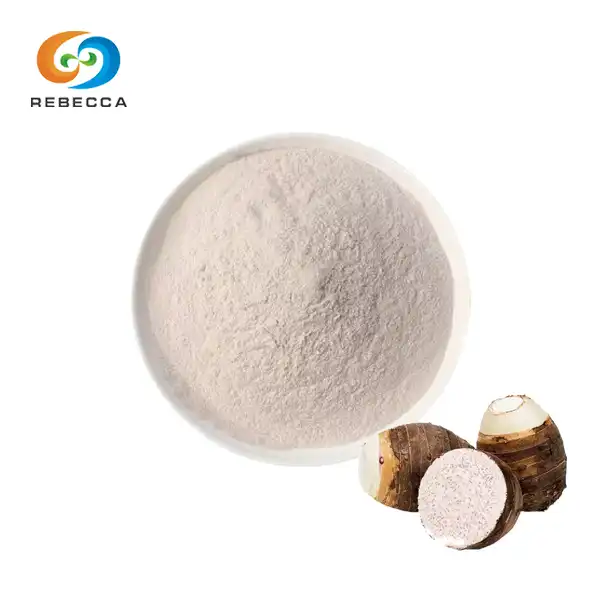
Taro Powder
Product Name:Taro powder
Latin Name: Henry Steudnera Tuber
Part used:Root
Specification: Straight Powder
Appearance: Light Purple Powder
Odor & Taste: Characteristics
Particle size:100% pass 80 mesh
Grade:Food/Pharm grade
Taro Powder Uses in Food and Beverage Formulation
Bubble Tea, Milk Tea, and Instant Beverage Bases
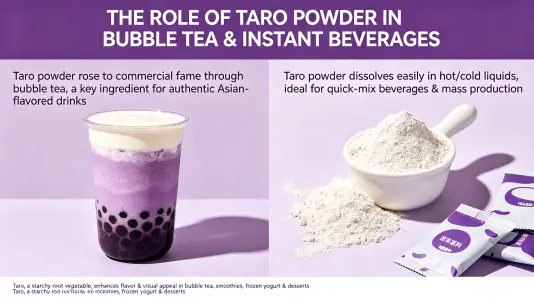
Bubble tea is where taro powder first became popular in the business world. Taro powder is a key ingredient for bubble tea makers who want to make real Asian-style drinks. The powder mixes easily with both hot and cold liquids, which makes it perfect for quick drink mixes and making drinks for sale. Large drink companies that need uniform spread in fast-moving beverage lines depend on that solubility profile a lot.
It smells great like flowers and is great for bubble tea drinks, not just boba. The taro plant comes from a root vegetable. It is starchy and works well for thick drinks and sweets like smooth taro bubble teas, milk teas, smoothies, frozen yoghurt, and other dessert recipes. Each of these groups is a different recipe setting where taro powder can add two benefits at once: flavour and visual appeal.
People who make drinks, like bubble tea and smoothies, like to use taro root powder. It goes well with mixed drinks because it is mildly flavoured and has a creamy feel. With milk, ice, and other things, it can be mixed to make a sweet and refreshing drink. This wide range of uses is a straight business chance for B2B buyers who sell to food service chains, café equipment companies, or beverage makers.
Baked Goods, Confectionery, and Savory Foods
Cooking and baking are two of the main ways that organic taro root powder is used. It works great for people who are allergic to or sensitive to gluten because it can be used instead of flour. Just the fact that it is naturally gluten-free opens up a big market area. Adding taro powder to flour mixes is good for clean-label baking brands, gluten-free product lines, and makers who care about allergens.
It can be used in a lot of different ways in the kitchen because it has a fine texture and a bland flavour. It's great for making soups, stews, and sauces thicker because it adds creaminess without changing the taste. This ability to thicken, provided by a well-known plant-based ingredient, is a real recipe plus for food companies making soups, sauces, and ready-to-eat savoury bases that can be served warm or cold.
It is used in a lot of sweet and savoury recipes because it tastes mild, earthy, and slightly nutty. With just one teaspoon of taro powder, you can make purple-colored drinks that are full of nutrients. It is a favourite in cakes, breads, and cookies because it gives them a beautiful colour and a mild flavour. That mix of colour and flavour is exactly what people who make speciality baking goods look for in an ingredient.

Natural Colorant for Clean-Label Food Manufacturing
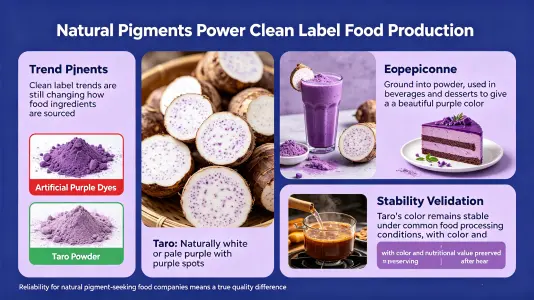
The clean-label trend is still changing how food ingredients are sourced. People are putting more and more pressure on brands that used fake violet or purple dyes to get rid of them. Taro powder fills that chasm immediately. Taro is naturally white or pale lavender with purple spots. It gives food a pretty purple colour when it's ground up and used in drinks and sweets.
The colour that comes from taro is different from many other plant dyes because it stays stable under the processing conditions that are common in food making. When heated, the food stays true to its colour and nutritional value, even after being pasteurised or cooked in a professional kitchen. Stability has been proven up to the normal temperatures used for food preparation. For food companies looking at natural colourants, that reliability is a real quality difference.
Taro Powder Uses in Health Supplements and Nutraceuticals
Digestive Wellness and Prebiotic Support
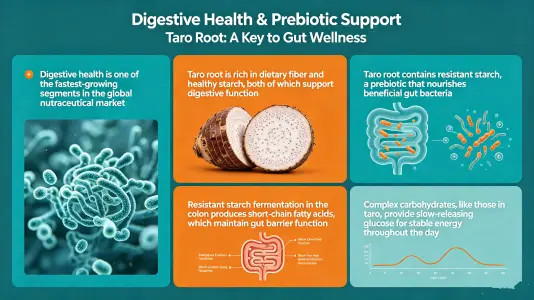
One of the most rapidly growing areas of the global supplement market is digestive health. Taro powder has been shown to have qualities that make it useful in this context. The taro root is a great source of food fibre and healthy starches, both of which help the digestive system work better.
Studies show that taro root has resistant starch, which is a type of prebiotic. Prebiotics feed the good bacteria in your gut, which helps them grow and do their job. There is a lot of evidence to back that prebiotic process. When the resistant starch in taro root ferments in the colon, it makes short-chain fatty acids that feed the bacteria in the gut and help the gut barrier work.
Complex carbs, which are the body's main source of energy, can be found in a lot of foods. Complex carbs are broken down slowly, which lets glucose slowly enter the bloodstream. Having the sugar slowly released helps keep blood sugar levels steady and gives you energy all day. This sustained-energy process is a real and practical benefit for supplement makers who want to make products for energy and metabolic health.
Antioxidant and Immune Wellness Applications
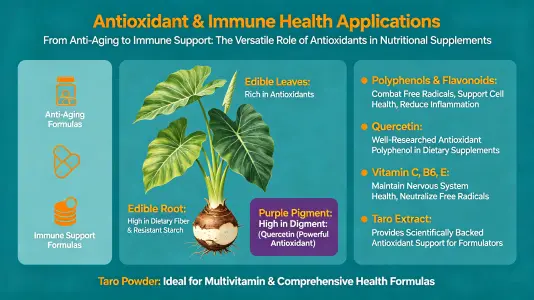
Demand is driven by antioxidants in a wide range of supplement types, from anti-aging mixes to immune support formulas. Taro powder, which is full of polyphenols and flavonoids, can help fight free radicals, which is good for cell health and reduces inflammation.
The leaves and root of the taro plant can be eaten and are full of antioxidants. The purple colour of the veggie gives it quercetin, a strong antioxidant that keeps the body safe from free radicals. Quercetin is one of the antioxidant polyphenols that has been studied the most in the field of dietary supplements. The fact that it is found in ingredients derived from taro gives formulators a good antioxidant story that is based on known biology.
The taro root is a great source of food fibre and healthy starches, both of which help the digestive system work better. Its high vitamin C, vitamin B6, and vitamin E levels also help keep your nervous system healthy and may get rid of free radicals. This addition of multiple vitamins strengthens taro powder's place in overall health powder mixes and multi-benefit nutritional formulas.
Cardiovascular and Metabolic Wellness Ingredient
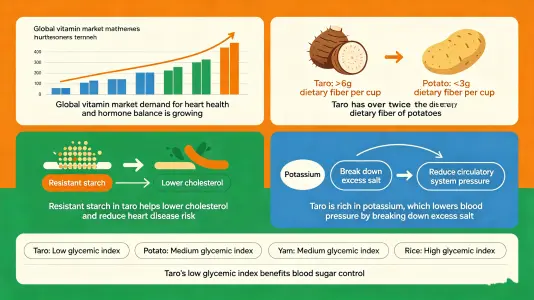
There is growth in the world vitamin market for heart health and hormonal balance. Each cup of taro root has more than 6 grams of fibre, which is more than twice as much as a cup of potatoes. There is also resistant starch in taro root. This cuts cholesterol and has been linked to a lower chance of heart disease.
Taro root has a lot of potassium, which is a mineral that helps lower blood pressure by breaking down too much salt. This makes the circulatory system less stressed, which is good for long-term cardiovascular health. There is a lot of evidence that potassium is good for heart health, and the fact that it is naturally found in taro root supports its use as a useful ingredient in heart-health supplements.
When you compare taro root to other sweet veggies like potatoes and yams, it has a lower glycaemic index. This means that it raises blood sugar levels more slowly and over time. Instead of rice, taro root can be especially helpful for people who are trying to control their blood sugar levels. That low glycaemic index profile is exactly what people who make functional foods look for when they make goods for managing blood sugar and metabolism.
Weight Management and Satiety Formulations
Managing your appetite and feeling full are two major sub-categories of supplements. This root vegetable has a lot of calories per piece, but it can be part of a healthy diet to help you lose weight. Many fibres make it so that your stomach doesn't empty as quickly, so you feel full between meals.
Over the course of 20 months, one study published in the Journal of Nutrition found that women who ate one gram of fibre every day lost half a pound of weight and had 0.25 percent less body fat. When taro powder is added to meal replacement shakes, protein blend bases, or functional food forms, the fibre and resistant starch in it help people feel full in a way that is both scientifically proven and useful for business.
- Fibre and resistant starch help the gut bacteria through prebiotic fermentation in digestive health mixes.
- Antioxidant mixtures: quercetin, polyphenols, and flavonoids help protect cells.Immune support powders: Vitamins C, B6, and E help the immune system work.
- Heart-healthy ingredients: fibre and potassium help keep blood pressure and cholesterol levels normal.
- Formulations for blood sugar balance: low glycaemic index and resistant starch help keep glucose levels stable.
- Weight control and feeling full: foods high in fibre make you feel full and may help you keep a healthy weight.

Taro Powder Uses in Cosmetics and Pharmaceutical Applications
Skincare Formulation: Antioxidant and Skin-Conditioning Properties
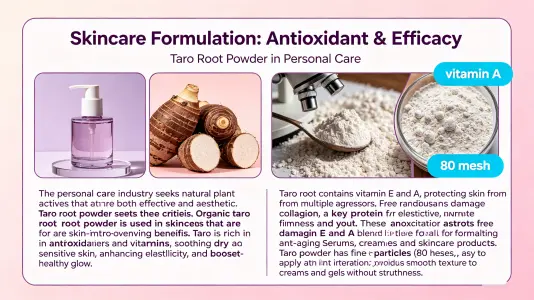
The personal care business is constantly looking for natural actives that come from plants that work well and look good on the package. Both conditions are met by taro powder. Organic taro root powder is often found in skin care items because it is known to improve skin. It has a lot of antioxidants and vitamins that can help soothe skin that is dry or sensitive, make skin more elastic, and promote a healthy look.
Vitamins E and A are found in large amounts in taro root. These vitamins protect skin from many things that can hurt it. Free radicals break down collagen, the protein that keeps skin flexible, tight, and young. These powerful antioxidants stop them. This mix of vitamin E and vitamin A from plants is a good beneficial ingredient for beauty chemists who make anti-aging serums, face creams, and skin-protection products.
The small powder size makes it easy to apply without irritating the skin. Taro powder's 80-mesh particle size is just what skin care formulators need—fine enough to give cream and gel bases a smooth texture without adding the gritty texture that larger powders do to high-end formulas.
Natural Soap, Body Scrub, and Color Cosmetics
Making natural soap is one of the most obvious ways to use taro powder. Natural soap makers like taro powder because it helps them make products that look good without using artificial dyes. The powder keeps its colour while it's being turned into soap, so the end goods are always beautiful. In their marketing papers, artisanal soap makers often talk about where they get their natural ingredients.
Formulations for body scrubs and exfoliants use more than one property at the same time. Body scrub recipes use the gentle scrubbing qualities and add natural colour to get the best results. The powder works well with sugar and salt bases to make goods that look like they came from a spa. A lot of formulators like that the ingredient works well with natural chemicals and essential oils.
The use of colour makeup is a new application area. Taro root powder has a natural purple pigment that can be used as a plant-based colourant in lip gloss, makeup bases, and blushes. These are the areas where customer demand for plant-based, synthetic-free colour ingredients is growing the most.

Pharmaceutical Grade Applications
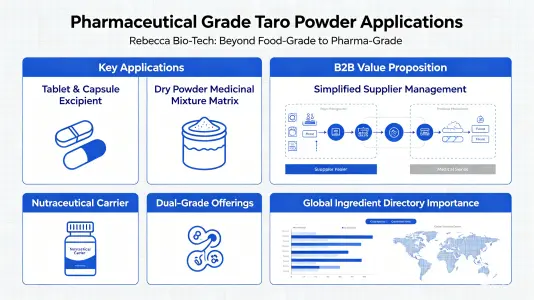
Its availability in pharmaceutical grade — as supplied by Rebecca Bio-Tech — opens applications that food-grade powder cannot access. Pharmaceutical-grade taro powder can serve as an excipient in tablet and capsule formulations, a base in pharmaceutical dry powder blends, or a carrier material in nutraceutical products requiring elevated quality documentation and purity standards.
Taro powder is a natural plant-based ingredient that is not only used in food products but also finds applications in the pharmaceutical and cosmetic sectors. For procurement teams sourcing across multiple product lines — food, cosmetics, and pharmaceutical supplements simultaneously — dual-grade availability from a single supplier simplifies vendor management and documentation significantly.
The B2B case for taro powder is therefore not confined to a single industry. As the demand for organic and natural ingredients continues to grow, many businesses are turning to products like organic taro root powder to meet the needs of their customers. This versatile ingredient has many uses, from cooking and baking to skincare and nutritional supplements. That multi-sector versatility is precisely why taro root powder is expanding in global ingredient catalogs.
Taro Powder Supplier: Rebecca Bio-Tech
It takes more than a low price to find a constant, high-purity taro powder that can be used in many industries. It needs a production partner with checked infrastructure, the ability to make two grades of products, and export knowledge that global buying teams rely on.
Send your inquiry today: information@sxrebecca.com
FAQs
1. What industries use taro powder as a raw material ingredient?
Taro powder is used in many ways, including making foods and drinks, making cosmetics, and making classic soups and stews. When it comes to business-to-business buying, the main types of businesses are those that make functional beverages, bakeries and food processing, health supplements and nutraceuticals, personal care and makeup, and pharmaceutical-grade ingredient creation.
2. Is taro powder suitable for gluten-free formulations?
Yes. There are no known allergens in taro in its whole form, such as gluten, wheat, or nuts. Because it's so easy to make, it's a great choice for people who have specific food needs or tastes. Because it is naturally gluten-free and hasn't been contaminated by grains, taro powder works well in approved gluten-free product lines. However, buyers should always check with their seller to make sure there are rules in place to avoid cross-contamination.
3. How does taro powder contribute to beverage formulations specifically?
Taro powder is a key ingredient for bubble tea makers who want to make real Asian-style drinks. The powder mixes easily with both hot and cold liquids, which makes it perfect for quick drink mixes and making drinks for sale. Its natural purple colour and sweet taste make it a good addition to smoothies, coffee, dairy-free drinks, and functional drink mixes aimed at health-conscious consumers.
4. What is the nutritional profile of taro powder relevant to supplement formulation?
Taro powder has a lot of fibre, which helps digestion and keeps your gut healthy. It has a lot of flavonoids and tannins, which can help fight free radicals. It also has nutrients like calcium, magnesium, manganese, potassium, and phosphorus that help keep your heart healthy, your bones strong, and your energy up. These multiple nutritional credentials make it possible for supplement makers to use a single raw ingredient to make claims about multiple benefits.
5. Why is taro powder used in cosmetic and personal care formulations?
Powder made from taro roots is known to help heal skin. It has a lot of antioxidants and vitamins that can help soothe skin that is dry or sensitive, make skin more elastic, and promote a healthy look. Its fine 80-mesh particle size also makes it easy to use in cream, liquid, and scrub forms. The natural purple pigment is also used as a clean-label colourant in colour cosmetics, body care, and soap.
References
1. Ferdaus, M.J., Chukwu-Munsen, E., Foguel, A., & da Silva, R.C. (2023). "Taro Roots: An Underexploited Root Crop." Nutrients, 15(15), 3337.
2. Gonçalves, A.C., et al. (2021). "Anticancer and Immunomodulatory Benefits of Taro (Colocasia esculenta) Corms, an Underexploited Tuber Crop." PMC / Frontiers in Pharmacology, PMC7795958.
3. Ajmera, R., & Elliott, B. (2023). "7 Surprising Benefits of Taro Root." Healthline.
4. WebMD Editorial Team (2024). "Taro Root: Health Benefits, Uses, Safety Information." WebMD.
5. Bode, A.M., & Dong, Z. (2011). "Taro Root — Nutritional Profile and Health Benefits." Dr. Axe (citing peer-reviewed sources).
6. Himeda, M., et al. (2012). "Physicochemical and thermal properties of taro (Colocasia esculenta sp) powders as affected by state of maturity and drying method." Journal of Food Science and Technology, 51(9), 1857–1865.